20% of Americans Are on the Fence: The Next Wave of Crypto Market Lies Here

marsbitОпубліковано о 2026-03-05Востаннє оновлено о 2026-03-05

Анотація

A study reveals that 20% of U.S. adults are considering cryptocurrency adoption, representing a critical intermediate group between outright rejecters and current holders. The research frames crypto acceptance as a three-stage process: rejection, consideration, and ownership. Key findings show that factors influencing the "consideration" phase (e.g., conservative ideology, support for tech innovation) differ from those driving "actual ownership" (e.g., existing stock ownership, higher risk tolerance). This intermediate group is essential for market growth, regulatory policy, and public opinion, as they represent the tipping point for broader adoption. The study emphasizes that understanding this gradual behavioral process—rather than a binary holder/non-holder view—is crucial for accurately predicting market and political trends.

Written by: Kyle Saunders

Compiled by: Chopper, Foresight News

Most research revolves around a simple question: Who holds it? Who doesn't?

Admittedly, this is a reasonable starting point for research. Holding behavior is observable, quantifiable, and actual. But for a market with a market cap in the trillions, it might not be the most critical question.

If you are concerned with market development, regulatory policy, political discourse, or the future direction of crypto assets, there is a question that might be more practically significant: Who is considering acquiring cryptocurrency?

Because the acceptance and adoption of an asset is never a binary, either-or choice, but a gradual process.

If you only study the final stage of this process, you miss the entire conversion funnel.

Rejection → Consideration → Holding: The Three Stages of Crypto Acceptance

In a new paper I recently co-authored with Erin Fitz, we did not treat crypto acceptance as a black-and-white outcome, but defined it as a gradual process.

From late 2024 to 2025, we conducted three independent representative surveys of US adults. Based on the results, we categorized respondents into three groups:

  • Do not hold and have no intention to hold cryptocurrency
  • Do not hold but are considering holding cryptocurrency
  • Currently hold cryptocurrency

Our first finding was straightforward yet crucial: About one-fifth of Americans do not hold cryptocurrency but are considering it.

This group is by no means an insignificant niche, a statistical error, or a group 'destined to hold.' They are a distinct segment with unique psychological characteristics and behavioral patterns, and this attribute makes them critically important.

Why is the 'Potential Holder' Group So Critical?

If the research perspective is limited to the binary comparison of 'holders' vs. 'non-holders,' it assumes all those not in the market are an undifferentiated whole.

But real-world behavioral choices are never like that.

The classic social psychology Theory of Planned Behavior posits that human behavior evolves through a series of preceding stages: beliefs, attitudes, perceived control, behavioral intention. One first 'considers' before forming a 'behavioral intention'; a 'behavioral intention' precedes taking actual action. And each stage does not necessarily transition to the next.
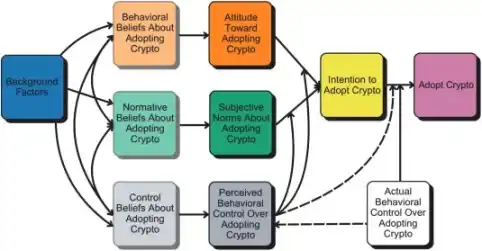
In other words, all holders were once potential holders; but not all potential holders will ultimately become actual holders.

When we view people's engagement with cryptocurrency as an ordered, gradual process rather than a binary characteristic, an interesting conclusion emerges: The factors influencing 'consideration to hold' are not entirely the same as those driving 'actual holding.'

There is a filtering mechanism at work in this conversion funnel.

Which Factors Influence 'Consideration'? Which Drive 'Actual Holding'?

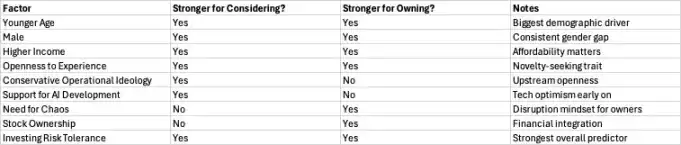
Some common influencing factors aligned with expectations: Younger individuals, men, those more open to new experiences, and those with a higher tolerance for financial risk were more likely to cross both the 'rejection→consideration' and 'consideration→holding' thresholds.

But two sets of significantly different patterns are worth highlighting.

Factors more strongly associated with 'Consideration to Hold':

  • More conservative operational ideology
  • Support for AI technology development

These factors play a role in the early stages of the crypto acceptance process, explaining why people might be open to cryptocurrency, but not necessarily pushing them to take the final step to 'actually hold.'

Factors more strongly associated with 'Actual Holding':

  • Already hold stocks
  • Need for chaos

Risk tolerance was the most influential factor overall: From the lowest to the highest levels, the probability of behavioral choice changed dramatically, with the probability of rejecting crypto decreasing by 32 percentage points and the probability of actually holding crypto increasing by 27 percentage points.

Here is a brief summary of the core differences:
Our survey data also aligns closely with the actual crypto market landscape: Bitcoin dominates overwhelmingly among both 'potential' and 'actual' holders (with Ethereum second), and many are open to multiple cryptocurrencies. The market itself corroborates this finding.
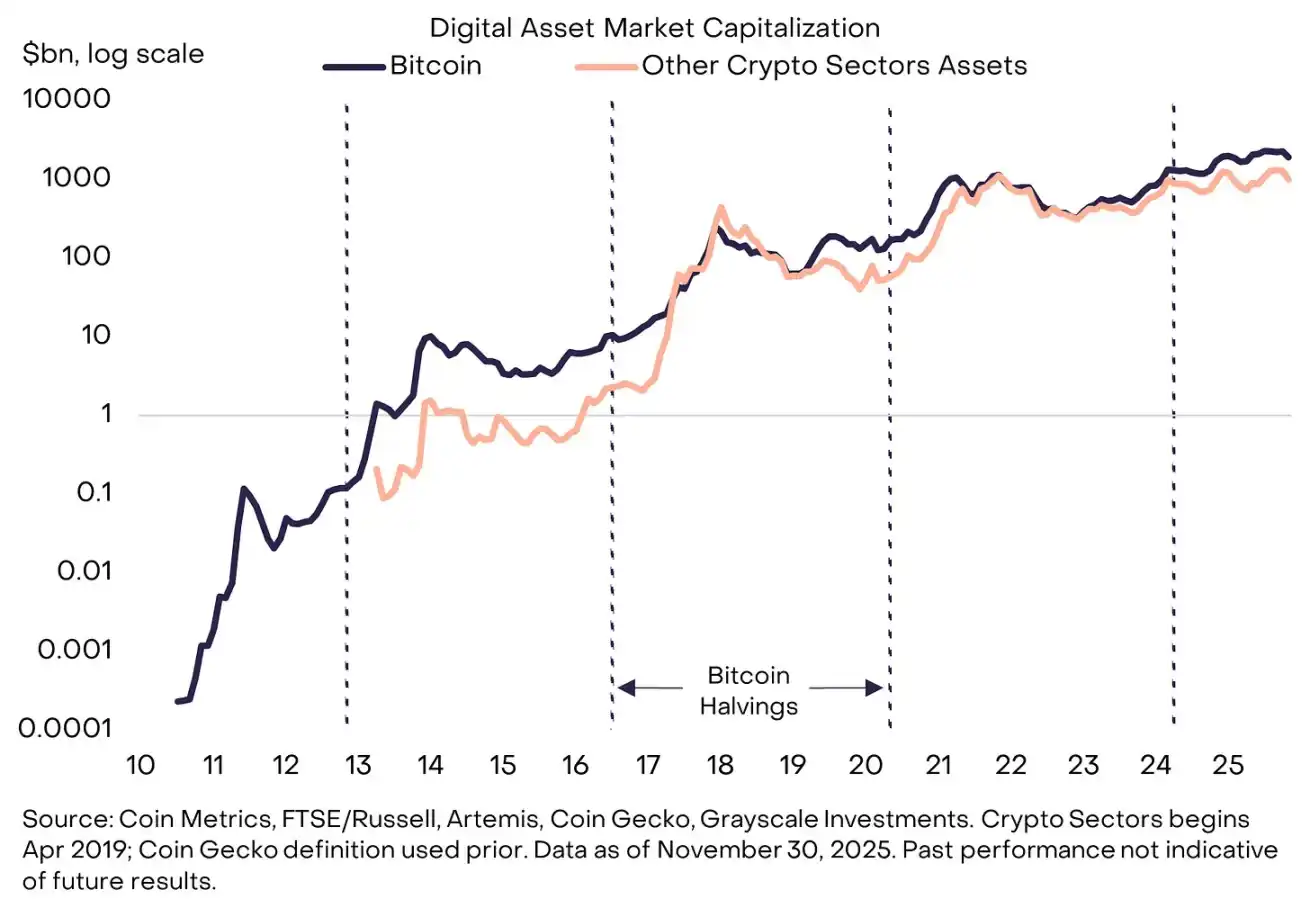
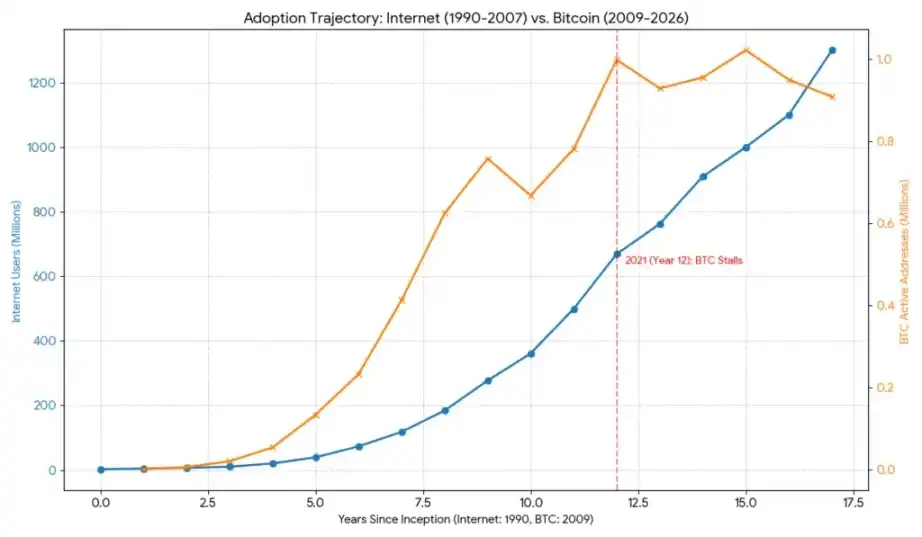
To understand how this landscape fits the broader technology diffusion curve (and why the 'potential holder' stage will determine whether crypto development stalls or scales), one can compare Bitcoin's adoption trajectory with that of the early internet. Survey data shows AI technology acceptance in the US reached about 55% in 2026.
Furthermore, this chart from the paper shows how crypto acceptance fits the Rogers Diffusion of Innovations curve:
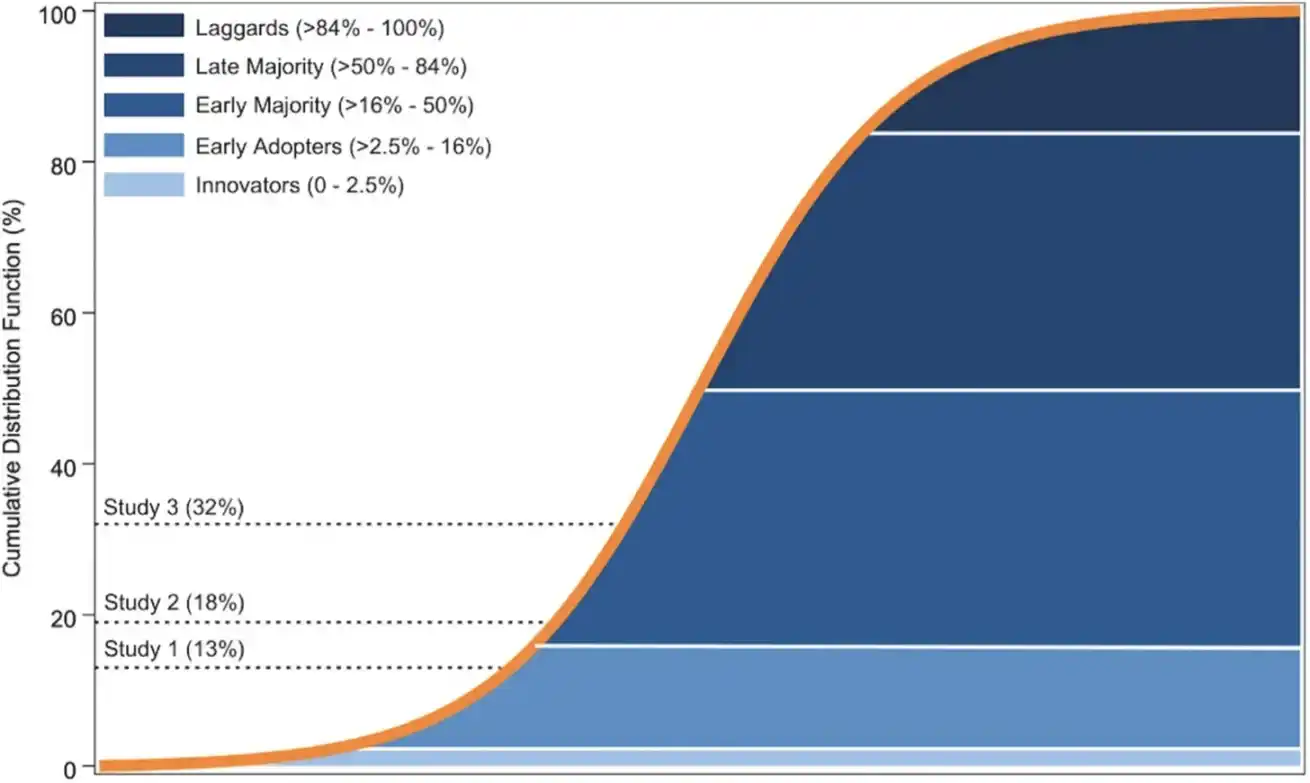
This is an adapted version of Rogers' 2003 Diffusion of Innovations curve. The solid orange line is the S-curve (the cumulative distribution function, with the scale on the left vertical axis). The blue area under the curve represents the probability distribution of the five adopter categories in Rogers' model, divided based on standard deviations from the mean in a normal distribution. In a normal distribution, these areas represent the probability proportion of each category in the whole population: Innovators (2.5%, 0 to mean minus 2 SD), Early Adopters (13.5%, mean minus 2 SD to mean minus 1 SD), Early Majority (34%, mean minus 1 SD to mean), Late Majority (34%, mean to mean plus 1 SD), Laggards (16%, mean plus 1 SD to 100%). The black dashed lines represent the self-reported cryptocurrency holding rates from our three studies (Study 1: 13%, Study 2: 18%, Study 3: 32%).

The Implications of These Findings Extend Beyond Crypto

You could interpret these results narrowly as consumer segmentation, but they have broader significance.

For Market Growth

The expansion potential of the crypto market lies not in converting staunch 'rejecters' into holders, but in figuring out what prevents potential holders from becoming actual holders. This barrier might not be ideological, but rather people's perception of their behavioral control, concerns about market volatility, or issues with asset liquidity.

For Regulatory Policy

If policymakers view only current cryptocurrency holders as the group with political influence, they misjudge the market's current state. The policy direction in the digital asset space will likely be determined by these open-minded yet undecided potential holders. Their preferences, risk profiles, and trust in institutions are critically important, especially as the crypto regulatory framework takes shape in 2026.

For Public Discourse

Online discussions often fall into polarization: either pro-crypto or anti-crypto. But our survey data shows a large, psychologically distinct middle group exists in reality. Historical experience suggests that it is this middle group, not the early adopters, that ultimately determines whether an innovation achieves widespread adoption, stalls, or triggers a backlash.

Acceptance and adoption are inherently gradual processes.

The core insight of this research is not just specific to the crypto space, but also a shift in research methodology and perspective.

When we simplify complex behaviors into binary, either-or choices, we risk conflating the behavioral rules of different stages. The factors that make people open to a new thing are not necessarily the same ones that drive them to take actual action.

This applies not only to cryptocurrency but also to the acceptance of AI technology, political participation, trust in institutions, and many other behavioral choices I've explored in this column.

The overlooked middle stage often holds the most intriguing behavioral patterns.

The acceptance and adoption of cryptocurrency is never simply a personality trait or an ideological signal, but a step-by-step behavioral process.

If you ignore this intermediate 'potential holding' stage, you will misjudge both the true direction of the market and the underlying political and social logic.


Пов'язані питання

QAccording to the research, what percentage of Americans are considered 'potential adopters' of cryptocurrency?

AApproximately one-fifth (20%) of Americans are potential adopters, meaning they do not currently hold cryptocurrency but are considering it.

QWhat is the key difference between the factors that influence 'considering adoption' and those that drive 'actual adoption' of crypto?

AFactors like a more conservative operational ideology and support for AI development are more strongly associated with the 'considering adoption' phase. In contrast, factors like already holding stocks and a 'need for chaos' are more strongly linked to taking the final step into 'actual adoption'.

QWhy is the 'potential adopter' group so crucial for understanding the crypto market's future?

AThis group is crucial because market growth depends on converting them into actual holders, not on convincing those who firmly reject crypto. Their preferences and perceived barriers (like concerns about volatility or liquidity) will determine if the market expands or stagnates.

QHow does the acceptance of cryptocurrency fit into Rogers' Diffusion of Innovations curve?

AThe research data shows that crypto adoption follows the S-curve of the Diffusion of Innovations model. The 'potential adopters' represent the large middle groups (early and late majority) whose adoption is critical for moving the technology from early adopters to mainstream普及.

QBeyond market growth, what other significant implications does the 'potential adopter' group have?

AThe group has major implications for regulatory policy, as their trust in institutions and risk profile will influence the shaping of crypto regulation. It also impacts social discourse, as this large middle group, not the polarized extremes, often determines whether an innovation is widely accepted or faces a backlash.

Пов'язані матеріали

The "Impossible Triad" Is Fundamentally a Pseudo-Problem

The article argues that blockchain's fundamental limitation is not the scalability trilemma (decentralization, scalability, security), which has been largely solved, but the lack of **privacy** and, until recently, clear **legitimacy**. Blockchain is described as a slow, expensive, globally shared computer whose core value is censorship resistance and verifiability. While ideal for native digital assets like money (e.g., stablecoins), its default transparency acts as a **tax**, exposing all transactions and enabling MEV extraction, which deters serious institutional capital. Simultaneously, its permissionless nature created regulatory ambiguity. The piece contends that **privacy** is the missing critical feature. It rejects the false choice between total transparency and complete anonymity. Modern cryptography (like zero-knowledge proofs) enables **compliant privacy**: users can prove facts (solvency, KYC status, compliance) without revealing the underlying sensitive data (specific holdings, identities). This preserves auditability for regulators and eliminates the leak of financial information. With recent regulatory progress (e.g., the GENIUS Act) addressing legitimacy, adding default, provably compliant privacy becomes a pure upgrade. It transforms blockchain from a costly, public ledger into a confidential settlement layer, finally bridging the gap to mainstream institutional and individual adoption of on-chain finance.

链捕手11 год тому

The "Impossible Triad" Is Fundamentally a Pseudo-Problem

链捕手11 год тому

Optical Chips: Collective Capacity Expansion

The global optical chip industry is experiencing a massive wave of expansion driven by surging AI data center demand. Major players across the US, Japan, Europe, and China are aggressively investing to ramp up production capacity. In the US, Coherent is expanding its 6-inch Indium Phosphide (InP) semiconductor fab in Texas, supported by CHIPS Act funding and a $2 billion strategic investment from NVIDIA. Lumentum is building a new factory for InP optical devices, and Nokia is scaling its advanced photonic chip packaging and testing capabilities. NVIDIA's investments aim to secure future supply of critical lasers and optical interconnect products for AI infrastructure. Japan's JX Advanced Metals, a leading InP substrate supplier, plans a multi-billion yen investment to increase its capacity 7-10 times, strengthening its grip on the crucial upstream materials market. In Europe, IQE and Tower Semiconductor settled a patent dispute and signed a multi-year InP epitaxial wafer supply agreement, highlighting that next-generation silicon photonics platforms will integrate high-performance InP components. STMicroelectronics and Sivers Semiconductors are also expanding silicon photonics production and partnerships. China is rapidly building out its domestic supply chain. Dongshan Precision's subsidiary, Source Photonics, announced a $12 billion project to expand optical chip and module production. Companies like Sanan Optoelectronics and Yunnan Germanium are scaling up InP chip manufacturing and substrate production, moving towards vertical integration from materials to modules. While debate continues around the exact future architecture—whether CPO (Co-Packaged Optics), NPO, or pluggables will dominate—analysts like Morgan Stanley argue the underlying driver is unchangeable: the explosive growth in bandwidth demand. This will inevitably increase the volume of optical engines, lasers, and related content per GPU, regardless of the final technical path. The competition for "more light" in the AI era has intensified into a global, full-chain capacity race.

marsbit13 год тому

Optical Chips: Collective Capacity Expansion

marsbit13 год тому

Stablecoins Finally Find Real Yield: An In-Depth Look at On-Chain Reinsurance Re | A Conversation with Re Founder Karan Saroya

Stablecoin Real Yield Found: A Deep Dive into On-Chain Reinsurance with Re's Karan Saroya As stablecoin supply exceeds $170 billion, the search for sustainable, non-speculative yield intensifies. Re, an on-chain reinsurance platform, provides an answer: connecting stablecoin capital to the trillion-dollar traditional reinsurance market. Re operates as a regulated reinsurer, accepting stablecoin deposits as collateral to back US insurance companies. These insurers pay premiums, generating yield that flows back to on-chain depositors. Currently supporting 35 insurers and underwriting $500 million, Re projects scaling to over $1 billion soon. Key insights from a Bankless podcast with founder Karan Saroya and investor Avichal of Electric Capital: 1. **Uncorrelated, Real-World Yield:** Re offers stablecoin holders access to reinsurance returns (targeting 12-14%+), an asset class entirely separate from crypto or equity markets. 2. **Operational Efficiency via Smart Contracts:** Re replaces traditional, labor-intensive capital fundraising with smart contracts, allowing a ~12-person team to compete with industry giants. 3. **Regulatory Leverage:** For every $1 of collateral, regulations allow backing $5-7 in written premiums. This leverage amplifies returns from the underlying risk-free rate. 4. **DeFi Integration:** Depositors receive receipt tokens, which can be used in protocols like Morpho for "looping," potentially pushing yields to 18-20%+. 5. **The "DeFi Mullet" Model:** A compliant front-end (regulated reinsurer) paired with a decentralized back-end (smart contracts, DeFi capital markets). 6. **RE Governance Token:** Modeled on Lloyd's of London, the token governs the central capital pool's allocation, counterparty acceptance, and parameters. 7. **Real Economic Impact:** Capital funds real-world productivity (factories, clinics, businesses) via insurance, moving beyond crypto's internal loops. The discussion highlights a pivotal moment: DeFi's supply-side infrastructure is now met by real demand for productive yield, potentially kickstarting a flywheel where vast on-chain stablecoin capital seeks these real-world returns.

链捕手14 год тому

Stablecoins Finally Find Real Yield: An In-Depth Look at On-Chain Reinsurance Re | A Conversation with Re Founder Karan Saroya

链捕手14 год тому

Торгівля

Спот
Ф'ючерси
活动图片