ETH tests 5-month high as whales retain this % of supply, more inside

AmbcryptoОпубліковано о 2023-02-19Востаннє оновлено о 2023-02-19

Анотація

Ethereum rose to $1,700 on February 17. Whale and shark address holding have not slowed down their accumulation.

The price of Ethereum [ETH] reached $1,700 on 17 February after five months. Is this ascent an indicator of things to come? Or will the whale accumulation result in dumping before the Shanghai upgrade?

“”

ETH witnesses brief surge

“”

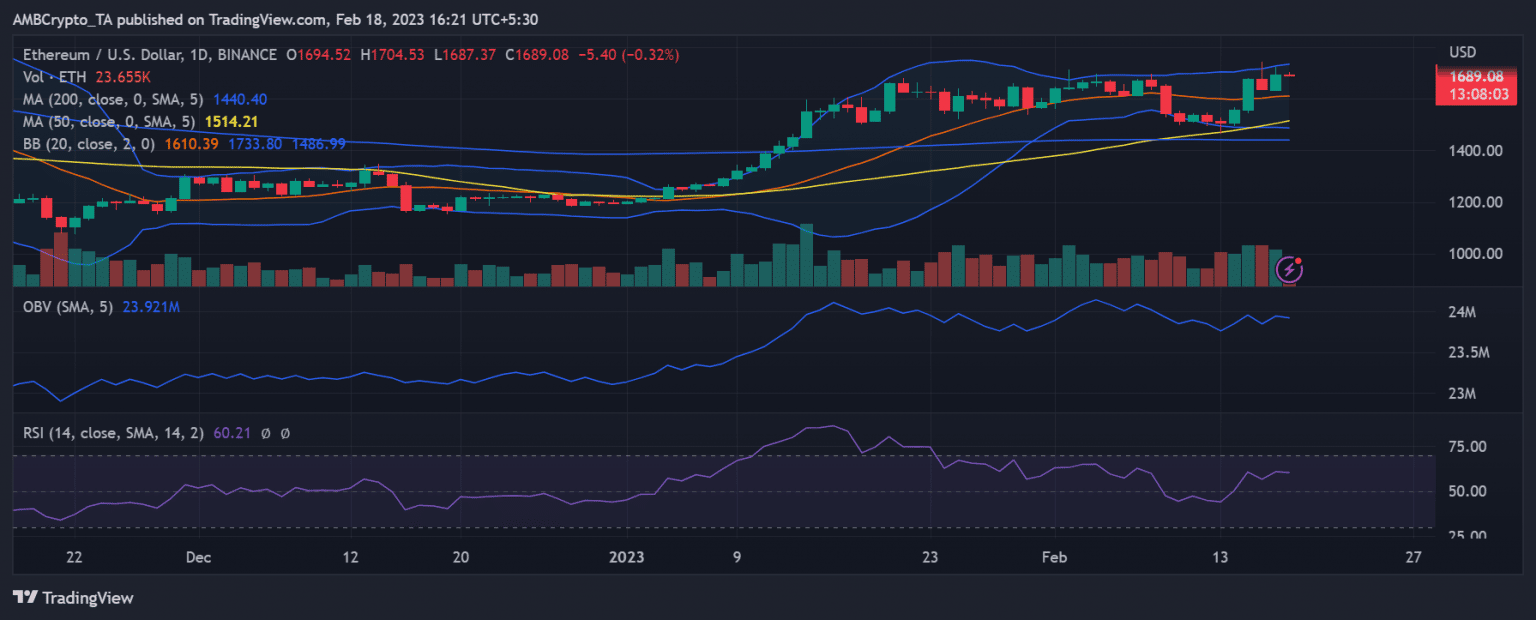
Ethereum gained 3.45% on 17 February, according to a daily period analysis of the cryptocurrency. According to additional research into that trading period, it peaked at $1,721 before ending trade at $1,694.

“”

It was five months since ETH’s price had last reached the $1,700 range during that trading period. Its price was roughly $1,694 at the time of writing.
Source: Trading View

“”

Furthermore, the Relative Strength Index (RSI) indicated that ETH was in a bull trend because its line was above the 60 mark. The price movement was also noted above both the long and short Moving Averages (blue and yellow lines). Therefore, the asset’s price moving above the (MAs) suggests a good price move and may also point to a possible future uptrend.

“”

Shark and whale hold on

“”

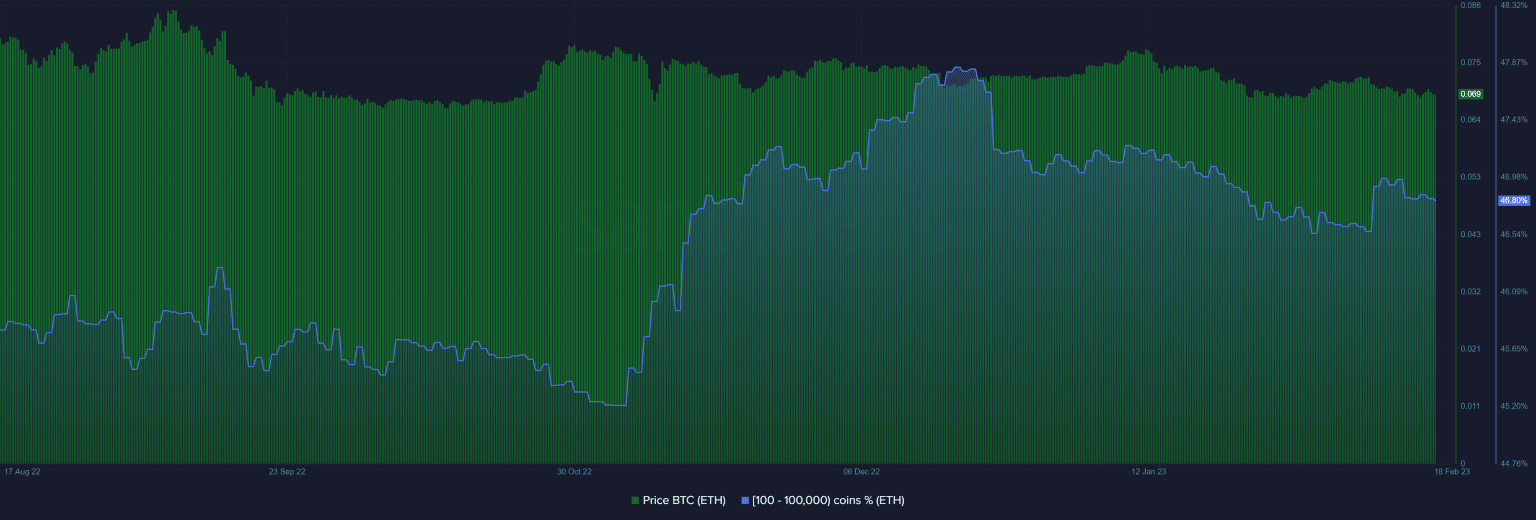
Recent data from Santiment showed that whale and shark addresses were still tightly clutching onto their ETH bags. The graph shows that whale and shark addresses with 100–100,000 ETH still retained close to 47% of the entire supply of ETH. Furthermore, the absence of a sell-off following the most recent price increase suggested that investors anticipated further price increases.
Source: Santiment

“”

In addition, an examination of the supply owned by the top addresses revealed that the addresses at the top had been on an accumulating binge. For most of January, the graph showing the quantity held by the top addresses as a proportion of the overall supply of Ethereum was rising. It has now leveled off, but at the time of writing, it was at 123.
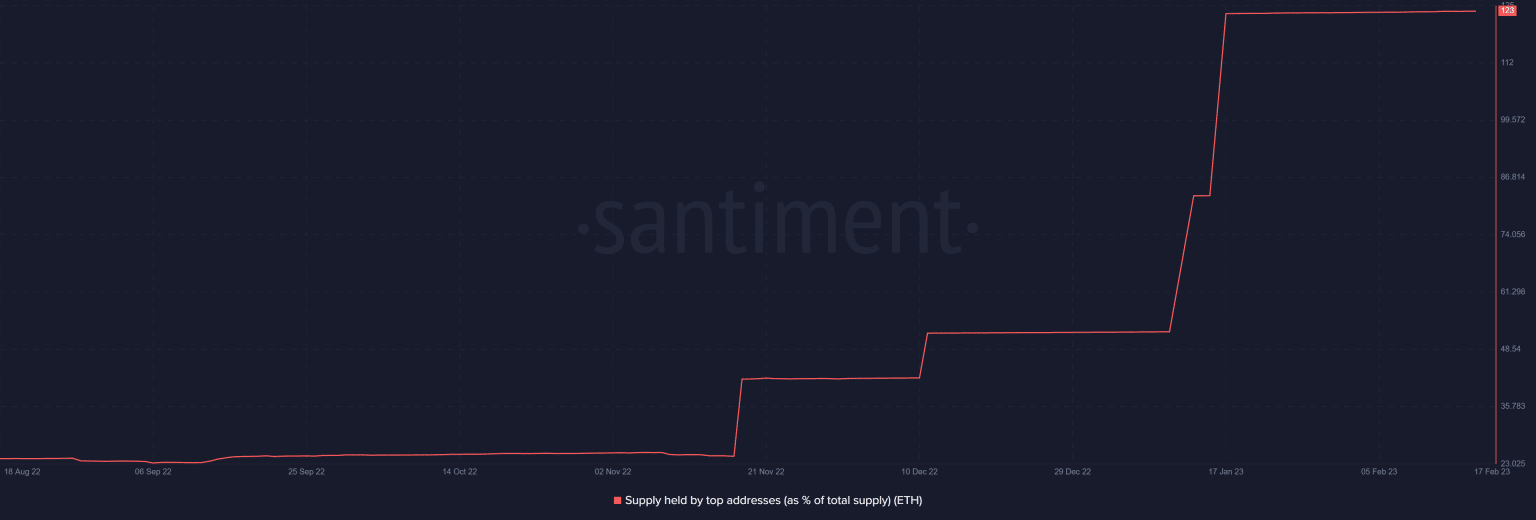
Source: Santiment

“”

Volatility incoming?

“”

Ethereum’s Shanghai upgrade will be the next big thing for the cryptocurrency sector. In March, users can withdraw more than $16.5 million worth of Ethereum (ETH) off the blockchain. The Merge was the last significant improvement to the network; however, it had little effect on the price of Ethereum.

“”

The Shanghai upgrade will affect the supply and demand of ETH, whereas the Merge was a purely technological development with no apparent economic consequences. However, because of the long-term and short-term nature of the upcoming development, it has the potential to affect the ETH price significantly.

“”

When staked ETHs are released, it is unknown how the shark and whale addresses will respond. But if they, too, decide to sell their assets, ETH’s value will plummet. So, in terms of Ethereum’s price movement, March will be a crucial month.


Пов'язані матеріали

US Government Lifts Ban on Crypto Perpetual Contracts for the First Time: What Does It Mean for the Market?

The U.S. Commodity Futures Trading Commission (CFTC) has issued guidance permitting 24/7 trading and clearing for crypto asset derivatives, effectively opening the U.S. market to crypto perpetual contracts for the first time. This move ends the previous ban and allows American individuals and institutions to trade these instruments around the clock. Direct beneficiaries include Kalshi, which received approval to list a Bitcoin perpetual contract; Coinbase, now the first CFTC-regulated futures commission merchant for U.S. clients to access global crypto derivatives; and CME, which will transition its Bitcoin futures and options to 24/7 trading. The CFTC emphasized this is a specific allowance for crypto assets, noting that traditional commodities like agriculture may not be suitable for non-stop trading. It also requires platforms to undergo case-by-case reviews for compliance and risk management. Industry leaders like Michael Saylor and Brian Armstrong praised the decision for integrating Bitcoin into capital markets and granting U.S. users access to a major global market segment. However, consumer advocacy group Better Markets criticized the CFTC for allegedly neglecting investor protection and favoring the industry it regulates. Other platforms like Kraken have announced plans to launch regulated perpetual futures for the U.S. market. The policy shift is expected to redirect significant liquidity and institutional participation to the newly accessible U.S. crypto derivatives landscape.

Odaily星球日报5 год тому

US Government Lifts Ban on Crypto Perpetual Contracts for the First Time: What Does It Mean for the Market?

Odaily星球日报5 год тому

How the CLARITY Act Reshapes the Stablecoin Yield Economy

The CLARITY Act, recently advanced by the U.S. Senate Banking Committee, fundamentally reshapes the stablecoin yield economy by closing loopholes left by the earlier GENIUS Act. Its Section 404 expands the ban on "hold-to-earn" rewards to all Digital Asset Service Providers (DASPs) and their affiliates, prohibiting any passive, interest-like yield. Crucially, it introduces a legal distinction, permitting "use-to-earn" rewards based on actual activities like spending, trading, or staking. In anticipation of this regulatory shift, major Wall Street asset managers—Morgan Stanley, BlackRock, and JPMorgan—have launched a series of tokenized money market funds (e.g., BlackRock's BRSRV, JPMorgan's JLTXX) designed explicitly for stablecoin reserve assets. These products represent a new, compliant yield layer: the stablecoin issuer earns interest from the underlying tokenized fund, which can then be passed to users through redesigned activity-based rewards. This marks a paradigm shift from a "hold-to-earn" to a "use-to-earn" market. While pathways remain for exchanges to redesign rewards (Path A) and for DeFi protocols to offer yield (Path B), the tokenized reserve asset layer (Path C) emerges as the most robust and strategically positioned infrastructure. However, this concentration—exemplified by BlackRock's BUIDL fund backing over 90% of USDtb's reserves—introduces new systemic risks. The final outcome hinges on regulatory decisions, particularly the OCC's proposed 20% cap on tokenized assets in reserves, which will determine the scalability of this new financial infrastructure layer.

marsbit6 год тому

How the CLARITY Act Reshapes the Stablecoin Yield Economy

marsbit6 год тому

Торгівля

Спот
Ф'ючерси
活动图片