$1 Billion in Iranian Cryptocurrency Seized by the U.S., Could It Be Added to the U.S. Strategic Bitcoin Reserve?

marsbitОпубліковано о 2026-06-02Востаннє оновлено о 2026-06-02

Анотація

US Treasury Secretary Scott Bessent announced the seizure of approximately $1 billion in Iranian cryptocurrency assets. The critical unanswered questions are the specific assets seized (e.g., Bitcoin vs. stablecoins like USDT) and their precise legal status (frozen vs. formally forfeited). According to a 2025 executive order, only Bitcoin that has undergone complete judicial forfeiture can be placed into a permanent, non-saleable Strategic Bitcoin Reserve. Other forfeited digital assets go to a separate US Digital Asset Reserve. Currently, only $344 million in USDT frozen by Tether is publicly confirmed. The remaining $656 million in assets lack public details. The assets' final disposition hinges on three factors: 1) Asset type, 2) Completion of the forfeiture process, and 3) Whether funds are used for victim restitution, law enforcement costs, or other exemptions before treasury transfer. Without confirmed forfeiture of Bitcoin, the seizure may primarily demonstrate stable币 regulatory compliance rather than augmenting the US Bitcoin reserve.

Written by: Gino Matos

Compiled by: Saoirse, Foresight News

Key Takeaways

  • Treasury Secretary Scott Bessent stated that the U.S. seized approximately $1 billion in Iranian crypto assets but did not disclose the relevant wallet addresses or token composition.
  • Asset category is crucial: Bitcoins legally forfeited can be transferred to the Trump Strategic Bitcoin Reserve; other tokens will be handled separately.
  • It remains unclear whether the assets are frozen, seized, or officially forfeited. Their legal status directly determines if the funds can be added to the reserve.

Treasury Secretary Scott Bessent stated at the Reagan National Economic Forum that the United States has seized approximately $1 billion in Iranian crypto assets. This seizure of Iranian assets serves as the first practical test following the implementation of the Trump administration's crypto reserve policy. Bessent added that the U.S. "directly took control of the wallets involved." According to a CBS report, he characterized these funds as money stolen from the Iranian people. However, Bessent did not disclose the asset types or corresponding wallet information—key details that precisely determine whether the funds can flow into the Strategic Bitcoin Reserve established by Trump.

According to an executive order signed by Trump in 2025, U.S. government-owned digital assets are divided into two separate accounts: The Strategic Bitcoin Reserve, specifically designated to hold bitcoins forfeited through civil or criminal judicial proceedings or collected as civil monetary penalties. The order explicitly states that government bitcoins deposited into this account are permanently prohibited from being sold. The other account is the U.S. Digital Asset Reserve, which holds non-bitcoin digital assets that have undergone final forfeiture proceedings. This classification framework makes the current seizure of Iranian crypto assets a practical test case: Only bitcoins that complete the final forfeiture process can be added to the Strategic Bitcoin Reserve; all other remaining tokens will be placed into the U.S. Digital Asset Reserve.

If the seized Iranian assets include bitcoin and the legal forfeiture is successfully completed, they can be incorporated into the reserve. If they consist of stablecoins or other types of tokens, they will likely be transferred to the Digital Asset Reserve. Another possibility is that the assets are merely in a frozen state, in which case the U.S. has not yet obtained legal ownership.

Clarifying the Actual Legal Meaning of "Seizure"

As early as April, the U.S. Treasury Department imposed sanctions on multiple Iran-linked wallets. Tether simultaneously disclosed that it cooperated with U.S. regulators to freeze a total of $344 million USDT across two addresses. Blockchain risk management firm TRM Labs confirmed that these wallets were linked to the Central Bank of Iran, the IRGC Quds Force, and Lebanon's Hezbollah. For the remaining approximately $656 million in assets, there is no publicly available breakdown by wallet or token type.

"Physical seizure" does not equal "legal ownership." OFAC sanctions rules clearly state that blocked assets are only subject to account freezing; the U.S. does not automatically gain ownership rights. Taking stablecoins like USDT as an example, issuers cooperating with regulators to lock addresses constitutes a sanction freeze, not a judicial forfeiture in the criminal law sense. Seizure at the enforcement level only represents the government's temporary control of the assets; ownership still awaits the outcome of forfeiture litigation.

Final forfeiture is a mandatory threshold for assets to enter the reserve: After assets complete the forfeiture process, deductions are made for victim compensation, specialized enforcement expenses, allocations to local law enforcement agencies, legally exempted returns, etc. Only the remaining assets are eligible for transfer into the reserve or the reserve account. Bessent's public statements leave the legal status of these assets entirely uncertain.

At the current Bitcoin price of approximately $73,000, if the entire $1 billion consisted of Bitcoin, it would be equivalent to about 13,632 BTC. According to 2025 statistics, the U.S. government has accumulated about 200,000 compliant bitcoins through past judicial proceedings. If this amount of BTC is fully deposited, the increment would represent 6.8% of the existing reserve volume. In current public records, only the $344 million USDT freeze is documented; details regarding the remaining $656 million in assets—their token types and legal forfeiture progress—are not publicly disclosed. No assets have completed the statutory forfeiture process.

The Industry Basis for the $1 Billion Seizure Figure

Considering the scale of Iran's crypto industry, the $1 billion seizure figure is reasonable, but the asset composition remains opaque.

Chainalysis estimates: In 2025, Iran's annual crypto transfer volume reached $7.78 billion. In Q4 2025, funds flows related to the Iranian Revolutionary Guard accounted for half of the country's total crypto transaction volume. TRM Labs estimates Iran's total annual crypto activity to be nearly $10 billion. Iran's leading exchange, Nobitex, has 11 million users, handling 70% of the country's crypto transactions. Investigations show that this platform has long processed transfers worth hundreds of millions of dollars for sanctioned entities like the Central Bank of Iran and the Revolutionary Guard.

Combining the above industry data, multiple rounds of U.S. enforcement actions plus issuer freezes totaling $1 billion in locked assets is plausible from an industry logic perspective, but the specific asset breakdown cannot be verified. The publicly announced $344 million USDT constitutes only 33% of the total, leaving 65.6% of the funds unaccounted for.
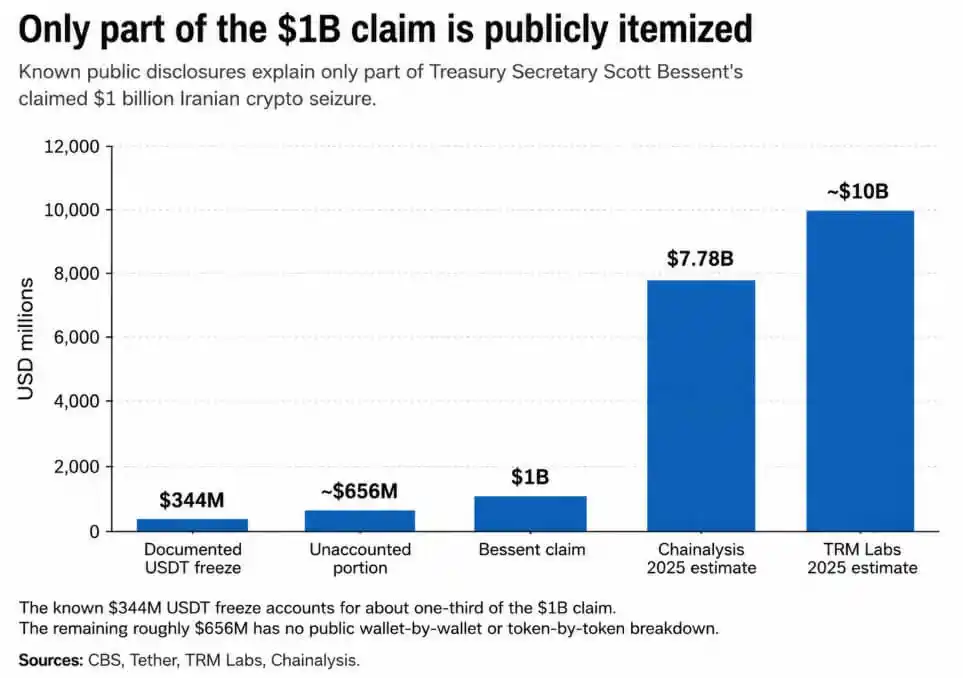
The known $344 million USDT freeze accounts for only 33% of the $1 billion in Iranian cryptocurrency that Bessent claims was seized, leaving $656 million publicly unaccounted for.

Projecting the Token Composition and Destination of the Seized Assets

If the $1 billion includes a significant amount of Bitcoin, and the U.S. completes the ownership forfeiture with no need for victim compensation and no diversion for enforcement expenses, the corresponding Bitcoin would enter the non-saleable strategic reserve. Crypto assets originally used by Iran to evade U.S. financial blockades would be transformed into a sovereign book reserve for the U.S. through sanction enforcement.

Currently, the only confirmed assets are $344 million USDT, frozen by Tether in cooperation with regulatory address freezes. If the remaining $656 million is also primarily stablecoins, the entire event essentially becomes a case of stablecoin regulatory compliance enforcement. Frozen USDT would remain locked; non-bitcoin assets, after forfeiture, would be transferred to the Digital Asset Reserve, with subsequent disposal plans determined entirely by the Treasury Secretary. A complete list of wallets and token types would directly change the nature of the event: it could either represent the implementation of U.S. sovereign Bitcoin accumulation or merely stablecoin regulatory compliance. Bessent has not disclosed any details at this stage.

The executive order also stipulates that forfeited assets can be returned to rightful victim claimants, allocated for case expenses, shared with state law enforcement agencies, or legally exempted from return. Any of these scenarios would prevent the assets from entering the reserve. These provisions represent multiple layers of hurdles for assets transitioning from "seized" to "treasury reserve," which can be triggered at any point before or after forfeiture.

The institutional framework established by Trump's reserve decree turns all future crypto seizures targeting adversarial nations into a matter of U.S. sovereign asset management.
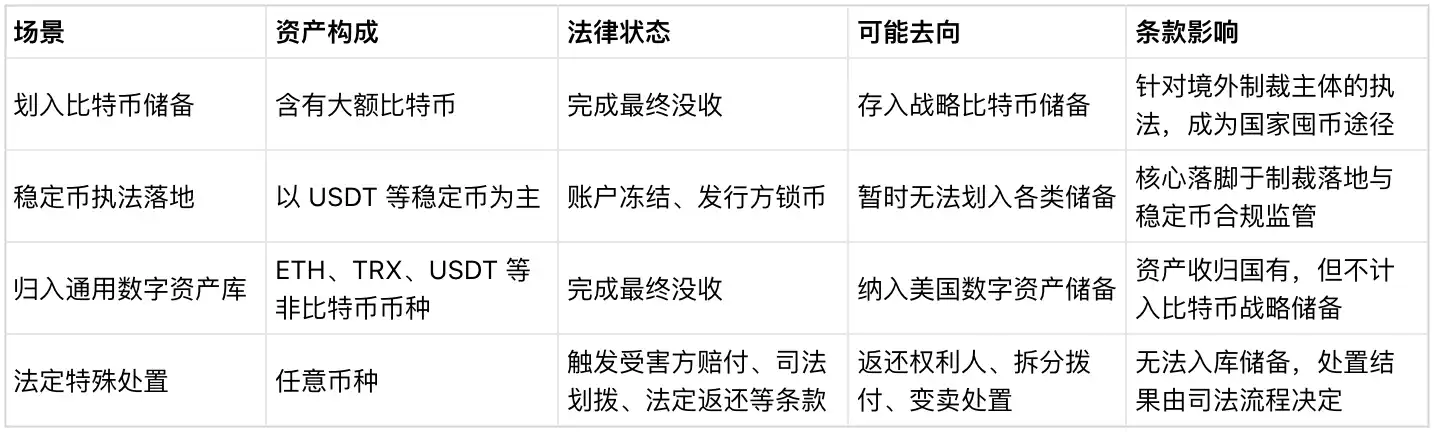
In the future, each U.S. crypto enforcement action against sanctioned entities like Iran and North Korea will involve three determinations: token type, legal status, and which treasury account to assign them to. Only by simultaneously meeting three conditions—the asset being Bitcoin, completing statutory forfeiture, and having no applicable compensation or allocation exemptions—can these Iranian assets potentially supplement the U.S. strategic reserve. As long as they successfully pass the two major hurdles of the forfeiture process and legal exemptions, crypto assets originally intended to circumvent U.S. financial controls would, in turn, become part of U.S. sovereign assets.


Пов'язані питання

QWhat are the two distinct accounts designated by the 2025 executive order for U.S. government digital assets, and what is the primary difference between them?

AThe two accounts are the Strategic Bitcoin Reserve and the U.S. Digital Asset Reserve. The Strategic Bitcoin Reserve is specifically for holding Bitcoin that has been legally forfeited or collected via civil monetary penalties, and these Bitcoins are permanently prohibited from being sold. The U.S. Digital Asset Reserve holds other, non-Bitcoin digital assets that have undergone final forfeiture adjudication.

QWhat is the key legal distinction between 'freezing' or 'seizing' assets and 'forfeiting' them, as it relates to the potential transfer of the $1 billion in Iranian crypto assets to the U.S. Strategic Bitcoin Reserve?

AFreezing or seizing assets represents temporary control or blockage by authorities, but legal ownership remains with the original holder until a court order. Forfeiture is the final legal process that transfers permanent ownership to the government. Only assets that have been formally forfeited are eligible for transfer into the Strategic Bitcoin Reserve.

QAccording to the article, what are the three main factors that will determine the final disposition of the seized Iranian crypto assets?

AThe three main factors are: 1) The type of cryptocurrency (e.g., Bitcoin vs. stablecoins), 2) The legal status of the assets (whether they are merely frozen/seized or have been formally forfeited), and 3) Which government account they can be assigned to (Strategic Bitcoin Reserve or U.S. Digital Asset Reserve) based on the type and legal status.

QWhat are some of the potential financial obligations that could prevent seized assets from entering the U.S. Strategic Bitcoin Reserve, even after forfeiture?

AAfter forfeiture, assets may be allocated to: victim restitution, law enforcement investigative expenses, sharing proceeds with state and local law enforcement agencies, or being legally exempted and returned to claimants. Any of these allocations would prevent the assets from being deposited into the Strategic Bitcoin Reserve.

QWhat portion of the claimed $1 billion in seized Iranian crypto assets has been publicly identified, and what specific asset does it consist of?

AOnly $344 million of the claimed $1 billion has been publicly identified. This portion consists of USDT (Tether stablecoins) that were frozen in two wallets by Tether in coordination with U.S. sanctions. The composition and status of the remaining $656 million are not publicly disclosed.

Пов'язані матеріали

Silicon Valley 'Startup Guru' Steve Hoffman: Web3 + AI Could Be a Trap

Silicon Valley investor and "Godfather of Startups" Steve Hoffman warns that combining Web3 with AI is likely a trap, not a promising venture. In an interview, Hoffman argues that while AI is a foundational technology touching all industries, Web3 adds complexity, friction, and regulatory risk without solving mainstream consumer or business needs. He advises founders to focus on deep, specialized applications where startups can out-iterate giants, rather than on generic features easily replicated by large tech companies. Hoffman observes that Silicon Valley will lead foundational AI research, while China excels at rapid, large-scale application and commercialization, particularly in robotics. He stresses that AI-driven autonomous agents capable of collaborative, multi-step tasks are 2-4 years away, which will cause significant job displacement. The solution is not to slow AI but to redesign business models around human-AI collaboration and reform social systems like education and retraining. For startups, Hoffman recommends focusing on vertical, expertise-heavy domains to build defensibility. He sees major opportunities in AI fraud detection and cybersecurity. Key founder mindsets include systemic thinking over feature-focus, relentless customer centricity, building adaptive teams, and deeply understanding AI's capabilities and limits. Hoffman is also leading a non-profit initiative to establish university centers aimed at training future leaders in responsible, human-value-aligned AI innovation.

marsbit1 год тому

Silicon Valley 'Startup Guru' Steve Hoffman: Web3 + AI Could Be a Trap

marsbit1 год тому

Token Inefficient, Economy Tokenless

The article "Tokens Aren't Economical, Economics Aren't Tokenized" analyzes a pivotal shift in the AI industry from a technology-driven narrative to one dominated by capital efficiency. It highlights two concurrent trends: a severe capital shortage due to the exorbitant and recurring costs of compute (e.g., OpenAI's high burn rate) and a wave of corporate spin-offs where major tech companies are separating their AI units (like Kuaishou's Kling and Baidu's Kunlunxin). The core argument is that AI's "anti-internet" business model, where user growth increases costs rather than profits, has created a disconnect between high valuations and actual cash flow. Spin-offs address this by allowing AI assets to be valued independently. Within a parent company, they are seen as cost centers, but as standalone entities, they are priced based on their growth potential and scarcity in the primary market, leading to massive valuation premiums (e.g., Kling's estimated value tripling post-spin-off). The industry is at an inflection point, moving from "model worship" to "value realization." The competition is evolving from a pure compute (GPU) race to a broader focus on systemic efficiency and full-stack engineering (involving CPUs and orchestration) to achieve viable commercialization. The year 2026 is framed as a critical moment where the industry must definitively answer how to economically translate AI capability into tangible business value, reshaping the sector's future power structure.

marsbit1 год тому

Token Inefficient, Economy Tokenless

marsbit1 год тому

Crossing the 'Memory Wall': The Wafer-Level Revolution and Computing Power Routes in the AI Inference Era

In 2026, a historic shift occurred in AI as major cloud providers' inference spending surpassed training spending for the first time, signaling a move from "building large models" to "using large models." This shifts the core challenge from computing power to the "memory wall"—the bottleneck of data movement (model weights, activations, KV Cache) between external DRAM and processors, where energy and latency from data transfer far exceed computation itself. Companies like Nvidia face GPU idle time due to bandwidth limits. In contrast, Cerebras Systems adopts a radical "wafer-scale" approach with its Wafer-Scale Engine (WSE). Instead of cutting a silicon wafer into many chips, Cerebras uses almost the entire wafer as one massive chip (WSE-3). This design provides 44GB of on-chip SRAM, delivering memory bandwidth thousands of times higher than traditional HBM (e.g., 21 PB/s vs. Nvidia B200). For LLM inference, weights are streamed layer-by-layer from external MemoryX storage to the chip, avoiding HBM bottlenecks. This results in token generation speeds 1.5–5 times faster than Nvidia's B200 in some models and significant advantages in first-token latency and long-context tasks. Additionally, Cerebras's architecture offers much lower interconnect power consumption (0.15 pJ/bit vs. GPU's ~10 pJ/bit). However, Cerebras faces challenges: SRAM scaling has slowed with advanced nodes, limiting future capacity gains; the chip requires specialized liquid cooling and custom software stacks; and its external I/O bandwidth (150 GB/s) is low compared to NVLink, hindering multi-system scaling for very large models. Competition is intensifying. Major players are pursuing three paths: 1) Developing proprietary inference ASICs (e.g., Google TPU, Microsoft Maia), 2) Leveraging advanced packaging (e.g., TSMC's SoW) to democratize wafer-scale-like integration, potentially eroding Cerebras's process advantage within a few years, and 3) Exploring optical interconnects for ultimate bandwidth. Commercially, Cerebras is transitioning from a hardware vendor to a service provider, facing the immense challenge of building high-power, specialized data centers to meet large contracts (e.g., 250MW/year from 2026–2028). In conclusion, the AI inference era presents a fundamental architectural trade-off. Cerebras opts for extreme physical optimization for low-latency, single-task performance, while Nvidia prioritizes versatility and massive cluster throughput. The path forward remains uncertain, with technology and business models still evolving in the race toward advanced AI.

marsbit1 год тому

Crossing the 'Memory Wall': The Wafer-Level Revolution and Computing Power Routes in the AI Inference Era

marsbit1 год тому

Has Bitcoin's 'Rebound Ended', Officially Entering the Late Bear Market Phase?

**Title: Has Bitcoin's Rebound Ended, Entering the Late Bear Market Phase?** **Summary:** Bitcoin's price has declined by 13% this week, signaling a potential return to late-stage bear market conditions. The price fell to around $67k, positioned between the Realized Price and Realized Cap Weighted Average. For the first time since early 2022, the Short-Term Holder cost basis has dropped below this key average, confirming a hallmark of late-cycle bear markets. Profitability metrics have collapsed sharply. The 7-day average of the Realized Profit/Loss ratio plummeted from a local high of 3.16 to 0.29, mirroring the February panic sell-off. Critically, the 90-day average never breached the threshold of 2, indicating the recent rally to $82k was a bear market bounce, not a structural shift. Realized losses surged to $1.35 billion daily, with $770 million coming from Long-Term Holders selling at a loss. This accelerating redistribution of supply from weak to strong hands is a necessary but ongoing process for a market bottom. The rally stalled almost precisely at the aggregate cost basis (~$83k) of US spot Bitcoin ETF investors, turning that level into strong resistance and leaving the average ETF holder underwater again. Spot market flows have turned decisively negative, showing sellers are dominating order books despite the price drop. While a significant futures long liquidation event cleared over $400 million in leverage, providing a potential reset, sustained spot demand is yet to materialize. Options markets continue to price in higher future volatility (Implied Volatility) than recent price action (Realized Volatility) has shown, with a persistent skew towards put options, indicating ongoing demand for downside protection. In conclusion, multiple metrics point to a fragile market structure. Resistance at the ETF cost basis, accelerating realized losses, dominant spot selling, and cautious options pricing all suggest the bear market trend persists. A sustainable recovery likely requires a resurgence of spot demand, ETF holders returning to profit, and a clear reduction in selling pressure.

marsbit1 год тому

Has Bitcoin's 'Rebound Ended', Officially Entering the Late Bear Market Phase?

marsbit1 год тому

Торгівля

Спот
Ф'ючерси

Популярні статті

Що таке BITCOIN

Розуміння HarryPotterObamaSonic10Inu (ERC-20) та його позиції у крипто-просторі Останніми роками ринок криптовалют спостерігав за зростанням популярності мем-коінів, які привертають інтерес не тільки трейдерів, але й тих, хто шукає спілкування та розважальну цінність. Серед цих унікальних токенів є HarryPotterObamaSonic10Inu (ERC-20), інтригуючий проект, що поєднує культурні посилання з тканинами криптовалюти. Ця стаття досліджує ключові аспекти HarryPotterObamaSonic10Inu, вивчаючи його механізми, спільноту та його взаємодію з ширшим крипто-ландшафтом. Що таке HarryPotterObamaSonic10Inu (ERC-20)? Як випливає з його назви, HarryPotterObamaSonic10Inu є мем-коіном, побудованим на блокчейні Ethereum, класифікованим за стандартом ERC-20. На відміну від традиційних криптовалют, які можуть підкреслювати практичну корисність або інвестиційний потенціал, цей токен процвітає завдяки розважальній цінності та силі своєї спільноти. Проект спрямований на створення середовища, де зацікавлені користувачі можуть об'єднуватися, ділитися ідеями та брати участь у заходах, натхненних різноманітними культурними явищами. Однією з примітних особливостей HarryPotterObamaSonic10Inu є нульовий податок на транзакції. Цей привабливий елемент має на меті заохочувати торгівлю та участь у спільноті, позбавлену додаткових витрат, які можуть відлякувати дрібних трейдерів. Загальна пропозиція монет становить один мільярд токенів, що позначає намір підтримувати суттєву циркуляцію в межах спільноти. Творець HarryPotterObamaSonic10Inu (ERC-20) Походження HarryPotterObamaSonic10Inu дещо окутане таємницею; деталі про творця залишаються невідомими. Розвиток цього токена позбавлений впізнаваної команди або чіткої стратегії, що не є рідкістю в секторі мем-коінів. Натомість проект виник органічно, а його розвиток значною мірою залежить від ентузіазму та участі його спільноти. Інвестори HarryPotterObamaSonic10Inu (ERC-20) Щодо зовнішніх інвестицій та підтримки, HarryPotterObamaSonic10Inu також залишається невизначеним. Токен не зазначає жодних відомих інвестиційних фондів або значної організаційної підтримки. Натомість життєва сила проекту полягає в його базовій спільноті, яка інформує про його зростання та стійкість через колективні дії та залученість у крипто-просторі. Як працює HarryPotterObamaSonic10Inu (ERC-20)? Як мем-коін, HarryPotterObamaSonic10Inu функціонує передусім поза традиційними рамками, що часто регулюють вартість активів. Є кілька відмінних аспектів, що визначають, як працює проект: Транзакції без податку: Завдяки відсутності податкових зборів на транзакції, користувачі можуть вільно купувати та продавати токен, не турбуючись про приховані витрати. Залучення спільноти: Проект процвітає завдяки взаємодії спільноти, використовуючи соціальні медіа для створення шуму та сприяння залученню. Обговорення, обмін контентом та залученість є ключовими елементами, що допомагають розширити його охоплення та зміцнити лояльність серед прихильників. Відсутність практичної корисності: Слід зазначити, що HarryPotterObamaSonic10Inu не пропонує конкретної корисності в рамках фінансової екосистеми. Натомість він класифікується як токен, що призначений в основному для розваги та спільнотних активностей. Культурне посилання: Токен кмітливо вплітає елементи популярної культури, щоб привернути інтерес, зв'язуючи з ентузіастами мемів та крипто-стежками. HarryPotterObamaSonic10Inu ілюструє, як мем-коіни функціонують інакше, ніж традиційні криптовалютні проекти, увійшовши на ринок як інноваційні соціальні конструкти, а не утилітарні активи. Хронологія HarryPotterObamaSonic10Inu (ERC-20) Історія HarryPotterObamaSonic10Inu відзначена кількома значними етапами: Створення: Токен виник з вірусного мему, захопивши уяву багатьох крипто-ентузіастів. Конкретні дати створення недоступні, що підкреслює його органічний розвиток. Лістинг на біржах: HarryPotterObamaSonic10Inu з'явився на різних біржах, дозволяючи зручніший доступ і торгівлю спільноти. Ініціативи залучення спільноти: Ведення діяльності, спрямованої на покращення взаємодії спільноти, включаючи конкурси, кампанії в соціальних мережах та створення контенту від фанатів та прихильників. Плани на майбутнє: Дорожня карта проекту включає запуск колекції NFT, мерчандайзинг та електронну комерцію, пов'язану з його культурними темами, що далі залучає спільноту та намагається додати більше вимірів до його екосистеми. Ключові моменти про HarryPotterObamaSonic10Inu (ERC-20) Спільнотний підхід: Проект надає пріоритет колективному внеску та креативності, забезпечуючи, щоб участь користувачів була в центрі його розвитку. Класифікація як мем-коін: Це є його епігенез розважальної криптовалюти, що відрізняється від традиційних інвестиційних інструментів. Жодного прямого відношення до Bitcoin: Незважаючи на схожість у назві, HarryPotterObamaSonic10Inu є відмінним і не має жодного зв’язку з Bitcoin або іншими усталеними криптовалютами. Зосередженість на співпраці: HarryPotterObamaSonic10Inu створено для того, щоб надати простір для співпраці та обміну історіями серед його власників, забезпечуючи шлях для творчості та спільного зв'язку. Перспективи на майбутнє: Амбіція розширитися за межі початкової концепції в NFT та мерчандайз відкриває шлях для проекту потенційно потрапити в більш мейнстрімні сфери цифрової культури. Оскільки мем-коіни продовжують захоплювати уяву спільноти криптовалют, HarryPotterObamaSonic10Inu (ERC-20) вирізняється своїми культурними зв'язками та орієнтованим на спільноту підходом. Хоча він може не відповідати типовій моделі утилітарного токена, його суть полягає в радощах і товариськості, що підтримуються серед його прихильників, підкреслюючи еволюційну природу криптовалют в усе більш цифрову епоху. Оскільки проект продовжує розвиватися, важливо спостерігати за тим, як динаміка спільноти вплине на його траєкторію в постійно змінюваному ландшафті технології блокчейн.

2.0k переглядів усьогоОпубліковано 2024.04.01Оновлено 2024.12.03

Що таке BITCOIN

Як купити BTC

Ласкаво просимо до HTX.com! Ми зробили покупку Bitcoin (BTC) простою та зручною. Дотримуйтесь нашої покрокової інструкції, щоб розпочати свою криптовалютну подорож.Крок 1: Створіть обліковий запис на HTXВикористовуйте свою електронну пошту або номер телефону, щоб зареєструвати обліковий запис на HTX безплатно. Пройдіть безпроблемну реєстрацію й отримайте доступ до всіх функцій.ЗареєструватисьКрок 2: Перейдіть до розділу Купити крипту і виберіть спосіб оплатиКредитна/дебетова картка: використовуйте вашу картку Visa або Mastercard, щоб миттєво купити Bitcoin (BTC).Баланс: використовуйте кошти з балансу вашого рахунку HTX для безперешкодної торгівлі.Треті особи: ми додали популярні способи оплати, такі як Google Pay та Apple Pay, щоб підвищити зручність.P2P: Торгуйте безпосередньо з іншими користувачами на HTX.Позабіржова торгівля (OTC): ми пропонуємо індивідуальні послуги та конкурентні обмінні курси для трейдерів.Крок 3: Зберігайте свої Bitcoin (BTC)Після придбання Bitcoin (BTC) збережіть його у своєму обліковому записі на HTX. Крім того, ви можете відправити його в інше місце за допомогою блокчейн-переказу або використовувати його для торгівлі іншими криптовалютами.Крок 4: Торгівля Bitcoin (BTC)Легко торгуйте Bitcoin (BTC) на спотовому ринку HTX. Просто увійдіть до свого облікового запису, виберіть торгову пару, укладайте угоди та спостерігайте за ними в режимі реального часу. Ми пропонуємо зручний досвід як для початківців, так і для досвідчених трейдерів.

4.7k переглядів усьогоОпубліковано 2024.12.12Оновлено 2026.06.02

Як купити BTC

Що таке $BITCOIN

ЦИФРОВЕ ЗОЛОТО ($BITCOIN): Комплексний аналіз Вступ до ЦИФРОВОГО ЗОЛОТА ($BITCOIN) ЦИФРОВЕ ЗОЛОТО ($BITCOIN) — це проект на основі блокчейну, що працює в мережі Solana, який має на меті поєднати характеристики традиційних дорогоцінних металів з інноваціями децентралізованих технологій. Хоча він має таку ж назву, як і Bitcoin, який часто називають “цифровим золотом” через його сприйняття як засобу збереження вартості, ЦИФРОВЕ ЗОЛОТО є окремим токеном, розробленим для створення унікальної екосистеми в ландшафті Web3. Його мета — позиціонувати себе як життєздатний альтернативний цифровий актив, хоча деталі щодо його застосувань і функціональностей все ще розробляються. Що таке ЦИФРОВЕ ЗОЛОТО ($BITCOIN)? ЦИФРОВЕ ЗОЛОТО ($BITCOIN) — це токен криптовалюти, спеціально розроблений для використання в блокчейні Solana. На відміну від Bitcoin, який виконує широко визнану роль зберігання вартості, цей токен, здається, зосереджується на більш широких застосуваннях і характеристиках. Помітні аспекти включають: Інфраструктура блокчейну: Токен побудований на блокчейні Solana, відомому своєю здатністю обробляти швидкі та низьковартісні транзакції. Динаміка постачання: ЦИФРОВЕ ЗОЛОТО має максимальне постачання, обмежене 100 квадрильйонами токенів (100P $BITCOIN), хоча деталі щодо його обігового постачання наразі не розголошуються. Утиліта: Хоча точні функціональності не викладені, є вказівки на те, що токен може бути використаний для різних застосувань, потенційно пов'язаних з децентралізованими додатками (dApps) або стратегіями токенізації активів. Хто є творцем ЦИФРОВОГО ЗОЛОТА ($BITCOIN)? На даний момент особа творців і команди розробників, що стоять за ЦИФРОВИМ ЗОЛОТОМ ($BITCOIN), залишається невідомою. Ця ситуація є типовою для багатьох інноваційних проектів у сфері блокчейну, особливо тих, що пов'язані з децентралізованими фінансами та феноменом мем-коінів. Хоча така анонімність може сприяти культурі, орієнтованій на спільноту, вона посилює занепокоєння щодо управління та підзвітності. Хто є інвесторами ЦИФРОВОГО ЗОЛОТА ($BITCOIN)? Доступна інформація вказує на те, що ЦИФРОВЕ ЗОЛОТО ($BITCOIN) не має жодних відомих інституційних спонсорів або помітних венчурних капіталовкладень. Проект, здається, працює за моделлю “рівний до рівного”, зосереджуючись на підтримці та прийнятті спільноти, а не на традиційних шляхах фінансування. Його активність і ліквідність переважно розташовані на децентралізованих біржах (DEX), таких як PumpSwap, а не на встановлених централізованих торгових платформах, що ще більше підкреслює його підхід знизу вгору. Як працює ЦИФРОВЕ ЗОЛОТО ($BITCOIN) Операційні механізми ЦИФРОВОГО ЗОЛОТА ($BITCOIN) можна детальніше розглянути на основі його дизайну блокчейну та характеристик мережі: Механізм консенсусу: Використовуючи унікальний proof-of-history (PoH) Solana в поєднанні з моделлю proof-of-stake (PoS), проект забезпечує ефективну валідацію транзакцій, що сприяє високій продуктивності мережі. Токеноміка: Хоча конкретні дефляційні механізми не були детально описані, велике максимальне постачання токенів вказує на те, що воно може задовольняти мікротранзакції або нішеві випадки використання, які ще потрібно визначити. Інтероперабельність: Існує потенціал для інтеграції з більш широкою екосистемою Solana, включаючи різні платформи децентралізованих фінансів (DeFi). Однак деталі щодо конкретних інтеграцій залишаються невизначеними. Хронологія ключових подій Ось хронологія, яка підкреслює значні віхи, пов'язані з ЦИФРОВИМ ЗОЛОТОМ ($BITCOIN): 2023: Початкове розгортання токена відбувається на блокчейні Solana, позначене його адресою контракту. 2024: ЦИФРОВЕ ЗОЛОТО набуває видимості, оскільки стає доступним для торгівлі на децентралізованих біржах, таких як PumpSwap, що дозволяє користувачам торгувати ним проти SOL. 2025: Проект спостерігає спорадичну торгову активність і потенційний інтерес до ініціатив, очолюваних спільнотою, хоча на даний момент не зафіксовано жодних значних партнерств або технічних досягнень. Критичний аналіз Сильні сторони Масштабованість: Основна інфраструктура Solana підтримує високі обсяги транзакцій, що може підвищити утиліту $BITCOIN у різних сценаріях транзакцій. Доступність: Потенційно низька торгова ціна за токен може привабити роздрібних інвесторів, сприяючи більш широкій участі завдяки можливостям дробового володіння. Ризики Відсутність прозорості: Відсутність публічно відомих спонсорів, розробників або процесу аудиту може викликати скептицизм щодо стійкості та надійності проекту. Волатильність ринку: Торгова активність сильно залежить від спекулятивної поведінки, що може призвести до значної волатильності цін і невизначеності для інвесторів. Висновок ЦИФРОВЕ ЗОЛОТО ($BITCOIN) постає як цікавій, але неоднозначний проект у швидко розвиваючійся екосистемі Solana. Хоча він намагається використати наратив “цифрового золота”, його відхід від встановленої ролі Bitcoin як засобу збереження вартості підкреслює необхідність чіткішого розмежування його передбачуваної утиліти та структури управління. Майбутнє прийняття та адаптація, ймовірно, залежатиме від вирішення поточної непрозорості та більш чіткого визначення його операційних та економічних стратегій. Примітка: Цей звіт охоплює синтезовану інформацію, доступну станом на жовтень 2023 року, і можуть відбутися події, що виходять за межі дослідницького періоду.

75 переглядів усьогоОпубліковано 2025.05.13Оновлено 2025.05.13

Що таке $BITCOIN

Обговорення

Ласкаво просимо до спільноти HTX. Тут ви можете бути в курсі останніх подій розвитку платформи та отримати доступ до професійної ринкової інформації. Нижче представлені думки користувачів щодо ціни BTC (BTC).

活动图片













