The entire Electric Coin Company (ECC) team behind privacy coin Zcash has left Bootstrap, a nonprofit created to support the token, after what ECC CEO Josh Swihart described as a governance breakdown that made the team’s work untenable. Swihart said the team will form a new company and continue building on Zcash, while stressing that the protocol itself is unaffected.
A Zcash Civil War In The Making?
In a statement posted to X, Swihart said that “over the past few weeks, it’s become clear that the majority of Bootstrap board members ... have moved into clear misalignment with the mission of Zcash,” naming Zaki Manian, Christina Garman, Alan Fairless, and Michelle Lai, which he referred to collectively as “ZCAM.”
Swihart framed the departure as a response to employment changes imposed by the board majority. “Yesterday, the entire ECC team left after being constructively discharged* by ZCAM,” he wrote. “In short, the terms of our employment were changed in ways that made it impossible for us to perform our duties effectively and with integrity.”
The exit represents a sharp escalation in tensions inside one of the support structures surrounding Zcash, a network that has historically relied on a small number of specialist organizations to fund and coordinate development. Swihart did not provide specific details on the governance actions or employment terms at issue, but portrayed the split as a defensive move to protect Electric Coin Company’s ability to execute its mandate.
“We’re founding a new company, but we’re still the same team with the same mission: building unstoppable private money,” Swihart said. He emphasized that “the Zcash protocol is unaffected,” adding that the decision was “simply about protecting our team’s work from malicious governance actions that have made it impossible to honor ECC’s original mission.”
Zooko Wilcox, the founder of Zcash said the conflict does not involve him or Shielded Labs, also sought to separate the organizational dispute from the operational status of the network. “Big drama in one (or two now?) of the many Zcash support orgs,” he wrote on X, before offering reassurance to users.
“The Zcash network is open source, permissionless, secure, and private, and nothing that happens in this conflict can change that,” Zooko said. “You can safely continue to use Zcash.”
In a second point, Zooko offered a character reference for the board members named by Swihart, highlighting how personal trust and long-running working relationships can factor into ecosystem governance disputes. “I’ve worked closely with Alan Fairless, Zaki Manian, and Christina Garman for more than 10 years, through many intense and difficult situations, and with Michelle Lai for about 5 years,” he wrote. “Based on my experiences, I believe them all to be people of exceptionally high integrity.”
Bootstrap Board Responds
[UPDATE:] After Swihart’s post, Bootstrap’s board issued its own statement tying the dispute to governance and legal constraints around a proposed transaction involving Zashi, describing the fallout as a disagreement over structure rather than over Zcash’s underlying mission. “We are saddened by this outcome and respect the contributions of those who have chosen to depart,” the board wrote, before adding that “it’s important to clarify the nature of the disagreement.”
Bootstrap said it was formed as a 501(c)(3) public-benefit nonprofit with “specific legal and fiduciary obligations” governing how assets, intellectual property, and transactions can be structured. According to the board, it had been discussing “external investment and alternative structures to privatize Zashi,” while working with legal counsel to ensure any path forward complied with US nonprofit law and preserved the long-term Zcash mission.
“There is nothing wrong with for-profits,” the statement said, adding that a well-executed effort could bring “a large amount of outside capital into making Zcash and privacy great and user-friendly,” but emphasizing that “Bootstrap/ECC’s nonprofit constraints are real.”
The board warned that the most recent version of the proposed deal could create legal and political risk for the broader ecosystem, arguing it “introduces new vulnerabilities for politically-motivated attacks on Zcash.” It cited the possibility of donor lawsuits and even an unwinding scenario in which “Zashi would have to be transferred back to ECC,” framing those tail risks as a threat not just to the parties involved but to “the entire Zcash ecosystem.”
In that context, the statement cast the standoff as a compliance issue: “This is not a disagreement about Zcash’s mission, which remains unchanged,” the board wrote. “It is about compliance with the legal and fiduciary obligations of a 501(c)(3), and about the moral imperative of ensuring Bootstrap’s assets remain dedicated to the mission they were meant to serve.”
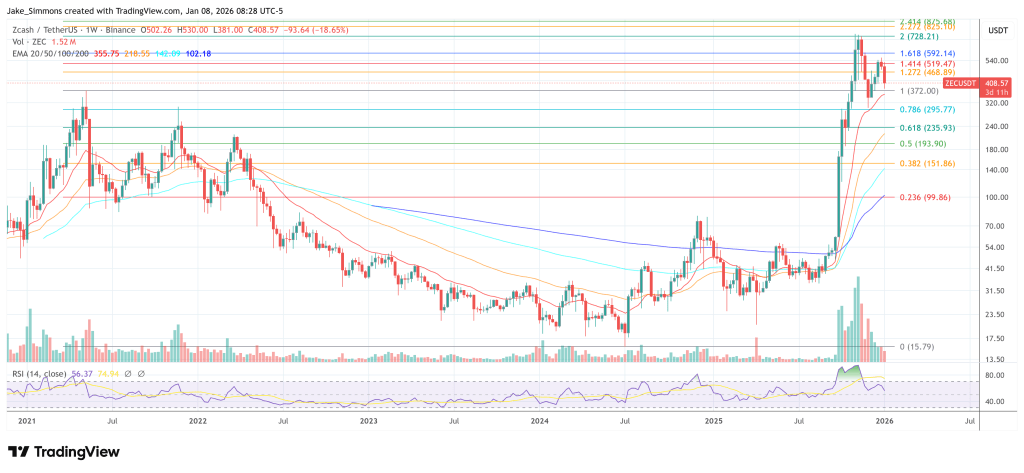
At press time, the ZEC price was strongly affected by the drama, trading at $408.57.