Stablecoins Don’t Meet Core Requirements Of Money, BIS Says

bitcoinist2026-04-21 tarihinde yayınlandı2026-04-21 tarihinde güncellendi

Özet

The Bank for International Settlements (BIS) General Manager, Pablo Hernández de Cos, stated that existing stablecoins fail to meet the core requirements of money, specifically "singleness" and "interoperability." Singleness refers to the need for different forms of money to be interchangeable at par value, which is ensured by central banks in traditional finance but not in decentralized stablecoins. Interoperability means seamless cross-platform transactions, which stablecoins currently lack due to fragmentation across multiple blockchains. These shortcomings limit stablecoins' network effects and widespread acceptance, keeping them a "niche" payment instrument. However, de Cos acknowledged their potential to improve cross-border payments, though he also warned of risks to financial stability and monetary policy. Despite a bearish crypto market, the stablecoin market cap has reached a new all-time high of over $320 billion.

The BIS General Manager has said that existing stablecoins fall short of the requirements for a widely accepted and used payment instrument.

Stablecoins Remain A “Niche” Payment Instrument

Pablo Hernández de Cos, General Manager at the Bank for International Settlements (BIS), spoke on the topic of stablecoins at a Bank of Japan seminar in Tokyo on Monday. The BIS is an international financial institution that serves as a bank for central banks. It’s owned by constituent central banks, of which there are 63 in total at the moment. The institution has been vocal about its concerns regarding stablecoins in the past.

Stablecoins are cryptocurrencies that have their price tied to a fiat currency. In recent years, these tokens have gained popularity, inviting regulation from major economic hubs.

Since stables run on blockchain technology, they naturally offer relatively cheap 24/7 transactions. This has made their main use, besides being a store of value, as a mode of payments.

Stablecoins try to mimic fiat currencies, but do they count as “money”? de Cos has discussed the two features that decide the “moneyness” of an instrument: singleness and interoperability.

First, singleness is the idea that different forms of money should be perfectly substitutable at par across financial intermediaries and platforms. In fiat economics, this is facilitated by central banks. For the decentralized stablecoins, there is no such central settlement so deviations can emerge.

Though, these differences tend to be relatively modest. “Yet confidence shocks can widen discounts abruptly and, when they do, users may refuse to accept certain stablecoins, as seen on several occasions in the past,” said de Cos.

The other property, interoperability, means that users can send and receive funds seamlessly across platforms and networks. Today, stablecoins are distributed across a wide range of blockchains, so even versions of the same token that run on different blockchains aren’t interoperable by default.

The BIS General Manager explained:

Together, these features undermine the network effects that are key to money – the use of money begets its acceptance, and acceptance begets wider use. It is therefore conceivable that under current designs stablecoins remain a “niche” instrument.

While current stablecoin systems may fall short of the requirements of a widely accepted payment instrument, de Cos noted that they have the potential to significantly enhance cross-border payments. But the opportunities provided by fiat-tied cryptocurrencies don’t come without challenges; the BIS head cautioned that these assets can affect credit supply, financial stability, and monetary and fiscal policy.

The wider digital asset sector has faced bearish winds since Q4 2025, but the stablecoin market has managed to hold up relatively well as its market cap has seen a slight uptrend in this period, according to data from DefiLlama.
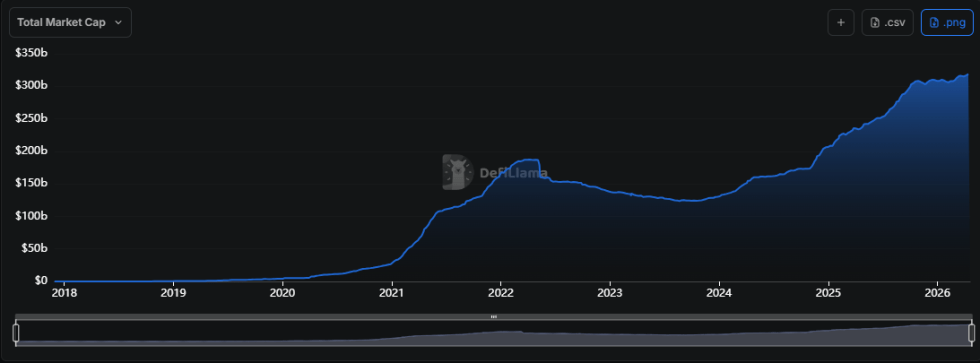
The trend in the stablecoin market cap over the last few years | Source: DefiLlama

Currently, the fiat-pegged coins have a combined valuation of over $320 billion, which is a new all-time high.

Bitcoin Price

At the time of writing, Bitcoin is trading around $75,000, up more than 6% over the past week.

The price of the coin seems to have retraced from its Friday high | Source: BTCUSDT on TradingView

Trend Kriptolar

İlgili Sorular

QAccording to the BIS General Manager, what are the two key features that determine the 'moneyness' of an instrument like a stablecoin?

AThe two key features are singleness and interoperability.

QWhat is the main reason the BIS believes stablecoins currently remain a 'niche' payment instrument?

ABecause they lack the network effects that are key to money, as their design undermines singleness and interoperability, which prevents wider acceptance and use.

QDespite their shortcomings, what potential benefit of stablecoins did the BIS General Manager acknowledge?

AHe noted that stablecoins have the potential to significantly enhance cross-border payments.

QWhat is the current total market capitalization of all stablecoins as mentioned in the article?

AThe combined valuation is over $320 billion, which is a new all-time high.

QWhat are the two specific risks that the BIS head cautioned stablecoins could pose?

AThey can affect credit supply, financial stability, and monetary and fiscal policy.

İlgili Okumalar

Apple and the Power Rebalancing with 'The Microns': Dissecting the Profit Ledger Behind the iPhone

The article analyzes the shifting profit dynamics and power balance between Apple and memory suppliers like Micron within the iPhone supply chain. It highlights a social media post criticizing Apple for raising iPhone prices while blaming memory chip cost increases, despite historically paying suppliers like Micron very little. An estimated iPhone 18 cost breakdown is referenced. Historically, memory was a minor cost component. In 2017's iPhone X, memory accounted for only about 1.6-2.3% of the price, with Apple capturing nearly 50% net profit. Over time, memory's share of the Bill-of-Materials (BOM) cost has grown significantly, reaching an estimated 12-15% for the iPhone 17 series. The core driver of this change is soaring demand for memory from the AI industry, particularly for High Bandwidth Memory (HBM) and AI servers, which is diverting production capacity and squeezing supply for consumer electronics. Memory manufacturers, after enduring periods of low profits, now hold greater pricing power. This is reflected in their recent strong financials, like Micron's 84.6% gross margin. Apple CEO Tim Cook initially described the memory price pressure as unprecedented in his 40-year career, later calling it a "once-in-a-century flood," before Apple announced price hikes across several product lines, causing a significant stock drop. Elon Musk echoed Cook's sentiment about the dramatic cost surge. The article concludes that the era of memory suppliers being at the mercy of Apple's pricing power has temporarily reversed, thanks to AI-driven demand. It notes Apple is reportedly seeking to diversify its supply chain, including exploring chips from China's CXMT.

Odaily星球日报34 dk önce

Apple and the Power Rebalancing with 'The Microns': Dissecting the Profit Ledger Behind the iPhone

Odaily星球日报34 dk önce

Conversation with the Founder of 42 Macro: The Fed's 'Boiling the Frog Slowly' and the K-Shaped Economy

In a conversation with Anthony Pompliano, Darius Dale, founder of 42 Macro, discusses the Federal Reserve's monetary policy and the K-shaped U.S. economy. Dale characterizes new Fed Chair Kevin Warsh as a "dove in hawk's clothing," expecting the Fed to signal or enact policy tightening in the coming quarters to create room for later easing. He argues current economic signals, including high deficit spending, debt monetization, and credit growth, strongly indicate inflation is not on a credible path back to 2%, forcing the Fed to act. The discussion highlights the stark "K-shaped" economic reality. While top earners, buoyed by massive cash savings (up ~$8 trillion since pre-pandemic), continue robust spending, those at the bottom face severe financial strain, with delinquency rates on consumer loans reaching crisis-era highs. Dale attributes much of the current social and political anxiety to this divergence, driven by the "Cantillon effects" of monetary expansion, which disproportionately benefits asset owners. He emphasizes that in this environment of "financial repression," individuals must participate in asset markets to avoid being left behind. On equities, Dale notes a rotation from the "Magnificent Seven" tech giants into broader AI-exposed companies, while warning that the tech giants' massive capital expenditure cycles could eventually puncture over-optimistic cash flow projections. Dale concludes by stressing that the core desire across all economic strata is simply the dignity to provide for one's family, a goal currently undermined by systemic policies that act as a "wealth siphon" from the bottom to the top.

marsbit1 saat önce

Conversation with the Founder of 42 Macro: The Fed's 'Boiling the Frog Slowly' and the K-Shaped Economy

marsbit1 saat önce

The Domestic Answer to Space Computing Power: Photonics Are More Efficient, Musk and Huang's Approaches Are Too Roundabout

The Space Computing Race: A Photonic Advantage The competition for space-based computing has intensified, with figures like Elon Musk and NVIDIA's Jensen Huang highlighting its potential. Musk predicts solar-powered AI satellites could offer the most cost-effective computing by 2032. However, space presents extreme challenges for traditional electronic chips: radiation from cosmic particles can cause errors, the vacuum environment hinders heat dissipation, and limited solar power constrains energy-hungry systems. Photonic computing, using light instead of electrons, offers a promising solution. Its core advantages for space are threefold: 1) **Radiation Resistance**: Photons are charge-neutral, making them inherently immune to particle interference. 2) **Low Heat Generation**: Light propagation in waveguides generates minimal heat, bypassing critical thermal management issues. 3) **Low Power Consumption**: Photonic chips have near-zero static power draw, aligning perfectly with the energy constraints of satellites. Furthermore, for a given payload weight and volume, photonic systems can potentially deliver higher total compute density. Since they require less bulky cooling and power infrastructure, more space can be allocated to the compute units themselves. While photonic computing holds great promise, current industry approaches face hurdles like the memory-compute bottleneck (separate storage and processing) and challenges in large-scale integration. Engineering for space—withstanding launch vibrations and validating full system operation in orbit—remains a critical step. The path forward resembles the evolution from single GPUs to computing clusters, but via a photonic route. As electronic chips approach physical limits in miniaturization, photonic computing and optical interconnects (光算光联) may provide a key alternative to bypass these constraints and define the next generation of space-based computing capabilities.

marsbit2 saat önce

The Domestic Answer to Space Computing Power: Photonics Are More Efficient, Musk and Huang's Approaches Are Too Roundabout

marsbit2 saat önce

İşlemler

Spot

Popüler Makaleler

CORE Nasıl Satın Alınır

HTX.com’a hoş geldiniz! CORE (CORE) satın alma işlemlerini basit ve kullanışlı bir hâle getirdik. Adım adım açıkladığımız rehberimizi takip ederek kripto yolculuğunuza başlayın. 1. Adım: HTX Hesabınızı OluşturunHTX'te ücretsiz bir hesap açmak için e-posta adresinizi veya telefon numaranızı kullanın. Sorunsuzca kaydolun ve tüm özelliklerin kilidini açın. Hesabımı Aç2. Adım: Kripto Satın Al Bölümüne Gidin ve Ödeme Yönteminizi SeçinKredi/Banka Kartı: Visa veya Mastercard'ınızı kullanarak anında CORE (CORE) satın alın.Bakiye: Sorunsuz bir şekilde işlem yapmak için HTX hesap bakiyenizdeki fonları kullanın.Üçüncü Taraflar: Kullanımı kolaylaştırmak için Google Pay ve Apple Pay gibi popüler ödeme yöntemlerini ekledik.P2P: HTX'teki diğer kullanıcılarla doğrudan işlem yapın.Borsa Dışı (OTC): Yatırımcılar için kişiye özel hizmetler ve rekabetçi döviz kurları sunuyoruz.3. Adım: CORE (CORE) Varlıklarınızı SaklayınCORE (CORE) satın aldıktan sonra HTX hesabınızda saklayın. Alternatif olarak, blok zinciri transferi yoluyla başka bir yere gönderebilir veya diğer kripto para birimlerini takas etmek için kullanabilirsiniz.4. Adım: CORE (CORE) Varlıklarınızla İşlem YapınHTX'in spot piyasasında CORE (CORE) ile kolayca işlemler yapın.Hesabınıza erişin, işlem çiftinizi seçin, işlemlerinizi gerçekleştirin ve gerçek zamanlı olarak izleyin. Hem yeni başlayanlar hem de deneyimli yatırımcılar için kullanıcı dostu bir deneyim sunuyoruz.

286 Toplam GörüntülenmeYayınlanma 2024.12.13Güncellenme 2026.06.02

CORE Nasıl Satın Alınır

Tartışmalar

HTX Topluluğuna hoş geldiniz. Burada, en son platform gelişmeleri hakkında bilgi sahibi olabilir ve profesyonel piyasa görüşlerine erişebilirsiniz. Kullanıcıların CORE (CORE) fiyatı hakkındaki görüşleri aşağıda sunulmaktadır.

活动图片