Why Do Memes Only Cut You? An Article That Explains Their True Growth Mechanism

比推2026-01-21 tarihinde yayınlandı2026-01-21 tarihinde güncellendi

Özet

The article "Why Do Meme Coins Only 'Cut' You? Clarifying Their True Growth Mechanism" offers a fresh, analytical perspective on meme coin dynamics, framing their growth not as irrational speculation but as a mathematically explainable phenomenon. The core argument is that a meme coin’s market capitalization isn't just driven by price increases (Z-axis), but is fundamentally supported and "propped up" by two underlying factors: narrative density (X-axis) and the network of传播 nodes (Y-axis). Together, these form the base radius of a "Wealth Cone." A meme with only height (price) but no base (narrative and community) is like a thin needle—easily toppled. A strong, expanding base is necessary to support sustainable, exponential growth. The proposed XYZ three-dimensional growth spiral model explains the interaction: * **X-axis (Narrative Density):** The meme's core idea, cultural resonance, originality, and the richness of community-created content. * **Y-axis (Propagation Network):** The transmission pipelines, from major influencers (e.g., Elon Musk) to KOLs and finally to retail investors. * **Z-axis (Capital Flow):** The monetization of attention, measured by market cap, trading volume, and crucially, liquidity depth. The lifecycle of a successful meme is a reflexive, spiral ascent through stages: **Ignition** (a Y-axis spike from a KOL callout lifts the Z-axis), **Spin** (price growth attracts more discussion, enriching the narrative), and **Ascension** (an expande...

Author: danny

Original Title:

Why Do the Memes You Buy Only Fall? — Deconstructing the Growth Spiral and Volume of Memes Using First Principles


In the eyes of most people, Meme coins are irrational狂欢, a fool's赌场. But from a mathematical perspective, the birth of every ten-thousand-fold myth is not accidental; it is actually a middle school spatial geometry evolution word problem.

This article proposes a颠覆性的 perspective: The market value of Meme coins is not "grown" but "propped up." The value of Memes can be calculated!

We are accustomed to focusing on the fluctuations of the Z-axis (price height), but we overlook that what determines life and death is the base radius constructed by the X (narrative density) and Y (propagation nodes) axes. A Meme with only height and no base is just a very thin "needle" that topples with the wind; only by continuously expanding the consensus radius can it support a stable, geometrically growing wealth cone under the gravity of capital.

Note: This article is a popular science article on "financial physics," not a rigorous econometric paper, and is only intended to provide a new perspective for viewing Memes.

1. The Beginning of the Theory: The Three-Dimensional Coordinate System of Memes

In the current cryptocurrency market, Meme coins are often seen as irrational狂欢. But is that really the case?

If we strip away the noise of emotions, KOL shilling, and community bandwagoning, we will find that the birth and death of every phenomenal Meme follows a strict mathematical logic.

The essence of Meme coins is the tokenization of the attention economy. Their market value is not determined by traditional discounted cash flow (DCF) but is jointly constructed by the breadth of the narrative, community resonance, and the explosive power of funds.

For better discussion, we define these factors as the XYZ three-dimensional growth spiral model.

These three axes are not just independent variables; there is a strong reflexivity between them—that is, a change in one variable reinforces another, forming a positive feedback loop.

Let's explain these parameters:

X-axis: Narrative Density and Cultural Memes

Definition: The "genes" of a Meme. Includes the core梗 (e.g., Doge), origin story (e.g., CZ's pet name), cultural symbols (e.g., Pepe the Frog), and the richness of community二次创作.

Key metrics: Narrative originality, replicability, emotional resonance.

Y-axis: Propagation Potential and Node Network

Definition: The transmission pipeline of information. From top-tier nodes (CZ, Elon Musk) to secondary nodes (Alpha Callers, KOLs), and then to end nodes (ordinary retail investors).

Key metrics: Node weight, propagation coverage, shilling frequency.

Z-axis: Fund Flow and Liquidity Carrier

Definition: The monetization result of attention. Includes on-chain fund inflows, liquidity depth—i.e., the沉淀的价值 or the total amount of sell orders that can be承接.

Key metrics: Market capitalization, trading volume, turnover rate, and liquidity (the most important metric).

2. Diagram of the Growth Curve of XYZ Axis Interaction

If we plot these three axes in three-dimensional space, the growth trajectory of a successful Meme will generally show a spiral upward trend: (as shown in the figure below)
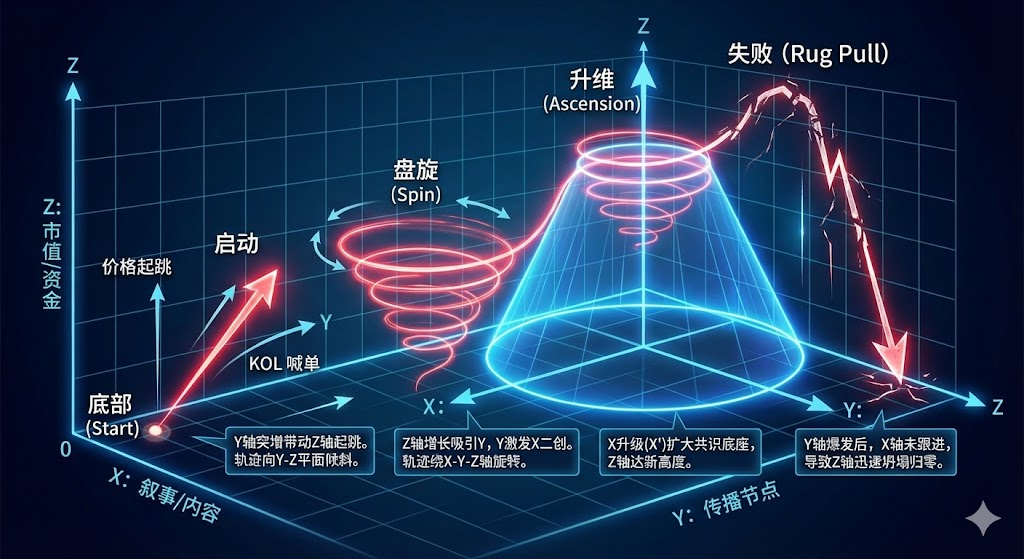
Bottom (Start): X, Y, Z are all close to zero.

Ignition: The Y-axis surges (KOL shilling), driving the Z-axis (price) to jump. The trajectory line tilts toward the Y-Z plane.

Spin: The growth of the Z-axis attracts more Y (more people discussing), and Y stimulates X's二次创作 (enriching content). The trajectory line begins to rotate around the X-Y-Z axes.

Ascension: As X is upgraded (X'), the base area of the cone expands (broader consensus range), and the Z-axis (market capitalization) reaches a new height.

Failed Meme (Rug Pull): Usually表现为 the Y-axis爆发后, the Z-axis briefly rises, but the X-axis fails to follow up with an upgrade (narrative scarcity), causing the Z-axis to quickly collapse to zero. The trajectory line shows an inverted V-shaped fall.

3. Evolution of the Growth Curve: The Spiral Ascension of Four Stages

From the previous section, we know that the lifecycle of a Meme is not linear but a vortex that continuously expands around the Z-axis (fund flow). In this section, we will analyze it based on the four development stages of Memes.

The figure below shows its standard evolution path: (I was also shocked at how cool AI drew it?!)


Original link:https://www.bitpush.news/articles/7604686

İlgili Sorular

QWhat is the core perspective proposed in the article regarding the growth of Meme coins?

AThe article proposes that Meme coin market capitalization is not simply 'rising' but is 'propped up' by a mathematical model involving narrative density (X-axis) and propagation nodes (Y-axis), which together form the base supporting the value (Z-axis).

QHow does the article define the X-axis in its Meme growth model?

AThe X-axis is defined as 'Narrative Density and Cultural Memes,' which includes the core meme, origin story, cultural symbols, and the richness of community-created content.

QAccording to the article, what is the role of the Y-axis in the Meme coin growth spiral?

AThe Y-axis represents 'Propagation Potential and Node Network,' which refers to the information transmission pipelines, from top nodes like influencers to secondary and end nodes like ordinary retail investors.

QWhat does the Z-axis represent in the XYZ model for Meme coins?

AThe Z-axis represents 'Capital Flow and Liquidity Carrier,' which is the monetization result of attention, including on-chain capital inflow, liquidity depth, and the total value that can absorb selling pressure.

QWhat is the key difference between a successful Meme and a failed one (Rug Pull) according to the model?

AA successful Meme undergoes a spiral ascent where narrative (X) and propagation (Y) expand to support the value (Z). A failed Meme (Rug Pull) sees a brief spike in Y and Z, but a lack of narrative development (X) causes the value to collapse back to zero.

İlgili Okumalar

You Bet on the News, the Pros Read the Rules: The True Cognitive Gap in Losing Money on Polymarket

The article explains that the key to profiting on Polymarket, a prediction market platform, lies not just predicting real-world events correctly, but in meticulously understanding the specific rules that govern how each market will be resolved. It illustrates this with examples, such as a market on Venezuela's 2026 leader, where the official rules defining "officially holds" the office overruled the intuitive answer of who was in practical control. Other examples include debates over the definition of a "token" or what constitutes an "agreement." The core argument is that a "reality vs. rules" gap creates pricing discrepancies that savvy traders ("车头" or "whales") exploit. The platform has a formal dispute resolution process managed by UMA token holders to settle ambiguous outcomes. This process involves proposal submission, a challenge window, a discussion period, and a final vote. However, the article highlights a critical flaw in this system compared to a traditional court: the lack of separation between the arbiters (UMA voters) and the interested parties (traders with financial stakes in the outcome). This conflict of interest undermines the discussion phase, leads to herd mentality, and results in opaque final decisions without explanatory rulings. Consequently, the system lacks a body of precedent, making it difficult for users to learn from past disputes. The ultimate takeaway is that success on Polymarket requires a lawyer-like scrutiny of the rules to identify and capitalize on the cognitive gap between how events appear and how they are contractually defined for settlement.

marsbit1 saat önce

You Bet on the News, the Pros Read the Rules: The True Cognitive Gap in Losing Money on Polymarket

marsbit1 saat önce

İşlemler

Spot
Futures
活动图片