Why 21Shares believes ‘passive strategies’ for crypto ETFs are outdated

ambcrypto2026-03-26 tarihinde yayınlandı2026-03-26 tarihinde güncellendi

Özet

21Shares President Duncan Moir argues that passive 'HODL' strategies for crypto ETFs are becoming outdated. Instead, the firm advocates for active management to capture yield and diversification opportunities in the growing asset class. Key strategies include yield-generating products like a preferred stock ETP offering an 11.5% dividend, staking rewards in ETFs, and thematic offerings such as a Bitcoin-and-gold ETP. While U.S. investor interest remains focused on large coins, European institutions are exploring newer assets and application layers. Despite a decline in total crypto ETF AUM to $130 billion, active strategies aim to drive future demand.

For most Bitcoin OGs in the space, the main crypto investment strategy has always been ‘HODL,’ which has been enough to outperform most assets in certain periods.

Early asset managers who entered the sector also adopted a similar passive strategy for their respective crypto ETFs (exchange-traded funds). They have been holding the crypto assets in the hope that, in three, six, or 12 months, their value would appreciate.

According to 21Shares president Duncan Moir, however, crypto ETFs are transitioning from passive management to active strategies. Moir noted that the sector was a ‘nascent’ and ‘growing asset class’ that fits perfectly with active management.

At the core of this new strategy is scaling yield streams and extra earning opportunities beyond just holding the crypto assets. From a regional crypto ETF demand, Moir said,

The interest is still concentrated in the larger coins in the US. In Europe, institutional clients are more interested in newer assets and the application layer beyond the Layer-1.
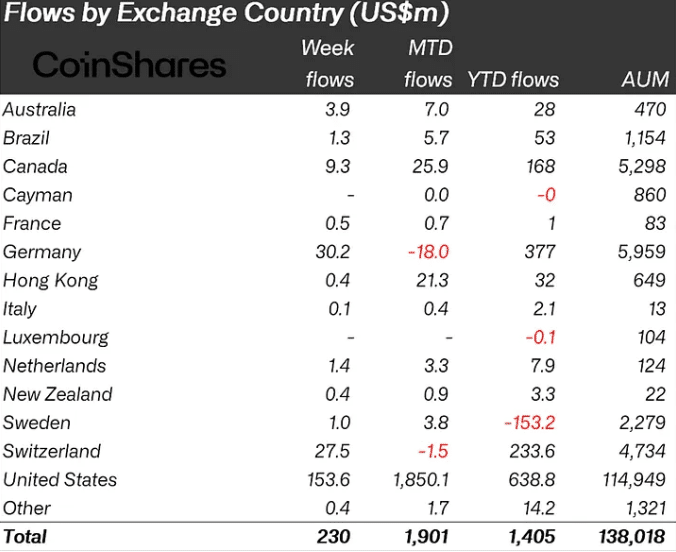
Source: CoinShares

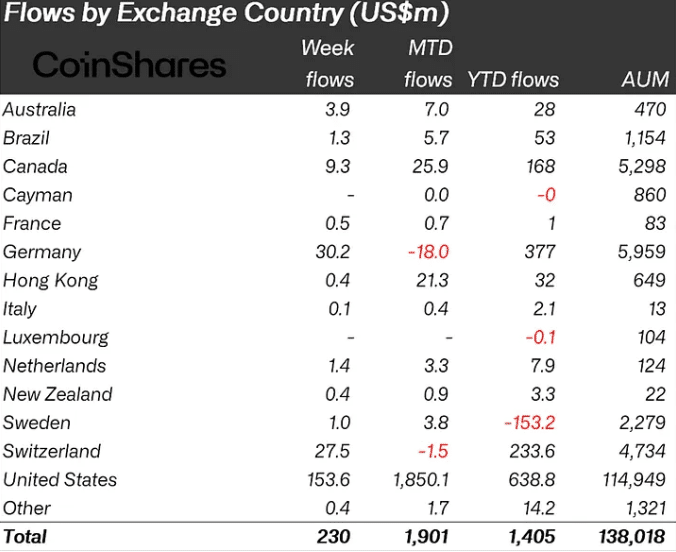
In fact, on a year-to-date (YTD) basis, the U.S. leads with $638 million in crypto inflows, followed closely by Germany at $377 million and Switzerland at $233 million.

Crypto ETFs evolution and diversification

For Moir, the mature investor base in Europe, who already hold Bitcoin and Ethereum, is looking to expand their crypto allocation with better offerings.

This led to 21Shares launching an ETP tied to Strategy’s preferred stock, Stretch (STRC), which offers an annual dividend yield of up to 11.5% payable monthly. This is one of the Strategy’s ways of raising capital for Bitcoin buys.

Moir noted that the product has been an instant success across several regions, underscoring a strong appetite for yield-bearing assets that are feasibly accessible via traditional platforms.

Additionally, crypto ETF staking rewards have become another active strategy to maximize investors’ returns.

Grayscale and BlackRock’s push for staking rewards in their respective Spot ETH ETFs is one example of asset managers seeking more opportunities for investors.

Finally, Moir said they also look for major thematic trends or future shifts that can be maximized. The approach informed the launch of 21Shares’ Bitcoin-and-gold ETP, based on the rising demand for safe havens amid debasement trade and rising U.S. fiscal debt.

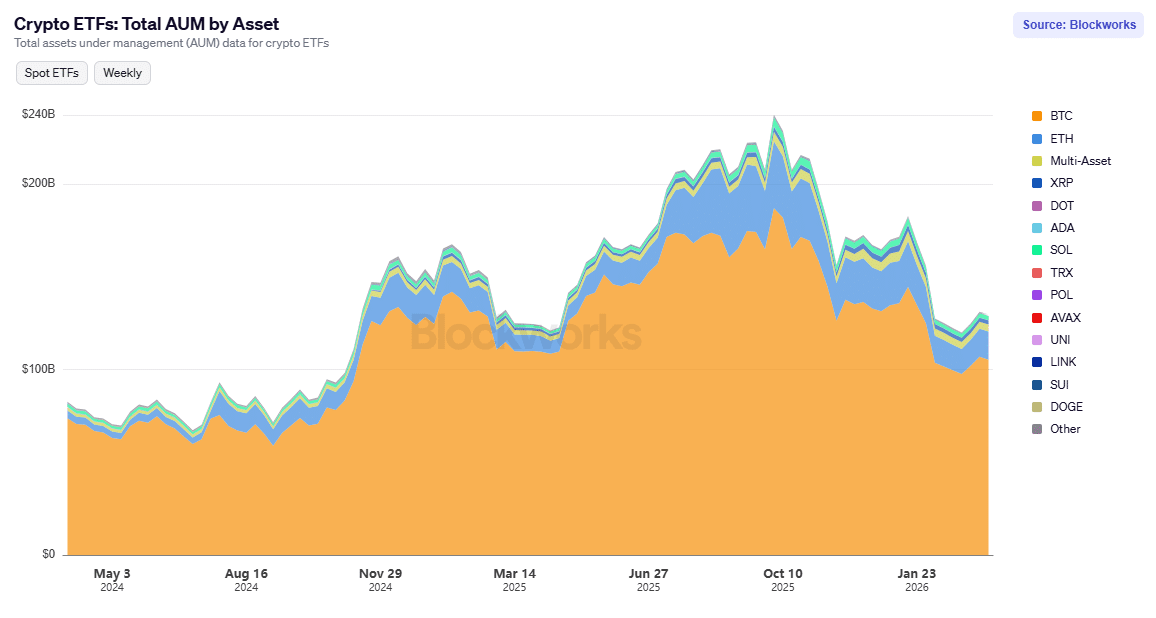
It remains to be seen how the new active strategy will drive demand into crypto ETFs. As of writing, the total crypto ETF assets under management (AUM) were about $130 billion, down from nearly $240 billion at the peak of 2025.
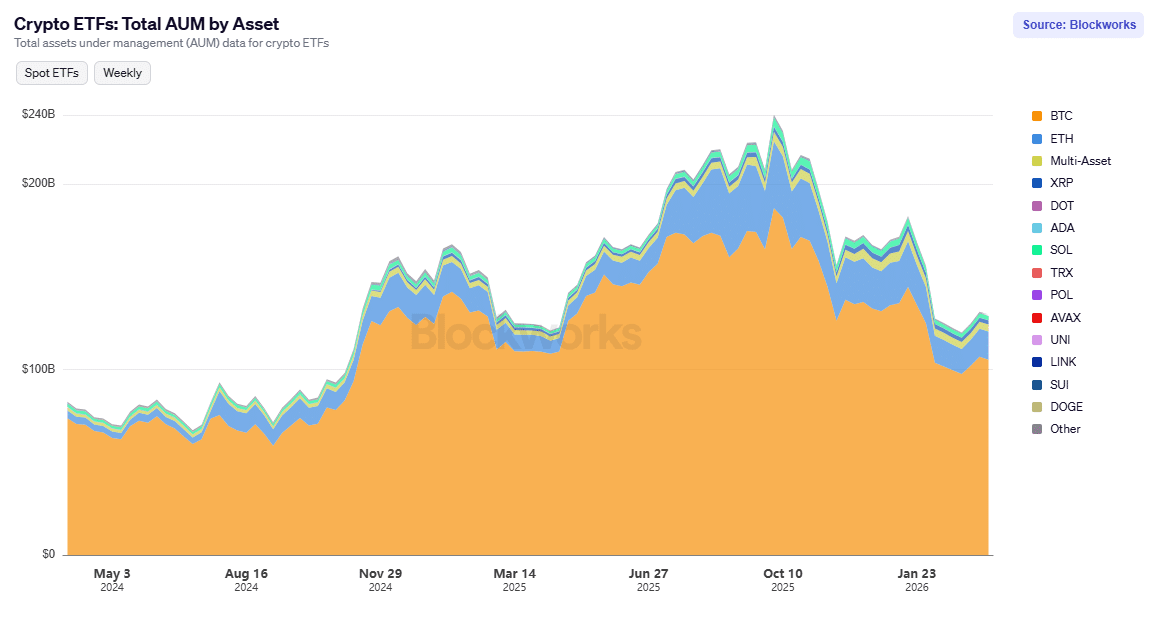
Source: Blockworks

Final Summary

  • 21Shares’ Duncan Moir said that active strategies will be at the center of the next crypto ETF management.
  • Yield-focused wrappers and staking rewards are some active strategies asset managers are deploying for investors.

İlgili Sorular

QAccording to 21Shares president Duncan Moir, why are crypto ETFs transitioning from passive to active strategies?

ABecause crypto sector is a 'nascent' and 'growing asset class' that fits perfectly with active management, focusing on scaling yield streams and extra earning opportunities beyond just holding crypto assets.

QWhat regional differences in crypto ETF demand does Duncan Moir highlight between the US and Europe?

AIn the US, interest is concentrated in larger coins, while in Europe, institutional clients are more interested in newer assets and the application layer beyond Layer-1.

QWhat are two specific active strategies mentioned that asset managers are using to maximize investor returns?

AYield-focused wrappers (like the ETP tied to Stretch offering 11.5% annual dividend) and staking rewards in crypto ETFs.

QWhat was the rationale behind 21Shares launching a Bitcoin-and-gold ETP?

AIt was based on the rising demand for safe havens amid debasement trade and rising U.S. fiscal debt, capitalizing on major thematic trends.

QWhat is the current total assets under management (AUM) for crypto ETFs as mentioned in the article?

AAbout $130 billion, down from nearly $240 billion at the peak of 2025.

İlgili Okumalar

Can Generative Models Finally Be Trained End-to-End? The Core Is a For Loop

This article introduces a novel training paradigm for generative models called Explorative Modeling (XM), which enables true end-to-end training. Traditionally, powerful generative models like autoregressive and diffusion models are not trained end-to-end. They are trained to predict a single small step but require iterative multi-step sampling for inference. This "exposure bias" leads to error accumulation and limits performance. The core challenge XM addresses is "mode blurring." In generative tasks, a single input (e.g., "generate a dog") corresponds to many valid outputs (multiple modes). Standard training objectives like reconstruction loss force the model to average these modes, producing unrealistic, blurry outputs. To avoid this, existing models break generation into many small, almost deterministic steps, sacrificing end-to-end training. XM tackles this by restructuring the training loop itself. Its key insight is to amplify "generative expressivity." For each training input, instead of generating one sample, the model generates K candidate outputs. Only the candidate closest to the real data is used for computing the loss and updating the model via backpropagation. This simple "best-of-K" mechanism is implemented as a short for-loop. By exploring multiple possibilities, the model learns to distribute its guesses across different modes rather than collapsing to their uninformative average. The paper demonstrates that "exploration" acts as a new, powerful scaling axis. Gains from XM increase with model size, data scale, and compute. Experiments show improvements in FID scores for image generation and significant efficiency gains, sometimes outperforming larger models without exploration. When pushed to the limit, XM enables fully single-step, end-to-end generative models. In robotics tasks, an "Explorative Policy" matched the performance of a 100-step Diffusion Policy with a single forward pass, drastically improving inference speed. While the best-of-K concept is not entirely new, the authors' contribution lies in formally understanding it as a direct method to boost generative expressivity without fragmenting the generation process. This work suggests that as models scale, enhancing exploration during training may become crucial for overcoming fundamental performance bottlenecks.

marsbit49 dk önce

Can Generative Models Finally Be Trained End-to-End? The Core Is a For Loop

marsbit49 dk önce

Annual Salary of Millions Competing for Electricians, Meta Rushes to Open Its Own Technical School

The AI boom is facing an unexpected bottleneck: a severe shortage of skilled construction workers and electricians. As tech giants like Meta, OpenAI, and Alphabet race to build massive data centers—such as OpenAI's $16 billion "Stargate" project—they are hitting a critical labor wall. The U.S. needs an estimated 130,000 more electricians, 240,000 construction workers, and 150,000 supervisors by 2030 for AI infrastructure alone, but tens of thousands of electrician jobs go unfilled each year. While AI companies offer high premiums, with electricians earning up to $280,000 annually, worker scarcity still causes massive losses—delays on a single project can cost $14.2 million per month. The complexity of building AI data centers, which require immense power (equivalent to powering hundreds of thousands of homes), sophisticated electrical systems, and advanced liquid cooling solutions, demands highly skilled technicians who are in short supply. To combat this, companies are investing heavily in training. Meta has committed $115 million to a free training school offering tuition, housing, and stipends, targeting 5,000 new workers. OpenAI is partnering with unions to secure skilled labor. These efforts are paying off, with a significant rise in Gen Z interest in trade schools over college. However, the power demands are staggering. AI data centers are driving a rapid surge in electricity consumption, projected to account for up to 12% of U.S. power use by 2028 and raising costs for consumers. Furthermore, the construction boom is project-based, leading to a potential future glut of trained workers once building peaks, which could depress wages industry-wide. The race for AI supremacy now depends as much on skilled hands as on advanced chips.

marsbit2 saat önce

Annual Salary of Millions Competing for Electricians, Meta Rushes to Open Its Own Technical School

marsbit2 saat önce

İşlemler

Spot
活动图片