White House Crypto Advisor Fires Back At Bank CEOs In Stablecoin Rewards Clash

bitcoinist2026-05-11 tarihinde yayınlandı2026-05-11 tarihinde güncellendi

Özet

As a key crypto market structure bill nears a markup, the White House's top crypto advisor has criticized bank CEOs for reigniting a debate over stablecoin rewards. This follows a letter from American Bankers Association CEO Rob Nichols urging bank executives to pressure lawmakers to revise the CLARITY Act, claiming its current language inadequately prevents crypto firms from offering "interest-like rewards" on payment stablecoins, which could risk bank deposits and financial stability. The bill prohibits interest-equivalent payments but allows rewards for specific activities like staking. Patrick Witt, a White House digital assets advisor, rebuked the banking CEOs for refusing to attend White House mediation meetings on this issue, which has delayed the bill for months. While Senate sources suggest the banking lobby's push is weak and the committee is focused on other bill aspects, the debate could resurface when the legislation reaches the full Senate.

As the highly anticipated markup of the crypto market structure bill approaches, the White House’s top crypto advisor has slammed the banking industry’s CEOs amid efforts to reopen the stablecoin rewards debate.

ABA CEO Urges Banks To Block Stablecoin Rewards

On Sunday, the American Bankers Association (ABA)’s CEO, Rob Nichols, sent a letter urging bank executives to push lawmakers to revisit the language on the crypto market structure bill, known as the CLARITY Act, ahead of its Thursday markup.

Nichols affirmed that he was “reaching out to make every bank leader in this country aware of an urgent advocacy fight that requires your immediate engagement,” adding that he wants Congress to establish digital asset rules and responsible guardrails for the crypto industry.
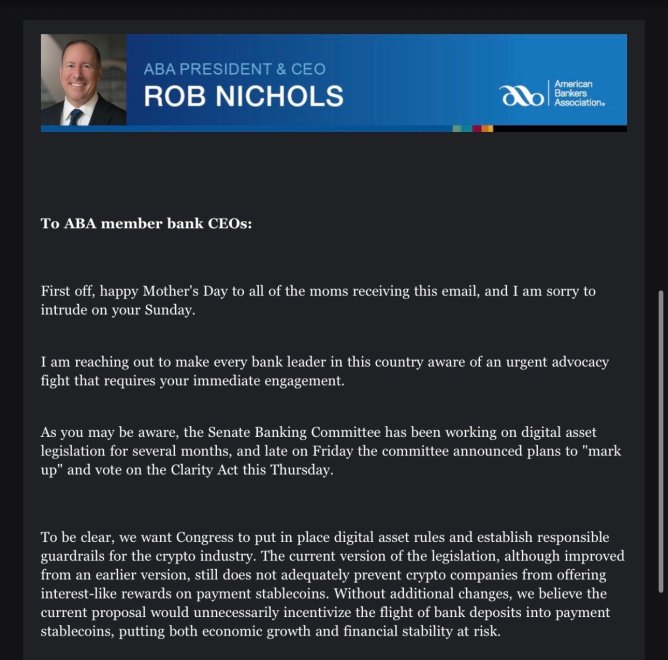
Nichols letter to bank executives. Source: Brendan Pedersen on X

However, he considers that the latest version of the bill “still does not adequately prevent crypto companies from offering interest-like rewards on payment stablecoins,” which would “unnecessarily incentivize the flight of bank deposits into payment stablecoins, putting both economic growth and financial stability at risk.”

“We believe the committee members may not be fully aware of the risks to the economy posed by the stablecoin loophole. Your immediate engagement can make a difference,” Nichols’ letter read.

For context, the latest version of the CLARITY Act prohibits any activity “economically or functionally equivalent to the payment of interest or yield on an interest-bearing bank deposit” on payment stablecoins.

Nonetheless, the text allows for payment of rewards tied to bona fide activities, including staking, transaction activity, or liquidity provision, aiming to promote a “buy and user” approach.

Last Friday, US banking trade groups, including ABA, sent a letter asking senators to amend the stablecoin yield compromise ahead of the markup, arguing that the language on the current version of the legislation still leaves room for rewards programs that could effectively replicate yield.

White House Crypto Advisor Slams CEOs For Skipping Yield Talks

Patrick Witt, executive director of the US President’s Council of Advisors on Digital Assets, fired back at Nichols and other banking industry CEOs for their recent push to revisit the Senate Banking Committee’s compromise on Stablecoin yield and rewards.

In an X post, Witt reacted to the recent letters, affirming that he had specifically requested that Nichols and other bank trade CEOs attend the White House’s meetings to mediate the stablecoin yield dispute, but that they refused.

As reported by Bitcoinist, the White House held multiple meetings to resolve the disagreement between the crypto and banking industries, which has delayed a vote on the legislation for four months.

Some reports at the time noted that no individual bank representatives attended the February meeting, but that the sector was represented through trade associations, including ABA, the Banking Policy Institute (BPI), and the Independent Community Bankers of America (ICBA).

“I guess the White House was beneath them?” the crypto advisor wrote on Monday. “In their defense, I wouldn’t want to have to defend their position in public either.”

Meanwhile, Senate sources have told journalist Eleanor Terret that the banking trade group effort was “pretty milquetoast,” adding that Committee members have already shifted their focus to wrapping up other outstanding issues in the bill, such as ethics language, which may complicate the sector’s efforts to reopen the debate.

“Still, the issue could resurface once the legislation reaches the Senate floor, where the banking groups may try to win over senators not on the Banking Committee,” Terret pointed out.
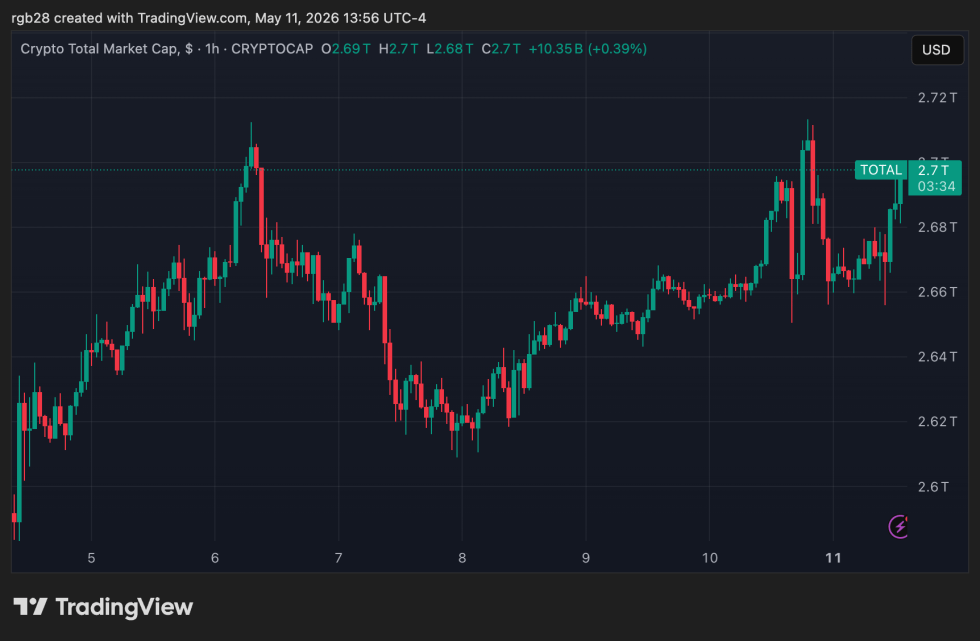
The total crypto market capitalization is at $2.7 trillion in the one-week chart. Source: TOTAL on TradingView


İlgili Sorular

QWhat is the main concern raised by ABA CEO Rob Nichols regarding the latest version of the CLARITY Act?

ARob Nichols's main concern is that the latest version of the bill does not adequately prevent crypto companies from offering interest-like rewards on payment stablecoins. He argues this could incentivize the flight of bank deposits into stablecoins, putting economic growth and financial stability at risk.

QHow did Patrick Witt, the White House crypto advisor, respond to the banking industry CEOs' efforts to revisit the stablecoin yield compromise?

APatrick Witt criticized the banking industry CEOs, noting that he had specifically requested they attend White House meetings to mediate the stablecoin yield dispute, but they refused. He suggested they avoided defending their position in public.

QWhat does the current text of the CLARITY Act allow regarding rewards on payment stablecoins?

AThe current text of the CLARITY Act prohibits activities economically equivalent to paying interest on bank deposits for payment stablecoins. However, it allows for rewards tied to bona fide activities such as staking, transaction activity, or liquidity provision.

QAccording to the article, what has delayed a vote on the crypto market structure legislation?

AA vote on the legislation has been delayed for four months due to the disagreement between the crypto and banking industries over the issue of stablecoin yields and rewards.

QWhat is the perspective of Senate sources, as reported by journalist Eleanor Terret, on the banking trade groups' latest effort?

ASenate sources described the banking trade group's effort as 'pretty milquetoast.' They added that Committee members have shifted focus to other outstanding issues in the bill, such as ethics language, which may complicate efforts to reopen the stablecoin debate.

İlgili Okumalar

How to Automate Any Workflow with Claude Skills (Complete Tutorial)

This is a comprehensive guide to mastering Claude Skills, a feature for creating permanent, reusable instruction sets that automate specific workflows. Unlike simple saved prompts, Skills function like trained employees, delivering consistent, high-quality outputs by defining the entire task process, standards, error handling, and output format. The guide is structured in four phases: **Phase 1: Installation (5 minutes).** Skills are folders containing a `SKILL.md` file. The user is instructed to find a relevant Skill online, install it, test it on a real task, and compare its performance to one-off prompts. **Phase 2: Building Your First Custom Skill.** Start by rigorously defining the Skill's purpose, trigger phrases, and providing a concrete example of perfect output. The `SKILL.md` file has two parts: a YAML frontmatter with a specific name/description/triggers, and a detailed, step-by-step workflow written in natural language with examples and quality standards. **Phase 3: Testing & Optimization for Production.** Test the Skill in three scenarios: 1) a standard, common task; 2) edge cases with missing or conflicting data; and 3) a pressure test with maximum complexity. Any failure indicates a needed instruction. Implement a weekly optimization cycle to continuously refine the Skill based on real usage. **Phase 4: Building a Complete Skill Library.** The goal is to create a team of Skills for all repetitive tasks. Examples are given for industries like real estate, marketing, finance, consulting, and e-commerce. The user should list their tasks, prioritize them, and build one new Skill per week, maintaining a master document to track their library. The conclusion emphasizes the compounding time savings: ten Skills saving 30 minutes each per week reclaims over 260 hours (6.5 work weeks) per year, fundamentally transforming one's work system.

marsbit10 dk önce

How to Automate Any Workflow with Claude Skills (Complete Tutorial)

marsbit10 dk önce

Dialogue with Vitalik, Xiao Feng, Aya Miyaguchi, and Joseph Chalom: From the 'Subtraction Principle' to the Agent Economy

Conversation with Vitalik Buterin, Xiao Feng, Aya Miyaguchi, and Joseph Chalom: Highlights from the Ethereum Application Summit on key future directions. Vitalik Buterin discussed the concept of "Full Stack Open Source Security," extending security from the protocol to hardware layers like wallets and chips. He predicted AI will simplify blockchain interaction, enabling natural language commands for complex operations. He emphasized that Ethereum's future focus should be on security, decentralization, and trustless infrastructure—the areas where it holds its core competitive edge. The fusion of AI, Fully Homomorphic Encryption (FHE), and blockchain is seen as crucial for real-world applications requiring privacy, such as healthcare. Xiao Feng underscored the importance of simplifying technology for mass adoption. He drew parallels to the evolution from command lines to GUIs and apps, suggesting that AI-driven natural language interfaces will be key to bringing more users into Web3. He stressed that while performance is important, Ethereum must continue to uphold its foundational principles of decentralization and user sovereignty. Aya Miyaguchi, Chair of the Ethereum Foundation, explained the evolving role of the Foundation through the "Principle of Subtraction." As the ecosystem matures, the EF is stepping back from areas where the community can take the lead, acting as one of many "gardeners" rather than a central driver. She highlighted that real applications are built on Ethereum's core values: censorship resistance, open source, security, and privacy. The concept of "Local-first" initiatives, like the Ethereum Applications Guild (EAG), was also emphasized for leveraging regional strengths to create global impact. Joseph Chalom, CEO of SharpLink, positioned Ethereum as the future infrastructure for global capital markets, differentiating it from Bitcoin through its "productivity" via staking yields. He envisioned the rise of an "Agent Economy" by 2027, where AI agents, powered by Web3 wallets, will autonomously manage financial tasks like yield optimization and RWA investments. The summit concluded that with core infrastructure maturing, the application layer is now the key driver for Ethereum's next phase of growth and real-world adoption.

marsbit11 dk önce

Dialogue with Vitalik, Xiao Feng, Aya Miyaguchi, and Joseph Chalom: From the 'Subtraction Principle' to the Agent Economy

marsbit11 dk önce

Cerebras IPO: A $48.8 Billion Valuation—Is the 'Nvidia Challenger' a Bubble or a New King?

Cerebras Systems, positioning itself as an NVIDIA challenger, is going public with a $48.8 billion valuation despite several underlying paradoxes revealed in its S-1 filing. While 2025 revenue grew 76% to $510M and GAAP net income was $237.8M, this profitability relies heavily on a one-time, non-cash accounting gain. Adjusting for this, the company's non-GAAP net loss actually widened to $75.7M. Furthermore, customer concentration remains extreme: 86% of 2025 revenue came from two Abu Dhabi-based entities, MBZUAI (62%) and G42 (24%). Its landmark deal with OpenAI, valued at over $20 billion, creates a complex, nested relationship where OpenAI is simultaneously a major customer, lender, warrant holder, and strategic partner with exclusivity clauses. Cerebras's technical edge in latency-sensitive AI inference is real, with its wafer-scale chip outperforming competitors in benchmarks. However, this advantage is confined to a specific niche, not the broader AI training market dominated by NVIDIA's CUDA ecosystem. With a 95x price-to-sales ratio, the valuation demands flawless execution of the OpenAI contract and massive future revenue growth. Key long-term risks include intense competition from giants like NVIDIA and AMD, a dual-class share structure granting insiders near-total voting control, and ongoing geopolitical uncertainties regarding export controls. The IPO is a pivotal capital markets event for AI infrastructure. As an investment, it represents a high-risk, high-reward bet on the "inference-first" narrative and Cerebras's ability to dominate its specialized segment, underpinned by a valuation that highlights the current fervor in the sector.

marsbit50 dk önce

Cerebras IPO: A $48.8 Billion Valuation—Is the 'Nvidia Challenger' a Bubble or a New King?

marsbit50 dk önce

İşlemler

Spot
Futures

Popüler Makaleler

HOUSE Nasıl Satın Alınır

HTX.com’a hoş geldiniz! Housecoin (HOUSE) satın alma işlemlerini basit ve kullanışlı bir hâle getirdik. Adım adım açıkladığımız rehberimizi takip ederek kripto yolculuğunuza başlayın. 1. Adım: HTX Hesabınızı OluşturunHTX'te ücretsiz bir hesap açmak için e-posta adresinizi veya telefon numaranızı kullanın. Sorunsuzca kaydolun ve tüm özelliklerin kilidini açın. Hesabımı Aç2. Adım: Kripto Satın Al Bölümüne Gidin ve Ödeme Yönteminizi SeçinKredi/Banka Kartı: Visa veya Mastercard'ınızı kullanarak anında Housecoin (HOUSE) satın alın.Bakiye: Sorunsuz bir şekilde işlem yapmak için HTX hesap bakiyenizdeki fonları kullanın.Üçüncü Taraflar: Kullanımı kolaylaştırmak için Google Pay ve Apple Pay gibi popüler ödeme yöntemlerini ekledik.P2P: HTX'teki diğer kullanıcılarla doğrudan işlem yapın.Borsa Dışı (OTC): Yatırımcılar için kişiye özel hizmetler ve rekabetçi döviz kurları sunuyoruz.3. Adım: Housecoin (HOUSE) Varlıklarınızı SaklayınHousecoin (HOUSE) satın aldıktan sonra HTX hesabınızda saklayın. Alternatif olarak, blok zinciri transferi yoluyla başka bir yere gönderebilir veya diğer kripto para birimlerini takas etmek için kullanabilirsiniz.4. Adım: Housecoin (HOUSE) Varlıklarınızla İşlem YapınHTX'in spot piyasasında Housecoin (HOUSE) ile kolayca işlemler yapın.Hesabınıza erişin, işlem çiftinizi seçin, işlemlerinizi gerçekleştirin ve gerçek zamanlı olarak izleyin. Hem yeni başlayanlar hem de deneyimli yatırımcılar için kullanıcı dostu bir deneyim sunuyoruz.

326 Toplam GörüntülenmeYayınlanma 2025.04.27Güncellenme 2025.04.27

HOUSE Nasıl Satın Alınır

Tartışmalar

HTX Topluluğuna hoş geldiniz. Burada, en son platform gelişmeleri hakkında bilgi sahibi olabilir ve profesyonel piyasa görüşlerine erişebilirsiniz. Kullanıcıların HOUSE (HOUSE) fiyatı hakkındaki görüşleri aşağıda sunulmaktadır.

活动图片