What’s next as GENIUS Act misses first major rulemaking deadline?

ambcrypto2026-07-18 tarihinde yayınlandı2026-07-18 tarihinde güncellendi

Özet

The GENIUS Act, the U.S. stablecoin framework passed in July 2027, has missed its first major rulemaking deadline. Regulators, including the Federal Reserve, were required to finalize rules by July 18, 2027, but none of the 10 related proposals have been officially completed. Six are past the comment period, while four remain open. Federal Reserve Chairman Kevin Warsh indicated final rules could be issued imminently. The banking industry has expressed concerns about the legislation creating an uneven playing field. Despite the regulatory delay, the stablecoin market has responded positively, with total supply growing from $250 billion to over $300 billion since the law's passage, and firms like Fidelity launching new offerings. Senator Bill Hagerty, a co-sponsor, hailed the act as a "watershed moment" for U.S. leadership in digital assets.

The U.S. stablecoin framework, the GENIUS Act, has hit the initial deadline of the 18th of July. Passed into law on the 18th of July 2027, the framework set multiple milestones for its progressive enactment.

For the first year after passage, regulators, including the Federal Reserve and the OCC, were mandated to finalize rulemakings for the GENIUS Act by the 18th of July, 2027.

In 18 months, or by January 2027, the framework should begin taking effect after the regulators publish final rules.

Finally, the transition period will end after three years, by mid-2028. After this, there will be no firm allowed to offer or handle stablecoins in the U.S. without GENIUS Act compliance.

Why are the final rules delayed?

Six regulators have issued 10 rulemaking proposals related to the law. But none of the proposals have been officially completed, at least as of writing. Only six of the proposals have closed their comment period, meaning the regulators could issue final rulings for them.
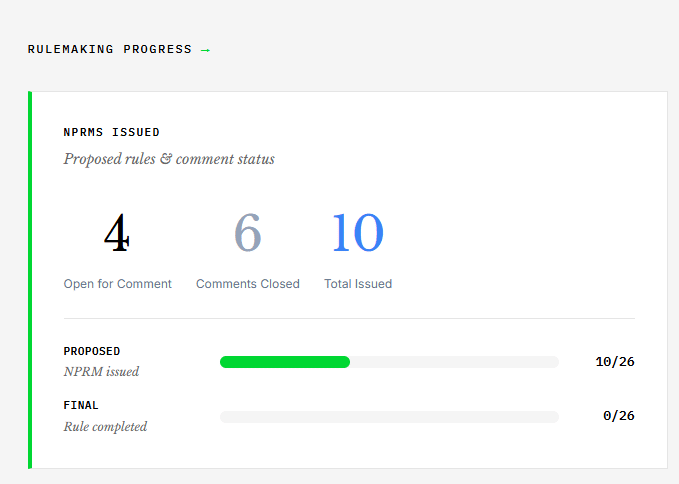
Source: Paradigm

Still, four other proposals, including Bank Secrecy Act and sanction compliance for FDIC-supervised stablecoin issuers, are still open for comment.

In other words, despite hitting the rulemaking deadline, the GENIUS Act was still far from finalizing key rules.

What’s next for the GENIUS Act?

However, it’s worth noting that in a recent Congress hearing, Kevin Warsh, the chairman of the Federal Reserve, said that the final rules could be issued soon.

We’re racing to put that out (GENIUS Act final rules) by this deadline, this Saturday.

For the banking industry, which has opposed the legislation due to the stablecoin yield loophole, it called for a review of the proposed rules to avoid.

Uneven playing field or opportunities for regulatory arbitrage, unintended policy consequences, or unworkable or incongruous requirements.

How has the stablecoin market responded?

The GENIUS Act is the first formal stablecoins framework in the U.S that aims to advance innovation and protect consumers. To achieve this, it has reserve requirements and anti-money laundering provisions.

Commenting on the legislation, Senator Bill Hagerty, who co-sponsored it, said,

The United States has the first comprehensive federal framework for payment stablecoins, positioning America not just to participate in the digital asset economy, but to lead it. It was a watershed moment, and it’s only the beginning.
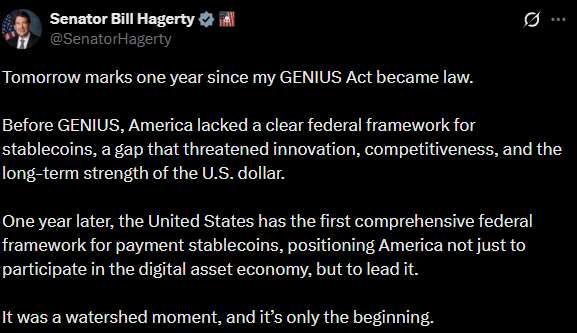
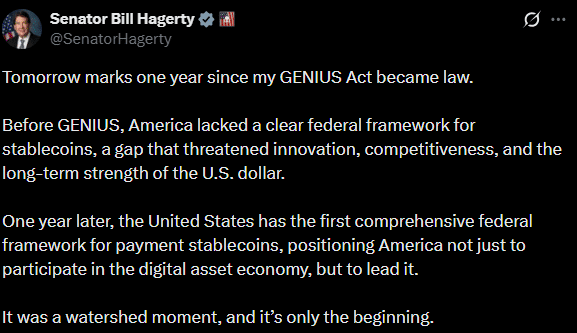
Source: X

Since the law, the stablecoin market supply surged from $250B to over $300B. Even several firms like Fidelity have begun their stablecoin offerings.

Additionally, some crypto platforms like Phantom recorded a 20% increase in stablecoin balance from $2.33B to $2.82B since the GENIUS Act was passed.

It remains to be seen how the growth will accelerate when regulators publish final rules as the legislation enters its second year.


Final SummaryThe

  • GENIUS Act has entered its second year, but final rules will likely stretch beyond the rulemaking deadline
  • Stablecoin market supply increased by over $50B after legislation became law, with Sen. Hagerty calling ‘watershed moment’


Trend Kriptolar

İlgili Sorular

QWhat is the first major rulemaking deadline that the GENIUS Act has missed, and who was responsible for meeting it?

AThe first major rulemaking deadline was July 18, 2027. Regulators, including the Federal Reserve and the OCC, were mandated to finalize rules for the GENIUS Act by this date, but none of the proposals have been officially completed.

QAccording to the article, what are two key reasons why the final rules for the GENIUS Act have been delayed?

ATwo reasons for the delay are: 1) Only six out of ten rulemaking proposals have closed their comment period, meaning regulators could only potentially issue final rules for those. 2) Four proposals, including those on Bank Secrecy Act and sanction compliance for FDIC-supervised issuers, are still open for comment.

QWhat specific market impact has the passage of the GENIUS Act had on the stablecoin sector?

ASince the GENIUS Act became law, the stablecoin market supply has surged from $250 billion to over $300 billion, an increase of over $50 billion. Firms like Fidelity have launched stablecoin offerings, and platforms like Phantom saw a 20% increase in stablecoin balances.

QWhat did Federal Reserve Chairman Kevin Warsh recently indicate about the timing of the final rules for the GENIUS Act?

AIn a recent Congress hearing, Federal Reserve Chairman Kevin Warsh said that the final rules could be issued soon, stating, "We're racing to put that out (GENIUS Act final rules) by this deadline, this Saturday."

QWhat is the banking industry's primary concern regarding the GENIUS Act, as mentioned in the article?

AThe banking industry opposes the legislation due to the stablecoin yield loophole. They have called for a review of the proposed rules to avoid an uneven playing field, opportunities for regulatory arbitrage, unintended policy consequences, or unworkable requirements.

İlgili Okumalar

China Monopolizes the Humanoid Market: The U.S. Is Forced to Defend Itself

China's Humanoid Robot Market Domination and US Response According to a report by Smart Analytics Global (SAG), Chinese manufacturers supplied over 97% of the global humanoid robot shipments (approximately 19,100 units) in the first half of 2026, a 272% year-on-year increase. Shanghai-based AGIBOT led with a 44% market share, followed by Unitree Robotics with 31%. Together, these two firms accounted for about 75% of global shipments. China itself represented over 85% of global demand for these devices, with industrial and commercial applications now comprising more than 70% of shipments. Key factors driving China's leadership include strong state support, abundant funding, expanding production capacity, IPO waves for developers, and a vast manufacturing ecosystem for rapid testing and deployment. Furthermore, over 90% of key components for humanoid robots are now sourced domestically. In response, the US Federal Communications Commission (FCC) banned federal agencies and subsidy recipients from purchasing or using foreign "advanced robotic devices," including humanoid and quadruped robots, citing national security concerns in July 2026. SAG forecasts global shipments to approach 60,000 units for full-year 2026, with industry revenue around $1.6 billion, projecting 500,000 units by 2030. The analysis notes potential challenges for Chinese expansion, such as reputational risks from alleged ties to China's defense sector and the precedent of trade disputes seen in solar panels and batteries, potentially triggered by the current low average robot price.

cryptonews.ru10 dk önce

China Monopolizes the Humanoid Market: The U.S. Is Forced to Defend Itself

cryptonews.ru10 dk önce

What's New in Ethereum's Roadmap: Privacy, Quantum Security, Native Rollup?

On August 10, 2024, Ethereum co-founder Vitalik Buterin revealed an updated technical roadmap, highlighting significant changes in priorities and new focus areas. Key new additions include: - **Strong Privacy Protection**: Elevated to a top-tier protocol concern. Proposals like EIP-8250 (keyed nonces for concurrency), EIP-8272 (recent roots for verification), and EIP-8182 (shared protocol-level privacy pools) aim to enable private transfers of ETH and ERC-20s, moving toward default private accounts. - **Quantum Resilience**: Priority increased. The plan addresses risks to ECDSA/BLS signatures, KZG commitments, and ZK systems, exploring solutions like leanSPHINCS signatures, STARK proofs (considered quantum-resistant), and streamlined verification processes. A full L1 upgrade is tentatively targeted for ~2029. - **Native Rollups**: A novel concept where rollups could reuse Ethereum's core validation infrastructure via a new EXECUTE precompile (EIP-8079 draft). This aims to reduce custom code and enhance security for certain L2s, while specialized chains will continue to exist. - **Protocol Simplification & Formal Verification**: Leveraging AI tools to make full-protocol formal verification feasible, aiming for more rigorous and machine-verifiable specifications. Other notable shifts: - State storage is evolving from Verkle trees to a Partitioned Binary Tree (PBT, EIP-8347 draft). - Some 2023 items like VDFs and certain EVM improvements were deprioritized. - Long-term discussions include blob/gas futures and non-EVM instruction sets (e.g., RISC-V). The "Strawmap" outlines potential upgrades through ~2029 but is a directional guide, not a firm timeline. Key milestones to watch include the Glamsterdam (Q4 2026) and Hegotá (2027) forks. Many proposals remain in draft or research phases.

marsbit31 dk önce

What's New in Ethereum's Roadmap: Privacy, Quantum Security, Native Rollup?

marsbit31 dk önce

Hyperliquid Trading Volume Soars, So Why Are Profits Falling?

Hyperliquid, a leading decentralized perpetuals trading platform, has seen its open interest surge to a record high above $11 billion, capturing roughly 9% of the global market share. Trading volume remains robust, nearing $178 billion over 30 days, driven largely by the explosive growth of third-party markets offering tokenized real-world assets (RWAs) like stocks and commodities. Despite this growth, the platform's protocol revenue has declined for four consecutive quarters, falling 43% from its Q3 2025 peak of $357 million to approximately $202 million in Q2 2026. This divergence is primarily attributed to the HIP-3 governance proposal, which allows external developers to launch their own markets and keep up to half of the generated fees. These third-party markets now account for nearly 50% of total volume. Consequently, the share of revenue redistributed to developers, market makers, and the treasury has tripled from 6% to 18% in a year. This directly reduces the funds allocated to the platform's buyback-and-burn mechanism for its native HYPE token, weakening a key price support. HYPE's price has fallen 28% from its all-time high. The platform's growth is also heavily concentrated, with a single entity, Trade.xyz, responsible for over 90% of HIP-3 open interest, introducing systemic risk. Additionally, the ecosystem lacks diversity beyond HYPE, faces ongoing token unlocks adding sell pressure, and is encountering increased regulatory scrutiny and new competition from platforms like Robinhood Chain. While still a major revenue generator in crypto, Hyperliquid's model of sharing fees to fuel expansion is currently compressing its own earnings and token economics.

marsbit31 dk önce

Hyperliquid Trading Volume Soars, So Why Are Profits Falling?

marsbit31 dk önce

İşlemler

Spot

Popüler Makaleler

GENIUS Nasıl Satın Alınır

HTX.com’a hoş geldiniz! Genius (GENIUS) satın alma işlemlerini basit ve kullanışlı bir hâle getirdik. Adım adım açıkladığımız rehberimizi takip ederek kripto yolculuğunuza başlayın. 1. Adım: HTX Hesabınızı OluşturunHTX'te ücretsiz bir hesap açmak için e-posta adresinizi veya telefon numaranızı kullanın. Sorunsuzca kaydolun ve tüm özelliklerin kilidini açın. Hesabımı Aç2. Adım: Kripto Satın Al Bölümüne Gidin ve Ödeme Yönteminizi SeçinKredi/Banka Kartı: Visa veya Mastercard'ınızı kullanarak anında Genius (GENIUS) satın alın.Bakiye: Sorunsuz bir şekilde işlem yapmak için HTX hesap bakiyenizdeki fonları kullanın.Üçüncü Taraflar: Kullanımı kolaylaştırmak için Google Pay ve Apple Pay gibi popüler ödeme yöntemlerini ekledik.P2P: HTX'teki diğer kullanıcılarla doğrudan işlem yapın.Borsa Dışı (OTC): Yatırımcılar için kişiye özel hizmetler ve rekabetçi döviz kurları sunuyoruz.3. Adım: Genius (GENIUS) Varlıklarınızı SaklayınGenius (GENIUS) satın aldıktan sonra HTX hesabınızda saklayın. Alternatif olarak, blok zinciri transferi yoluyla başka bir yere gönderebilir veya diğer kripto para birimlerini takas etmek için kullanabilirsiniz.4. Adım: Genius (GENIUS) Varlıklarınızla İşlem YapınHTX'in spot piyasasında Genius (GENIUS) ile kolayca işlemler yapın.Hesabınıza erişin, işlem çiftinizi seçin, işlemlerinizi gerçekleştirin ve gerçek zamanlı olarak izleyin. Hem yeni başlayanlar hem de deneyimli yatırımcılar için kullanıcı dostu bir deneyim sunuyoruz.

600 Toplam GörüntülenmeYayınlanma 2026.04.29Güncellenme 2026.06.02

GENIUS Nasıl Satın Alınır

Tartışmalar

HTX Topluluğuna hoş geldiniz. Burada, en son platform gelişmeleri hakkında bilgi sahibi olabilir ve profesyonel piyasa görüşlerine erişebilirsiniz. Kullanıcıların GENIUS (GENIUS) fiyatı hakkındaki görüşleri aşağıda sunulmaktadır.

活动图片