What happened in crypto today: Hormuz tensions, oil prices impact the market

ambcrypto2026-03-23 tarihinde yayınlandı2026-03-23 tarihinde güncellendi

Özet

Trump’s 48-hour ultimatum over the Strait of Hormuz triggered a crypto market downturn, reinforcing Bitcoin’s role as a macro stress outlet. BTC swung between $68,265 and $71,051 before settling near $69,195, down 2.2%, with over $123 million in liquidations. Ethereum fell 2.1%, and the Fear and Greed Index dropped to 9, indicating rising fear. The sell-off spread to altcoins like XRP and SOL, with total market cap falling to $2.37 trillion. Bitcoin dominance rose to 58.2%, showing a defensive shift into BTC rather than altcoins. Spot Bitcoin ETFs saw $163 million in outflows on March 18, reversing prior inflows, though cumulative inflows remain above $56 billion. The market appears reactive, with fragile liquidity and no significant new capital entering.

Trump’s 48-hour ultimatum over the Strait of Hormuz quickly spilled into crypto, reinforcing Bitcoin’s [BTC] role as the first macro stress outlet. Within hours, BTC swung between $68,265 and $71,051 before settling near $69,195, down 2.2%.

In fact, this sharp range expansion signals rapid repricing rather than stable demand. At the same time, liquidations surged to over $300 million, an 80% increase, with over $123 million from BTC, indicating that forced unwinds dominated price action.
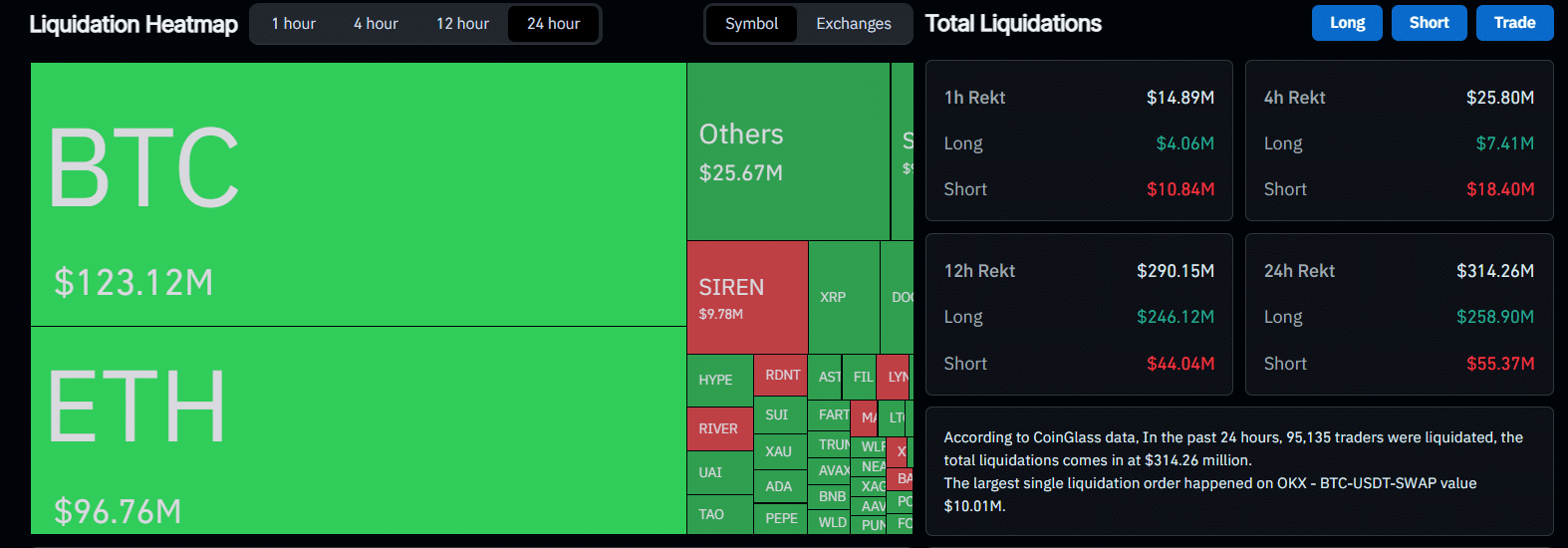
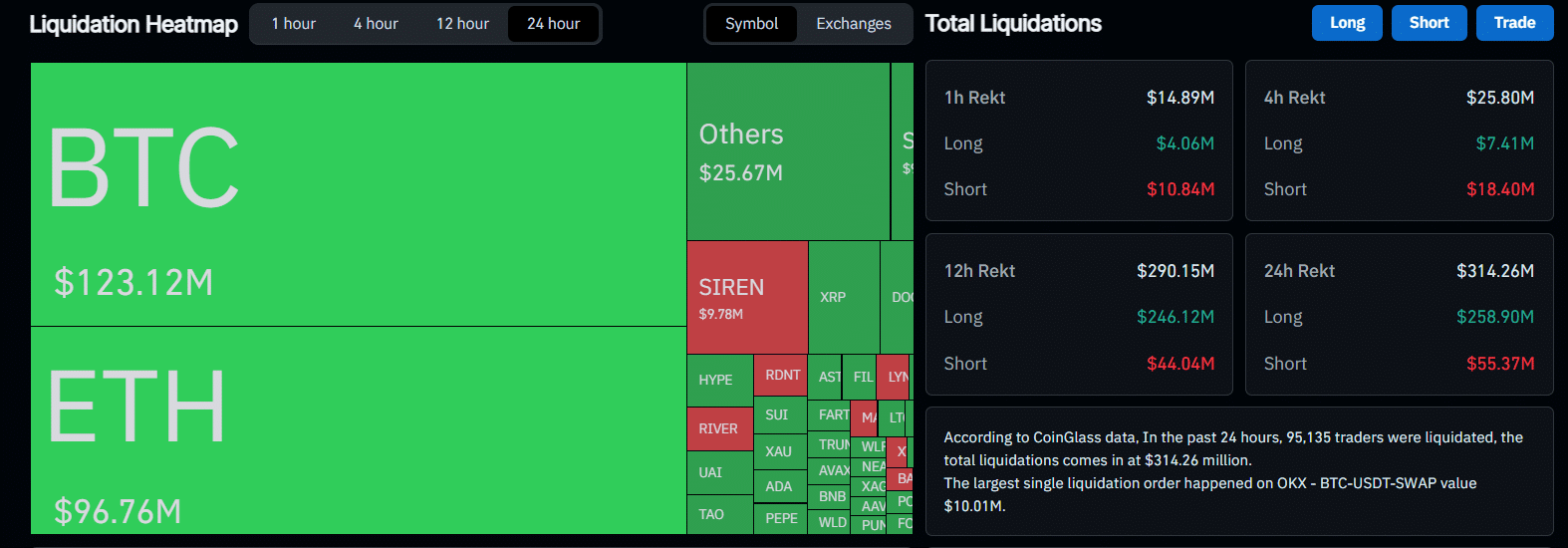
Source: CoinGlass

Meanwhile, Ethereum [ETH] fell 2.1%, confirming broad risk sensitivity. As volatility increased, the Fear and Greed Index dropped to 9, while shorts rose to 51.7%.

This setup implies that traders are shifting toward protection rather than accumulation, which suggests fragile liquidity and a market driven more by reaction than conviction.

Market-wide correction unfolds in tandem

Bitcoin’s drop set off a broader reaction, as altcoins moved lower in tandem but with varying intensity. Ethereum fell 3.01% to $2,091, while Ripple [XRP] dropped 3.04% and Solana [SOL] declined 2.86%, showing coordinated but uneven pressure.

In fact, this spread highlights how altcoins amplify downside when liquidity tightens, yet still track Bitcoin’s direction closely. Meanwhile, total market cap slipped to $2.37 trillion, signaling capital outflows, although not a full breakdown in structure.

At the same time, the CoinMarketCap 20 Index fell 2.5%, confirming broad weakness across large caps. This setup implies risk appetite is softening, while capital becomes more selective, meaning altcoins remain vulnerable but can stabilize quickly if Bitcoin regains momentum.

Bitcoin reflects macro stress amid oil-driven risks

As Hormuz tensions intensified, Bitcoin remained aligned with risk assets, not a safe-haven shift. Bitcoin dominance rose to 58.2%, up 0.27%, signaling rotation into BTC over altcoins rather than broad inflows.

This reflects defensive positioning within crypto, not renewed risk appetite. Meanwhile, ETF flows reflected shifting conviction across the market. On the 17th of March, Spot Bitcoin ETFs recorded $199 million in net inflows.

However, this trend quickly reversed. On the 18th of March, flows flipped to $163 million in outflows, signaling short-term uncertainty.

Even so, cumulative inflows still exceed $56 billion. As a result, underlying institutional interest continues to persist despite recent fluctuations.

As the price holds near $68,700–$69,000, stability appears conditional rather than strong. At the same time, stablecoin supply shows no sharp expansion, indicating limited fresh liquidity entering the market.


İlgili Sorular

QWhat was the immediate impact of Trump's 48-hour ultimatum over the Strait of Hormuz on the cryptocurrency market?

AThe news caused Bitcoin's price to swing between $68,265 and $71,051, ultimately settling near $69,195 with a 2.2% drop, and triggered over $300 million in liquidations.

QHow did the broader altcoin market react to Bitcoin's price drop?

AAltcoins moved lower in tandem, with Ethereum falling 3.01%, Ripple (XRP) dropping 3.04%, and Solana (SOL) declining 2.86%, showing coordinated but uneven pressure.

QWhat did the rise in Bitcoin dominance to 58.2% signify about market sentiment?

AIt signaled a defensive rotation of capital into Bitcoin over altcoins, reflecting risk-off positioning within crypto rather than a broad shift into crypto as a safe-haven or renewed overall risk appetite.

QWhat was the trend in Spot Bitcoin ETF flows around March 17th and 18th?

ANet inflows of $199 million were recorded on March 17th, but this quickly reversed to $163 million in outflows on March 18th, indicating short-term uncertainty among investors.

QWhat does the lack of a sharp expansion in stablecoin supply indicate about the market?

AIt suggests that there is limited fresh liquidity entering the cryptocurrency market, meaning recent price action is more driven by existing capital repositioning than by new money flowing in.

İlgili Okumalar

Dylan Patel: Founder of SemiAnalysis, Praised by Jensen Huang, is a 'Beekeeper' and 'Forum Enthusiast'

Dylan Patel, founder of the independent research firm SemiAnalysis, has an unconventional background. A former beekeeper from rural Georgia, he entered the semiconductor world as a self-taught "forum warrior," discussing chip technology anonymously online from a young age. He launched the SemiAnalysis blog in May 2020, which later transitioned to a paid subscription model. The firm has grown from a one-person operation to a global team of around 60, with a dedicated teardown lab. Its detailed, technically-focused analysis on semiconductor supply chains, AI infrastructure, and products has earned significant industry recognition. Notably, NVIDIA founder Jensen Huang has publicly cited their reports. In a landmark case, a critical 2024 report on AMD's MI300X GPU software stack led to a 90-minute call with AMD CEO Lisa Su, who thanked him for the constructive feedback. SemiAnalysis later acknowledged AMD's improvements. The firm's influence on markets was seen when a report on NVIDIA's Rubin memory configuration was partially shared, affecting memory stock prices. Dylan Patel emphasized the importance of context, contrasting the shared excerpt with the report's actual title. SemiAnalysis, now a multi-faceted consultancy with revenue projected to reach $100 million, is known for its deep technical insights that influence major industry players and investment decisions.

marsbit37 dk önce

Dylan Patel: Founder of SemiAnalysis, Praised by Jensen Huang, is a 'Beekeeper' and 'Forum Enthusiast'

marsbit37 dk önce

Dylan Patel: SemiAnalysis, Praised by Jensen Huang, is Founded by a 'Beekeeper and Forum Warrior'

Dylan Patel, founder of the independent research firm SemiAnalysis, has an unconventional background. Growing up in rural Georgia, he later worked as a beekeeper in Minnesota. His entry into semiconductors began as a self-taught "forum warrior," engaging anonymously in online tech communities from a young age. In May 2020, he started the SemiAnalysis blog on WordPress, later moving it to Substack as a paid subscription service. The firm has since evolved from a one-person operation into a global company with around 60 employees, featuring a dedicated chip teardown lab. Its revenue, reaching $20 million last year, is projected to surpass $100 million this year. SemiAnalysis is highly regarded in the AI and semiconductor industry for its deep technical analysis. NVIDIA founder Jensen Huang has publicly praised its reports. In a notable instance, a critical report on AMD's MI300X GPU software shortcomings prompted a 90-minute call with CEO Lisa Su, who thanked Patel for the "constructive feedback." A later report acknowledged AMD's subsequent improvements. The firm's analyses have significant market impact. For example, a June report discussing potential memory configuration changes in NVIDIA's next-generation servers was cited as a factor in pressure on memory-related stocks. Patel plans to establish a venture capital firm, having already made personal investments in about 20 startups. SemiAnalysis combines roles as a consultancy, model platform, and tech lab, focusing on the practical bottlenecks in AI infrastructure.

Odaily星球日报42 dk önce

Dylan Patel: SemiAnalysis, Praised by Jensen Huang, is Founded by a 'Beekeeper and Forum Warrior'

Odaily星球日报42 dk önce

Ethereum Q1 Report: On-chain Activity Hits Record High, Tokenized Assets Lead the Industry

Ethereum Q1 2026 Report: On-chain activity hits record high, tokenized assets lead the industry. In Q1 2026, Ethereum's network experienced a unique divergence: on-chain activity soared while USD-denominated metrics declined. Monthly active users reached 13.2 million, transactions hit 200.4 million, and TPS averaged 25.78, all setting new highs. However, total value locked (TVL) fell 11.0% to $316.2B, DEX volume dropped 24.0% to $134.5B, and ETH's fully diluted market cap fell 30.3% to $290B. A key driver was the Blob Parameter Fork (BPO#2) in January, which increased data capacity and caused a sharp 47.9% drop in layer-1 transaction fees despite higher usage. Etherean's tokenized asset market cap reached $203.4B, up 42.9% year-over-year. While stablecoins ($178.9B) saw a slight dip, tokenized funds ($19.4B, +73.1% YoY), commodities ($4.7B, +325.9% YoY), and stocks ($365.1M) grew strongly. Ethereum dominates cross-chain comparisons, holding 71% of TVL, 79.2% of active loans, 61.8% of stablecoins, and 73% of tokenized funds among top chains. The report highlights a "Jevons Paradox" scenario: network expansion reduces per-transaction costs but unleashes latent demand, driving long-term growth. Ethereum's strategy mirrors Amazon's early focus on scale over profit. Its open, neutral foundation is seen as critical for institutional adoption, as evidenced by growing activity from firms like BlackRock and JPMorgan. The roadmap targets further scalability, aiming for thousands of TPS by 2029 to solidify its role as a global financial settlement layer.

marsbit45 dk önce

Ethereum Q1 Report: On-chain Activity Hits Record High, Tokenized Assets Lead the Industry

marsbit45 dk önce

İşlemler

Spot
Futures
活动图片