Gold Reaches Two-Month High, Exceeding $4,400, Amid Continued Accumulation of Reserves by China

cryptonews.ru2026-08-11 tarihinde yayınlandı2026-08-11 tarihinde güncellendi

Özet

Gold prices soared to over $4,400, hitting a two-month high, driven primarily by a weak U.S. jobs report and sustained gold accumulation by China. The July employment data, showing a loss of 23,000 jobs against expectations of an 80,000 gain, shifted market expectations away from near-term Federal Reserve rate hikes. This pushed Treasury yields down, boosting gold's appeal as a non-yielding asset. Technically, gold broke above its 100-day moving average, attracting new buyers. China provided further support, with the People's Bank of China extending its gold-buying streak to 21 months by adding roughly 20 tons in July. This consistent central bank demand, valued for gold's sovereignty from other governments, has underpinned prices. Geopolitical tensions in the Middle East, particularly involving the U.S. and Iran near the Strait of Hormuz, added a safe-haven bid. Analysts like Peter Schiff noted gold breaking its recent negative correlation with oil, suggesting both could rise together on inflation fears amid economic weakening. The rally's sustainability hinges on upcoming U.S. inflation data. A softer CPI could fuel further gains toward $4,500, while hotter data could reverse the rally by strengthening the dollar and yields.

The price of gold rose to approximately $4,434–$4,435 before sellers finally entered the game. By 1:00 PM Eastern Time (EDT) on Tuesday, August 11, the spot price of gold was $4,382.43, putting the market in wait-and-see mode for a breakout.

Disappointing Jobs Report Overturns Fed Expectations

The spark was the U.S. July jobs report. The economy lost 23,000 jobs, while economists had expected about 80,000 new jobs, and significant downward revisions made the previous months' figures substantially weaker.

This labor market miss quickly shifted expectations regarding Federal Reserve policy. Traders scaled back bets on another near-term rate hike, which led to a decline in Treasury yields and gave gold fresh arguments against interest-bearing assets.

Holding gold does not generate income, so rising yields are one of the most reliable factors pressuring the gold price. When yields fall, this disadvantage becomes less significant, and capital has fewer reasons to stay in bonds and cash.
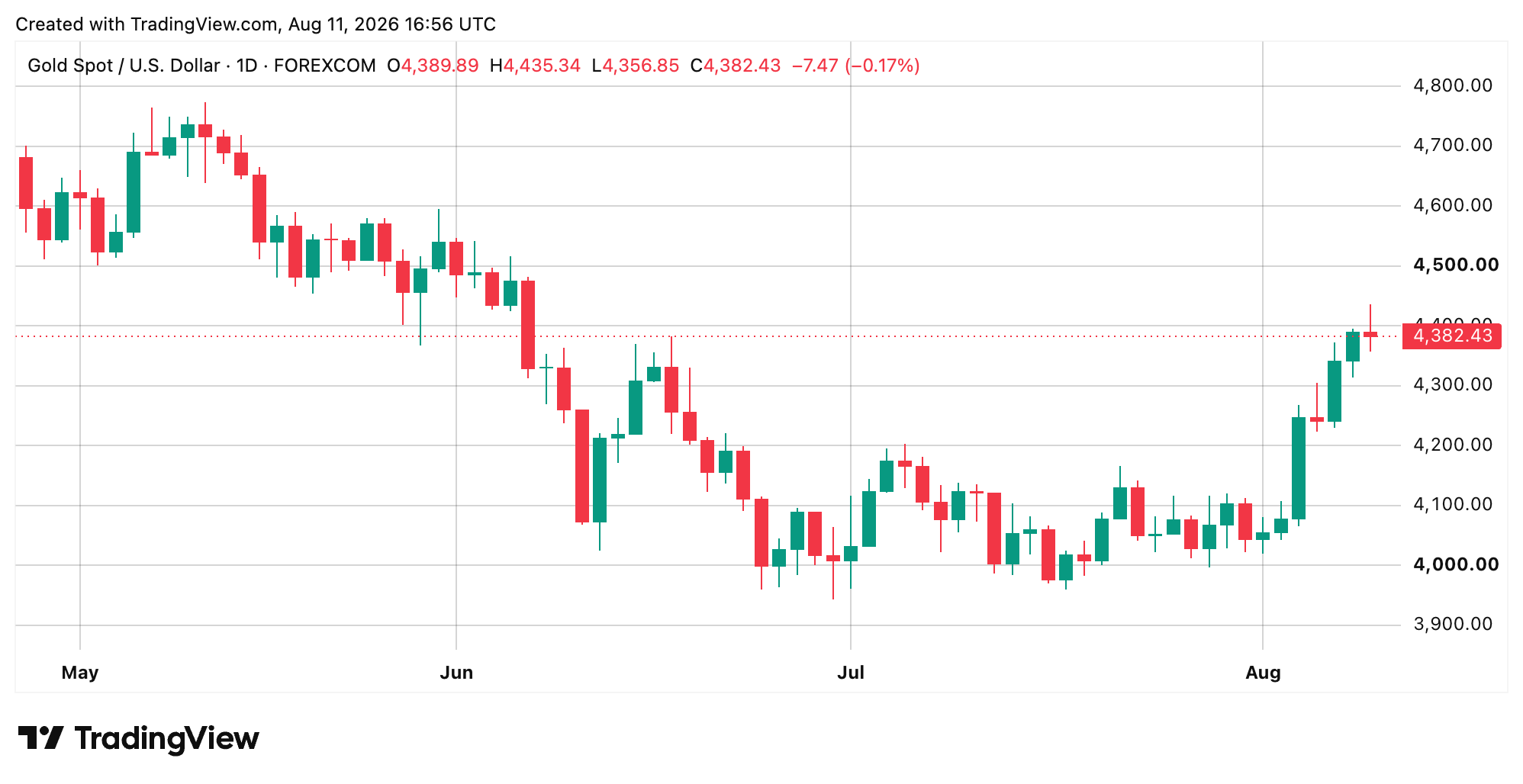
Gold Chart on August 11, 2026, at 1:00 PM Eastern Time (EDT).

The price rise also allowed gold to decisively break through the 100-day moving average—a technical indicator that traders closely watch. Breaking this barrier attracted new buyers to the market after the price of gold had tumbled to $3,966 during the summer correction.

China Continues to Accumulate Gold

Another powerful supporting factor was China. In July, the People's Bank of China extended its gold-buying campaign to 21 consecutive months, purchasing about 20 metric tons, or roughly 640,000 ounces.

By the end of July, China's official gold reserves had grown to approximately 76.08 million ounces. Chinese gold-backed exchange-traded funds also attracted new investments, leading to increased investor demand in addition to the central bank's persistent accumulation.

Central banks value gold for its independence from other governments or currency issuers. This steady institutional demand has repeatedly provided support for prices, even when a strengthening U.S. dollar should have exerted more downward pressure on gold prices.

Geopolitical Risks Keep Buyers in the Market

Ongoing tensions between the U.S. and Iran added another reason to keep gold on hand, especially since a conflict in the Strait of Hormuz could disrupt global oil supplies and rekindle inflation fears.

As a result, gold finds itself in the familiar situation of dual pressures. Expensive oil could revive inflation and lead to tighter monetary policy, which would hurt the gold price, while geopolitical instability simultaneously sends safe-haven capital rushing straight to the metal. Gold advocate and economist Peter Schiff believes this trend will continue.

"Gold and silver prices rose today alongside a 5% rise in oil prices," Schiff wrote on social media platform X. "The metals are shedding the recently established negative correlation with oil. Gold and oil should rise together as inflation pushes the consumer price index and bond yields higher, while the U.S. economy weakens as jobs are cut."

In another post on X, Schiff continued:

"Gold is now above $4,400. Silver is approaching $66. The market is signaling something to you. Are you listening?"

Inflation Data Could Either Bolster or Derail the Rally

The next decisive moment will be the U.S. inflation data. A more moderate Consumer Price Index (CPI) could further weaken the case for Fed tightening and give gold another chance to turn the recent breakout zone into sustainable support.

Higher readings could quickly unravel this situation, pushing Treasury yields and the U.S. dollar higher. Traders are now watching the $4,500 level and gold's 200-day moving average to see whether this recovery will continue or become another failed breakout after a rapid rally.

end-content

İlgili Sorular

QWhat was the key factor that triggered the recent rise in gold prices according to the article?

AThe key trigger was the disappointing U.S. July employment report, which showed a loss of 23,000 jobs against expectations of a gain, leading traders to scale back expectations for near-term Fed rate hikes.

QHow has China's behavior contributed to the support for gold prices?

AChina's central bank has extended its gold-buying campaign for 21 consecutive months, purchasing around 20 tons in July. Official reserves have grown to approximately 76.08 million ounces, providing consistent institutional demand.

QWhat technical level did gold break through, attracting new buyers to the market?

AGold confidently broke through the 100-day moving average, a key technical indicator watched by traders, attracting new buyers after a summer correction.

QWhat geopolitical risk is mentioned as a reason for investors to hold gold?

AOngoing U.S.-Iran tensions in the Strait of Hormuz region are cited, as a potential disruption to global oil supplies could reignite inflation fears and drive safe-haven capital into gold.

QAccording to the article, what upcoming U.S. data could either reinforce or derail the gold rally?

AUpcoming U.S. inflation (CPI) data is the next critical test. A more moderate CPI could weaken the case for Fed tightening, while higher figures could push Treasury yields and the dollar up, threatening the rally.

İlgili Okumalar

Weak US Employment and $1.1 Billion into ETFs: Wintermute on the New Rally and Inflation Risks

Analysts at Wintermute stated that the cryptocurrency market gained support following a weak U.S. jobs report. Against this backdrop, U.S. spot Bitcoin and Ethereum ETFs collectively attracted $1.1 billion in inflows over the week. While demand via ETFs has recovered, there is insufficient data to confirm a sustainable shift in market sentiment. U.S. spot Bitcoin ETFs saw inflows of $853.5 million over five sessions, the best weekly result since mid-April. Ethereum ETFs attracted another $244.9 million, marking a fifth consecutive positive week. Over 80% of the inflows into both groups went to BlackRock. Wintermute notes that relatively restrained trading volumes may indicate large investors gradually building positions rather than short-term capital rotation. A disappointing U.S. employment report for July, which showed a loss of 23,000 jobs versus an expected gain of 80,000, led markets to reduce the probability of a Federal Reserve rate hike in September. This supported risk assets, including crypto. However, Wintermute cautions that the upcoming U.S. Consumer Price Index report on August 12 poses a key test. Higher-than-expected inflation could revive rate hike fears above 50%, risking a reversal of the recent rally. Beyond ETFs, institutional adoption of blockchain infrastructure continues, exemplified by Wells Fargo's planned launch of tokenized deposits. Wintermute views this as banks modernizing their settlement systems, which could eventually support broader digital asset integration. The firm concludes that while the ETF inflows are a positive signal, one week is not enough to confirm a durable trend, and the market remains highly sensitive to macroeconomic data, particularly inflation.

cryptonews.ru35 dk önce

Weak US Employment and $1.1 Billion into ETFs: Wintermute on the New Rally and Inflation Risks

cryptonews.ru35 dk önce

İşlemler

Spot
活动图片