What Exactly Is a16z's 'New Media'? New Media Is a Migration of Power

marsbit2026-01-23 tarihinde yayınlandı2026-01-23 tarihinde güncellendi

Özet

The article explores a16z's concept of "new media," arguing it represents a fundamental shift in power dynamics rather than just new content formats. It posits that in an era of content oversupply and near-zero distribution costs, attention and trust have become the new scarcities. The core value is no longer mere exposure but the ability to influence decisions—termed "agency"—the power to make others act based on your judgment. The piece contrasts old media (centralized, institution-owned, creators as employees) with new media (decentralized, individual-as-node, creators building direct influence). This transforms media from an institutional asset into personal capital and a tool of power. a16z treats this media capability as core infrastructure, recognizing that the traditional model of "capital → company → market" has flipped. Now, "agency → community → market → capital" is key, as capital alone no longer guarantees action. The article concludes by introducing Internet Capital Markets (ICM) as the next evolution, solving new media's flaw by turning influence and consensus into tradable, ownable capital structures—moving from "right to distribute" to "right to price." The ultimate leverage shifts from code to new media: scalable narrative, judgment, and taste.

Original Author: Julie Chen(@0xJuliechen)

a16z raised $1.5 billion. What exactly is the 'new media' they are betting on?

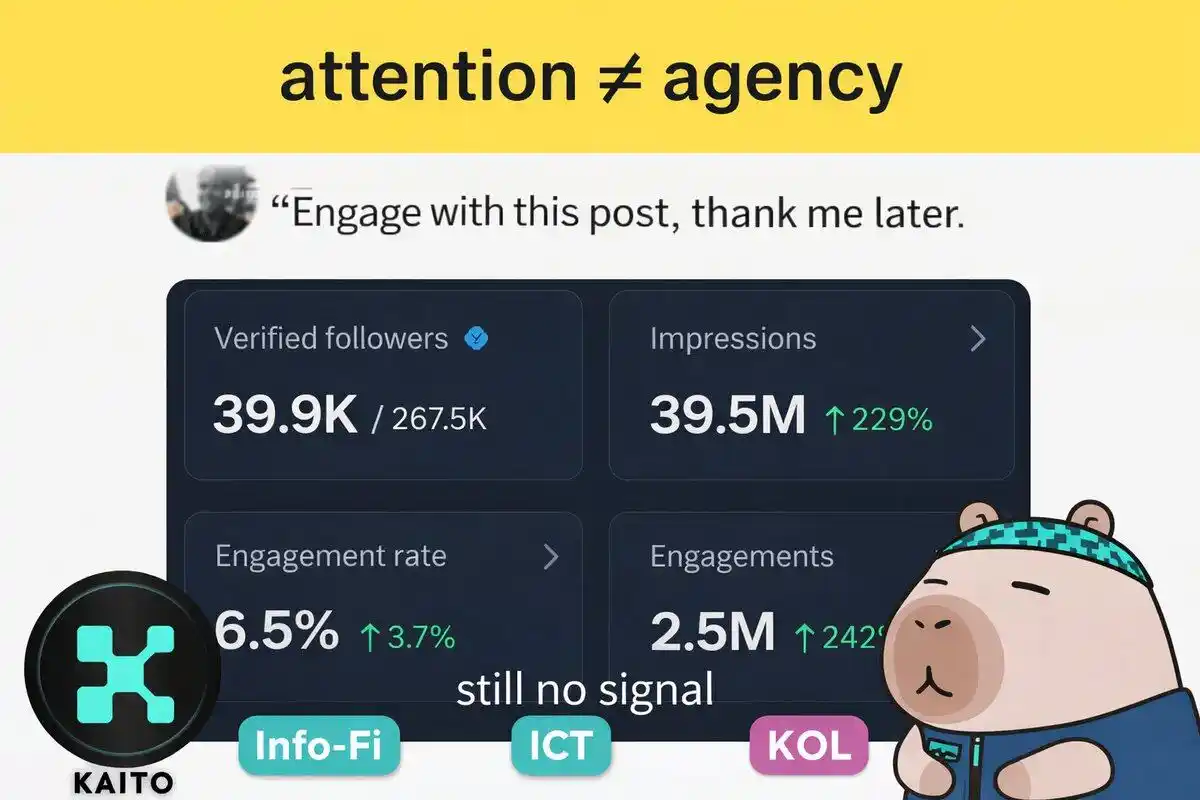
On X, everyone is a KOL, with millions of traffic every month. Traffic is no longer valuable. What is valuable is attention, the power of 'belief,' and the right to scarcity.

This article explains a16z's new media, agency (the power to act), how to make traffic meaningful on Twitter, and ICM.

🌟🌟

@a16z raised $1.5 billion at the beginning of the year, making headlines across major platforms. They raised so much money to tell a story of "all in on America, believing in AI + crypto and technology."

Two months ago, they specifically established a new media team to help a16z itself and its portfolio companies do "new media."

In Silicon Valley's AI/Web3 companies, there have been recent hires, with heavy rewards for finding a "storyteller"—someone who can write threads, shitpost, and tell stories.

a16z's new media partner directly stated: Marketing majors have replaced computer science as the "hot commodity."

What a16z has truly valued in recent years is not the content itself, but the way power is restructured.

New media is just the surface.

The real change is: Who has the qualification to make people act (agency).

1️⃣ Why has 'New Media' been elevated so highly in the past two years?

Because the path of the attention economy has basically run out of tricks.

  • Extreme content surplus
  • Distribution costs are nearly zero
  • Being seen no longer constitutes an advantage

What is truly scarce now is not exposure.

It's two things:

  • Is your judgment trustworthy?
  • Can you turn "belief" into "action"?

This is also why you can clearly feel a change:

In the past, media was about telling stories and setting narratives;

Now, media is starting to directly influence decisions and trigger actions.

When content is no longer scarce,

What becomes truly valuable is no longer 'what you said,'

but—what happens next.

This is the core meaning behind a16z's repeated discussion of new media.

It's not about the forms like threads, podcasts, or short videos,

but that the distribution structure has changed, and the power structure has changed along with it.

A simplest comparison:

Old Media

  • Scarce distribution (TV, newspapers, platforms)
  • Value concentrated in institutions
  • Creators are essentially employees

New Media

  • Decentralized distribution (X / YouTube / Substack / Podcasts)
  • Individuals themselves become nodes
  • Creators directly accumulate influence and bargaining power

The real change can actually be summed up in one sentence:

Media has changed from an institutional asset to personal capital.

And once media becomes personal capital,

it is no longer just an "exposure tool,"

but begins to become a tool of power.

When media belongs to an institution, it is your exposure tool;

When media belongs to an individual, it becomes your ability to influence others' decisions.

And influencing decisions is power.

2️⃣ Agency (The Power to Act)

The end goal of new media is not page views,

but agency (the power to act).

Agency means others are willing to act with you, trust your judgment, and pay for your concepts.
Packy mentioned in 《The Power Brokers》:

The goal of a Fund is to earn carry with as few people as possible, in as short a time as possible.
A Firm's goal is to continuously compound long-term advantages through scale.

This distinction explains one thing:

Why in traditional VC, media capability has always been "icing on the cake";

While at a16z, this has been directly made into infrastructure.

For a long time, the default order was:

Money → Company → Market

Money came first, deciding everything.

But in a world of extreme media saturation, this order has flipped:

Agency → Community → Market → Capital

Why is it that now "there is a lot of money, but things are hard to do"?

Because capital no longer automatically translates into action.

  • Distribution is not scarce
  • Attention is extremely noisy
  • Trust cannot be bought with budget

We've seen this many times in the crypto world (won't give examples to avoid offending people):

There's a lot of money, but projects still fail to cold start.

Valuations are high, but no one is really willing to participate.

The narrative is complete, but no one follows up with execution.

It's not because of insufficient money.

It's because there is no agency.

The truly scarce resource now is not capital.

It is:

  • The ability to make a group of people believe in the same thing simultaneously
  • The ability to make them act at the same point in time

Whoever can do this,

holds the real leverage.

So I am not praising, but using a16z to explain a structural change that is happening.

3️⃣ What does New Media solve? What is it still missing?

If media can form consensus, and consensus can drive action, then the market is the settlement layer of consensus.

Why ICM (Internet Capital Markets) necessarily appears after new media:

Because new media has a natural structural defect:

  • Influence ≠ Ownership
  • Traffic can be monetized, but it is not composable, not holdable long-term
  • Creators still rely on platform revenue sharing, brand partnerships, advertising cycles

The concept of ICM was first proposed by @solana. It fills in precisely this gap:

  • Transforming narrative / consensus / culture
  • Into a tradable, holdable, collaborative capital structure

ICM solves the next-step problem for new media:

How is influence priced, traded, and sustained?

To differentiate in one sentence:

  • new media:→ Who can gain attention
  • ICM:→ How attention becomes a capital structure
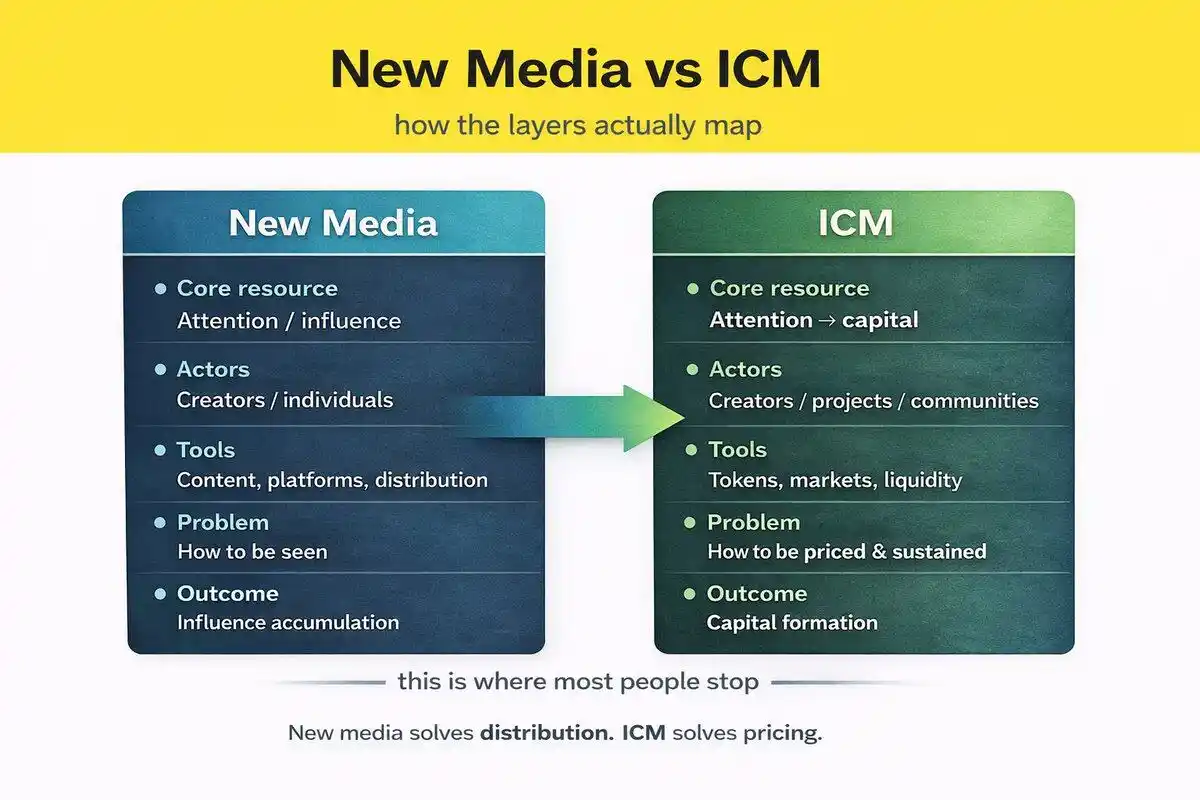
Conclusion:

New media solves the "right to disseminate," ICM solves the "right to price."

The essence of ICM:

  • Turning attention → agency → pricing → capital formation
  • Not a speculative tool, but coordination infrastructure

Closing

Finally, I want to quote my favorite saying from Naval Ravikant to echo this point and conclude the article.

Naval said: Code and media are the leverage behind the new wealthy class.

Indeed, over the past 10 years, Silicon Valley's nouveau riche and big tech companies (internet / software / AI) have essentially relied on "code leverage" to create wealth.

With the proliferation of Cursor and Claude, everyone can vibe code; the ability to code is becoming less scarce. There are even predictions that all entry-level programming jobs will be replaced by AI within the next 10 years.

The truly scarce leverage in the next cycle is new media:

Namely, the scalable dissemination of narrative × judgment × taste. Good leverage can continuously generate compound interest while you sleep, influence others in your absence, and help you build "trust + reputation + opportunity access."

code is law

New media is the law.

Original article link

İlgili Sorular

QWhat is the core concept of 'new media' as discussed in the a16z context?

AThe core concept is not about the format (like threads or podcasts), but a shift in power structure. It's about media transforming from an institutional asset into personal capital, where the ability to influence decisions and trigger action (agency) becomes the new scarce resource, replacing mere attention or exposure.

QAccording to the article, what is the key difference between 'old media' and 'new media'?

AOld media is characterized by scarce distribution (TV, newspapers), value concentrated in institutions, and creators as essentially employees. New media is defined by decentralized distribution (X, YouTube), individuals becoming nodes themselves, and creators directly accumulating influence and bargaining power.

QWhat does the term 'agency' mean in this article, and why is it important?

A'Agency' refers to the power to make others act, to have them believe in your judgment and pay for your concepts. It is important because in a world of abundant capital and content, the true scarcity is no longer money or exposure, but the ability to coordinate belief and trigger simultaneous action among a group of people.

QWhat problem does ICM (Internet Capital Markets) solve in relation to new media?

AICM solves the structural defect of new media, where influence does not equal ownership and attention is monetizable but not composable or long-term holdable. It transforms narrative, consensus, and culture into tradable, ownable, and collaborative capital structures, essentially solving the 'pricing power' for the 'propagation power' that new media creates.

QWhy does the article suggest that 'new media' is becoming the most important lever in the next cycle?

AAs AI tools make coding skills less scarce, the next cycle's truly scarce lever will be new media—the scalable propagation of narrative, judgment, and taste. It builds a lever that generates compound interest while you sleep, influences others in your absence, and establishes trust, reputation, and opportunity gateways.

İlgili Okumalar

Understanding Hash in One Article: The "Browser Miner" on Ethereum

Hash is an Ethereum-based ERC-20 token described as a "browser-minable post-quantum token." Its key features include enabling browser-based GPU mining without specialized hardware, a fixed supply cap of 21 million tokens, immutable and permissionless smart contracts with no team allocation or pre-mining, and an emphasis on post-quantum security using Keccak256 hashing. The mining mechanism is a simplified on-chain proof-of-work where miners solve unique challenges tied to their wallet address. Key design elements prevent answer theft, with epochs resetting every 100 blocks (~20 minutes) and a per-block minting limit. Emission follows a Bitcoin-like halving schedule every 100,000 mints, starting at 100 tokens per mint. Projections suggest all tokens could be mined within approximately 294 days if a target rate of one mint per minute is sustained. Hash emphasizes "post-quantum" security by leveraging hash-based primitives like Keccak256, which are considered more resistant to quantum attacks compared to elliptic-curve cryptography. While not a fully post-quantum asset, it aligns with Ethereum's broader post-quantum research narrative. The project completed its Genesis sale at $0.03 and began trading on Uniswap, with its price reaching around $0.19. The initial circulating supply is small, with 5% sold in Genesis and 5% allocated to liquidity. The majority (47.6% of total supply) is allocated to early-stage mining, leading to a front-loaded emission schedule. This structure, combined with low initial liquidity, makes Hash a high-volatility, high-risk project dependent on sustained miner participation and market demand to absorb new supply.

marsbit2 dk önce

Understanding Hash in One Article: The "Browser Miner" on Ethereum

marsbit2 dk önce

OpenAI's Largest Internal Wealth Creation: 600 People Cash Out a Total of $6.6 Billion, 75 Take Home the Maximum $30 Million Each

A Wall Street Journal report reveals OpenAI's unprecedented pre-IPO wealth creation. In a single employee stock sale last October, over 600 current and former employees sold shares, collectively cashing out approximately $6.6 billion. Due to high investor demand, the company tripled the individual sale cap to $30 million, with about 75 employees selling the maximum amount. This event represents the largest such transaction in tech industry history for a private company. OpenAI's valuation was $500 billion for this tender offer. Employees with over two years of tenure were eligible, allowing many post-ChatGPT hires their first liquidity event. The company's stock has reportedly grown over 100-fold in seven years. Following a restructuring, employees collectively hold about 26% of OpenAI. The scale of executive wealth is also staggering. In court testimony related to Elon Musk's lawsuit, President and co-founder Greg Brockman confirmed his OpenAI stake is worth around $30 billion. Analysis indicates about 165 current and former employees hold a combined ~$164.9 billion in equity, averaging nearly $1 billion per person in paper wealth. OpenAI's per-employee stock-based compensation is estimated to be 34 times the average of major tech firms before their IPOs. OpenAI continues its rapid ascent, closing a $122 billion funding round at an $852 billion valuation in March. With monthly revenue hitting $2 billion, over 900 million weekly ChatGPT users, and plans for a potential trillion-dollar IPO in late 2026, this wealth-creation engine shows no signs of stopping.

链捕手25 dk önce

OpenAI's Largest Internal Wealth Creation: 600 People Cash Out a Total of $6.6 Billion, 75 Take Home the Maximum $30 Million Each

链捕手25 dk önce

Understanding CPO (Co-Packaged Optics) in One Article: Why Nvidia Is Willing to Spend $3.2 Billion on a Fiber?

NVIDIA and Corning announced a multi-year strategic partnership on May 6, 2026, with NVIDIA committing up to $3.2 billion to support Corning's U.S. expansion. This investment will triple Corning's manufacturing plants and significantly boost its optical fiber and communications production capacity. The core driver behind this massive investment is the fundamental shift from copper to optical interconnect technology within AI data centers. As GPU clusters scale, copper wires face critical limitations: severe signal attenuation over distance, high energy consumption for signal integrity, and excessive heat generation. Optical fiber, transmitting light instead of electrical signals, solves these issues with minimal loss, near-light speed, and lower power needs. The article outlines a three-stage evolution of data center interconnect: 1. **Traditional Copper Interconnects:** The mainstream solution of the 2010s, now being phased out due to scaling bottlenecks. 2. **Pluggable Optical Modules:** The current mainstream, where modules convert electrical signals to light externally. This process still introduces energy loss and latency. 3. **CPO (Co-Packaged Optics):** The next-generation technology where the optical engine is integrated directly with the GPU chip package. This drastically reduces the electrical signal travel distance to mere millimeters, slashing power consumption and latency while boosting data density. NVIDIA CEO Jensen Huang has identified CPO as an essential core technology for AI infrastructure. NVIDIA's investment signifies a strategic shift from being a buyer to actively controlling its supply chain for critical components. With demand for specialized optical fiber far outstripping supply—evidenced by soaring prices—securing long-term manufacturing capacity has become a competitive necessity. While Corning's expansion may pressure some suppliers, a projected global fiber supply gap of 5-15% over the next few years creates a significant opportunity window, particularly for Chinese manufacturers competitive in optical preforms, chips, and modules. Ultimately, NVIDIA's move is not about chasing a trend but an engineering imperative. The transition to light-based interconnects like CPO is driven by the physical limits of copper, marking a definitive step in the ongoing AI computing revolution.

marsbit50 dk önce

Understanding CPO (Co-Packaged Optics) in One Article: Why Nvidia Is Willing to Spend $3.2 Billion on a Fiber?

marsbit50 dk önce

İşlemler

Spot
Futures
活动图片