Web3 Teams, Stop Wasting Your Marketing Budget on Platform X

Odaily星球日报2026-03-12 tarihinde yayınlandı2026-03-12 tarihinde güncellendi

Özet

Web3 marketing teams are wasting budgets on ineffective X platform campaigns, as traditional promotion strategies have become obsolete. The classic model—announcement, followed by coordinated KOL posts—fails due to new paid partnership disclosures that make ads obvious, reducing engagement. X’s algorithm prioritizes drama, memes, and debates over formal announcements. Using Starknet’s recent strkBTC campaign as a case study, the author notes its low organic reach: only 100+ independent posts about Starknet exceeded 10 likes in February. Instead of sparking discussion, paid KOL promotions are easily identified and ignored. The solution is to flip the strategy: start by building narrative momentum through controversial topics (e.g., “Ethereum L2 vs. Bitcoin L2”), encourage creator debates and community content, and only then issue the announcement. For developer outreach, focus on building ecosystem prestige rather than direct promotion. The key is to create talk-worthy moments, not just distribute news.

Original Author / Stacy Muur

Compiled / Odaily Planet Daily Golem(@web 3_golem)

Every month, Green Dots conducts research on KOL promotional campaigns on Platform X to understand the strategies of other Web3 marketing teams and track which strategies and post styles are truly effective. However, due to the new paid partnership policy introduced by X, which has changed the marketing environment on Platform X(related reading:Musk casually overturns the rice bowl of crypto KOLs), most Web3 project promotion strategies are no longer suitable. Stacy Muur reveals in this article the common problems in many recent Web3 promotional activities, using Starknet as the case study for this analysis.

Author's statement: This is not targeting Starknet; their technical strength remains strong. Despite the many doubts and suspicions from the outside world after the airdrop and TGE, the team continues to release and develop products, which deserves respect. But this article focuses only on one aspect: marketing strategy. Starknet's recent new product promotion is just a typical example.

How did Starknet conduct its advertising?

Starknet recently launched strkBTC [₿] and invited some content creators on Platform X to promote this event. They adopted a very classic promotion model:

  1. First, release an announcement with a promotional video;
  2. Within 12-48 hours of the announcement, KOLs publish collaborative promotional posts;
  3. Subsequently, publish articles specifically explaining the advantages of the product.

Even though this promotion was carried out in late February, to comply with Platform X's paid partnership policy, some creators included the paid partnership label when publishing related posts. But the focus of this article is not on the disclosure of payments, but on the effectiveness of the promotion strategy itself.

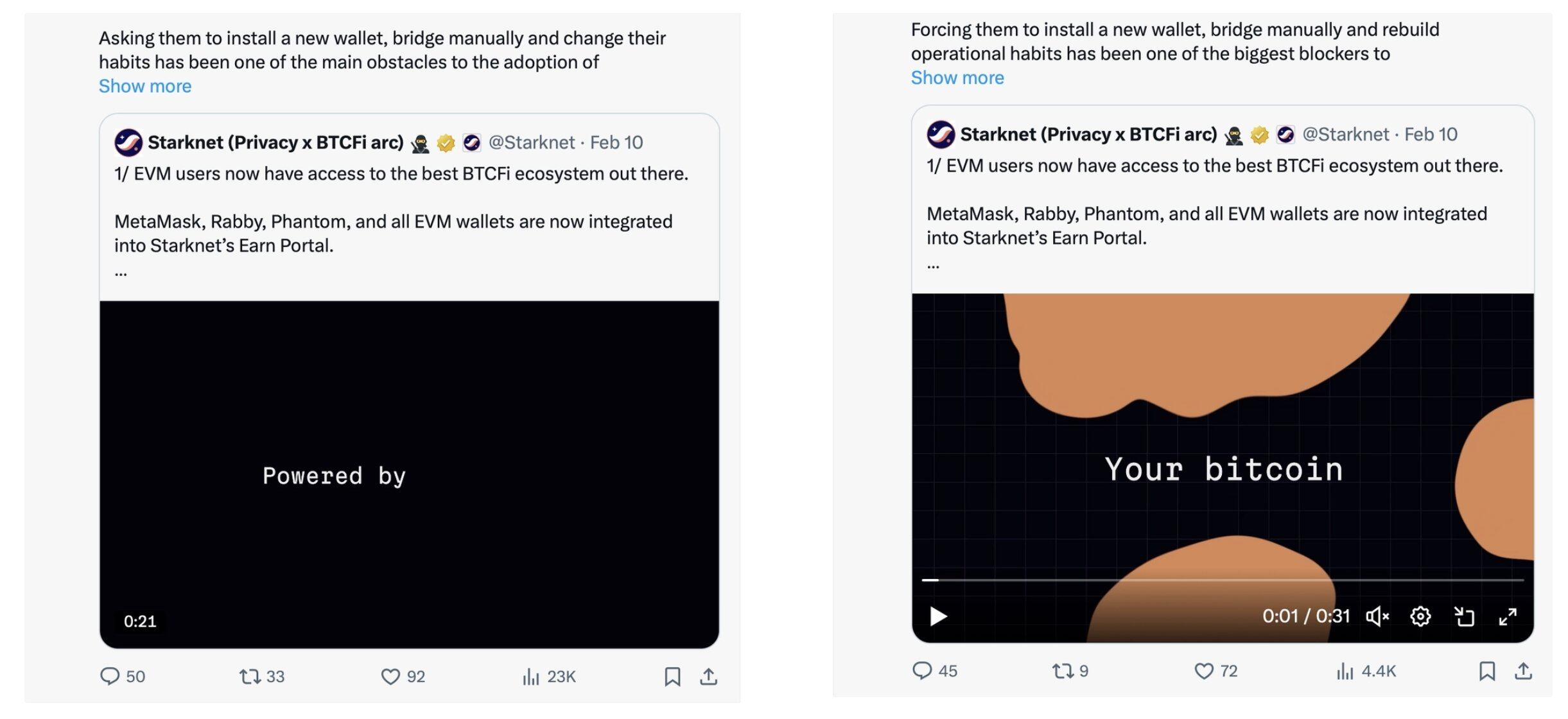
On February 10th, around another announcement released by Starknet, their marketing team conducted another KOL promotion. Exactly the same routine: first release a video announcement, then promote through KOLs.
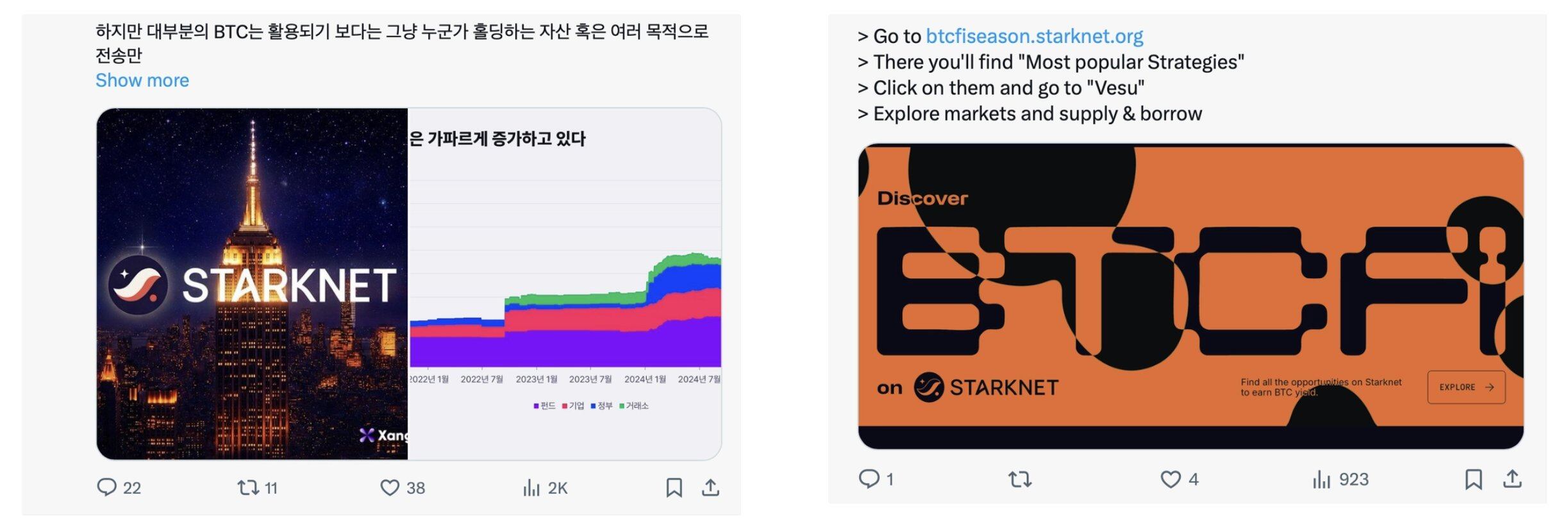
Of course, Starknet also had other promotional methods, such as publishing a few long articles and conducting some promotional activities in the Korean language region.
For the record, I don't know who was responsible for managing this campaign or if any agency was involved. I am merely providing some thoughts from an outsider's perspective, from a marketer's point of view.

One problem is obvious throughout the promotion: the screening of creators involved in the promotion is weak.

X is a perception layer. Ideally, creator promotions on X should bring:

  • More discussion about the brand
  • Trigger more voluntary posts from independent creators
  • Drive the production of more community content
  • Stronger ecosystem activation

But is that what we see? Not really.

If you use simple filtering conditions on X to view popular posts mentioning Starknet in February, the results are obvious.
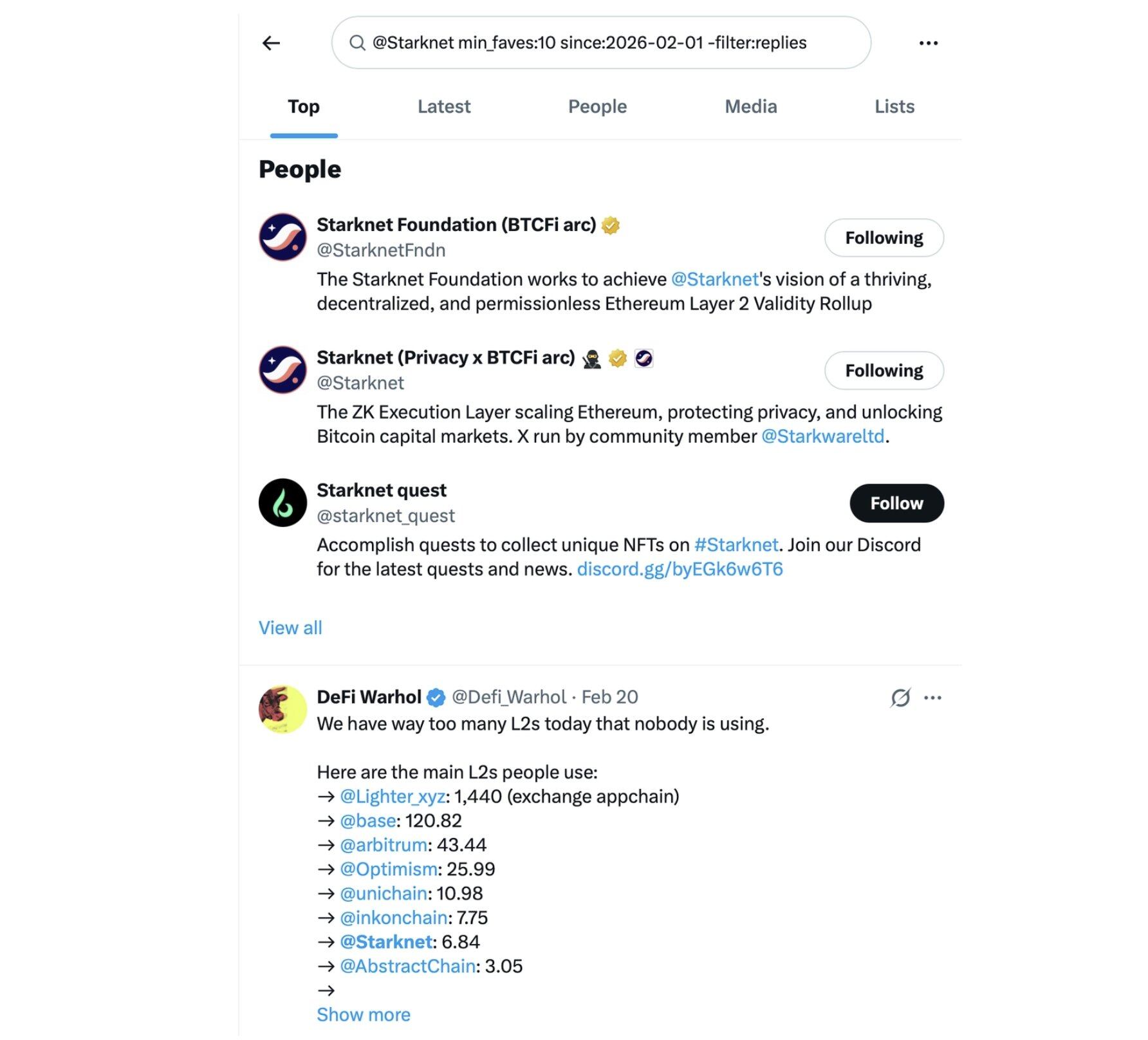
The most mentioned post was actually from Warhol. Overall, there were only a little over 100 independent posts mentioning Starknet in February that received more than 10 likes. For a well-known L2 ecosystem, this number is not high.

Some popular organic mentions of Starknet included:

  • Mookie's post about token unlocks (approx. 10k views)
  • Warhol's post about the best internship brands in the crypto industry (approx. 16k views)
  • Warhol's L2 rating list (approx. 30k views)
  • santiment's post ranking L2s by developer activity (approx. 50k views)
  • mztacat's post about the "Big Four companies" (approx. 82k views)

That's roughly the extent of Starknet's mentions on Platform X in February. This leads to a more important question, not just concerning Starknet, but concerning the fact that the classic Web3 marketing strategy is gradually failing on Platform X.

Why is the classic Web3 advertising strategy failing?

For years, the default mode of Web3 marketing has been: Announcement -> KOL promotion -> Community discussion.

This classic model worked when X's timeline was less crowded, narratives were strong, and most promotions were not easily identifiable as paid promotions. But the following changes have caused this model to fail.

Paid Disclosure Kills Implicit Spread

Once creators start adding paid disclosure information, this promotion model becomes obvious to fans.

First, users see an announcement, then within the next 24 hours, 5-10 similar promotional posts appear, all with largely identical content. Users can immediately recognize this structure. It doesn't trigger community discussion; instead, it sends a signal that "this is an advertising campaign."

In the environment of Crypto Twitter, advertisements rarely spark community discussion; they are usually just scrolled past by users.

KOL Behavior is Now Very Easy to Identify

Crypto Twitter has matured; people understand how KOL marketing works.

When the same group of creators quotes the same announcement with slightly different wording, it is easily interpreted as a coordinated promotional campaign. And once KOL content is clearly identified as a promotion, user engagement rates drop because the audience switches from curiosity mode to ad-filtering mode.

X Rewards Buzz, Not Announcements

X is not a distribution channel; it's a narrative space. Unless a Web3 project's announcement can trigger the following, they rarely become trending topics:

  • Arguments and debates
  • Meme coins
  • Hot takes
  • Competition between KOLs

Without these dynamic factors, dissemination can only bring brief user reach without truly winning users' minds. Therefore, to truly gain buzz, Web3 projects should change the sequence of their marketing campaigns.

The old promotion flow was: Announcement -> KOL promotion -> Community discussion. The new promotion structure should be: First build buzz -> Spark creator debates -> Generate community content -> Finally announce, so the announcement becomes the final confirmation moment, not the starting point.

If the project skips the narrative stage, promotion is out of the question.

How to redesign a promotion campaign for Starknet

Let's get back to reality. Starknet carries heavy baggage. The previous airdrop phase triggered a lot of fear, uncertainty, and doubt. Explanations and promotional videos alone cannot solve this problem; the project needs to control the conversation to resolve it. Different goals require different marketing strategies.

If the goal is to win users' minds

The strategy should be to actively engage in controversy. Don't try to suppress critics; design topics that can spark debate.

For example:

  • "Which L2 is better for developing BTCFi?"
  • "Ethereum L2 vs Bitcoin L2"
  • "Top five ecosystems for BTCFi developers"

Then sponsor posts related to ranking lists, posts comparing Starknet with other projects, and posts with debates. Maybe half the timeline will support Starknet, and the other half will attack Starknet, but both sides increase exposure. Creating drama is not bad marketing; marketing that goes unnoticed is bad.

If the goal is to dominate public opinion

Then stop publishing lengthy PR articles; few people read them. Instead, publish visual infographics, ecosystem maps, competitor comparisons, and short frameworks that KOLs can reuse. Giving creators space to remix content is far more powerful than content they can only quote.

The goal of dominating public opinion is not one good article, but dozens of derivative articles. This is how narratives spread.

If the goal is to attract developers

Then remember that developer acquisition is a B2B model. Publishing announcements on X is not effective for developer onboarding. What projects should do is:

  • Build topic momentum
  • Build ecosystem prestige
  • Show that developers have already succeeded there

Once this trend forms, onboarding developers becomes much easier. Because developers also chase hotspots.

Conclusion

The traditional Web3 promotion model (Release announcement -> KOL promotion) is dying on X. The new model is more like: Design topics -> Spark creator interest -> Trigger discussion -> Let the community take it from there.

The project's announcement is still important, but it should no longer be the beginning of the promotion campaign; it should be the end point.


İlgili Sorular

QAccording to the article, why is the classic Web3 marketing strategy of 'announcement → KOL promotion' no longer effective on X?

AThe strategy is no longer effective due to three main reasons: 1. Paid disclosure labels kill organic spread by making the promotional nature obvious to users. 2. KOL coordinated promotion is now easily identifiable by the mature crypto Twitter audience, causing them to switch to 'ad-filtering mode'. 3. The X platform rewards hot topics, drama, and narratives, not simple announcements, which rarely go viral without these elements.

QWhat does the author propose as the new, more effective structure for a Web3 marketing campaign on X?

AThe author proposes a new structure: Build the narrative first → Spark creator debate → Generate community content → Finally, publish the official announcement. The announcement should be the final confirmation moment, not the starting point.

QWhat was a key problem identified in Starknet's recent promotional campaign, as cited in the case study?

AA key problem was the weak vetting of the creators participating in the promotion, which failed to generate significant independent discussion, voluntary posts from other creators, community content, or stronger ecosystem activation.

QFor the goal of 'winning mindshare', what type of content does the author suggest a project like Starknet should sponsor instead of long articles?

AThe author suggests sponsoring content that creates debate and drama, such as rankings, comparison posts pitting Starknet against other projects, and posts with arguments. Examples include 'Which L2 is better for BTCFi development?' or 'Ethereum L2 vs Bitcoin L2'.

QWhat does the author state is the fundamental difference in how the X platform should be viewed for marketing, as opposed to being a distribution channel?

AThe author states that X is not a distribution channel but a 'narrative venue' or a 'perception layer'. It is a place for narratives, hot takes, memes, and debates, not just for broadcasting announcements.

İlgili Okumalar

TechFlow Intelligence Bureau: Chip Stocks Lose Trillions in a Single Day, Bitcoin Falls Below $60,000, US-Iran Conflict Escalates

**Daily Tech & Markets Roundup: AI Advances, Market Turmoil, and Geopolitical Tensions** **AI / LLMs**: Anthropic's internal report on AI self-improvement sparked serious discussions about Recursive Self-Improvement (RSI). Meanwhile, debate continues on AI coding tools after Claude was accused of introducing bugs into the rsync codebase. In positive news, DeepSeek V4 Flash impressed in local deployment tests, and GitHub Copilot now supports custom endpoints for local models. A surprising research turn suggests removing chain-of-thought prompting can sometimes improve LLM performance. **Crypto / Web3**: Bitcoin plunged below $60,000, with its RSI hitting levels last seen during the COVID-19 crash, driven by strong U.S. jobs data reviving interest rate hike fears. Discussions highlight Ethereum DeFi's continued lack of a smooth consumer payment layer. **Chips / Hardware**: Chip stocks suffered a massive sell-off, with the Philadelphia Semiconductor Index posting its worst single-day drop in six years, erasing over a trillion dollars in value. Marvell, Micron, AMD, and Intel were among the biggest losers. **Tech Companies**: A leaked Microsoft document revealing goals to make Copilot "addictive" drew criticism. LinkedIn founder Reid Hoffman left Microsoft's board to focus full-time on his AI agent startup, Manus. Google was revealed to be paying SpaceX $920 million monthly for AI training compute. **Markets & Macro**: A blowout U.S. jobs report (172k vs. 80k expected) crushed hopes for near-term rate cuts, sending Treasury yields soaring and triggering a broad market sell-off. CEOs from Kraft, McDonald's, and Whirlpool simultaneously warned U.S. consumers are exhausting their savings. **Geopolitics**: U.S.-Iran tensions escalated with missile/drone interceptions and U.S. strikes on Iranian radar sites, keeping the critical Strait of Hormuz largely closed since late February and posing ongoing oil supply risks. **The Bottom Line**: The strong jobs data acted as a single trigger for correlated sell-offs across equities, crypto, and chips. Underlying the volatility is a stark contradiction between robust employment data and warnings of consumer weakness, alongside geopolitical risks that could reignite inflation, leaving markets to price in a fraught macro outlook with no clear "soft landing" path.

marsbit1 saat önce

TechFlow Intelligence Bureau: Chip Stocks Lose Trillions in a Single Day, Bitcoin Falls Below $60,000, US-Iran Conflict Escalates

marsbit1 saat önce

It Took Me a Year to See the Bitter Truth About Agent Payments

After a year building infrastructure for the Agent economy, engaging with major players like Stripe, Visa, and Coinbase, the author shares a sobering analysis of the current state of Agent payments. The core finding is a stark lack of genuine, immediate demand across most envisioned use cases. The article breaks down four key market segments: 1. **Agent-to-Merchant (Consumer Shopping):** For most product categories (e.g., clothing, electronics), conversational AI shopping is a step backwards from visual e-commerce interfaces. While agents excel at understanding needs, they can't replace side-by-side product comparison. Real merchant interest is defensive "Agent Engine Optimization," not driven by current customer demand. Potential exists for high-frequency, low-decision purchases (like food delivery) or navigating complex store UIs, but these require massive B2C distribution channels dominated by giants like Amazon. 2. **Agent-to-API (Developer Services):** Developers already have subscriptions and billing relationships for APIs (compute, data). Prepaid balances solve micro-payment issues for low transaction volumes. A deeper structural problem is that major SaaS vendors' business models rely on enterprise contracts, resisting granular pay-per-call pricing. While protocols like MPP and x402 serve the long tail of niche services, this market is small and developers are historically low-willingness-to-pay. 3. **Agent-to-Agent:** This remains largely theoretical with minimal transaction volume. While it represents a long-term bet on a fundamentally new transaction infrastructure (sub-second, micro-penny to million-dollar, multi-party settlements), it does not constitute a present market. 4. **Agent-to-Finance:** This is the only category with existing, paying demand. Integrating AI into financial workflows (trading, portfolio management) is a natural evolution and enables new capabilities like autonomous rebalancing. However, competition favors established, regulated institutions. The "real problem" is not moving money between agents, but the broader challenge of **coordination**—orchestrating work between agents and humans, verifying outcomes, and settling results. Payment is just one component of settlement, which is itself part of coordination. Companies that solve the coordination layer will subsume payment, not the other way around. While well-funded incumbents build defensively for a long-term future, startups must find where the market is today—which, for the author's team, lies outside these four categories in an area of real, growing, and underserved activity.

marsbit2 saat önce

It Took Me a Year to See the Bitter Truth About Agent Payments

marsbit2 saat önce

It Took Me a Year to See the Hard Truth About Agent Payments

**Title: It Took Me a Year to See the Hard Truth About Agent Payments** Over the past year, I've worked on infrastructure for the Agent economy, engaging with major players like Stripe, Visa, Coinbase, and numerous startups. The findings reveal a stark reality: genuine, widespread demand for Agent-based payments does not yet exist. **Key Observations:** * **Agent-to-Merchant (Shopping):** The user experience for AI shopping often falls short, especially for visual product discovery. While AI excels at understanding needs, conversational interfaces can't yet replace browsing and comparing multiple products visually. Current merchant interest is largely defensive ("Agent Engine Optimization") for a future that hasn't arrived. High-frequency, low-friction purchases (like food delivery) are potential fits, but lack open APIs and face high AI inference costs. Simpler, more affordable, or cross-language interactions for complex UIs are a niche opportunity but require massive consumer distribution to scale. * **Agent-to-API (Developer Tools):** Developer payment needs for APIs (computing, data, models) are already met through subscriptions and prepaid credits. The core challenge is not payment friction but supplier economics: most large SaaS providers prefer enterprise contracts over micropayments for API calls. Protocols like MPP and x402 suit the long-tail of smaller services but cater to a developer market historically reluctant to pay for these tools. Major infrastructure needs at the top of the stack are already being addressed. * **Agent-to-Agent (Machine Commerce):** This is a long-term vision with almost no current transaction volume. While a future with high-speed, high-frequency, multi-party machine-to-machine transactions would require novel infrastructure, it remains theoretical. The market is not here yet. * **Agent-to-Finance:** This is the only category with clear, present demand. Financial professionals and DeFi users already pay for tools, and AI augmentation is a natural evolution. Autonomous AI agents can enable entirely new financial strategies. However, competition is fierce from established, regulated incumbents who can more easily layer AI onto their existing products. **The Core Insight:** Companies, especially giants with long time horizons, are building defensively for a potential future of mass machine commerce. For them, early investment is a low-cost hedge. For startups, the current market reality is different. The primary challenge isn't just moving money between agents (payments). The larger, unsolved problem is **orchestration** – coordinating work between agents and humans, verifying outcomes, and then settling. Payment is just a part of settlement, which is just a part of orchestration. Companies that solve the orchestration problem will subsume payments, not the other way around. After a year of building, we see the real, growing, and underserved market opportunity lies in this broader domain of orchestration.

链捕手3 saat önce

It Took Me a Year to See the Hard Truth About Agent Payments

链捕手3 saat önce

İşlemler

Spot
Futures
活动图片




