Web3 and DApps in 2026: A utility-driven year ahead for crypto

cointelegraph2025-12-24 tarihinde yayınlandı2025-12-24 tarihinde güncellendi

Özet

By 2026, the crypto industry is shifting from speculative hype toward a utility-driven focus. Decentralized applications (DApps) are increasingly built for real-world use, with developers prioritizing polished user experience, interoperability, and sustainable monetization rather than short-term gains. Key improvements include account abstraction, gas sponsorships, and faster blockchain performance, narrowing the gap with Web2 applications. Ecosystems like Ethereum, Solana, and TON are competing not just on scalability but also on distribution and practical relevance. The emergence of super-apps and AI agents may further simplify user interaction. The year will test whether DApps can retain users without speculative incentives—making actual utility the defining metric for success.

As the crypto space headed into the last month of 2025, the mood was different from previous cycles. The year didn’t bring another decentralized finance (DeFi) summer or non-fungible token (NFT) euphoria, but instead ushered in a slow and sober pivot toward utility.

Decentralized applications (DApps) are software programs that run on blockchain networks, rather than centralized servers. By using smart contracts, DApps allow users to interact directly with apps for payments, finance, gaming or social media while retaining greater control over identities and assets.

Active builders held steady in 2025 but shifted their priorities to a longer-term outlook. According to Electric Capital’s Developer Report, the number of full-time crypto developers — defined as contributors committing code at least 10 days per month — rose 5% year-on-year, even as total developer counts dipped slightly.

The divergence suggests that speculative “tourist” participation has waned, while more builders are pursuing crypto as a full-time profession. In practice, that points to a smaller but more committed developer base, with sustained development effort increasingly concentrated among long-term teams rather than short-term projects.
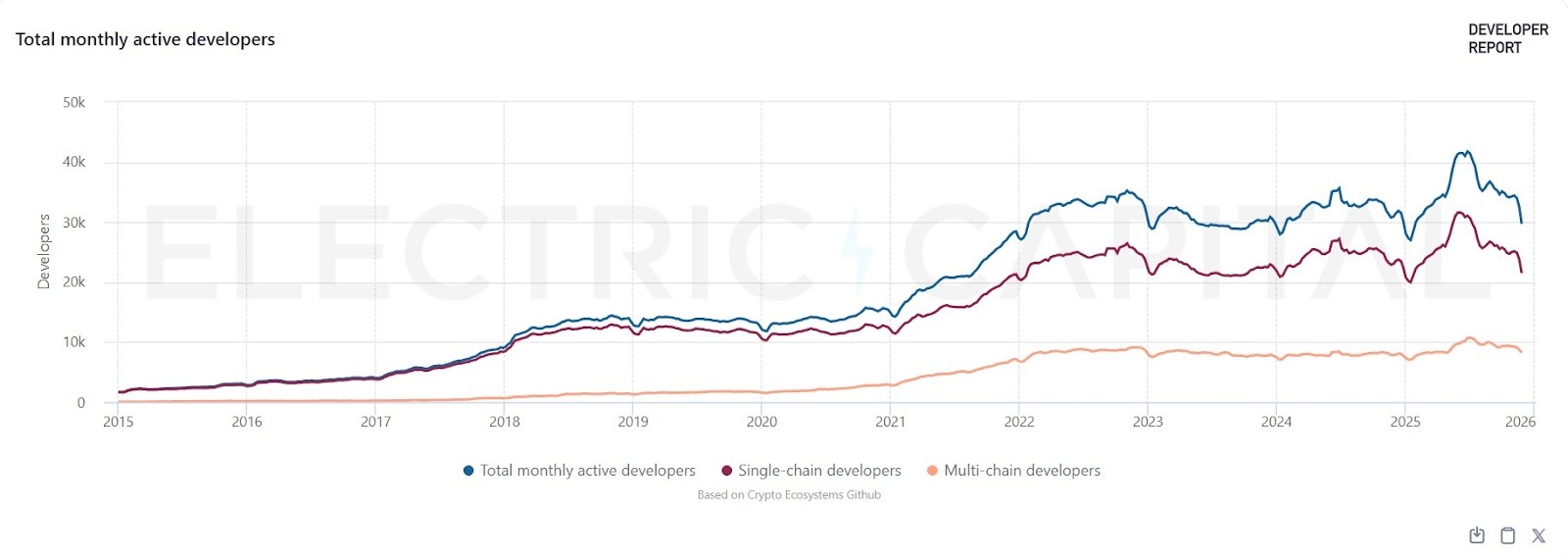
Total monthly active developers. Source: Electric Capital

Web3 gaming developers are also identifying different drivers of success for gaming DApps. According to a survey by the Blockchain Gaming Alliance (BGA), Web3 game developers are tying success to polished gameplay, sustainable monetization and infrastructure that supports spending.

This means that builders are depending less on external forces like traditional gaming giants coming into Web3 and instead focusing on controllable factors such as implementing interoperability, integrating artificial intelligence and creating player-driven economies.
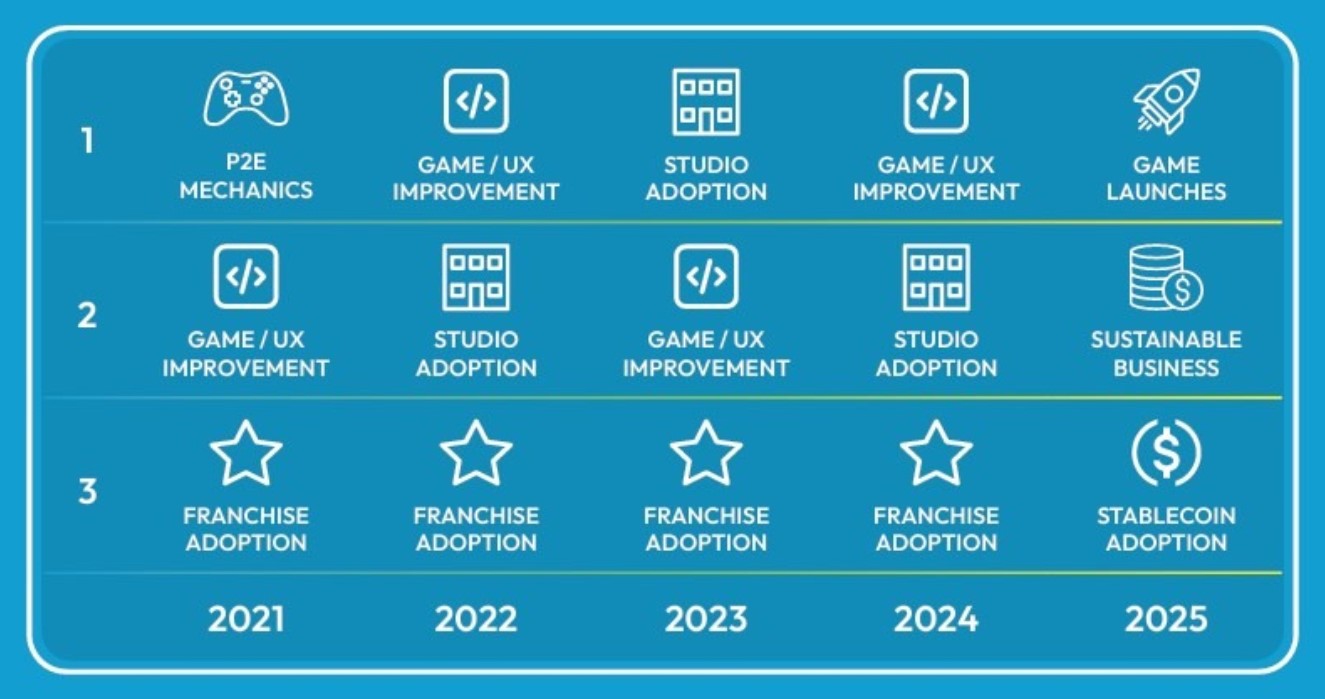
Key factors that are perceived to drive the growth of the blockchain gaming industry. Source: BGA Survey

If 2024 was defined by layer-2 scaling paths, 2025 became a year of preparation. Builders focused on making crypto usable, pushing account abstraction into production, tightening wallet UX and building mobile distribution channels through ecosystems like Solana’s Saga and The Open Network’s deep integration with Telegram.

At the same time, regulators across major jurisdictions like the United States, Europe and Asia have drawn clearer boundaries around stablecoins, custody and reporting, giving developers a framework to build within. The result was a year spent building the groundwork instead of chasing breakout apps.

The groundwork now sets up 2026 as a decisive test of relevance. With tooling largely in place and compliance streamlined, DApps will need to address the challenging question of whether they can attract and retain users without relying on speculative incentives.

The industry spent much of 2025 talking about a pivot to utility, but 2026 is where this claim would have to meet reality. If everyday users don’t stay once yields fade and rewards disappear, the problem will no longer be the technology, but the applications themselves.

How DApps can compete with Web2 in 2026

While DApps focused on competing with each other for user attention in previous years, 2026 may become the year when they must stand against Web2 applications and their scale.

For DApps to stand a chance, they must erase barriers that historically caused friction for mainstream users — and the shift is already underway. Account abstraction is moving closer to becoming the default experience across major ecosystems, enabling smart accounts that behave more like familiar log-in mechanisms than cryptographic tooling.

Gas sponsorships, where apps pay gas on behalf of users, reduced one of the biggest pain points, while social logins and MPC wallets removed the need for seed phrases. Moreover, sub-second finality on high-performance blockchains like Solana and modular rollups on Ethereum have narrowed the latency gap.

The emerging layer of AI agents capable of interacting with smart contracts could make DApp usage feel less like managing a wallet and more like a regular application.

Related: Tether deepens AI bet, backs Italian firm’s humanoid robots

This highlights the stark contrast between 2025 and 2026. This year showed fragmentation fatigue, where thousands of isolated DApps, each with separate accounts, assets and user journeys, created a high cognitive load for new users.

Because of this, the next leap for the sector may come from modular, interoperable super apps that bundle multiple needs in one interface, similar to how WeChat and Grab built dominance in the Web2 space.

Payments, savings and stablecoin rails could sit alongside NFT creator tools, gaming assets, loyalty tokens and social identity, allowing users to move across experiences inside a single ecosystem.

If 2025 was the year protocols built the foundation, 2026 may be the year to test whether these actually work in daily use.
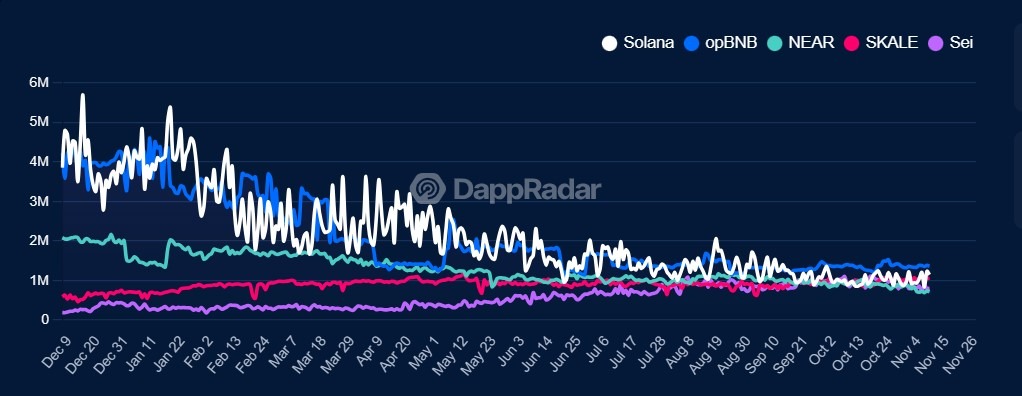
Solana and opBNB dominate in unique active wallets in 2025. Source: DappRadar

Related: Web3 gaming, DeFi lead sector activity in October despite market decline: Report

Which ecosystems are positioned to win in 2026?

Several ecosystems enter 2026 with distinct advantages, not only in throughput or developer tools, but also in distribution, user funnels and real-world relevance.

Ethereum remains the center of smart contract development, but its 2025 upgrades were incremental in nature. Improvements tied to the Fusaka upgrade focused on advancing Ethereum's data availability and zero-knowledge roadmap.

It includes early steps toward more efficient proof systems and shared sequencing concepts rather than immediate fee reductions on the mainnet. Together with the continued maturation of rollups, these changes position Ethereum to support cheaper and faster settlement over time, without compromising its security model.

Related: Vitalik Buterin pitches ZK-proofs to audit X algorithm and rankings

Solana continues to carve out the consumer lane, powering sub-second transactions for payments, in-app micro-purchases and mobile-native experiences that feel more Web2 than Web3.

On the other hand, TON stands out with arguably the strongest user funnel in the crypto space. Telegram's massive user base, Mini Apps and seamless wallet integrations created a distribution channel that would be difficult to replicate.
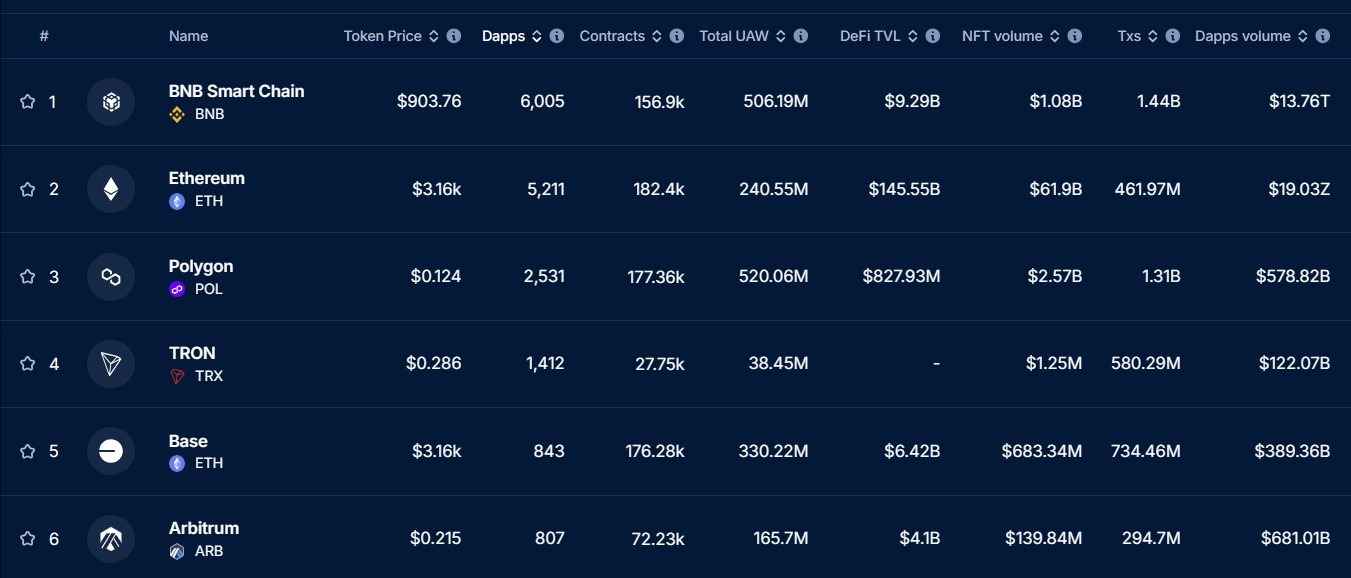
DappRadar integrated data showed that BNB Chain has over 6,000 DApps. Source: DappRadar

Beyond chains, thematic sectors could also define what could dominate the sector in 2026. Decentralized physical infrastructure networks (DePIN) gained traction in 2025 by anchoring crypto to real-world workflows like bandwidth, compute markets, mobility networks and energy credits.

These provided revenue paths that are not dependent on yield farming. In June, a World Economic Forum (WEF) report predicted that the sector could grow to $3.5 trillion by 2028, driven by the adoption of blockchain and artificial intelligence.

Meanwhile, creator-focused DApps are also maturing beyond NFTs and speculation toward micro-IP ownership, music royalties and fan-powered monetization models.

If these trends hold, the ecosystems best placed to succeed in 2026 will likely be the ones that combine distribution, scalability and clearer everyday use cases — not just the fastest network, but the one with the most active users.

2026 will be a turning point for utility

Crypto has already spent years building, scaling networks, tightening security, refining user experiences and building regulatory foundations to support its developments.

With infrastructure reaching consumer-grade readiness, the next phase may be less about which chain processes transactions faster and more about which products we are willing to return to without the usual token incentives.

If 2025 was a year spent in construction, 2026 is shaping up to be a year to evaluate — one where DApps must deliver practical value and not just promises. The winners will be those that feel similar to everyday applications, with simple onboarding, invisible gas and stable cost structures.

Magazine: Ethereum’s Fusaka fork explained for dummies: What the hell is PeerDAS?

İlgili Sorular

QWhat was the main shift in the crypto space during 2025 according to the article?

AThe main shift in 2025 was a slow and sober pivot toward utility, moving away from speculative trends like DeFi summers and NFT euphoria, with builders focusing on long-term development and making crypto usable.

QHow did the developer landscape change in 2025 based on Electric Capital's Developer Report?

AAccording to Electric Capital's Developer Report, the number of full-time crypto developers (those committing code at least 10 days per month) rose 5% year-on-year, while total developer counts dipped slightly, indicating a smaller but more committed developer base focused on long-term projects.

QWhat are the key factors that Web3 game developers believe drive success for gaming DApps, as per the Blockchain Gaming Alliance survey?

AWeb3 game developers tie success to polished gameplay, sustainable monetization, and infrastructure that supports spending, focusing on controllable factors like interoperability, AI integration, and player-driven economies rather than relying on external forces like traditional gaming giants.

QWhat technological and UX improvements are helping DApps compete with Web2 applications in 2026?

AImprovements include account abstraction becoming the default experience, gas sponsorships where apps pay gas fees for users, social logins, MPC wallets eliminating seed phrases, sub-second finality on high-performance blockchains, and AI agents that make DApp usage feel like regular applications, all reducing friction for mainstream users.

QWhich ecosystems are positioned to win in 2026, and what advantages do they have?

AEthereum remains the center of smart contract development with incremental upgrades focused on data availability and zero-knowledge proofs. Solana excels in consumer applications with sub-second transactions for payments and mobile-native experiences. TON has a strong user funnel through Telegram's massive user base and seamless wallet features. Additionally, ecosystems supporting DePIN and creator-focused DApps with real-world utility are well-positioned.

İlgili Okumalar

Crypto GPs' Midlife Crisis: No PMF, No LP's Next Check

The article "The Midlife Crisis of Crypto GPs: No PMF, No LP's Next Check" analyzes the shifting crypto fundraising landscape. It argues that the era of LPs funding vague "vision" is over; GPs must now offer products with clear Product-Market Fit (PMF) to secure capital. The market has matured. LPs, disillusioned by the last cycle's failures and wary of long lock-up periods, now demand tangible, near-term returns rather than speculative narratives. The proliferation of accessible crypto ETFs and other liquid products has reduced the need for VC blind pools as an entry point. The author categorizes crypto fundraising products into three types: Primary (VC funds, with blind pools or clear pipelines), Liquid (alpha/beta, directional/market-neutral strategies), and CeFi/DeFi Native Yield (crypto-specific mechanisms like staking, farming). Focusing on the Primary market, the piece details why traditional LP rationales for investing in crypto VCs have weakened: easier beta access via ETFs, diminished "access" and "judgement" premiums as LPs build internal teams, and a widespread lack of proven superior returns from GPs. Ultimately, only specific players are likely to remain at the primary VC table: large funds with access to patient endowment capital, family offices/HNWIs investing proprietary capital, the few funds with demonstrable excess returns from the last cycle, and those with clear "deal-making" or ecosystem resource advantages. For others, the path forward is to rebuild trust by proving alpha-generation capability in a niche or providing concrete, valuable services.

链捕手10 dk önce

Crypto GPs' Midlife Crisis: No PMF, No LP's Next Check

链捕手10 dk önce

The Age of Decoupling Has Arrived: Bitcoin is No Longer the Sole Compass of Crypto

The era of the cryptocurrency market moving in lockstep with Bitcoin is ending, as the industry splits into two distinct asset categories: endogenous and exogenous. Endogenous assets, like Bitcoin, derive value purely from the crypto market's cycles. Their narratives swing between being "interstellar money" in bull markets and "digital collectibles" in bear markets. Exogenous assets, however, are nominally crypto but operate with independent value drivers. Examples include: * **Venice:** An AI inference service using tokens for payments; its consumer-AI business model is decoupled from crypto price swings. * **Figure:** A fintech lender using blockchain to speed up loan approvals; its core value is in credit, not crypto. * **Stablecoin firms like BVNK:** Acquired by traditional finance giants (Mastercard, Stripe), their growth is tied to payment infrastructure, not market cycles. Hybrid projects like **Hyperliquid** (a decentralized exchange) show a shift, with a growing share of non-crypto trading (e.g., prediction markets). This divergence is fundamental. Endogenous assets remain highly correlated to Bitcoin, similar to gold miners to gold. Exogenous assets are evolving to have their own fundamentals, like the weak correlation between gold and the S&P 500. This changes investment analysis. Evaluating exogenous assets requires traditional fundamental research—assessing user bases, unit economics, and moats—more akin to fintech investing than charting Bitcoin. Promising exogenous sectors include: on-chain exchanges/brokers, AI-crypto fusion, privacy-focused digital banks, lending (institutional/private credit), stablecoins/real-world asset tokenization, payment rails, and non-financial crypto-consumer products. Currently, investing via equity is often safer than via tokens, as token value accrual mechanisms need further regulatory and industry development (e.g., the CLARITY Act). Nonetheless, the core trend is clear: crypto market drivers are diversifying from a single factor (Bitcoin) to multiple fundamentals, ending the era of uniform market moves.

marsbit1 saat önce

The Age of Decoupling Has Arrived: Bitcoin is No Longer the Sole Compass of Crypto

marsbit1 saat önce

Five Cryptos That Could Outperform Bitcoin Over the Next Cycle Due To Higher Growth Velocity

Bitcoin's growth often sets market trends, but analysts believe the next cycle's highest percentage gains may come from assets with greater growth velocity. While Bitcoin provides stability, several cryptocurrencies are positioned for stronger relative upside. This article highlights five such assets, with a particular focus on Ozak AI as the potential high-growth standout of the cycle. Ethereum (ETH) is noted for its ongoing evolution and institutional adoption. Solana (SOL) is recognized for its high throughput and history of sharp rallies. Chainlink (LINK) is highlighted as essential infrastructure for DeFi and AI applications. Avalanche (AVAX) is mentioned for its subnet architecture and enterprise potential. Ozak AI ($OZ) is presented as a distinct early-stage opportunity, currently in presale at $0.014 with a target listing price of $1.00. The project is building a full AI-native blockchain ecosystem, including prediction agents, a data stream network, and structured data vaults. Analysts suggest its early valuation stage and focus on AI infrastructure could allow for exponential growth velocity compared to more mature assets like Bitcoin, which requires massive capital inflows for significant price movement. The final takeaway positions Ozak AI as a high-asymmetry bet for investors seeking exponential upside alongside more stable assets.

TheNewsCrypto1 saat önce

Five Cryptos That Could Outperform Bitcoin Over the Next Cycle Due To Higher Growth Velocity

TheNewsCrypto1 saat önce

What's New in Jensen Huang's 'Agent Factory'?

In a keynote at COMPUTEX 2026, NVIDIA CEO Jensen Huang shifted the company's focus from hardware "full-stack" solutions to the era of AI Agents. The centerpiece is the Vera Rubin platform, now in production, which is designed specifically for Agent workloads and offers 10x the efficiency of its predecessor. The platform features the new Vera CPU, built for AI, and incorporates Spectrum-X Ethernet Photonics with CPO technology for improved networking and energy efficiency. NVIDIA introduced DSX, an integrated toolkit for designing, simulating, and operating AI data centers, aiming to streamline "AI factory" deployment and management. For end-user deployment, the company unveiled DGX Station for Windows, a desktop AI supercomputer for running Agents locally, and the RTX Spark SoC for AI PCs. On the software front, NVIDIA launched the 550B-parameter Nemotron 3 Ultra model for enterprise Agents and the Cosmos 3 foundation model for physical AI, unifying visual reasoning and action prediction. In robotics, a partnership with Unitree yielded the H2 Plus, a reference humanoid robot built on the Isaac GR00T platform to lower development barriers. Security was emphasized with enhanced confidential computing for Vera Rubin and new data path security features for the BlueField-4 STX storage platform. The presentation highlighted a strategic pivot: NVIDIA is reorganizing its entire technology stack—from chips and data centers to models, software, and robots—around the emerging ecosystem of autonomous, practical AI Agents.

marsbit2 saat önce

What's New in Jensen Huang's 'Agent Factory'?

marsbit2 saat önce

İşlemler

Spot
Futures

Popüler Makaleler

BILL Nasıl Satın Alınır

HTX.com’a hoş geldiniz! Billions Network (BILL) satın alma işlemlerini basit ve kullanışlı bir hâle getirdik. Adım adım açıkladığımız rehberimizi takip ederek kripto yolculuğunuza başlayın. 1. Adım: HTX Hesabınızı OluşturunHTX'te ücretsiz bir hesap açmak için e-posta adresinizi veya telefon numaranızı kullanın. Sorunsuzca kaydolun ve tüm özelliklerin kilidini açın. Hesabımı Aç2. Adım: Kripto Satın Al Bölümüne Gidin ve Ödeme Yönteminizi SeçinKredi/Banka Kartı: Visa veya Mastercard'ınızı kullanarak anında Billions Network (BILL) satın alın.Bakiye: Sorunsuz bir şekilde işlem yapmak için HTX hesap bakiyenizdeki fonları kullanın.Üçüncü Taraflar: Kullanımı kolaylaştırmak için Google Pay ve Apple Pay gibi popüler ödeme yöntemlerini ekledik.P2P: HTX'teki diğer kullanıcılarla doğrudan işlem yapın.Borsa Dışı (OTC): Yatırımcılar için kişiye özel hizmetler ve rekabetçi döviz kurları sunuyoruz.3. Adım: Billions Network (BILL) Varlıklarınızı SaklayınBillions Network (BILL) satın aldıktan sonra HTX hesabınızda saklayın. Alternatif olarak, blok zinciri transferi yoluyla başka bir yere gönderebilir veya diğer kripto para birimlerini takas etmek için kullanabilirsiniz.4. Adım: Billions Network (BILL) Varlıklarınızla İşlem YapınHTX'in spot piyasasında Billions Network (BILL) ile kolayca işlemler yapın.Hesabınıza erişin, işlem çiftinizi seçin, işlemlerinizi gerçekleştirin ve gerçek zamanlı olarak izleyin. Hem yeni başlayanlar hem de deneyimli yatırımcılar için kullanıcı dostu bir deneyim sunuyoruz.

107 Toplam GörüntülenmeYayınlanma 2026.05.07Güncellenme 2026.06.01

BILL Nasıl Satın Alınır

ATWO Nedir

I. Proje TanıtımıArena Two, hayranların gerçek zamanlı etkinlik sonuçlarında aktif, tokenleştirilmiş bir rol oynamasına olanak tanıyan merkeziyetsiz bir etkileşimli platformdur. Hayranları pasif izleyicilere indirgeyen geleneksel yayıncılık modellerinin aksine, Arena Two, hayranların doğrudan gerçek zamanlı oy kullanmalarını ve sahadaki sonuçları etkilemelerini sağlamak için blok zinciri teknolojisini kullanır.II. Token BilgileriToken adı: ATWO(Arena Two)III. İlgili BağlantılarWeb sitesi:https://arenatwo.com/Keşif araçları:https://basescan.org/token/0x499D35eBE6cEe9B2Ac35Fd003fcBbeeB9CFc7B32Twitter:https://x.com/arenatwoXNot: Proje tanıtımı, resmi proje ekibi tarafından yayınlanan veya sağlanan materyallerden gelmektedir ve yalnızca referans amaçlıdır, yatırım tavsiyesi niteliği taşımaz. HTX, ortaya çıkan doğrudan veya dolaylı kayıplardan sorumluluk kabul etmez.

63 Toplam GörüntülenmeYayınlanma 2026.05.18Güncellenme 2026.06.01

ATWO Nedir

ATWO Nasıl Satın Alınır

HTX.com’a hoş geldiniz! Arena Two (ATWO) satın alma işlemlerini basit ve kullanışlı bir hâle getirdik. Adım adım açıkladığımız rehberimizi takip ederek kripto yolculuğunuza başlayın. 1. Adım: HTX Hesabınızı OluşturunHTX'te ücretsiz bir hesap açmak için e-posta adresinizi veya telefon numaranızı kullanın. Sorunsuzca kaydolun ve tüm özelliklerin kilidini açın. Hesabımı Aç2. Adım: Kripto Satın Al Bölümüne Gidin ve Ödeme Yönteminizi SeçinKredi/Banka Kartı: Visa veya Mastercard'ınızı kullanarak anında Arena Two (ATWO) satın alın.Bakiye: Sorunsuz bir şekilde işlem yapmak için HTX hesap bakiyenizdeki fonları kullanın.Üçüncü Taraflar: Kullanımı kolaylaştırmak için Google Pay ve Apple Pay gibi popüler ödeme yöntemlerini ekledik.P2P: HTX'teki diğer kullanıcılarla doğrudan işlem yapın.Borsa Dışı (OTC): Yatırımcılar için kişiye özel hizmetler ve rekabetçi döviz kurları sunuyoruz.3. Adım: Arena Two (ATWO) Varlıklarınızı SaklayınArena Two (ATWO) satın aldıktan sonra HTX hesabınızda saklayın. Alternatif olarak, blok zinciri transferi yoluyla başka bir yere gönderebilir veya diğer kripto para birimlerini takas etmek için kullanabilirsiniz.4. Adım: Arena Two (ATWO) Varlıklarınızla İşlem YapınHTX'in spot piyasasında Arena Two (ATWO) ile kolayca işlemler yapın.Hesabınıza erişin, işlem çiftinizi seçin, işlemlerinizi gerçekleştirin ve gerçek zamanlı olarak izleyin. Hem yeni başlayanlar hem de deneyimli yatırımcılar için kullanıcı dostu bir deneyim sunuyoruz.

56 Toplam GörüntülenmeYayınlanma 2026.05.18Güncellenme 2026.06.01

ATWO Nasıl Satın Alınır

Tartışmalar

HTX Topluluğuna hoş geldiniz. Burada, en son platform gelişmeleri hakkında bilgi sahibi olabilir ve profesyonel piyasa görüşlerine erişebilirsiniz. Kullanıcıların A (A) fiyatı hakkındaki görüşleri aşağıda sunulmaktadır.

活动图片














