Wall Street Plunged into 'AI Phobia': An Indiscriminate Sell-off Is Spreading

marsbit2026-02-11 tarihinde yayınlandı2026-02-11 tarihinde güncellendi

Özet

Wall Street is experiencing a widespread "AI panic," triggering indiscriminate sell-offs across sectors perceived as vulnerable to AI disruption. The fear intensified recently when a tax-strategy tool from startup Altruist Corp. caused sharp declines in shares of major wealth managers like Charles Schwab, Raymond James, and LPL Financial. This reflects a broader market shift from focusing on AI winners to hastily dumping stocks of companies—from small software firms to large financial services—deemed at risk of being replaced by AI-driven products. Similar sell-offs occurred earlier in software, insurance, and asset management after AI companies like Anthropic and Insurify launched new tools. While some investors see this as an overreaction, citing the slow pace of technological adoption historically, others warn that AI’s rapid advancement is fueling legitimate anxiety. High market valuations have made stocks particularly sensitive to any negative signals, amplifying the volatility. The key uncertainty remains how quickly and deeply AI will reshape industries, leaving the market in a state of cautious speculation.

Source: Jinshi Data

On Wall Street, growing fears about artificial intelligence are hammering the stocks of companies that could become its targets of disruption, from small software firms to large wealth management companies, none have been spared.

The latest round of selling erupted on Tuesday when a tax strategy tool launched by a little-known startup, Altruist Corp., caused shares of Charles Schwab Corp., Raymond James Financial Inc., and LPL Financial Holdings Inc. to fall by 7% or more.

This marked the steepest decline for some of these stocks since the market crash triggered by the trade war last April. But it is just the latest example of the "sell first, ask questions later" mentality—a mindset that is rapidly taking hold as the hundreds of billions of dollars poured into AI begin to translate into commercial products, sparking anxiety that AI could disrupt entire industries.

"Companies with any potential disruption risk are being sold off indiscriminately," said John Belton, a fund manager at Gabelli Funds.

Over the past few years, advancements in AI technology have been at the forefront of Wall Street, with tech stocks leading the gains. As this rally pushed stock prices to record highs, questions have persisted about whether this is a bubble about to burst or whether it will trigger a productivity boom that reshapes the American corporate landscape.

But since the beginning of last week, a series of AI product launches has triggered a noticeable market shift. Instead of focusing on picking winners, investors are quickly trying to avoid holding any company facing even the slightest risk of being replaced.

"I don't know what's going to happen next," said Will Rhind, CEO of Graniteshares Advisors.

"Last year's story was that we all believed in AI—but we were looking for applications, and as we keep discovering applications that seem increasingly powerful and persuasive, it is now leading to disruption."

For some time, the software industry has been troubled by concerns about AI. Last week, when a new tool from Anthropic PBC triggered sharp declines in stocks across industries such as software, financial services, asset management, and legal services, these worries began to shift more broadly to other sectors.

The same fears hit U.S. insurance broker stocks hard on Monday after the online insurance marketplace Insurify launched a new app using ChatGPT to compare auto insurance rates. On Tuesday, wealth management stocks became the next victim, as the product Hazel launched by Altruist—which helps financial advisors create personalized strategies for clients—dragged these stocks down.
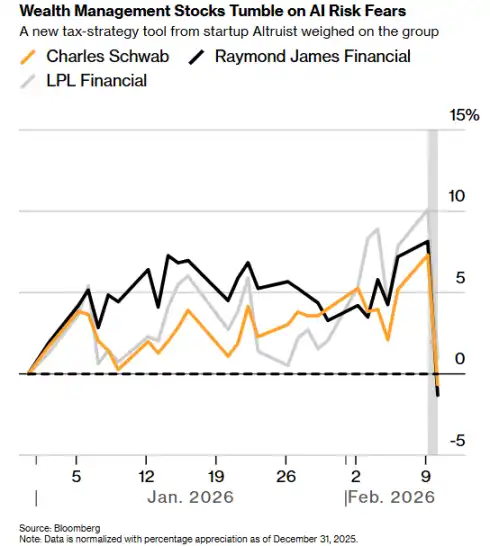
Wealth management stocks plunge on AI risk concerns

Altruist CEO Jason Wenk said he himself was surprised by the scale of the stock market reaction, which wiped tens of billions of dollars from the market value of several investment firms. But he said it sends a strong signal about the competitive threat his company poses.

"People are beginning to realize—the architecture we used to build Hazel, it can replace any job in wealth management," he said in an interview. "Usually these jobs are done by entire teams. And now, AI can effectively do these jobs for just $100 a month."

AI companies like OpenAI and Anthropic have already made solid progress in the field of software engineering with products that help developers simplify and debug code processes, and are now entering other industries.

However, many questions remain about how this technology will be adopted. Take banking, for example, which has periodically faced challenges from electronic services and other technologies, but these have ultimately failed to undermine its dominance.

Gabelli fund manager Belton is one of the skeptics about how Wall Street has shifted from worrying about an AI bubble to fearing its imminent disruption of large parts of the economy.

"There will be winners and losers in every industry," Belton said. But he added: "A rule of thumb is that technological disruption often takes longer to materialize than expected."

This pullback may also reflect widespread anxiety about the sharp rise in stock prices over the past few years, driven by the AI spending boom and an unusually resilient U.S. economy. This has already pushed valuations too high and made investors more sensitive to concerns about a reversal.

"As long as they emit a signal that the market perceives as somewhat negative, the stock will fall 10%, which would never happen in a market that hasn't reached current trading levels," said Graniteshares' Rhind.

For Ross Gerber, CEO of Gerber Kawasaki, the anxiety about AI losers that has been hitting parts of the market over the past week is premature. He said it is still too early to say exactly what the impact will be.

"We can try to extrapolate how AI will change the world in five years, but we just don't know," he said. "The market is trying to judge this while we are still at the beginning of this infancy."


İlgili Sorular

QWhat is the main reason behind the recent sell-off in Wall Street stocks, particularly affecting companies like Charles Schwab and Raymond James?

AThe sell-off is primarily driven by growing fears that new AI products, such as Altruist Corp's tax strategy tool Hazel, could disrupt traditional business models in industries like wealth management, leading investors to indiscriminately dump stocks perceived as vulnerable to AI-driven disruption.

QHow did the launch of Altruist Corp's Hazel tool impact the stock prices of major financial firms?

AThe launch of Hazel caused significant stock price declines, with companies like Charles Schwab Corp., Raymond James Financial Inc., and LPL Financial Holdings Inc. falling by 7% or more, marking some of their worst drops since the market crash triggered by the trade war in April of last year.

QWhat shift in investor behavior is observed as AI products become commercially available?

AInvestors have shifted from focusing on picking AI winners to rapidly avoiding any companies that face even the slightest risk of being disrupted by AI, adopting a 'sell first, ask questions later' mentality.

QAccording to Jason Wenk, CEO of Altruist, why is AI seen as a threat to the wealth management industry?

AJason Wenk stated that AI tools like Hazel, built with advanced architectures, can replace various jobs in wealth management that are typically done by entire teams, performing these tasks effectively for as low as $100 per month.

QWhat skepticism do some experts, like John Belton of Gabelli Funds, express about the current AI-driven market disruption fears?

AJohn Belton expresses skepticism, noting that technological disruption often takes longer to materialize than expected, and while there will be winners and losers in every industry, the current panic may be premature given the early stage of AI adoption.

İlgili Okumalar

From Survival to Accelerated Growth: The Journey of Zcash's Three-Year Rise as Told by the Founder of ZODL

**From Survival to Accelerated Growth: Zcash Founder Details the 3-Year Rise** Three years ago, Zcash (ZEC) was a struggling pioneer in privacy technology, with a price near $30, low shielded supply (11%), and a community mired in governance disputes. Today, ZEC trades around $600, with over 31% of its supply (~$3B) in user-controlled shielded pools. This transformation resulted from breaking key constraints. First, **governance shackles were removed**. The old model guaranteed funding to two entities (ECC and ZF) regardless of performance, creating a monopoly. In 2024, ECC rejected further direct funding, forcing a change. The NU6 upgrade ended direct funding, allocating 8% to community grants and 12% to a protocol-controlled treasury for retroactive rewards, expiring in 2028 unless renewed by overwhelming consensus. The entities also relinquished their trademark-based veto power, freeing community governance. Second, the **product focus shifted** from pure cryptography to user growth. Previously, engineering excelled at privacy tech but failed to attract users. In early 2024, the team (later ZODL) pivoted to building products users wanted, like the Zodl wallet (default privacy, hardware support, cross-asset swaps). This drove shielded supply to grow over 400% in ZEC terms, with 86.5% of recent transactions being shielded, representing real user adoption. Third, the **narrative evolved** from the limiting "privacy coin" label to "unstoppable private money." This clarified Zcash's value proposition: a Bitcoin-like monetary policy with verifiable private payments via advanced cryptography. This structural narrative—protocol (Zcash), asset (ZEC), gateway (Zodl)—enabled broader exchange listings, institutional interest, and ETF filings. Finally, **organizational constraints were broken**. In early 2026, the ECC team left its non-profit structure after disputes over control, forming Zcash Open Development Lab (ZODL). ZODL raised $25M from top VCs (Paradigm, a16z, etc.), gaining the capital and agility of a startup to scale consumer products. Current metrics show strong momentum: social discussion volume for ZEC surged 15,245% in a year, with 81% positive sentiment. The focus is now on enhancing user experience (Zodl wallet), scalability (Tachyon project targeting Visa-level throughput with 25-second blocks), and post-quantum security (quantum-recoverable wallets coming soon). Zcash is positioned to become faster, more usable, scalable, and quantum-resistant.

marsbit4 dk önce

From Survival to Accelerated Growth: The Journey of Zcash's Three-Year Rise as Told by the Founder of ZODL

marsbit4 dk önce

Five Counterparty Risk Architectures: A Settlement-Layer Methodology for Classifying TradFi Models in Crypto Exchanges

**Summary:** This companion piece reframes the five TradFi-on-crypto exchange architectures, previously classified by "architectural fingerprint," through the lens of counterparty risk. The core question is: whose balance sheet bears the loss first in a stress scenario, and has it historically done so? Each of the five models corresponds to a distinct risk holder with its own documented failure modes. * **Model 1 (Stablecoin-Settled CEX Perpetuals):** Risk is held by the stablecoin issuer (e.g., reserve composition, bank connectivity) and the CEX's own book. History includes Tether's banking disconnections (2017) and reserve misrepresentations (CFTC 2021 Order). * **Model 2 (CFD Brokers):** Risk resides on the broker's balance sheet (B-book model). Regulatory differences (e.g., ESMA's mandatory negative balance protection vs. Mauritius FSC's lack thereof) define loss allocation rules, as seen in the 2015 SNB event (Alpari UK insolvency). * **Model 3 (Off-Chain Custody & Transfer Agent Chain):** Risk lies with the off-chain custodian/platform. User asset recovery depends on Terms of Use and corporate structure, exemplified by the Celsius bankruptcy ruling (2023) where Earn Account assets were deemed property of the estate. * **Model 4 (DEX Perpetual Protocols):** No single balance sheet bears risk. Loss absorption relies on a protocol's insurance fund and Auto-Deleveraging (ADL) mechanism, as demonstrated in the GMX V1 (2022) and dYdX v3 YFI (2023) incidents. * **Model 5 (Regulated CCP - DCM-DCO-FCM):** The most institutionalized model concentrates risk in the Central Counterparty (CCP). However, history shows CCPs can employ non-standard tools under extreme stress, such as mass trade cancellation (LME Nickel, 2022) or enabling negative price settlements (CME WTI, 2020). The report argues that regulatory choices and counterparty risk structures are co-extensive, not in an upstream-downstream relationship. It concludes with five separate observation checklists (not predictions) for monitoring the structural vulnerabilities of each risk model.

marsbit21 dk önce

Five Counterparty Risk Architectures: A Settlement-Layer Methodology for Classifying TradFi Models in Crypto Exchanges

marsbit21 dk önce

İşlemler

Spot
Futures
活动图片