Volume Shows Big Players Are Reloading On Solana As They Push For 4-Month Highs

bitcoinist2026-05-14 tarihinde yayınlandı2026-05-14 tarihinde güncellendi

Özet

Institutional investors are showing renewed bullish interest in Solana (SOL), driven by significant inflows into Solana ETFs. Since the beginning of the month, these ETFs have seen total net inflows of $90 million, including a single-day high of $26 million on May 11. This activity has pushed SOL to a four-month high near $97 and boosted total ETF net assets to $1.02 billion. While derivative data presents mixed signals—with a long/short ratio below 1 indicating some bearishness—trading volume has surged significantly. However, broader market pressure persists due to geopolitical tensions and inflation concerns. Bullish fundamentals for SOL include the upcoming major "Alpenglow" network upgrade, Western Union's launch of its USDPT stablecoin on Solana, and potential regulatory clarity from the advancing CLARITY Act. Technical analysis suggests a strong buy sentiment with key resistance at $95, a breakout above which could target $100. Despite these positive factors, SOL's price was trading around $90 at the time of writing, reflecting a 5% daily decline.

Solana is seeing renewed interest from institutional investors, who appear to have flipped bullish on SOL again. This follows the record inflows that the SOL ETFs have recorded since the start of this month, which have pushed the altcoin to a four-month high.

Solana Sees Fresh Inflows From Institutional Investors

According to SoSoValue data, Solana ETFs have recorded a total net inflow of $90 million since the start of the month, higher than their net inflows over the past three months. Notably, these funds saw total inflows of $26 million on May 11, which is the highest daily net inflow since February 25.

The Solana ETFs now boast total net assets of $1.02 billion, which represents almost 2% of SOL’s market cap. Meanwhile, renewed inflows into these funds pushed SOL to a four-month high of around $97, with the altcoin now eyeing a push toward the psychological $100 level. However, derivatives data paint a mixed signal about the sentiment towards SOL at the moment.

CoinGlass data show that the long/short ratio is currently below 1, suggesting that more traders remain bearish on Solana. However, SOL’s derivative trading volume has surged by 33%, reaching $12.81 billion. Options volume is up 116%, reaching $37.75 million, while the options open interest has climbed 22% to $125 million.

It is worth noting that Solana and the broader crypto market remain under bearish pressure as U.S.-Iran peace talks appear to have stalled. This has raised concerns that the war could begin again, which is bearish for crypto prices. At the same time, recent inflation data show that inflation is steadily rising due to the war in Iran.

Other Bullish Fundamentals For SOL

In addition to renewed inflows into Solana ETFs, there are other bullish fundamentals for SOL, including the Alpenglow upgrade going live on the community test cluster. This comes ahead of the planned rollout on the mainnet in the third quarter of this year. This upgrade is notably the biggest consensus change in Solana’s history, and it aims to make the network 100x faster.

Meanwhile, Western Union just launched its USDPT stablecoin on the Solana network, boosting the network’s adoption. The CLARITY Act is also set to advance, which would provide regulatory clarity for SOL once the Senate eventually passes the crypto bill. From a technical analysis perspective, crypto researcher Senior noted that technicals signal a strong buy sentiment, with the immediate resistance for SOL at $95. His accompanying chart indicated that SOL could easily rally to $100 if it successfully breaks above this resistance.
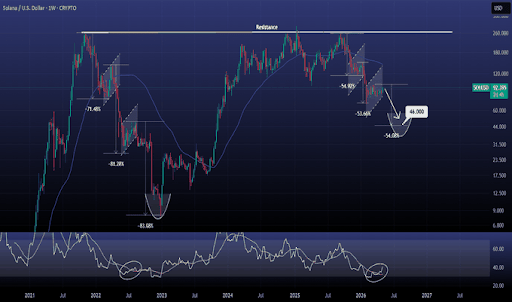
Source: Chart from Senior on X

At the time of writing, the Solana price is trading at around $90, down over 5% in the last 24 hours, according to data from CoinMarketCap.


SOL trading at $90 on the 1D chart | Source: SOLUSDT on Tradingview.com

İlgili Sorular

QAccording to the article, what is the key reason behind Solana reaching a four-month high price?

AThe key reason is renewed interest and record inflows into Solana ETFs from institutional investors. Since the start of the month, these ETFs have recorded a total net inflow of $90 million, pushing SOL to a four-month high of around $97.

QWhat does the data from CoinGlass show about trader sentiment towards SOL in the derivatives market?

ACoinGlass data shows a mixed signal. The long/short ratio is currently below 1, suggesting more traders are bearish on Solana. However, derivative trading volume surged by 33%, options volume is up 116%, and options open interest has climbed 22%, indicating heightened market activity.

QWhat is the Alpenglow upgrade, and why is it significant for Solana?

AThe Alpenglow upgrade is a major consensus change that has gone live on Solana's community test cluster, ahead of its planned mainnet rollout in Q3. It is significant because it is described as the biggest consensus change in Solana's history and aims to make the network 100x faster.

QBesides ETF inflows, what are two other bullish fundamentals for SOL mentioned in the article?

ATwo other bullish fundamentals mentioned are: 1) Western Union launching its USDPT stablecoin on the Solana network, boosting adoption. 2) The potential advancement of the CLARITY Act, which would provide regulatory clarity for SOL if the Senate passes the crypto bill.

QWhat is the immediate technical resistance level for SOL according to the crypto researcher Senior, and what could happen if it breaks above that level?

AAccording to crypto researcher Senior, the immediate technical resistance level for SOL is at $95. His analysis indicates that if SOL successfully breaks above this resistance level, it could easily rally to $100.

İlgili Okumalar

SpaceX, OpenAI, Anthropic: The Three AI Giants Racing for IPO, Which One Is Worth Betting On?

SpaceX, OpenAI, and Anthropic are poised for historic IPOs within weeks, potentially raising a combined $180 billion—a sum exceeding the entire internet bubble's fundraising. The hosts of the Limitless Podcast argue this isn't just individual company financing but an unprecedented capital concentration for AI infrastructure, driven by an insatiable need for compute, data centers, power, and chips. SpaceX's IPO is notable for reportedly changing market index rules to allow faster inclusion, potentially funneling trillions in passive retirement funds into its stock, despite its unproven space-based data center business model. In contrast, Anthropic demonstrates explosive growth, with ARR reportedly hitting $45 billion and approaching profitability, fueled by strong enterprise adoption of products like Claude Code. Google's separate $80 billion raise highlights the immense capital pressure, even for giants. The discussion acknowledges bubble risks but leans optimistic. The hosts contend the massive spending is building essential physical infrastructure for the next technological era. A key bottleneck isn't capital but the real-world limits of chip manufacturing and construction speed. As long as demand for AI compute outstrips supply, this investment cycle represents a foundational build-out rather than a purely financial bubble. All three companies are seen as foundational bets on the future, with Anthropic often cited as the most immediately compelling due to its proven revenue trajectory.

marsbit1 saat önce

SpaceX, OpenAI, Anthropic: The Three AI Giants Racing for IPO, Which One Is Worth Betting On?

marsbit1 saat önce

From 'Old Guys' to 'New Favorites': How AI Is Revaluing Old Infrastructure from Dell to Nokia?

From "Vintage Tech" to "New AI Darlings": How AI Revalues Old Infrastructure One year ago, tech giants like Dell, Nokia, Cisco, and Western Data were seen as slow-growth, low-valuation stories, far from the AI spotlight dominated by players like Nvidia. Now, these legacy tech stocks are gaining market attention, sparking debate on whether this is genuine industry revaluation or a temporary narrative. As AI moves from model parameters to real-world data centers, the market is recognizing companies with proven delivery and infrastructure capabilities. This shift marks a change in the AI investment thesis: from pure model and GPU focus to the complex systems engineering required for deployment. Companies like Dell, HPE, and Corning are being revalued not for being "sexy" AI innovators, but for their decades of accumulated expertise in supply chains, enterprise delivery, and infrastructure—assets that have become critical in the AI buildout phase. The revaluation is unfolding across three key infrastructure lines: 1. **Servers & System Integration:** Dell and HPE are emerging as crucial system integrators or "general contractors" for AI data centers, translating GPU orders into complete, deployable server racks integrated with power, cooling, and networking. 2. **Networking & Connectivity:** AI's scale demands robust high-speed connections. Corning (fiber optics), Nokia (AI-RAN, 6G), and Cisco (data center switches) are gaining importance for enabling efficient data transfer within and between AI clusters. 3. **Storage:** Beyond high-speed memory (HBM/DRAM), the AI data explosion is driving demand for high-capacity hard drives (HDDs) from companies like Western Digital and Seagate to handle training data, logs, and cold storage cost-effectively. For this revaluation to be substantive and not just a narrative, three criteria are key: 1) Concrete AI-related order and revenue growth (e.g., Dell's AI server sales), 2) Upward revisions to company financial guidance, and 3) Sustainable improvements in profit quality, not just top-line revenue spikes. In essence, AI's transition to a real construction phase is re-pricing "old assets" against "new demand." The opportunity, however, is selective. Only those legacy firms that are demonstrably integrated into the capital expenditure chains of data center and enterprise AI deployment are likely to experience a true "logic re-rating" rather than just a temporary valuation bounce.

marsbit1 saat önce

From 'Old Guys' to 'New Favorites': How AI Is Revaluing Old Infrastructure from Dell to Nokia?

marsbit1 saat önce

The Merger of Codex and ChatGPT Marks the Beginning of a Major Reshuffle in Programming Tools

OpenAI is shifting its strategic focus from ChatGPT to Codex, merging them along with the browser tool Atlas into a unified desktop super-app. This move signals an internal belief that Codex, originally a programming tool, represents the next evolution of AI more than conversational models like ChatGPT. Over the past year, Codex's weekly active users have surged past 5 million. The key distinction is that while ChatGPT answers questions, Codex executes tasks. Enterprises increasingly value this ability to get work done over simply receiving advice. Consequently, Codex is attracting professionals beyond developers, including analysts, bankers, marketers, and product managers. OpenAI's reorganization and increased investment in Codex stem from recognizing that the future of AI competition lies in execution capabilities, not just conversation. The company is launching role-specific plugins (e.g., for data analysis, sales, design) to transform Codex into a broad knowledge work platform that automates and redefines white-collar workflows. Beyond being a tool, Codex reflects OpenAI's ambition to redefine software. New features like "Sites"—which generates interactive websites from documents—and collaborative "Annotations" aim to create a paradigm where the AI understands the goal and handles the tools and steps, functioning more like a digital colleague than traditional software. The ultimate goal is a unified experience where the user cares only about the completed task.

marsbit1 saat önce

The Merger of Codex and ChatGPT Marks the Beginning of a Major Reshuffle in Programming Tools

marsbit1 saat önce

Interpreting Investment Opportunities in the Age of Great Navigation, Invesco Great Wall Fund Releases '2026 Report on Chinese Enterprises Going Global'

Invesco Great Wall Fund has released its "2026 China Corporate Globalization Report," titled "The 'Great Navigation Era' of Chinese Enterprises." The report analyzes the new trends and investment opportunities as Chinese companies expand globally, moving from simple product exports to comprehensive overseas operations involving services, branding, and local production. Driven by factors like trade friction, the pursuit of higher profit margins abroad, and policy support, globalization is becoming essential for Chinese companies. The report outlines an evolution: from early product export ("Globalization 1.0") to the current "Globalization 2.0," characterized by overseas capacity, capital goods investment, consumer brand expansion, and service exports. Chinese firms' competitive advantages are highlighted, including a vast engineer talent pool, low-cost and robust infrastructure, and complete industrial clusters. Specific sectors with significant出海 potential are identified: * **Capital Goods** (e.g., engineering machinery, power equipment): Benefiting from global demand, especially in Belt & Road markets and the AI-driven power grid upgrade cycle. * **Consumer Brands**: Transitioning from cost to brand advantage, leveraging供应链 efficiency. * **Technology & Innovation**: Including AI applications, optical modules within global tech supply chains, and new energy vehicles focusing on local production. * **Pharmaceuticals**: Chinese biotech firms are becoming preferred partners for global pharma, with potential for breakthrough drugs in areas like oncology and weight loss. The report concludes that corporate globalization represents a sustained, core theme for China's capital markets, though companies must navigate challenges like geopolitics and localization.

marsbit2 saat önce

Interpreting Investment Opportunities in the Age of Great Navigation, Invesco Great Wall Fund Releases '2026 Report on Chinese Enterprises Going Global'

marsbit2 saat önce

İşlemler

Spot
Futures

Popüler Makaleler

4 Nasıl Satın Alınır

HTX.com’a hoş geldiniz! 4 (4) satın alma işlemlerini basit ve kullanışlı bir hâle getirdik. Adım adım açıkladığımız rehberimizi takip ederek kripto yolculuğunuza başlayın. 1. Adım: HTX Hesabınızı OluşturunHTX'te ücretsiz bir hesap açmak için e-posta adresinizi veya telefon numaranızı kullanın. Sorunsuzca kaydolun ve tüm özelliklerin kilidini açın. Hesabımı Aç2. Adım: Kripto Satın Al Bölümüne Gidin ve Ödeme Yönteminizi SeçinKredi/Banka Kartı: Visa veya Mastercard'ınızı kullanarak anında 4 (4) satın alın.Bakiye: Sorunsuz bir şekilde işlem yapmak için HTX hesap bakiyenizdeki fonları kullanın.Üçüncü Taraflar: Kullanımı kolaylaştırmak için Google Pay ve Apple Pay gibi popüler ödeme yöntemlerini ekledik.P2P: HTX'teki diğer kullanıcılarla doğrudan işlem yapın.Borsa Dışı (OTC): Yatırımcılar için kişiye özel hizmetler ve rekabetçi döviz kurları sunuyoruz.3. Adım: 4 (4) Varlıklarınızı Saklayın4 (4) satın aldıktan sonra HTX hesabınızda saklayın. Alternatif olarak, blok zinciri transferi yoluyla başka bir yere gönderebilir veya diğer kripto para birimlerini takas etmek için kullanabilirsiniz.4. Adım: 4 (4) Varlıklarınızla İşlem YapınHTX'in spot piyasasında 4 (4) ile kolayca işlemler yapın.Hesabınıza erişin, işlem çiftinizi seçin, işlemlerinizi gerçekleştirin ve gerçek zamanlı olarak izleyin. Hem yeni başlayanlar hem de deneyimli yatırımcılar için kullanıcı dostu bir deneyim sunuyoruz.

381 Toplam GörüntülenmeYayınlanma 2025.10.20Güncellenme 2026.06.02

4 Nasıl Satın Alınır

Tartışmalar

HTX Topluluğuna hoş geldiniz. Burada, en son platform gelişmeleri hakkında bilgi sahibi olabilir ve profesyonel piyasa görüşlerine erişebilirsiniz. Kullanıcıların 4 (4) fiyatı hakkındaki görüşleri aşağıda sunulmaktadır.

活动图片