White House Concession Removes Ethical Hurdle, Clarity Act Races Against Final Window Before Recess?

Odaily星球日报2026-07-21 tarihinde yayınlandı2026-07-21 tarihinde güncellendi

Özet

On July 21st, industry sources reported that the Trump administration has agreed to include an ethics provision in the "Clarity Act" (Digital Asset Market Clarity Act of 2025). This concession addresses the long-standing conflict-of-interest concerns regarding government officials and the crypto industry, potentially removing the final major obstacle to the bill's progress. Additionally, Patrick Witt, the executive director of the White House's Digital Asset Advisory Committee, confirmed he will remain in his role to help finalize the bill, alleviating previous concerns about his potential departure. The Clarity Act aims to establish a unified federal regulatory framework for the U.S. digital asset market. Its core objective is to resolve regulatory ambiguity by defining different types of digital assets (digital commodities, investment contract assets, and permitted payment stablecoins) and clarifying the respective oversight roles of the SEC and CFTC. This would end the long-running jurisdictional dispute between the two agencies and provide clearer compliance paths for the industry. With the ethics issue moving toward resolution, the most urgent challenge now is time. The U.S. Congress is set to begin its August recess in mid-August, leaving only a few working weeks to finalize the text and advance the bill through the Senate. Industry advocates, like the Blockchain Association's Kristin Smith, stress that this is a critical moment. If negotiations conclude successfully ...

Original | Odaily Planet Daily (@OdailyChina)

Author | Azuma (@azuma_eth)
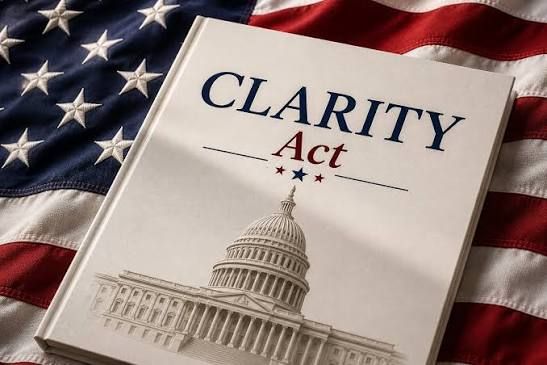
Beijing time, July 21st - Multiple industry sources have revealed that the Trump administration has agreed to include an ethics provision in the "Clarity Act" (Digital Asset Market Structure Bill), and the relevant text has been submitted to some Republican senators. Although the specific details of the provision are not yet fully public, industry participants generally believe this progress could clear the way for an updated version of the bill text (expected to be released in the coming days) and subsequent Senate voting.

Over the past year, negotiations surrounding the "Clarity Act" have progressed slowly. After parties gradually reached compromises on earlier disagreements such as stablecoin yields and DeFi regulation, the biggest remaining controversy was how to handle potential conflicts of interest between U.S. government officials and the crypto industry. With the White House expressing willingness to concede on the ethics provision, the last major obstacle that has long hindered the bill's progress is showing signs of possible resolution.

In addition to progress on the ethics provision, another positive signal regarding the "Clarity Act"'s push emerged this morning: Patrick Witt, Executive Director of the White House Digital Asset Advisory Committee responsible for driving the bill's passage, has confirmed he will remain in his position to help the bill through its final sprint. Previous reports suggested Witt might leave his post before the "Clarity Act" entered a critical Senate phase due to training obligations with the U.S. Army National Guard, which had sparked industry concerns about the bill's pace. Witt has now confirmed that his training mission will be postponed, allowing him to continue participating in the bill's passage process.
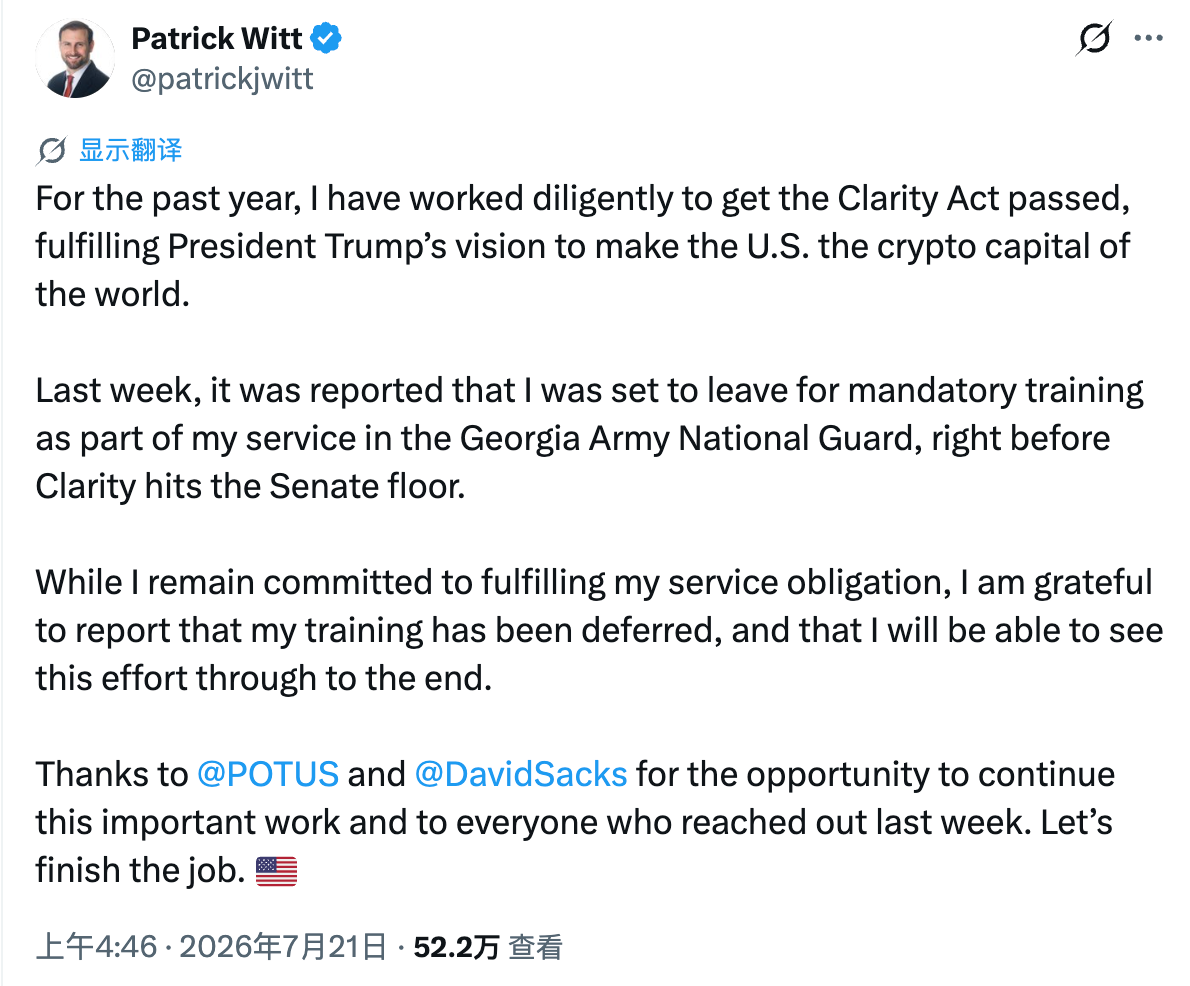
For the entire cryptocurrency industry, the latest developments may indicate that this nearly year-long regulatory standoff has finally reached its most critical turning point.

Content and Significance of the Clarity Act (Skip if Familiar)

As one of the core legislative pieces of the Trump administration's push for the U.S. to become a "global crypto hub," the full name of the "Clarity Act" is the *Digital Asset Market Clarity Act of 2025*. It aims to establish a unified federal regulatory framework for the U.S. digital asset market.

The core objective of this bill is to address the long-standing regulatory ambiguity faced by the U.S. crypto industry in recent years — clarifying the legal attributes of different digital assets and redefining the regulatory responsibilities between the U.S. Securities and Exchange Commission (SEC) and the Commodity Futures Trading Commission (CFTC).

Specifically, the Clarity Act attempts to establish a digital asset classification system, categorizing assets into digital commodities, investment contract assets, and permitted payment stablecoins. Among these, digital commodities with blockchain network functionality would be primarily regulated by the CFTC; investment contract assets involving fundraising and issuance would remain under SEC jurisdiction; stablecoin issuers would mainly be regulated by banking authorities.

The significance of this framework lies in ending the years-long turf war between the SEC and CFTC over digital asset regulatory authority, providing the industry with a clearer compliance path. In the past, under former SEC Chairman Gary Gensler, the SEC tended to classify a large number of digital assets as securities based on the Howey Test, expanding its regulatory scope through enforcement actions; meanwhile, the CFTC argued that some highly decentralized digital assets were closer to commodities and should fall under its purview. This long-standing conflict over regulatory boundaries has kept U.S. crypto businesses, trading platforms, and developers in an uncertain environment.

If the Clarity Act ultimately passes, the U.S. crypto industry may usher in its first comprehensive market structure regulatory framework. For the market, its short-term impact might be boosting sentiment through improved policy expectations, but the longer-term significance lies in reducing regulatory uncertainty and providing a clearer institutional basis for traditional financial institutions and long-term capital to enter the digital asset space.

The Final Disagreement: The Ethics Controversy

The Clarity Act's journey to this point has not been easy. On July 17th last year, the Clarity Act passed the U.S. House of Representatives with a vote of 294 to 134, securing support far exceeding the simple majority requirement. However, unlike the GENIUS Act, which progressed smoothly around the same time and was eventually signed by Trump, the Clarity Act encountered more complex political maneuvering after moving to the Senate.

Compared to the House, while Republicans still hold a majority in the Senate, the Clarity Act, as a major regulatory legislation affecting the entire digital asset market structure, still requires a degree of bipartisan support to proceed to a final vote. This means the bill faces a complex negotiation in the Senate centered on regulatory direction, industry interests, and political demands.

Over the past year, disagreements surrounding the Clarity Act have mainly focused on three areas — stablecoin yield rules, DeFi regulatory boundaries, and potential conflicts of interest between the Trump administration and the crypto industry. Now, the first two major disagreements have gradually cooled as negotiations progressed. Regarding stablecoin yields, once the most contentious issue, parties have reached a compromise solution: "prohibiting yield purely for holding stablecoins, but allowing rewards based on actual activities."

Now, the only issue remaining on the negotiation table is the final disagreement: the ethics issue. Over the past year of negotiations, Congressional members and the White House have spent significant time negotiating ethical clauses aimed at restricting the President, Vice President, members of Congress, and other federal officials from profiting from digital assets during their terms (refer to *Trump's 'Pay Stub' Exposed: Cryptocurrency Generates $1.4 Billion, Stock Trades Exceed 22,000*). With the latest developments this morning, it indicates a potential breakthrough in the last political battle surrounding the "Clarity Act."

More Pressing Than Content Disagreement: Time

However, compared to disputes over the bill's content, an even more pressing problem facing the "Clarity Act" now is time. The U.S. Congress typically enters its August recess in mid-August, leaving only about a dozen working days for both parties to complete text coordination and push for Senate consideration.

Kristin Smith, CEO of the Blockchain Association, which has played a significant lobbying role in the "Clarity Act" process, stated bluntly yesterday: "This is the most critical moment."
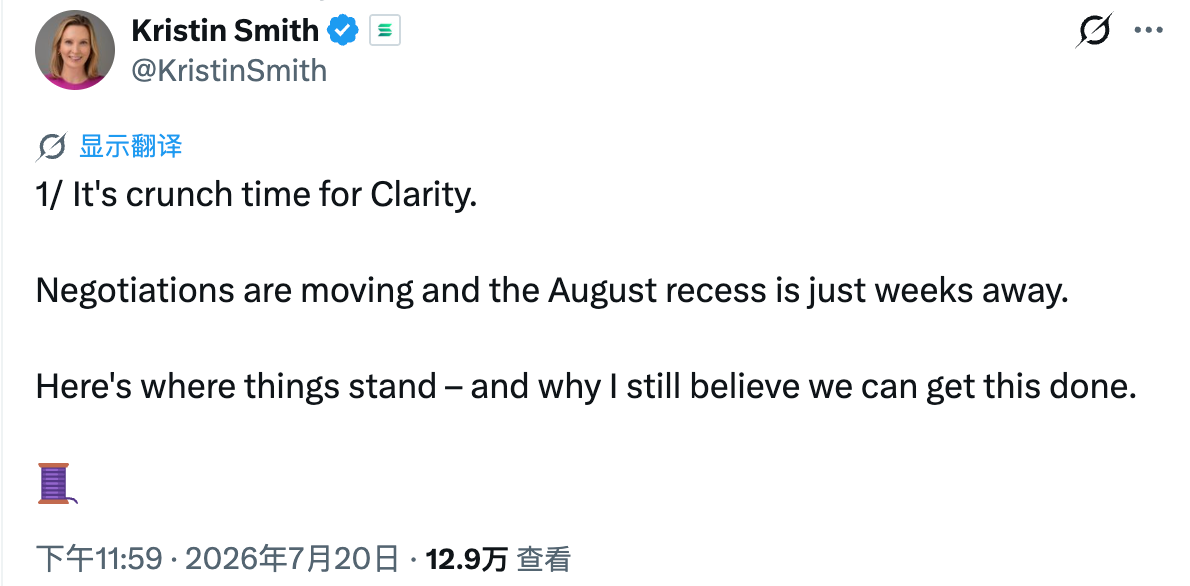
Smith said the "Clarity Act" has gone through a long process, and the current version already includes stronger illegal finance oversight provisions, more comprehensive consumer protection measures, and enhanced regulatory requirements for spot trading platforms. This is one of the most comprehensive digital asset market structure frameworks she has seen. If both sides can resolve the ethics-related disputes in the coming weeks, the "Clarity Act" might have a chance to complete a key breakthrough before the Congressional recess; but if negotiations stall again, this crypto regulatory framework, which has been in the works for over a year, may have to wait for a new political window.

A Historic Turning Point for Crypto Regulation?

Of course, there is still one final step before the "Clarity Act" truly becomes law. Even if the White House has agreed to accept the ethics provision, uncertainties remain regarding the subsequent text release, Senate consideration, and final bipartisan coordination. However, judging from the signals released so far, this digital asset market structure bill, which has undergone over a year of struggle, is getting closer to the finish line.

If the "Clarity Act" can achieve a breakthrough before the August 10th recess, it could become an important turning point in the history of cryptocurrency regulation in the United States and globally. Over the past few years, one of the biggest challenges for the global crypto industry has not been a lack of market demand, but the absence of a sufficiently clear, stable, and predictable regulatory framework. Different jurisdictions have vast differences regarding digital asset attributes, trading platform responsibilities, and issuance rules, forcing businesses and capital to navigate constantly changing regulatory environments.

The significance of the "Clarity Act" lies precisely in its attempt to establish a clearer rule system for digital assets through legislation. Once implemented, this framework could provide an important reference model for global markets. For trading platforms, it means a clearer registration and operation path; for developers, a more predictable innovation environment; and for traditional financial institutions, clearer compliance foundations for entering the digital asset space.

This is not just an upgrade of the U.S. regulatory system itself; it represents the global digital asset market gradually transitioning from the early stage of regulatory exploration to a more mature, institutionalized development phase.

Recommended Reading:

CLARITY Act Countdown: 25 Days Left – How Will the Crypto Market Respond if It Fails Before August Recess?


Trend Kriptolar

İlgili Sorular

QWhat is the Clarity Act and what is its main purpose?

AThe Clarity Act, short for the Digital Asset Market Clarity Act of 2025, is a piece of legislation aimed at establishing a unified federal regulatory framework for the US digital asset market. Its main purpose is to resolve long-standing regulatory ambiguity by clearly defining the legal status of different digital assets (e.g., digital commodities, investment contract assets, stablecoins) and re-delineating the regulatory jurisdictions between the SEC and the CFTC.

QWhat was the most significant remaining obstacle to the Clarity Act's progress as described in the article?

AThe most significant remaining obstacle was the ethics provision. This involved handling potential conflicts of interest between US government officials and the cryptocurrency industry, specifically aiming to restrict federal officials from profiting from digital assets during their tenure. The article indicates recent progress, with the Trump administration agreeing to include such a provision.

QWhy is time considered a particularly urgent factor for the Clarity Act's passage?

ATime is urgent because the US Congress typically enters its August recess in mid-August. The article states there are only about a dozen working days left for both parties to finalize the bill's text and push it through Senate consideration before this recess. Missing this window could delay the bill until a new political opportunity arises.

QWho is Patrick Witt and what was the significance of him staying in his role?

APatrick Witt is the Executive Director of the White House Digital Asset Advisory Council, responsible for driving the bill's enactment. The significance of him confirming he would stay on is that it removes a potential disruption to the bill's final push. There were concerns he might leave for military training, but his training was postponed, allowing him to continue assisting the bill's passage.

QAccording to the article, what could be the broader global significance if the Clarity Act is passed?

AIf passed, the Clarity Act could represent a major turning point in global crypto regulation. It would provide a clearer, more stable, and predictable regulatory framework. This could serve as a key reference model for other jurisdictions, potentially helping the global digital asset market transition from an early exploratory regulatory phase to a more mature and institutionalized stage of development.

İlgili Okumalar

9.42 Million Retail Investors Compete for Changxin Technology, Who Got Allotted?

Evergreen Technology's IPO subscription results are now available. On July 20, the domestic memory chip giant announced the offline preliminary allotment results and online lottery results for its IPO. A total of approximately 9.43 million retail investors participated in the online subscription, generating 770,000 winning lots with a final winning rate of about 0.4714%, setting a record for new shares on the STAR Market. After triggering a clawback mechanism from institutional to retail investors, the online retail allocation was significantly increased to 3.851 billion shares. Simultaneously, 285 institutional investors participated in the offline subscription, ultimately receiving 2.173 billion shares at an allotment rate of approximately 0.1756%. Leading insurers and public funds were among the major recipients. Notably, Liang Wenfeng, founder of the major AI model company DeepSeek, through his quantitative investment firms Ningbo Huanfang Quantitative and Zhejiang Jiuzhang Asset, secured the largest share among private funds, with a total allotment worth approximately 175 million yuan. Estimates suggest potential profits could reach 730 million yuan if Evergreen Technology's market capitalization reaches 3 trillion yuan post-listing. The company is expected to list on July 27 and could become the highest-valued tech stock on the A-share market, with various brokerages providing valuations ranging from 1 trillion to over 4 trillion yuan. However, recent significant corrections in global tech stocks may impact its post-listing performance. (Character count: 1,196)

marsbit14 dk önce

9.42 Million Retail Investors Compete for Changxin Technology, Who Got Allotted?

marsbit14 dk önce

L2 'Recalibration': When L1 Becomes Its Own Rollup, What Is Ethereum's Endgame?

The article discusses the evolving relationship between Ethereum's Layer 1 (L1) and Layer 2 (L2) solutions, moving beyond the initial "L2 for scaling" model. As Ethereum L1 itself scales (increasing Gas Limit, statelessness, zkEVM), the unique value proposition of L2s shifts from merely providing cheap execution to offering differentiated features like application-specific optimization, privacy, and flexible governance. The piece explores three key themes: 1. **L2's New Role:** L2s are transitioning from a pure scaling technology to a spectrum of execution environments with varying degrees of security inheritance from Ethereum L1. 2. **Interoperability as State Trust:** Solving L2 fragmentation is less about cross-chain bridges and more about enabling faster, trust-minimized state verification between environments. This involves initiatives like faster L1 finality, intent-based architectures (Open Intents Framework), and native account abstraction. 3. **Blurring Layers:** With the potential integration of zk-proofs into L1 validation (making L1 akin to its own "Rollup") and the concept of "Native Rollups," the rigid boundary between L1 and L2 may fade. The future could be a unified system with multiple execution domains (for DeFi, gaming, privacy, etc.) sharing a common security, settlement, and state framework. In conclusion, Ethereum's goal is not to abandon L2s or re-centralize everything on L1, but to re-integrate the fragmented user experience—liquidity, accounts, applications—while preserving the scaling benefits of a multi-environment ecosystem. The endgame is a cohesive "one chain" feeling for users, powered by diverse but securely interconnected execution layers.

marsbit55 dk önce

L2 'Recalibration': When L1 Becomes Its Own Rollup, What Is Ethereum's Endgame?

marsbit55 dk önce

İşlemler

Spot

Popüler Makaleler

HOUSE Nasıl Satın Alınır

HTX.com’a hoş geldiniz! Housecoin (HOUSE) satın alma işlemlerini basit ve kullanışlı bir hâle getirdik. Adım adım açıkladığımız rehberimizi takip ederek kripto yolculuğunuza başlayın. 1. Adım: HTX Hesabınızı OluşturunHTX'te ücretsiz bir hesap açmak için e-posta adresinizi veya telefon numaranızı kullanın. Sorunsuzca kaydolun ve tüm özelliklerin kilidini açın. Hesabımı Aç2. Adım: Kripto Satın Al Bölümüne Gidin ve Ödeme Yönteminizi SeçinKredi/Banka Kartı: Visa veya Mastercard'ınızı kullanarak anında Housecoin (HOUSE) satın alın.Bakiye: Sorunsuz bir şekilde işlem yapmak için HTX hesap bakiyenizdeki fonları kullanın.Üçüncü Taraflar: Kullanımı kolaylaştırmak için Google Pay ve Apple Pay gibi popüler ödeme yöntemlerini ekledik.P2P: HTX'teki diğer kullanıcılarla doğrudan işlem yapın.Borsa Dışı (OTC): Yatırımcılar için kişiye özel hizmetler ve rekabetçi döviz kurları sunuyoruz.3. Adım: Housecoin (HOUSE) Varlıklarınızı SaklayınHousecoin (HOUSE) satın aldıktan sonra HTX hesabınızda saklayın. Alternatif olarak, blok zinciri transferi yoluyla başka bir yere gönderebilir veya diğer kripto para birimlerini takas etmek için kullanabilirsiniz.4. Adım: Housecoin (HOUSE) Varlıklarınızla İşlem YapınHTX'in spot piyasasında Housecoin (HOUSE) ile kolayca işlemler yapın.Hesabınıza erişin, işlem çiftinizi seçin, işlemlerinizi gerçekleştirin ve gerçek zamanlı olarak izleyin. Hem yeni başlayanlar hem de deneyimli yatırımcılar için kullanıcı dostu bir deneyim sunuyoruz.

382 Toplam GörüntülenmeYayınlanma 2025.04.27Güncellenme 2026.06.02

HOUSE Nasıl Satın Alınır

Tartışmalar

HTX Topluluğuna hoş geldiniz. Burada, en son platform gelişmeleri hakkında bilgi sahibi olabilir ve profesyonel piyasa görüşlerine erişebilirsiniz. Kullanıcıların HOUSE (HOUSE) fiyatı hakkındaki görüşleri aşağıda sunulmaktadır.

活动图片