Vibe Coding, Possibly a New Narrative for Web3

深潮2025-12-19 tarihinde yayınlandı2025-12-19 tarihinde güncellendi

Özet

"Vibe Coding, the Next Web3 Narrative" explores how AI-assisted development, or "Vibe Coding," is poised to transform Web3 application landscape, similar to how Pump.fun revolutionized token creation. Key signals from Web2 indicate rapid growth: programming-related LLM queries grew from 11% to 50% of all usage in under a year, and leading AI development platforms saw valuations surge 72x. Studies show 84% of developers use or plan to use AI tools, with 41% of code now AI-generated. While Web3 Vibe Coding platforms are still emerging, early examples include: - @dreamspaceHQ for no-code website and dashboard creation with multi-chain data aggregation. - @Minidevx for building mini-apps on Farcaster. - @Poofnew, a chain-based Replit alternative for creating apps via prompts. - @RemixGG_ for creating and playing games on Base. The movement empowers non-developers (especially degens) to rapidly experiment with consumer apps, trading terminals, SocialFi, and more—accelerating innovation and narrative cycles. The article concludes that Vibe Coding could do for Web3 apps what Pump.fun did for tokens, marking 2026 as a pivotal year for adoption and signaling.

Author:miguelrare

Compiled by: Deep Tide TechFlow

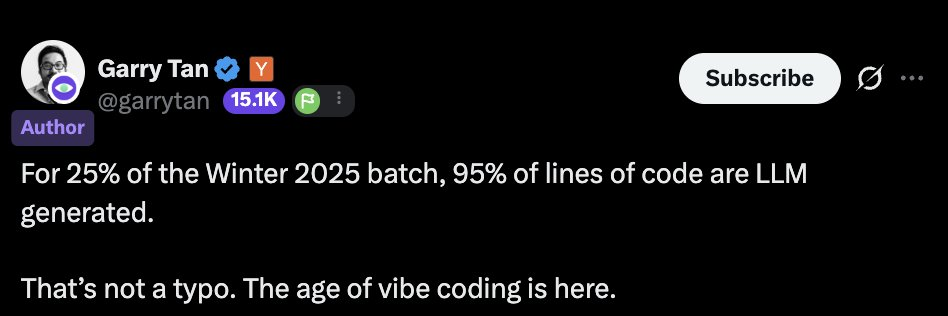
Pumpfun has brought hundreds of thousands of new tokens to the market,

and Vibecoding will bring the same transformation to Web3 applications.
$GOAT is a pioneer in the field of AI agents.

It successfully combined two major hot narratives at the time: AI agents + Meme coins, instantly making "token value" clear to speculators (degens).

However, $GOAT did not appear out of thin air; its success relied on a series of important catalysts from Web2—the infrastructure provided by X and the growing momentum of OpenAI.

If you were active in the market at the time, you probably remember what happened next.

Shortly after $GOAT was launched, everyone started talking about Virtual Protocol. This was a project that existed before the narrative exploded, and its FDV (fully diluted valuation) had hovered between $20 million and $50 million for nearly a year.

Now, a very similar pattern is forming around Vibecoding. This term has only recently emerged. Some speculators are already doing Vibecoding for simple on-chain projects, but due to a lack of infrastructure, especially in the Web3 space, these applications have failed to gain enough attention.

Here is a detailed analysis:

  • The rise of Vibecoding in Web2

  • Its inevitable impact on Web3

  • The formation of early on-chain infrastructure

  • Bullish signals from Web2

Bullish Signals from Web2

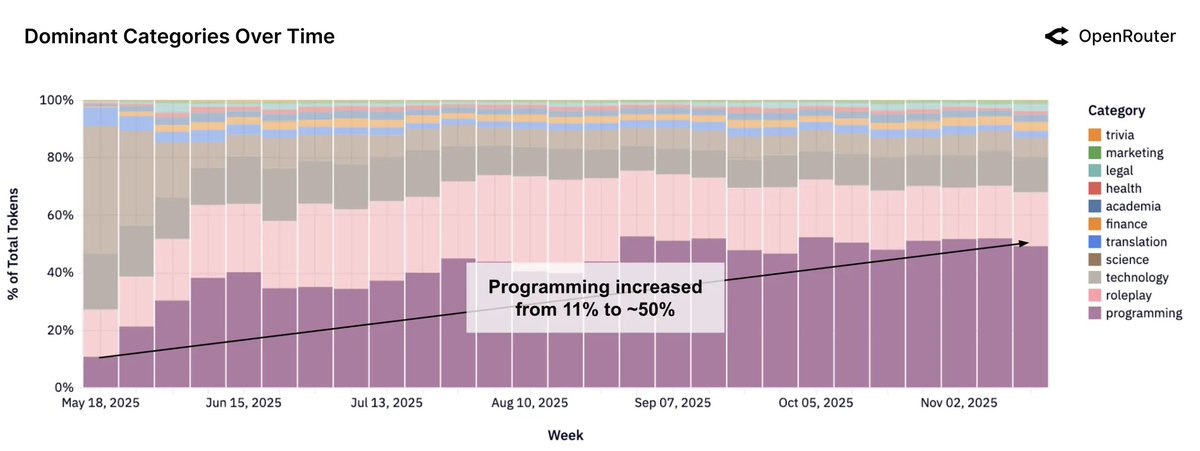
From May 2025 to December 2025, the proportion of all LLM queries related to programming grew from 11% to 50%.

In less than a year, programming queries accounted for half of all LLM usage categories.
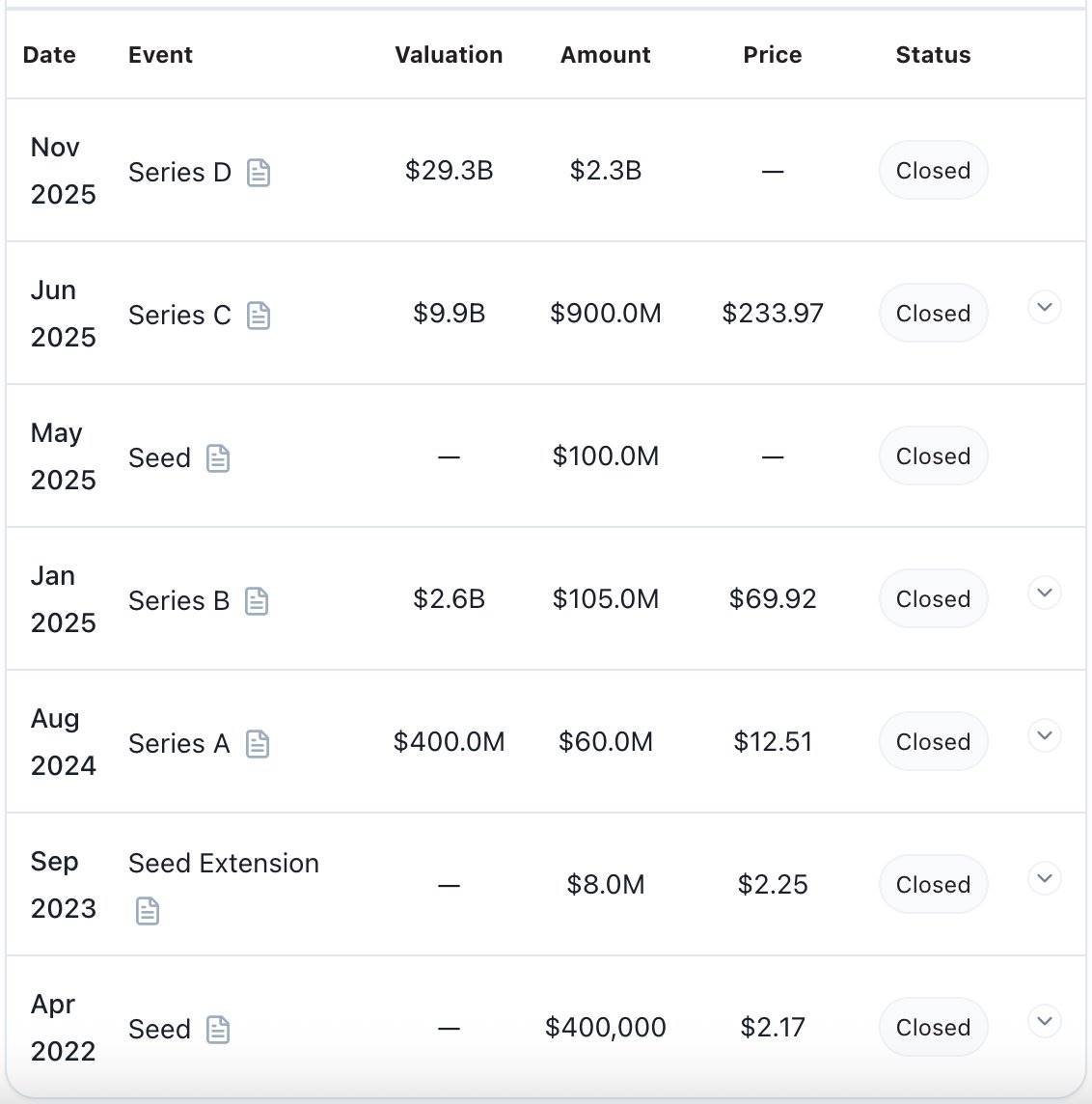
At the same time, the valuation of the most popular AI-driven development platform surged 72 times in one year, from $400 million to $29.3 billion.
If we zoom out and look at survey data and research reports, there are three important signals worth noting:

  • 84% of respondents are using or plan to use AI tools in their development process.

  • 41% of code is now generated by AI.

  • Developers report that AI tools improve productivity by an average of 10%-30%.

At the same time, it is important to clarify that Vibecoding is not the same as AI-assisted development.

For complex production-level systems, relying solely on Vibecoding may be risky. However, given the astonishing expansion speed of this field, more and more developers will begin to incorporate Vibecoding into their workflows.

(According to the 2025 Stack Overflow Developer Survey, only 17% of developers are currently using Vibecoding, which means there is still huge room for growth.)

The PumpFun Effect

A few years ago, issuing your own token was not easy. Teams tried various issuance mechanisms until PumpFun introduced an extremely simple model. PumpFun provided creators with a simplified way to issue tokens and also brought a new trading experience to speculators (degens). So, why can't we see a similar pattern replicated in Web3 applications?
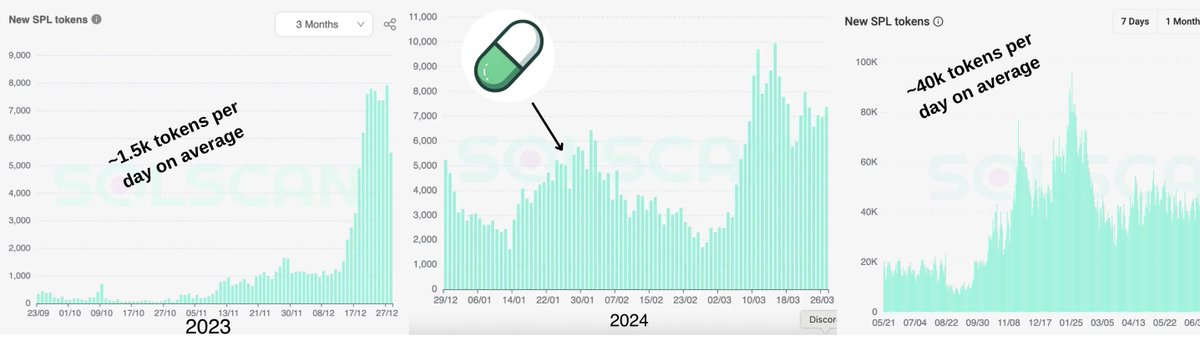
Speculators (Degens) are always the first users and early adopters of emerging narratives.

Many of them know exactly what products the market currently needs, how to launch these products, and what Crypto Twitter (CT) truly cares about—because they have been observing new project launches for years.

Empowering degens to turn ideas into products without coding skills or high costs essentially provides the front line with fresh ideas to experiment with.

Therefore, we may see hundreds of creative experiments emerging across multiple tracks:

Consumer applications, trading terminals, SocialFi, prediction markets, GameFi Ponzi projects, and more.

This phenomenon, in turn, may accelerate the growth of specific market narratives.

Beyond the Front Line: AI Integration into Core Protocols

Beyond the abstract concept of "frontline narratives," there is another direction that excites me—AI directly integrated into large protocols.

The simplest example is trading terminals.

Delta-neutral strategies, points farming, arbitrage operations—all of these can be transformed into personalized bots or features by users entering simple prompts on the platform.

For example:

Monitor the funding rates of tokenized stocks and automatically open positions when significant spreads appear between two perpetual decentralized exchanges (perps DEXes).

In practice, this approach allows platforms to meet thousands of small user needs that are often relatively simple but overlooked by teams.

"We already have Cursor, Replit, Lovable—why do we need a Web3 fork?"
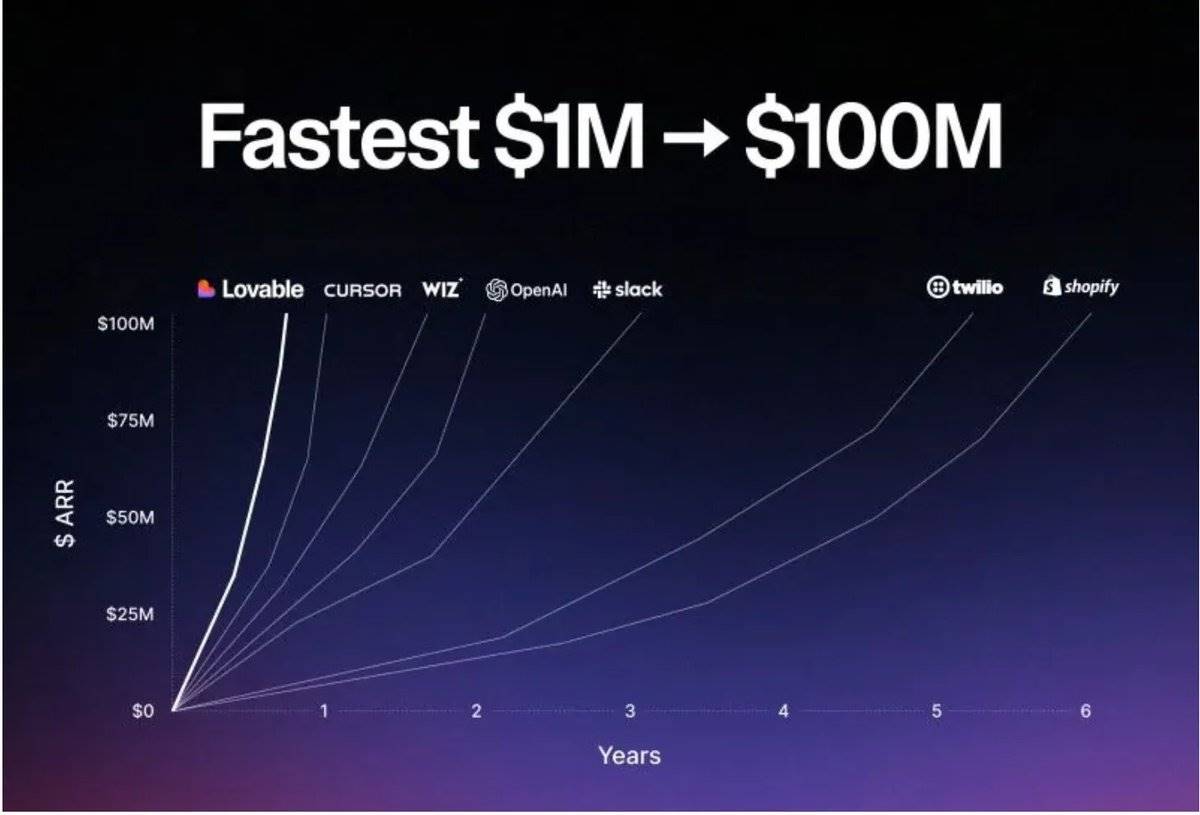
For a while, I asked myself the same question.

But after extensive research, the answer became very clear.

Even in the Web2 Vibecoding space, there is no absolute winner. Each platform has its unique features, including its own priorities, functions, and target user groups.

Some products excel at solving one or two specific problems,

while others try to do everything and end up achieving nothing.

Web3 Vibecoding platforms will not be hindered by competition with Lovable or Replit.

Their infrastructure is specifically built for on-chain creativity, not for Web2 applications.

Web3 Vibe Ecosystem
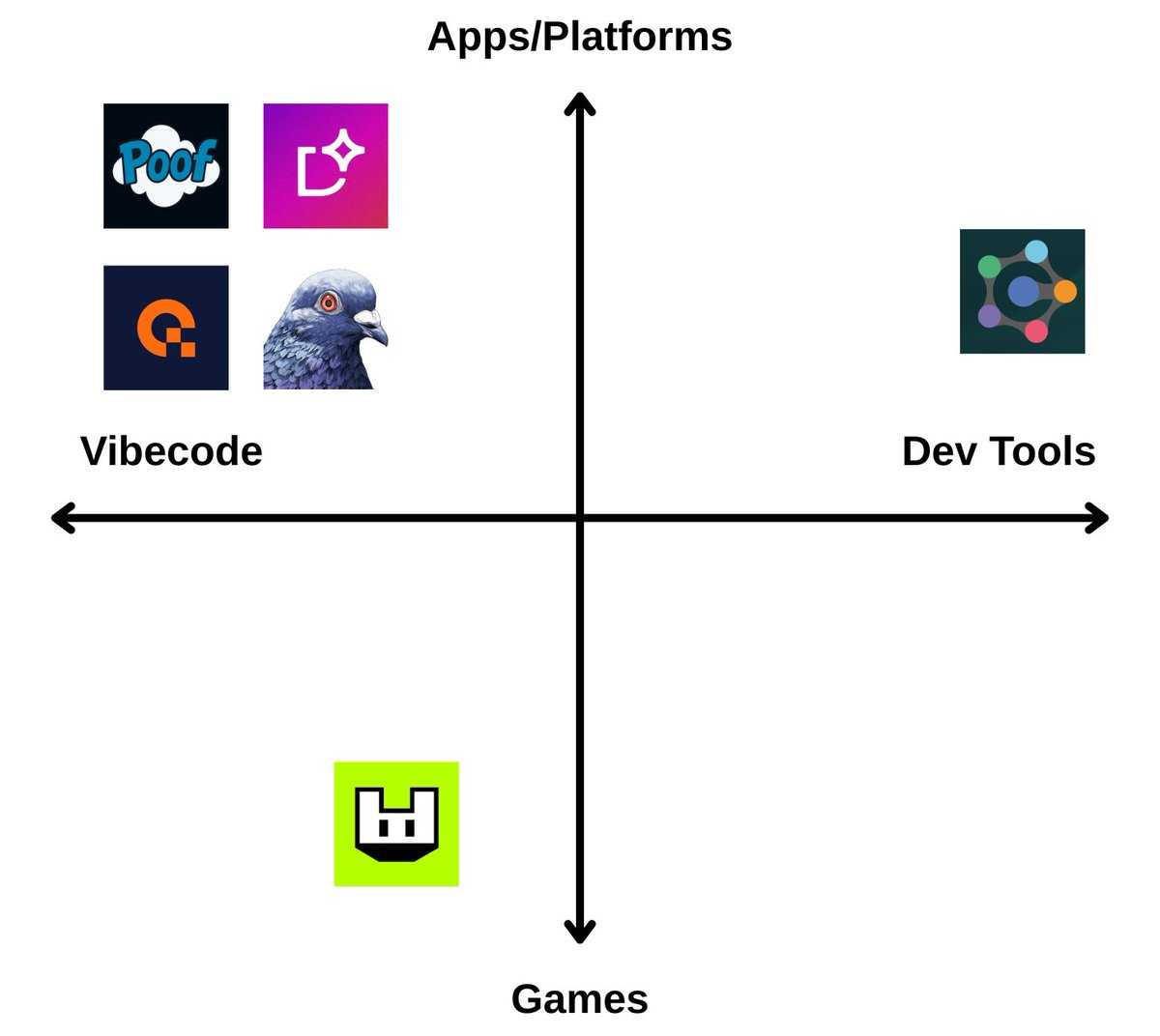
As of December 2025, there are still very few Web3 projects focused on Vibecoding or development tools, and cases of non-developers successfully launching meaningful Web3 products are even rarer.

Nevertheless, I believe it is still very important to sort out the current industry landscape.

Application/Platform Overview

@dreamspaceHQ—Without any coding knowledge, you can create websites, platforms, and dashboards.

The core advantage of Dreamspace is that, in addition to creating or connecting smart contracts through prompts, you can also aggregate data across multiple chains: BTC, ETH, zkSync, Sei, Base, and even Stellar, WTF?

@Minidevx—A Vibecoding platform based on Base, focused on building mini-apps on Farcaster.

Currently, the product is still in its early stages, with relatively few launched applications.

Minidev launched its token $MINI about a month ago—which may seem a bit rushed. Nevertheless, @0xjenil is still actively launching and improving the product, so I wouldn't be surprised to see high-quality applications emerging on Minidev soon.

@Poofnew —An on-chain version of Replit

Poof allows you to create on-chain websites and applications through prompts, which are passed to an agent and then assigned to three specialized agents: UI Agent, Smart Contract Agent, and Actions Agent.

In July of this year, the team showcased an application built entirely using Poof, where two users could duel for a "Waifu" and bet SOL in the process.

This kind of project demonstrates the flexibility of Poof as an experimental field.

Games

@RemixGG_ —A Vibecoding platform where you can create games on Base through prompts or play hundreds of games created by other users.

Some of these games are really quite good.

This application is extremely simple: download it to your phone, no wallet required, swipe through the content, try out games, or create your own.

In my opinion, this is exactly the kind of product that can attract Web2 users—they won't even realize they are using Web3 infrastructure.

Development Tools

@CodigoPlatform—Codigo is an AI-driven development platform built specifically for Solana.

It combines a cloud IDE, specially trained AI models, and complete build and deployment tools.

However, unlike Poof, Codigo is difficult to classify as a Vibecoding platform—you still need some programming skills.

Trading Bots

@pigeon_trade —A trading bot with built-in AI.

In addition to spot, perpetual, and prediction market trading, you can chat with Pigeon and Vibecode custom functions, such as:

  • Monitor funding rates on specific DEXes, set alerts, or automatically open positions

  • Track selected wallets and copy trades

  • Look for arbitrage opportunities on Polymarket and more.

Final Thoughts

Currently, there are still very few high-quality Web3 Vibecoding platforms.

Most existing projects are either still in development or have not found product-market fit (PMF), which is completely normal.

As mentioned earlier, Virtual Protocol also took a long time to form a complete narrative.

Often, the product is not bad; it is just launched too early.

I firmly believe that 2026 will be the year we start to see real signals:

Non-developers will independently build profitable Web2 companies based on creativity, large platforms will integrate Vibecoding tools, and the number of users and annual recurring revenue (ARR) of Cursor, Replit, and Lovable will continue to grow exponentially.

As always, degens will be the first users.

In a few months or a year, we will look back and compare the starting point of the Vibecoding narrative to the rise of PumpFun.

The only difference?

Pumpfun brought us hundreds of thousands of new tokens -> Vibecoding will bring the same transformation to Web3 applications.

İlgili Sorular

QWhat is the core argument made about Vibecoding in relation to Web3?

AThe article argues that Vibecoding will bring a transformative change to Web3 applications, similar to how Pump.fun revolutionized token creation by enabling the launch of hundreds of thousands of new tokens. It suggests that Vibecoding will empower non-developers to easily build and experiment with on-chain applications, accelerating innovation and adoption in the Web3 space.

QAccording to the article, what are some key bullish signals from Web2 that support the rise of Vibecoding?

AKey bullish signals from Web2 include: programming-related LLM queries growing from 11% to 50% of all queries between May and December 2025; the valuation of a popular AI-driven development platform surging 72x from $400M to $29.3B in a year; 84% of surveyed developers using or planning to use AI tools; 41% of code now being AI-generated; and AI tools boosting developer productivity by 10-30% on average.

QHow does the article compare the potential impact of Vibecoding to the 'Pump.fun effect'?

AThe article compares Vibecoding to the 'Pump.fun effect' by stating that just as Pump.fun simplified token creation and launched a massive wave of new tokens, Vibecoding platforms will democratize the creation of Web3 applications. It will allow degens and non-coders to easily turn ideas into on-chain products, leading to hundreds of creative experiments across various sectors like consumer apps, trading terminals, SocialFi, and GameFi.

QName three Web3 projects mentioned in the article that are building Vibecoding infrastructure and briefly describe their focus.

A1. @dreamspaceHQ: A platform for creating websites, platforms, and dashboards with no coding, with a core strength in aggregating data across multiple blockchains. 2. @Poofnew: An on-chain version of Replit that uses AI agents to build on-chain websites and applications from prompts. 3. @RemixGG_: A Vibecoding platform focused on creating and playing games on Base, designed to be simple and accessible to attract Web2 users.

QWhat is the author's outlook for the Vibecoding narrative in 2026?

AThe author believes that 2026 will be the year we start to see real signals of Vibecoding's impact: non-developers independently building profitable Web2 companies, large platforms integrating Vibecoding tools, and continued exponential growth in user numbers and Annual Recurring Revenue (ARR) for platforms like Cursor, Replit, and Lovable. Degens will be the first users, and the narrative's rise will be compared to that of Pump.fun.

İlgili Okumalar

North Korean Hackers Loot $500 Million in a Single Month, Becoming the Top Threat to Crypto Security

North Korean hackers, particularly the notorious Lazarus Group and its subgroup TraderTraitor, have stolen over $500 million from cryptocurrency DeFi platforms in less than three weeks, bringing their total theft for the year to over $700 million. Recent major attacks on Drift Protocol and KelpDAO, resulting in losses of approximately $286 million and $290 million respectively, highlight a strategic shift: instead of targeting core smart contracts, attackers are now exploiting vulnerabilities in peripheral infrastructure. For instance, the KelpDAO attack involved compromising downstream RPC infrastructure used by LayerZero's decentralized validation network (DVN), allowing manipulation without breaching core cryptography. This sophisticated approach mirrors advanced corporate cyber-espionage. Additionally, North Korea has systematically infiltrated the global crypto workforce, with an estimated 100 operatives using fake identities to gain employment at blockchain companies, enabling long-term access to sensitive systems and facilitating large-scale thefts. According to Chainalysis, North Korean-linked hackers stole a record $2 billion in 2025, accounting for 60% of all global crypto theft that year. Their total historical crypto theft has reached $6.75 billion. Post-theft, they employ specialized money laundering methods, heavily relying on Chinese OTC brokers and cross-chain mixing services rather than standard decentralized exchanges. Security experts, while acknowledging the increased sophistication, emphasize that many attacks still exploit fundamental weaknesses like poor access controls and centralized operational risks. Strengthening private key management, limiting privileged access, and enhancing coordination among exchanges, analysts, and law enforcement immediately after an attack are critical to improving defense and fund recovery chances. The industry's challenge now extends beyond secure smart contracts to safeguarding operational security at the infrastructure level.

marsbit58 dk önce

North Korean Hackers Loot $500 Million in a Single Month, Becoming the Top Threat to Crypto Security

marsbit58 dk önce

Circle CEO's Seoul Visit: No Korean Won Stablecoin Issuance, But Met All Major Korean Banks

Circle CEO Jeremy Allaire's recent activities in Seoul indicate a strategic shift for the company, moving away from issuing a Korean won-backed stablecoin and instead focusing on embedding itself as a key infrastructure provider within Korea’s financial and crypto ecosystem. Despite Korea accounting for nearly 30% of global crypto trading volume—with a market characterized by high retail participation and altcoin dominance—Circle has chosen not to compete for the role of stablecoin issuer. Instead, Allaire met with major Korean banks (including Shinhan, KB, and Woori), financial groups, leading exchanges (Upbit, Bithumb, Coinone), and tech firms like Kakao. This approach reflects a broader industry transition: the core of stablecoin competition is shifting from issuance rights to systemic positioning. With Korean regulators still debating whether banks or tech companies should issue stablecoins, Circle is avoiding regulatory uncertainty by strengthening its role as a service and technology partner. The company is deepening integration with trading platforms, building connections, and promoting stablecoin infrastructure. This positions Circle to benefit regardless of which entity eventually issues a won stablecoin. Allaire also noted the potential for a Chinese yuan stablecoin in the next 3–5 years, underscoring a regional trend of stablecoins becoming more regulated and integrated with traditional finance. Ultimately, Circle’s strategy highlights that future influence in the stablecoin market will belong not necessarily to the issuers, but to the foundational infrastructure layers that enable cross-system transactions.

marsbit1 saat önce

Circle CEO's Seoul Visit: No Korean Won Stablecoin Issuance, But Met All Major Korean Banks

marsbit1 saat önce

SpaceX Ties Up with Cursor: A High-Stakes AI Gambit of 'Lock First, Acquire Later'

SpaceX has secured an option to acquire AI programming company Cursor for $60 billion, with an alternative clause requiring a $10 billion collaboration fee if the acquisition does not proceed. This structure is not merely a potential acquisition but a strategic move to control core access points in the AI era. The deal is designed as a flexible, dual-path arrangement, allowing SpaceX to either fully acquire Cursor or maintain a binding partnership through high-cost collaboration. This "option-style" approach minimizes immediate regulatory and integration risks while ensuring long-term alignment between the two companies. At its core, the transaction exchanges critical AI-era resources: SpaceX provides its Colossus supercomputing cluster—one of the world’s most powerful AI training infrastructures—while Cursor contributes its AI-native developer environment and strong product adoption. This synergy connects compute power, models, and application layers, forming a closed-loop AI capability stack. Cursor, founded in 2022, has achieved rapid growth with over $1 billion in annual revenue and widespread enterprise adoption. Its value lies in transforming software development through AI agents capable of coding, debugging, and system design—positioning it as a gateway to future software production. For SpaceX, this move is part of a broader strategy to evolve from a aerospace company into an AI infrastructure empire, integrating xAI, supercomputing, and chip manufacturing. Controlling Cursor fills a gap in its developer tooling layer, strengthening its AI narrative ahead of a potential IPO. The deal reflects a shift in AI competition from model superiority to ecosystem and entry-point control. With programming tools as a key battleground, securing developer loyalty becomes crucial for dominating the software production landscape. Risks include questions around Cursor’s valuation, technical integration challenges, and potential regulatory scrutiny. Nevertheless, the deal underscores a strategic bet: controlling both compute and software development access may redefine power dynamics in the AI-driven future.

marsbit2 saat önce

SpaceX Ties Up with Cursor: A High-Stakes AI Gambit of 'Lock First, Acquire Later'

marsbit2 saat önce

İşlemler

Spot
Futures

Popüler Makaleler

CFG Nasıl Satın Alınır

HTX.com’a hoş geldiniz! Centrifuge (CFG) satın alma işlemlerini basit ve kullanışlı bir hâle getirdik. Adım adım açıkladığımız rehberimizi takip ederek kripto yolculuğunuza başlayın. 1. Adım: HTX Hesabınızı OluşturunHTX'te ücretsiz bir hesap açmak için e-posta adresinizi veya telefon numaranızı kullanın. Sorunsuzca kaydolun ve tüm özelliklerin kilidini açın. Hesabımı Aç2. Adım: Kripto Satın Al Bölümüne Gidin ve Ödeme Yönteminizi SeçinKredi/Banka Kartı: Visa veya Mastercard'ınızı kullanarak anında Centrifuge (CFG) satın alın.Bakiye: Sorunsuz bir şekilde işlem yapmak için HTX hesap bakiyenizdeki fonları kullanın.Üçüncü Taraflar: Kullanımı kolaylaştırmak için Google Pay ve Apple Pay gibi popüler ödeme yöntemlerini ekledik.P2P: HTX'teki diğer kullanıcılarla doğrudan işlem yapın.Borsa Dışı (OTC): Yatırımcılar için kişiye özel hizmetler ve rekabetçi döviz kurları sunuyoruz.3. Adım: Centrifuge (CFG) Varlıklarınızı SaklayınCentrifuge (CFG) satın aldıktan sonra HTX hesabınızda saklayın. Alternatif olarak, blok zinciri transferi yoluyla başka bir yere gönderebilir veya diğer kripto para birimlerini takas etmek için kullanabilirsiniz.4. Adım: Centrifuge (CFG) Varlıklarınızla İşlem YapınHTX'in spot piyasasında Centrifuge (CFG) ile kolayca işlemler yapın.Hesabınıza erişin, işlem çiftinizi seçin, işlemlerinizi gerçekleştirin ve gerçek zamanlı olarak izleyin. Hem yeni başlayanlar hem de deneyimli yatırımcılar için kullanıcı dostu bir deneyim sunuyoruz.

255 Toplam GörüntülenmeYayınlanma 2026.03.19Güncellenme 2026.03.19

CFG Nasıl Satın Alınır

WL Nedir

I. Proje TanıtımıWorldLand, Ethereum ekosistemini geliştirmek için tasarlanmış, Ethereum'un L2 veya yan zinciridir.II. Token Bilgileri1) Temel BilgilerToken adı: WL (WorldLand)III. İlgili BağlantılarWeb sitesi:https://worldland.foundation/Keşif Araçları:https://bscscan.com/address/0x8aaB31fbc69C92fa53f600910Cf0f215531F8239Sosyal Medya:https://x.com/WorldLand_space Not: Proje tanıtımı, resmi proje ekibi tarafından yayımlanan veya sağlanan materyallerden gelmektedir, yalnızca referans amaçlıdır ve yatırım tavsiyesi niteliği taşımaz. HTX, ortaya çıkan doğrudan veya dolaylı kayıplardan sorumluluk kabul etmez.

152 Toplam GörüntülenmeYayınlanma 2026.03.28Güncellenme 2026.03.28

WL Nedir

WL Nasıl Satın Alınır

HTX.com’a hoş geldiniz! WorldLand (WL) satın alma işlemlerini basit ve kullanışlı bir hâle getirdik. Adım adım açıkladığımız rehberimizi takip ederek kripto yolculuğunuza başlayın. 1. Adım: HTX Hesabınızı OluşturunHTX'te ücretsiz bir hesap açmak için e-posta adresinizi veya telefon numaranızı kullanın. Sorunsuzca kaydolun ve tüm özelliklerin kilidini açın. Hesabımı Aç2. Adım: Kripto Satın Al Bölümüne Gidin ve Ödeme Yönteminizi SeçinKredi/Banka Kartı: Visa veya Mastercard'ınızı kullanarak anında WorldLand (WL) satın alın.Bakiye: Sorunsuz bir şekilde işlem yapmak için HTX hesap bakiyenizdeki fonları kullanın.Üçüncü Taraflar: Kullanımı kolaylaştırmak için Google Pay ve Apple Pay gibi popüler ödeme yöntemlerini ekledik.P2P: HTX'teki diğer kullanıcılarla doğrudan işlem yapın.Borsa Dışı (OTC): Yatırımcılar için kişiye özel hizmetler ve rekabetçi döviz kurları sunuyoruz.3. Adım: WorldLand (WL) Varlıklarınızı SaklayınWorldLand (WL) satın aldıktan sonra HTX hesabınızda saklayın. Alternatif olarak, blok zinciri transferi yoluyla başka bir yere gönderebilir veya diğer kripto para birimlerini takas etmek için kullanabilirsiniz.4. Adım: WorldLand (WL) Varlıklarınızla İşlem YapınHTX'in spot piyasasında WorldLand (WL) ile kolayca işlemler yapın.Hesabınıza erişin, işlem çiftinizi seçin, işlemlerinizi gerçekleştirin ve gerçek zamanlı olarak izleyin. Hem yeni başlayanlar hem de deneyimli yatırımcılar için kullanıcı dostu bir deneyim sunuyoruz.

201 Toplam GörüntülenmeYayınlanma 2026.03.28Güncellenme 2026.03.28

WL Nasıl Satın Alınır

Tartışmalar

HTX Topluluğuna hoş geldiniz. Burada, en son platform gelişmeleri hakkında bilgi sahibi olabilir ve profesyonel piyasa görüşlerine erişebilirsiniz. Kullanıcıların A (A) fiyatı hakkındaki görüşleri aşağıda sunulmaktadır.

活动图片