USDT moves $156B in small transfers as Tether eyes $500B valuation

ambcrypto2025-12-13 tarihinde yayınlandı2025-12-13 tarihinde güncellendi

Özet

Tether (USDT) is rapidly expanding its influence beyond stablecoins, with $156 billion settled in small transfers under $1,000, indicating growing use for remittances and daily transactions in regions with limited banking access. The company is now targeting capital markets, exploring a stock sale that could value it at $500 billion and raise up to $20 billion, potentially tokenizing its shares for enhanced liquidity. Additionally, Tether is diversifying into acquisitions like a majority stake in Juventus FC, investing €1 billion, and expanding into AI, robotics, and commodity markets, where it became the largest non-central bank gold buyer with 116 tonnes in Q3 2025.

Tether [USDT] is getting bigger!

The company is scaling across payments, capital markets, and even legacy institutions. From a surge in small-dollar transfers to ambitions that stretch far beyond stablecoins, Tether is testing the limits of how big a crypto-native giant can go.

Small transfers, big deal

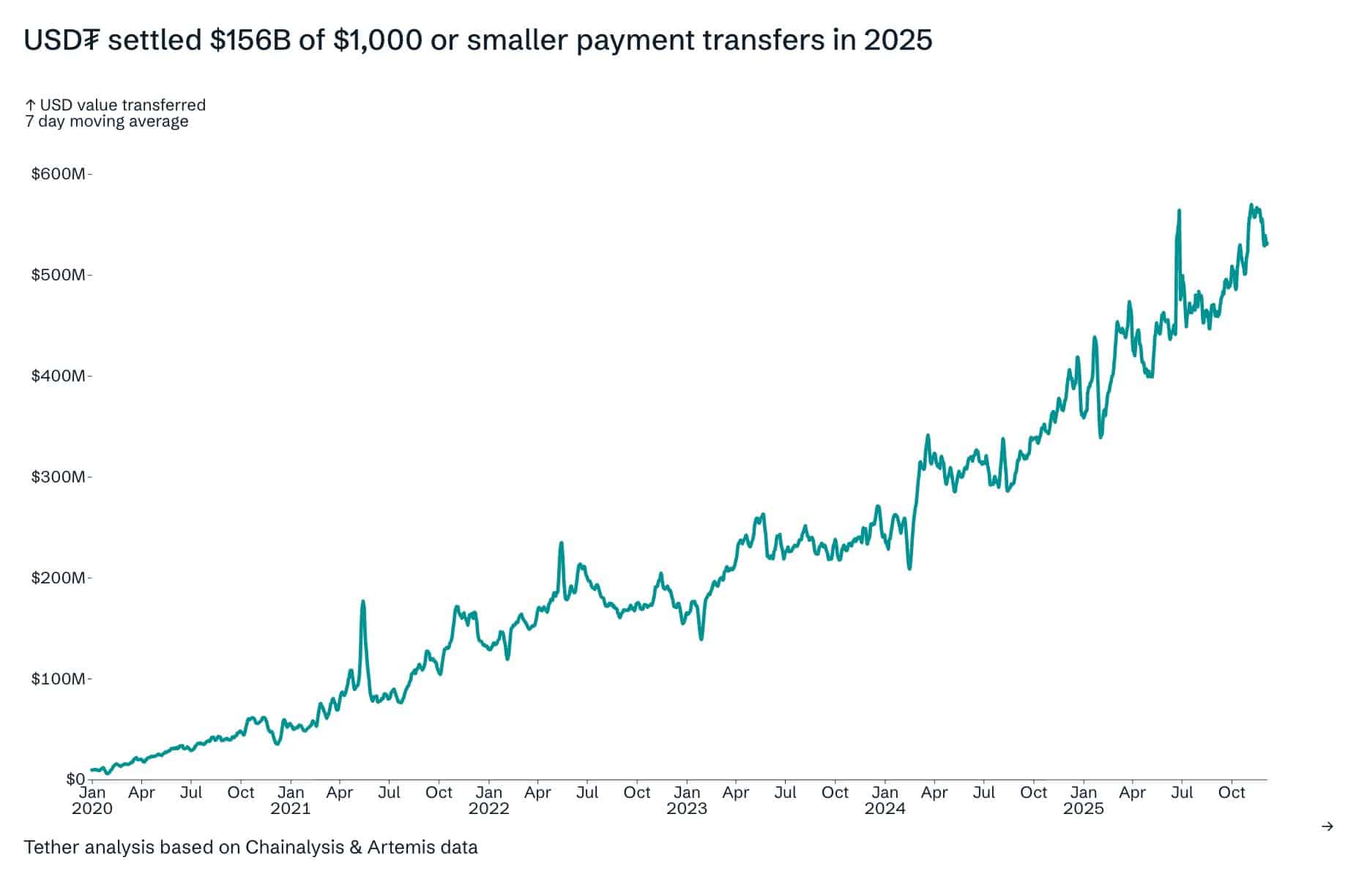
According to data shared by Tether CEO Paolo Ardoino on X, USDT settled $156 billion worth of transfers under $1,000. As the chart shows, small-value transactions have climbed steadily over the past few years, moving through 2024 and into 2025.

Source: X

The seven-day Moving Average is now consistently above $500 million, indicating high-frequency usage.

In regions where traditional banking is expensive or difficult to access, USDT has become a straightforward payment method for remittances and everyday transactions.

From payments to capital markets

That steady rise in small USDT transfers is a precursor for more.

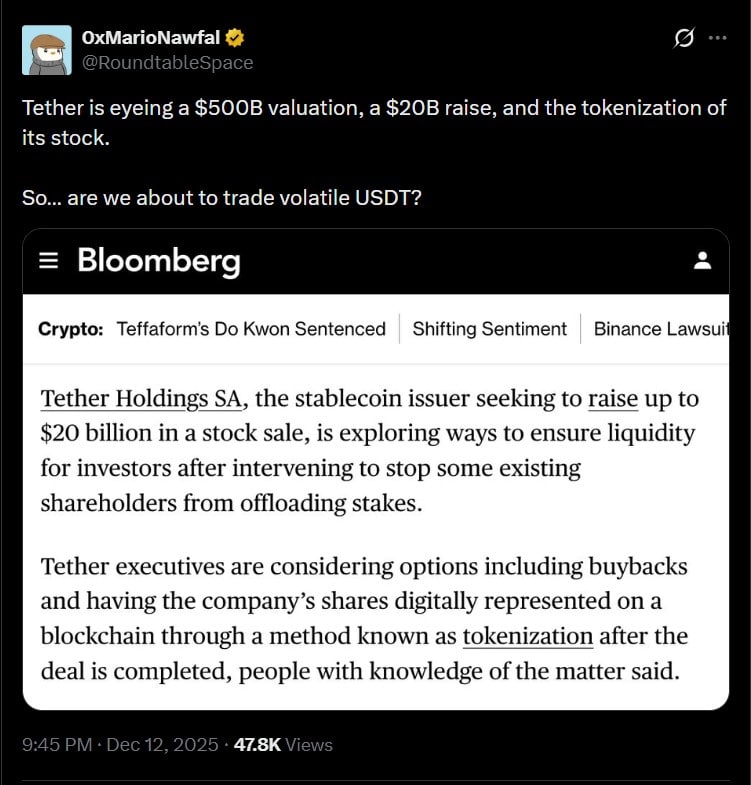
Beyond payments, the company is now eyeing the capital markets. According to a Bloomberg report, Tether is exploring a stock sale that could value the firm at around $500 billion and raise as much as $20 billion.

Executives are also considering tokenizing Tether’s shares on a blockchain to improve liquidity for investors.

Source: X

The move would take Tether from issuing the world’s largest stablecoin to turning itself into a tradeable, on-chain financial asset.

Tether beyond USDT

The company has submitted a binding all-cash proposal to acquire Exor’s 65.4% stake in Italian football giant Juventus FC, with plans to invest €1 billion into the club if the deal closes.

At the same time, Tether is pushing deeper into AI and robotics, backing an Italian humanoid robotics startup and supporting large-scale compute infrastructure for open AI development.

It is also deep in the commodity markets. In Q3 2025, Tether became the largest gold buyer outside central banks, holding 116 tonnes and driving fresh demand for tokenized gold.


Final Thoughts

  • $156 billion in small USDT transfers; Tether is becoming a global payments backbone.
  • A potential $500B valuation shows ambition to rival traditional financial giants.
Next: Analyzing MYX’s price surge – Is $3.45 the next stop?
Share
  • Share
  • Tweet

İlgili Okumalar

Jensen Huang's CMU Speech: In the AI Era, Don't Just Watch, Build

Jensen Huang, CEO of NVIDIA and a first-generation immigrant, delivered the commencement address to Carnegie Mellon University's class of 2026. He shared his personal journey from a humble background to founding NVIDIA, emphasizing resilience, learning from failure, and the responsibility that comes with leadership. Huang framed the present moment as the dawn of the AI revolution, a shift he believes is more profound than previous computing waves. He described AI as fundamentally resetting computing—moving from human-written software to machines that understand, reason, and use tools. This will create a new industry for generating intelligence and transform every sector. While acknowledging AI's potential to automate tasks and displace some jobs, Huang distinguished between the *tasks* of a job and its core *purpose*. He argued AI will augment human capability, not replace humans. The real risk, he stated, is not AI itself, but people being left behind by those who effectively use AI. He presented AI as a generational opportunity for massive infrastructure investment—in chip factories, data centers, energy grids, and advanced manufacturing—that could re-industrialize nations like the U.S. and bridge the digital divide by making computing and intelligent tools accessible to all. Huang called for a balanced approach: advancing AI safely and responsibly, establishing prudent policies, ensuring broad access, and encouraging universal participation. He urged the graduates not to fear the future but to engage with optimism and ambition, reminding them of CMU's motto, "My heart is in the work." His core message was clear: this is their moment to actively build and shape the AI-powered future, not merely observe it.

marsbit41 dk önce

Jensen Huang's CMU Speech: In the AI Era, Don't Just Watch, Build

marsbit41 dk önce

The Era Has Arrived Where Human Writers Must Prove They Are Not Machines

The article describes an era where AI-generated content is flooding the market, forcing human authors to prove they are not machines. It begins with the example of dozens of AI-written, error-ridden biographies of Henry Kissinger appearing on Amazon within hours of his death, a pattern repeated for other deceased celebrities and even living experts who find fraudulent books under their names. This spam content has exploded, with monthly new book releases on platforms like Amazon reaching 300,000 by late 2025. The issue spans genres, from suspiciously high proportions of AI-written teen romance and self-help books to dangerous, AI-generated foraging guides containing lethal advice. The platforms' automated review systems, designed to catch plagiarism and banned words, are ill-equipped to detect AI-generated text that avoids these pitfalls while being nonsensical or fraudulent. The problem has infiltrated traditional publishing. A major publisher, Hachette, had to recall a bestselling horror novel after AI detection tools suggested 78% of its content was machine-generated. An acclaimed European philosophy book was later revealed to be entirely written by AI under a fake author persona. In response, authors are fighting back. At the 2026 London Book Fair, 10,000 writers published a blank book titled "Don't Steal This Book" containing only their signatures—using emptiness as a protest weapon in an age of AI overproduction. Initiatives like the "Human Author Certification" program have emerged, ironically placing the burden on humans to prove their work is not machine-made. The article warns of a vicious cycle: AI-generated low-quality books pollute the data used to train future AI models, leading to "model collapse" and an ever-worsening flood of digital waste, eroding trust in publishing and devaluing human creativity.

marsbit1 saat önce

The Era Has Arrived Where Human Writers Must Prove They Are Not Machines

marsbit1 saat önce

İşlemler

Spot
Futures
活动图片