US CPI Preview: Overall Inflation May Break Through 4% to Hit a Three-Year High, While Core Inflation Could Be Significantly Below Expectations

marsbit2026-06-10 tarihinde yayınlandı2026-06-10 tarihinde güncellendi

Özet

US CPI Preview: Headline Inflation May Top 4%, Hitting Three-Year High, Core Could Fall Short of Expectations. Wall Street's major institutions (Goldman Sachs, UBS, Deutsche Bank, Morgan Stanley) anticipate May's headline CPI year-over-year to rise sharply to the 4.17%-4.3% range from April's 3.81%, largely driven by a significant jump in energy prices due to recent geopolitical tensions. This could mark the highest level since April 2023. In contrast, core CPI (excluding food and energy) is forecast to increase only 0.17%-0.22% month-over-month, notably below the market consensus of 0.27%-0.30%. Key moderating factors include cooling shelter inflation (OER and rent) and weaker auto insurance prices, while used car prices are expected to be flat. However, upward pressures persist within core components. Airfare, IT goods, and some non-shelter services are expected to show strength, partially offsetting the cooling trends. This divergence makes the report complex for markets: high headline inflation from transient energy shocks versus a potentially softer underlying core trend. Market pricing via inflation swaps suggests a slightly higher-than-expected headline print, historically associated with a modest dollar rally post-release. Looking ahead, the trajectory for inflation remains highly dependent on future oil price movements.

Original Author: Long Yue

Original Source: Wall Street News

At 20:30 Beijing time tonight, the US Bureau of Labor Statistics will release the May CPI data. This is also the most watched heavyweight inflation data by the market before the Federal Reserve's new Chairman Wash's policy rate meeting next week.

According to reports from the Chase the Trade desk, Wall Street's four major institutions—Goldman Sachs, UBS, Deutsche Bank, and Morgan Stanley—have released a flurry of preview reports on the eve of the data release. The forecasts from the four institutions vary, but the direction is similar: Overall inflation may be high, but core inflation may not be that hot. Energy prices are pushing up overall CPI, while factors such as rent and auto insurance are suppressing core CPI.

Overall CPI May Rise Above 4% to Hit a Three-Year High, Core CPI Possibly Below Consensus

Looking at the forecasts, the four institutions' predictions for the May year-on-year overall CPI are concentrated in the range of 4.17% to 4.3%, all higher than April's 3.81%. However, the forecasts for the month-on-month core CPI are generally lower than the market consensus.
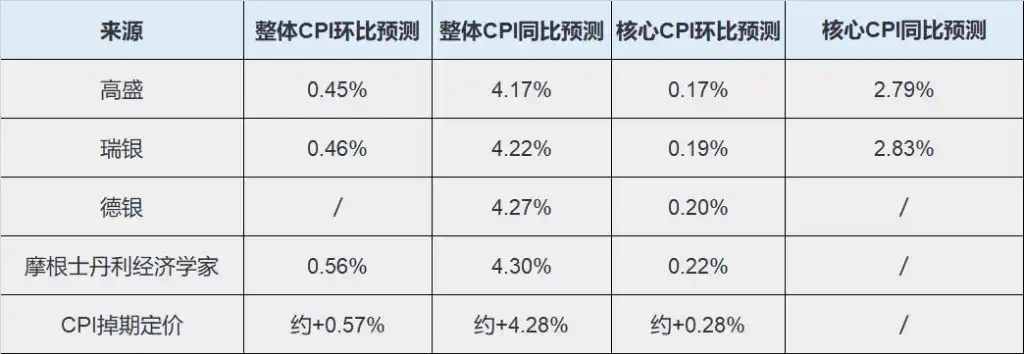
The trends of overall and core inflation show a clear divergence.

The "worrying" part is overall inflation. The year-on-year predictions from Goldman Sachs, UBS, Deutsche Bank, and Morgan Stanley are all above 4%. Deutsche Bank's estimate of 4.27% and Morgan Stanley's estimate of 4.3% are 46-49 basis points higher than April's figure and would be the highest since April 2023.

The "positive" part is core inflation. Excluding food and energy, the month-on-month core CPI may only be 0.17%-0.22%, significantly lower than the market's mainstream expectation of 0.27%-0.30%.

Overall Inflation May Break 4%: Energy Is the "Culprit"

Energy will be the core driver of the potential jump in this inflation reading.

Following the outbreak of the Iran war, US retail gasoline prices have risen sharply, driving a projected month-on-month increase in energy commodity prices of about 6%~7% for May, with the entire energy category seeing a month-on-month increase of nearly 4%. This effect directly pushes the year-on-year overall CPI from 3.81% in April to 4.17%~4.3% in May.

Deutsche Bank's calculations show that energy inflation year-on-year may approach 24%; back in February, this number was only 0.5%.
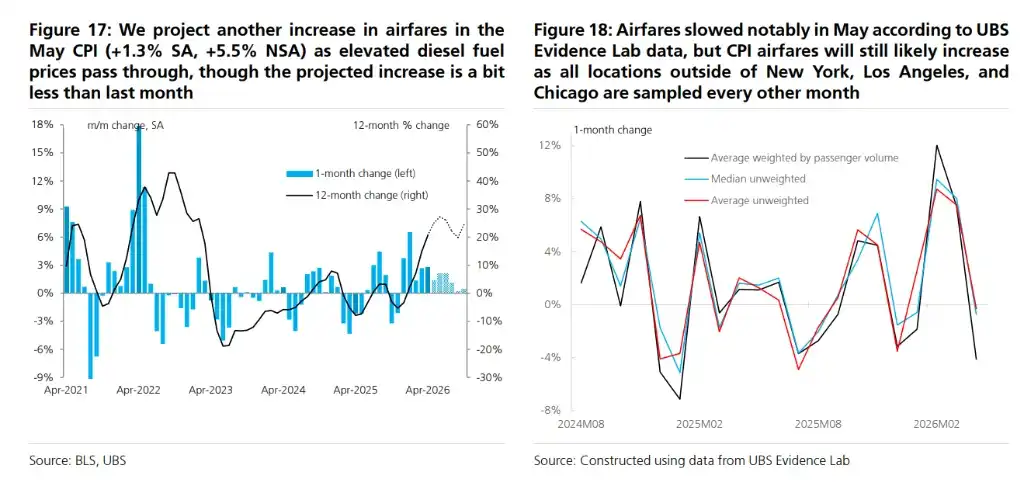
Airfare increases are one of the most direct transmission channels. Rising fuel costs directly increase airline operating costs. Airfare prices in May are expected to rise month-on-month by 1.3%~2%.

The good news is that gasoline prices peaked on May 20th and have since fallen by about 40 cents per gallon. UBS expects this to lead to a month-on-month decline of about 0.13% in the overall CPI for June, with the year-on-year rate falling back to around 3.81%. In other words, May is likely the peak of this round of overall inflation.

Why Core Inflation May Be Lower Than Expected: The Key Lies in Housing Cooling Down Again

Core CPI excludes food and energy. Precisely because these two hottest components are excluded, the May core data will look much more moderate.

Housing carries a very high weight in the US CPI, about 35%.

Both Goldman Sachs and UBS predict that Owner's Equivalent Rent (OER) and primary residence rent in May will increase month-on-month by about 0.22%~0.23%, continuing a slowing trend. In April, these two components rose by 0.53% and 0.55% month-on-month, respectively. Deutsche Bank also lists "housing inflation trends remaining moderate" as one of the reasons for the softness in core inflation.

Because OER itself has a large weight, even a decrease from around 0.5% to just over 0.2% will significantly lower the core CPI reading.

Auto insurance is another cooling point.

Goldman Sachs expects auto insurance prices to fall 0.1% month-on-month in May. Its online data model shows that changes in premiums are giving a downward signal for auto insurance CPI. Deutsche Bank also mentions that auto insurance is expected to be weak again.

There is also no significant upward pressure in used cars. Goldman Sachs expects used car prices to remain flat and new car prices to rise 0.1%; UBS expects used car prices to fall 0.26% and new car prices to fall 0.10%.

This means that several items that have frequently disturbed US core inflation in recent years—housing, auto insurance, used cars—are not giving strong inflation signals this time. In other words, the low May core CPI is not due to a single component "suddenly cooling down."
Core Inflation Is Not Cooling Across the Board: Airfare, IT Goods, and Some Services Still Have Pressure

A core CPI reading below consensus does not mean all core items are cooling.

Airfare is an upward item.

Goldman Sachs expects airfares to rise 2% in May. UBS expects a 1.34% increase. The reason is that jet fuel prices remained high for most of May, which may be passed through to ticket prices.

There is significant divergence in judgments on hotel prices. Goldman Sachs expects hotel prices to rise 0.2%; UBS lowered its lodging forecast based on Smith Travel Research data, expecting the price of lodging away from home to fall 0.77%. However, UBS also notes that CPI measures prices at the time of booking, while STR data is closer to check-in time. This timing difference may bring upside risks, especially potentially reflecting early demand related to the World Cup.

There is also stickiness in goods.

UBS expects core goods prices to rise 0.08% month-on-month, between the 0.11% in March and 0.03% in April. Its assessment is that the impact of tariffs on the 12-month core goods inflation may have slightly passed its peak, but residual pass-through will still keep monthly core goods prices growing slightly positively for the rest of this year.

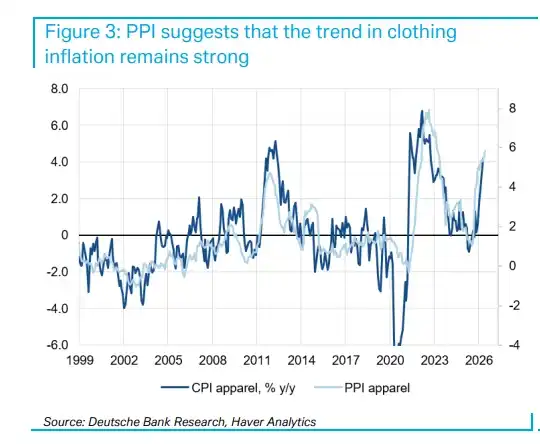
Deutsche Bank also mentions that import prices indicate that IT goods prices still have strong momentum, partly due to global memory chip prices remaining high. Meanwhile, apparel PPI shows that apparel inflation trends remain strong, although import prices are weak, and the momentum in CPI may have slowed compared to previous months.

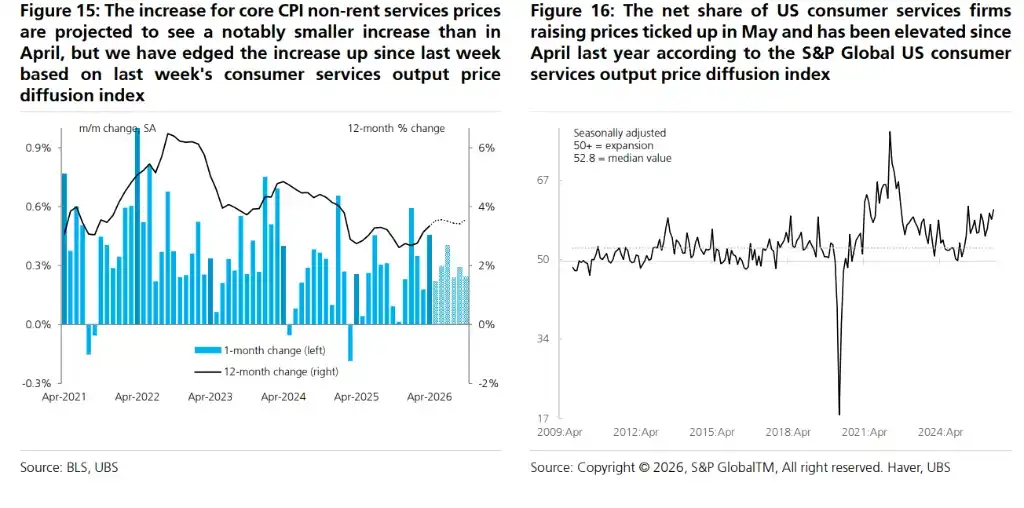
Services are more complex.

UBS has raised its forecast for non-rent core services prices from 0.17% to 0.21%, citing the S&P Global US Consumer Services Output Price Diffusion Index showing an increase in the proportion of consumer service firms raising prices in May, reaching the second-highest level since 2009, excluding the abnormal pandemic period.
What to Really Watch Tonight Is Not Just an Overall Inflation Above 4%

The surface numbers for May CPI may be high, but breaking them down is more crucial.

If overall CPI is high, primarily driven by gasoline and energy, the market will likely combine that with the decline in gasoline prices in June to judge its sustainability.

If core CPI is significantly lower than expected, the market will continue to examine where the low inflation is coming from: a trend slowdown in housing or a one-off seasonal drag.

If airfare, IT goods, and non-rent services continue to be strong, the significance of the core cooling will be discounted.

Therefore, this CPI might give the market two messages simultaneously:

On one hand, overall inflation has broken through 4% again, potentially even hitting a new high since April 2023.

On the other hand, core inflation might only be around 0.2%, clearly below market consensus.

This is what makes tonight's CPI so difficult to trade: overall inflation looks hot, but core inflation may not be that hot; oil prices push up the overall figure, while housing and auto insurance push down the core.

Inflation Swap Pricing: The Market Is Betting on a Dollar-Rising Surprise

The inflation swap market is currently pricing May overall CPI at 4.27%~4.28%, slightly above the Bloomberg survey median of 4.2%.

The analytical framework of Morgan Stanley strategist Molly Nickolin shows that in the past 12 CPI releases, inflation swap pricing correctly predicted the direction of the year-on-year inflation 9 times before the release. The current pricing implies an upside deviation of about 0.48 standard deviations relative to economists' expectations.

Based on historical backtesting, a 0.48 standard deviation upside surprise typically corresponds to a DXY US Dollar Index increase of about 0.14% within one hour of the release. Among all G10 currencies, the Swedish Krona (SEK) has historically performed the weakest in a "USD-bullish" CPI release day, with the largest average decline.

Looking Ahead: Oil Prices Are the Biggest Variable for the Inflation Path

The path of core CPI in the coming months depends on how long oil prices can be maintained.

The current baseline forecast is: Month-on-month core CPI remains around 0.2%. However, if the Middle East situation persists and the decline in oil prices falls short of expectations, upside risks will become more prominent—high oil prices not only directly push up energy prices but also continue to seep into core inflation through intermediate channels like airfare and transportation.

Deutsche Bank's long-term forecast is more pessimistic: Even if oil prices start to decline in June, overall energy inflation year-on-year will remain above 10% until early 2027 before turning negative. Core services inflation (excluding rent/OER) is also expected to remain above 3% for a long time.


Trend Kriptolar

İlgili Sorular

QWhat is the main reason why the overall CPI might exceed 4% in May according to the article?

AThe primary reason is a significant surge in energy prices. Following the outbreak of the Iran war, U.S. retail gasoline prices climbed sharply, driving energy commodity prices up by approximately 6-7% month-over-month in May. This pushed the overall CPI year-over-year rate from 3.81% in April to the predicted range of 4.17% - 4.3% in May.

QWhy is the core CPI for May expected to be significantly lower than market consensus?

AThe core CPI is expected to be lower mainly due to cooling in key categories with high weights, particularly housing. Components like Owners' Equivalent Rent (OER) and primary residence rent are predicted to show slower month-over-month growth around 0.22-0.23%, down from around 0.5% in April. Additionally, factors like auto insurance and used car prices are also providing a cooling effect.

QWhich specific core components are identified as still presenting upward pressure on inflation?

AWithin the core CPI, airfares are an upward component, with forecasts of a 1.34% to 2% month-over-month increase due to high aviation fuel costs. IT goods prices are also cited as having strong momentum, partly due to high global memory chip prices. Furthermore, some non-rent core services show resilience, with a notable share of consumer service firms reporting price increases.

QBased on inflation swap pricing, what market reaction does the article suggest for a potential upside surprise in the CPI data?

ABased on historical analysis by Morgan Stanley, the current inflation swap pricing implies an upside surprise of about 0.48 standard deviations. Historically, such a surprise has been associated with the DXY U.S. Dollar Index rising approximately 0.14% within one hour after the data release. Among G10 currencies, the Swedish Krona (SEK) typically shows the weakest performance on such 'dollar-bullish' CPI days.

QWhat is considered the biggest variable for the future path of inflation according to the article's conclusion?

AThe future path of inflation, particularly core CPI, is highly dependent on oil price movements. Oil prices are identified as the biggest variable. If Middle East tensions persist and oil prices do not decline as expected, there will be significant upside risks, as high oil prices not only directly impact energy costs but also continue to feed into core inflation through channels like airfares and transportation.

İlgili Okumalar

U.S. Tech Momentum Stocks Post Largest Single-Day Gain Ever, But Is the Plunge Over?

US tech momentum stocks staged a sharp rebound on Tuesday (July 21st). Morgan Stanley's TMT Momentum Factor surged over 12%, marking its largest single-day gain on record, exceeding even peaks from the 2000 dot-com bubble. Key momentum indices from Goldman Sachs also posted their strongest daily performances in years. The rally was led by semiconductors, with the Philadelphia Semiconductor Index jumping 4.6%. This rebound followed three consecutive down days and a cumulative 33% plunge in momentum stocks, one of the steepest drawdowns since the dot-com era. Analysts attribute the surge largely to a short squeeze. Heavy selling had pushed high-beta momentum stocks into deeply oversold territory, forcing many short sellers, particularly in Asia, to cover their positions, creating a self-reinforcing buying spiral. However, the rebound's internals appear weak. Trading volume was notably low, and advancing stocks still lagged decliners on the S&P 500, indicating a narrow, concentrated rally rather than broad market participation. Diverging views emerge on the outlook. BTIG warns the bounce has hit key resistance and recommends selling into strength, citing extreme volatility and historical parallels to past market tops. Conversely, Goldman Sachs and UBS believe the momentum unwind is nearing its end, suggesting it may be time to gradually add exposure, as positioning has been significantly reduced. They caution, however, that high volatility warrants a measured approach, potentially using defined-risk strategies. The upcoming earnings season, particularly reports from major tech firms like Alphabet, is seen as a critical test for the rally's sustainability. Simultaneously, bond markets flashed a warning, with yields rising partly due to spiking oil prices. Analysts note that if long-term Treasury yields break decisively higher, it could pose a significant headwind for equities, especially growth stocks.

marsbit5 dk önce

U.S. Tech Momentum Stocks Post Largest Single-Day Gain Ever, But Is the Plunge Over?

marsbit5 dk önce

U.S. Tech Momentum Stocks Record Largest Single-Day Gain Ever, but Has the Rout Ended?

U.S. tech momentum stocks staged a dramatic rebound on Tuesday, July 21st. Key momentum indices like the Morgan Stanley TMT Momentum Factor and Goldman Sachs' High Beta Momentum Long Index posted historic or near-historic single-day gains, fueled largely by semiconductor stocks. This sharp rally followed a severe three-day sell-off that saw momentum stocks plunge 33%, marking one of the steepest pullbacks since the dot-com bubble. Analysts attribute the bounce primarily to a short squeeze, as forced covering from over-leveraged traders, particularly in Asia, created a buying spiral. However, the rally's health is questioned due to weak market breadth—overall trading volume was low, and decliners outnumbered advancers in the S&P 500 despite the index's gain—suggesting a narrow, concentrated surge rather than broad recovery. Opinions on the sustainability diverge. BTIG strategists warn the rebound has hit key resistance levels, citing extreme volatility and historic stock dispersion as signs of an ongoing broader correction, and recommend selling into strength. Conversely, Goldman Sachs and UBS view the aggressive momentum unwinding as nearing its end, noting reduced positioning and a lack of new fundamental catalysts. They suggest the sell-off presents a selective opportunity to add exposure, albeit cautiously and gradually using defined-risk strategies. The immediate trajectory hinges on the ongoing earnings season, with market focus on Alphabet's capital expenditure guidance for AI investment clarity. Meanwhile, bond markets present a risk, with rising Treasury yields—potentially heading toward 5.5%—and widening credit spreads for mega-cap tech companies posing a threat to equity valuations. The combination of technical factors, earnings results, and macro conditions leaves the durability of the rebound in doubt.

链捕手7 dk önce

U.S. Tech Momentum Stocks Record Largest Single-Day Gain Ever, but Has the Rout Ended?

链捕手7 dk önce

Long-Divided Must Unite, Long-United Must Divide: When L1 Becomes Its Own Rollup, What Is Ethereum's Endgame?

"The Inevitable Cycle: When L1 Becomes Its Own Rollup – What is Ethereum's Endgame?" For years, the Ethereum community grappled with concerns that L2s were fragmenting the ecosystem and eroding L1's value. While L2s provided cheaper execution, they also splintered liquidity and the unified user experience of a single chain. This has prompted a fundamental reassessment of the relationship between L1 and L2. Ethereum's roadmap is evolving. The "Scale" initiative merges L1 and L2 expansion into a holistic framework. L1 itself is advancing with higher gas limits, statelessness, and zkEVM verification, no longer content to be just a low-throughput settlement layer. Consequently, the primary value proposition of L2s is shifting from merely providing cheap blockspace to offering L1 cannot easily provide: application-specific optimizations, privacy features, and flexible governance models. L2s are becoming a spectrum of execution environments with varying degrees of security inheritance from Ethereum. A critical challenge in this multi-chain future is interoperability. The vision is to make Ethereum "feel like one chain again." This relies on advancements in native account abstraction (like EIP-7702) and intent-based architectures (Open Intents Framework), where users declare desired outcomes, and solvers handle the complex cross-chain execution. Furthermore, shortening Ethereum's finality time from minutes to seconds is crucial, as it underpins trust between chains for bridges, stablecoins, and cross-chain applications. Perhaps the most provocative idea is that Ethereum L1 itself could become a form of "its own Rollup." As zkEVM and proof systems mature, high-performance nodes could execute transactions and generate validity proofs. Regular validators would then verify these proofs instead of re-executing all transactions. This blurs the traditional L1/L2 hierarchy, making "Rollup" more of a general execution-verification architecture. Native Rollup aims to integrate L2 validation more directly into the Ethereum protocol, allowing L2s to inherit L1's security more fully and move away from reliance on security councils. In the end, L2s are not destined to replace L1 or be made obsolete by it. The likely future is a unified system where diverse execution environments—each optimized for specific use cases like DeFi, gaming, or privacy—coexist. They will share a common foundation of security, liquidity, and verifiable state, seamlessly connected to restore a cohesive user experience. The next phase for Ethereum is not just about scaling through separation, but about intelligently reintegrating what was separated back into a coherent whole.

链捕手24 dk önce

Long-Divided Must Unite, Long-United Must Divide: When L1 Becomes Its Own Rollup, What Is Ethereum's Endgame?

链捕手24 dk önce

Agent Race Ends, Super Workbench Takes Over

The era of fragmented AI agents is ending. Over the past month, China's tech giants—Tencent, Alibaba, and ByteDance—have simultaneously shifted strategy: instead of launching new, standalone AI agents, they are consolidating their various agent projects into unified "super workbenches." Tencent integrated its QClaw teams into WorkBuddy, a strategic product hailed as a potential third flagship after QQ and WeChat. Alibaba is merging its QoderWork, Wukong, and MuleRun agents into a new "Qianwen Office" platform under DingTalk's leadership. ByteDance rebranded its TRAE SOLO coding agent to TRAE Work, signaling a broader focus on workflow collaboration. This convergence marks a pivotal industry consensus. The initial exploration phase, where companies rapidly built numerous overlapping agents for different scenarios, proved costly and inefficient. With open-source tools eroding technical barriers, competition has shifted from agent creation to resource consolidation and cost control. Historically, platform wars are won not by creating more products, but by simplifying them—as seen with browsers unifying web access and super-apps consolidating services. Now, the "super workbench" aims to become the unified AI entry point for work. This reflects a deeper market realization: the primary audience for AI is no longer just programmers (a market in the tens of millions) but all knowledge workers (a market of billions). The real opportunity lies in augmenting everyday tasks—managing emails, documents, data, and meetings—across the entire workday. The core battleground is becoming control over the primary AI entry point that employees use daily. Tencent's WorkBuddy leverages WeChat and Tencent Docs; Alibaba's Qianwen Office taps into DingTalk's organizational data; ByteDance's TRAE Work integrates with Feishu's workflows. Whoever owns this "super workbench" gains strategic control over orchestrating enterprise data and APIs. This shift is redefining enterprise software. Traditional SaaS applications, valued for their user interfaces, will recede into the background. Their core functionalities will be exposed as standardized "Skills" or APIs for the super workbench's agents to invoke. Software value will shift from selling user seats to charging based on API calls and outcomes delivered. The evolution of agents is moving through clear stages: first as novel standalone products, then as consolidated primary work entry points, and finally as pervasive, invisible capabilities embedded into the digital fabric. The recent moves by major tech firms signal the transition from the first stage into the second, accelerating toward the third. In the end, the most successful agent technology may become invisible—like electricity or the HTTP protocol—a fundamental, unnamed infrastructure powering work itself.

marsbit51 dk önce

Agent Race Ends, Super Workbench Takes Over

marsbit51 dk önce

İşlemler

Spot

Popüler Makaleler

4 Nasıl Satın Alınır

HTX.com’a hoş geldiniz! 4 (4) satın alma işlemlerini basit ve kullanışlı bir hâle getirdik. Adım adım açıkladığımız rehberimizi takip ederek kripto yolculuğunuza başlayın. 1. Adım: HTX Hesabınızı OluşturunHTX'te ücretsiz bir hesap açmak için e-posta adresinizi veya telefon numaranızı kullanın. Sorunsuzca kaydolun ve tüm özelliklerin kilidini açın. Hesabımı Aç2. Adım: Kripto Satın Al Bölümüne Gidin ve Ödeme Yönteminizi SeçinKredi/Banka Kartı: Visa veya Mastercard'ınızı kullanarak anında 4 (4) satın alın.Bakiye: Sorunsuz bir şekilde işlem yapmak için HTX hesap bakiyenizdeki fonları kullanın.Üçüncü Taraflar: Kullanımı kolaylaştırmak için Google Pay ve Apple Pay gibi popüler ödeme yöntemlerini ekledik.P2P: HTX'teki diğer kullanıcılarla doğrudan işlem yapın.Borsa Dışı (OTC): Yatırımcılar için kişiye özel hizmetler ve rekabetçi döviz kurları sunuyoruz.3. Adım: 4 (4) Varlıklarınızı Saklayın4 (4) satın aldıktan sonra HTX hesabınızda saklayın. Alternatif olarak, blok zinciri transferi yoluyla başka bir yere gönderebilir veya diğer kripto para birimlerini takas etmek için kullanabilirsiniz.4. Adım: 4 (4) Varlıklarınızla İşlem YapınHTX'in spot piyasasında 4 (4) ile kolayca işlemler yapın.Hesabınıza erişin, işlem çiftinizi seçin, işlemlerinizi gerçekleştirin ve gerçek zamanlı olarak izleyin. Hem yeni başlayanlar hem de deneyimli yatırımcılar için kullanıcı dostu bir deneyim sunuyoruz.

453 Toplam GörüntülenmeYayınlanma 2025.10.20Güncellenme 2026.06.02

4 Nasıl Satın Alınır

Tartışmalar

HTX Topluluğuna hoş geldiniz. Burada, en son platform gelişmeleri hakkında bilgi sahibi olabilir ve profesyonel piyasa görüşlerine erişebilirsiniz. Kullanıcıların 4 (4) fiyatı hakkındaki görüşleri aşağıda sunulmaktadır.

活动图片