Uniswap v4 Hook Analysis: Architecture Design, Common Vulnerabilities, and Protection Practices

marsbit2026-06-22 tarihinde yayınlandı2026-06-22 tarihinde güncellendi

Özet

Uniswap v4's Hook mechanism is a major innovation, enabling custom logic injection into liquidity pool lifecycle events like swaps and liquidity provisioning. This transforms the AMM into programmable infrastructure, shifting the security model from protocol-level to pool-level, as each pool's safety now depends on its bound Hook contract. The core architecture revolves around the singleton PoolManager contract, which manages all pools via a flash accounting system. State changes are tracked in transient storage and must be settled by the end of a transaction. Hook contracts are permanently bound to pools via a PoolKey, with their permissions encoded directly into their address via specific low-order bits. This design introduces unique security considerations and challenges for future upgrades. Key vulnerabilities and best practices identified include: - **Access Control Gaps:** Early versions of the BaseHook abstract contract only protect `unlockCallback()`, leaving other lifecycle functions (`beforeSwap`, `afterSwap`, etc.) exposed unless explicitly secured by developers. - **Unrestricted Pool Binding:** The `initialize()` function does not validate if a Hook "consents" to a new pool. Hooks must implement their own whitelisting in `beforeInitialize` to prevent unauthorized pool creation. - **Async/Custom Curve Hooks:** These high-risk Hooks can completely replace Uniswap's swap logic. Their security depends entirely on their own implementation, as they operate outside the...

Since the mainnet launch of Uniswap v4, the Hook mechanism has become one of the most-discussed innovations in DeFi. The memecoin launchpad Flaunch on Base leverages Hooks to achieve fixed presale pricing and automatic listing and liquidation mechanisms; the liquidity protocol Bunni v2 uses Hooks to build programmable liquidity and restaking models; tokens like SATO, uPEG (Unipeg), and Slonks, which revolve around Hook-based gameplay, have also seen tens-of-times price surges in short periods this year.

On the flip side of the Hook ecosystem's prosperity, attacks targeting Hook implementation flaws have also increased significantly. This article will start with the Hook mechanism in Uniswap v4, gradually analyze its core call stack, and help project teams understand potential vulnerabilities.

Uniswap v4 Hook Security

1. Introduction

The most significant architectural change in Uniswap v4 compared to v3 is the introduction of the Hook mechanism: it allows developers to attach custom contracts to lifecycle events of liquidity pools, injecting arbitrary logic at nodes such as swap, add/remove liquidity, and initialization.

Key changes in v4 are as follows:

- Singleton Pattern: All pool states are centrally managed by a single PoolManager contract, no longer deploying separate contracts for each pool.

- Flash Accounting: Intermediate balance changes during a transaction are recorded only in transient storage, with final settlement occurring only at the end of the transaction.

- Hook Mechanism: Each pool can be bound to a Hook contract. The PoolManager will call back to this contract at key nodes (beforeInitialize, beforeSwap, afterAddLiquidity, etc.).

- Hook Immutability: Once a pool is initialized, the bound Hook address is permanently fixed (The Hook address bound to a pool cannot be changed, but whether the Hook contract itself is upgradeable depends on its implementation).
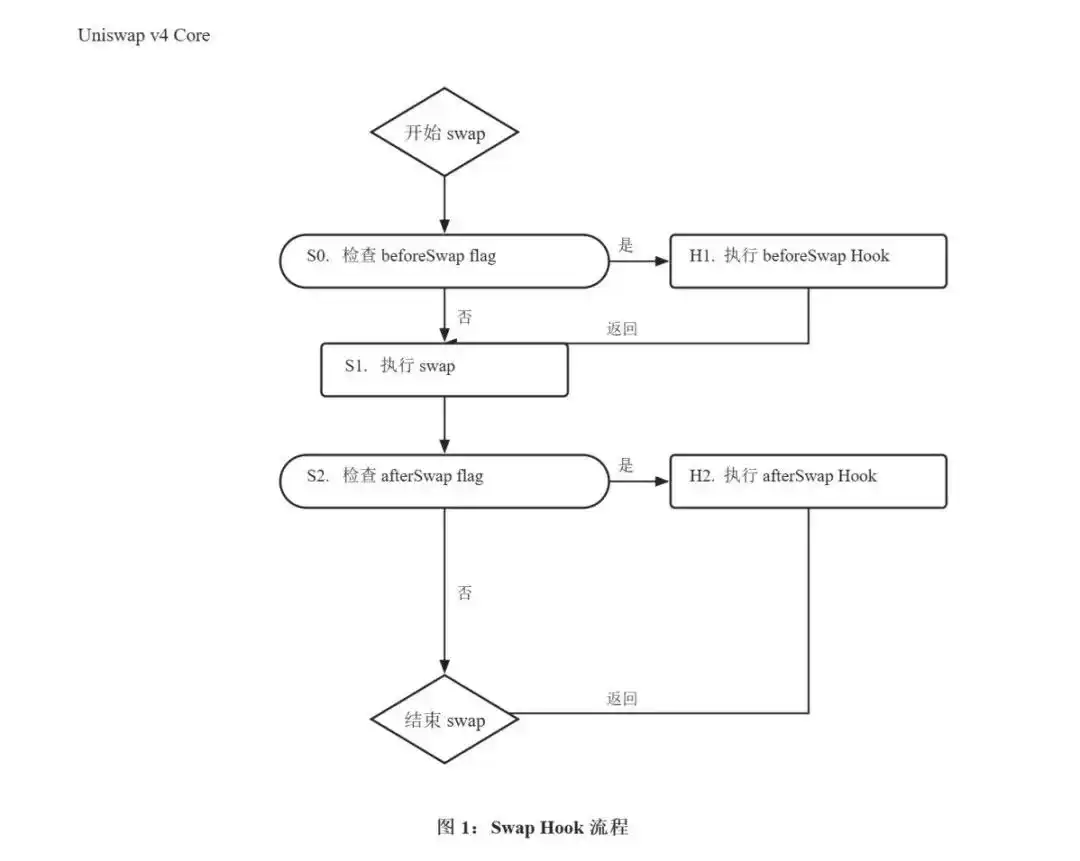
In the v3 era, developers only needed to trust the Uniswap protocol itself; in the v4 era, the security of each pool depends on the Hook it's bound to. Hooks expand AMM from a fixed financial primitive to a programmable financial infrastructure, but the security model has also fragmented from "protocol-level" to "pool-level."

2. Hook Architecture

2.1 PoolManager and the unlock/callback Model

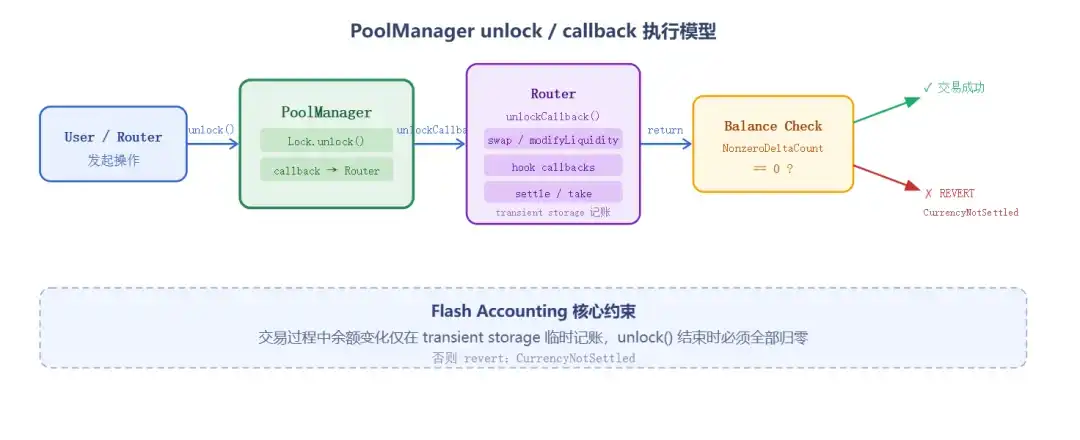
The core contract of v4 is the singleton PoolManager. Any operation that changes a pool's state (swap, add/remove liquidity) must first call PoolManager.unlock() to obtain one-time callback permission, then perform the specific action within unlockCallback(). At the end of the entire process, the PoolManager will verify whether the ledger balances:
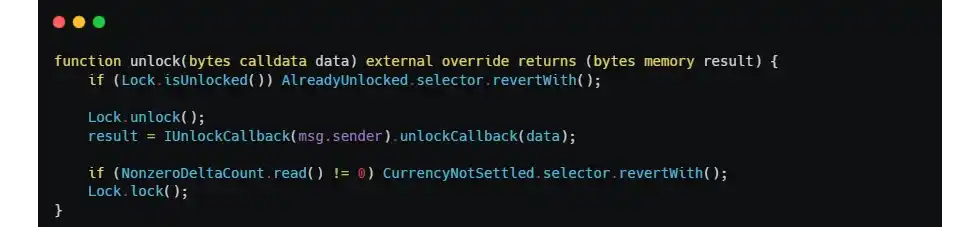
If NonzeroDeltaCount != 0, it directly reverts. This is the core constraint of v4's flash accounting. Any Hook can temporarily unbalance the accounts during execution but must settle itself before the transaction ends; otherwise, the entire transaction rolls back.

Each pool is uniquely identified by a PoolKey structure, which includes a hooks field:

PoolId is calculated as keccak256(PoolKey), so different hook addresses will result in different pools. This also means the PoolManager does not verify whether a Hook address has been used for other pools; the same Hook contract can be bound to multiple pools simultaneously.
2.2 Hook Permission Bits Encoded in the Address

A counterintuitive design in v4 is: Hook permissions are not determined by a variable inside the contract but by the deployment address of the Hook contract.

The PoolManager checks the lower 14 bits of the Hook address to determine if the Hook needs to be called at a certain lifecycle point:

For example, BEFORE_SWAP_FLAG = 1 << 7. If bit 7 of the Hook address is 1, the PoolManager will call the Hook's beforeSwap() before a swap; otherwise, even if the Hook contract implements beforeSwap(), it will never be called by the PoolManager.

This means the Hook must be deployed via CREATE2 + salt to calculate an address where the lower bits exactly match the target permissions. Uniswap officially provides the HookMiner tool for this purpose:
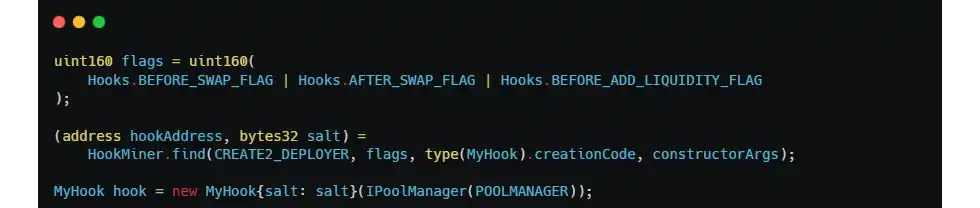
Mismatches between permission bits and function implementation can lead to two types of issues:

(1) A hook function is implemented, but the address does not encode the corresponding permission bit—The PoolManager will never call that function, rendering the logic useless.

(2) The address encodes a permission bit, but the hook does not implement the corresponding function—The PoolManager may revert during the callback (causing DoS) or fail on return value verification, preventing the related operation from executing.

This is also a natural obstacle to Hook upgrades: If a Hook is upgradable via a proxy, the deployment address remains unchanged during upgrades, so post-upgrade, only existing hook function implementations can be modified, not new hook types added. To reserve future extensibility, all possible permission bits must be pre-mined during initial deployment.

2.3 BaseHook and a Commonly Overlooked Access Control Trap

The BaseHook abstract contract provided by earlier versions of the Uniswap v4 periphery allows developers to inherit it for custom Hook implementation. One important role of BaseHook is to provide the onlyPoolManager modifier for the unlockCallback() function:

However—here lies a design trap that is very easy to overlook—early versions of BaseHook only added onlyPoolManager to unlockCallback, providing no protection for other hook callback functions (beforeSwap, afterSwap, beforeAddLiquidity, etc.). Access control for these functions must be explicitly added by the Hook developer.

3. Hook Lifecycle Code Walkthrough

Using an exact-input swap as an example, the following analyzes the complete call stack from when a user initiates a transaction to settlement.

3.1 Pool Initialization and Hook Binding

Anyone can call PoolManager.initialize() to create a new pool:
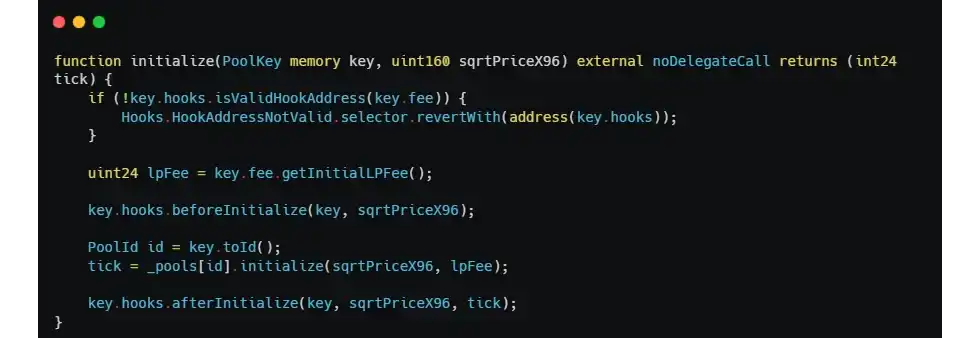
isValidHookAddress only checks the compatibility of the address permission bits with the fee field. It does not verify whether the Hook is already used in other pools, nor does it check if the Hook "wants" to accept this PoolKey. If the Hook design does not include whitelisting or single-pool binding logic in beforeInitialize, anyone can construct a new pool using the same Hook but with an arbitrary token pair, triggering all subsequent callbacks of the Hook.

3.2 beforeSwap and BeforeSwapDelta

The swap process entry is PoolManager.swap(). Before executing the core swap logic, it calls Hooks.beforeSwap():
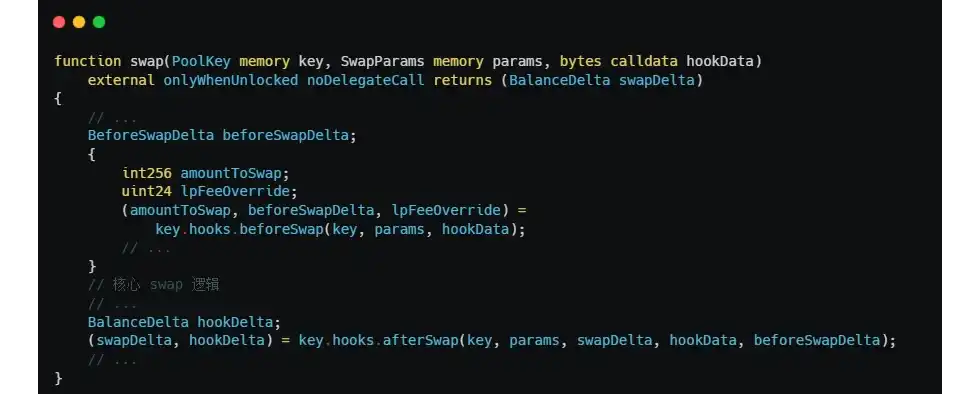
The return value of beforeSwap is a triple (bytes4, BeforeSwapDelta, uint24):

- bytes4: Must equal IHooks.beforeSwap.selector, otherwise PoolManager directly reverts.

- BeforeSwapDelta: The delta adjustments for the specified token and unspecified token that the Hook makes for this swap.

- uint24: Dynamic LP fee override value (only effective when the pool has dynamic fees enabled).

BeforeSwapDelta is an alias for int256, with the high 128 bits being the delta for the specified token (the token the user specified the amount for) and the low 128 bits being the delta for the unspecified token:
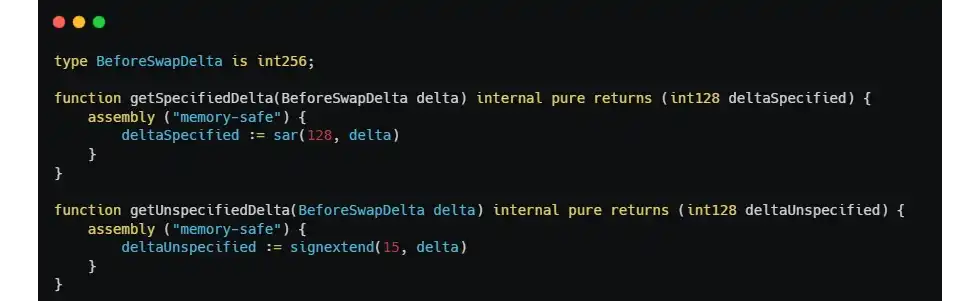
Note that the semantic of BeforeSwapDelta is: the Hook should return a positive value for collecting fees and a negative value for refunding tokens. Developers can easily get the sign wrong. Simultaneously, the correspondence between specified and unspecified depends on params.zeroForOne and the sign of amountSpecified. Slight carelessness in writing can lead to token misplacement.

The PoolManager directly adds the specifiedDelta returned by beforeSwap to the amountToSwap:

This line implies a crucial semantic: the Hook can intercept the swap amount. When hookDeltaSpecified equals -params.amountSpecified, amountToSwap directly becomes zero, meaning the Hook completely takes over this swap—this is the so-called Async Hook or Custom Curve Hook.

Async Hooks are the highest-risk design pattern in v4: they essentially replace Uniswap's swap logic with the Hook's own logic. If the Hook has vulnerabilities or is malicious itself, user funds are no longer constrained by Uniswap's native pricing logic but rely primarily on the correctness of the Hook's own implementation.

3.3 Delta Settlement and NonzeroDeltaCount

The deltas returned by beforeSwap and afterSwap do not immediately trigger transfers but are recorded in the PoolManager's internal ledger:
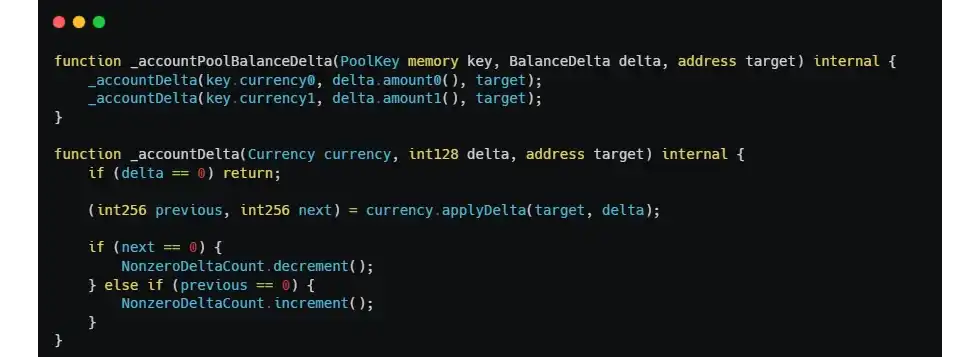
Whenever the cumulative delta for a token changes from zero to non-zero, NonzeroDeltaCount increments; when it returns to zero, it decrements. As mentioned in 2.1, if NonzeroDeltaCount != 0 at the end of unlock(), the entire transaction reverts.

The Hook balances its delta through two actions: settle() (transferring to the PoolManager) and take() (taking from the PoolManager):

The security semantics brought by this mechanism are clear: everyone must eventually balance the accounts. However, it only guarantees "account conservation," not "account correctness." If the Hook returns a maliciously constructed delta in beforeSwap, the PoolManager will faithfully account for this delta. As long as it's eventually settled and balanced, the transaction succeeds—even if this means the Hook can, by forging business states, cause the system to incorrectly believe an attacker has certain asset rights, which the PoolManager cannot recognize as an error at the business level.

A previous security incident involving Cork Protocol was due to a vulnerability in its Hook, and it had been audited by four firms before the attack. In retrospect, we found:

- Three of the four audits did not include the CorkHook contract in their scope.

- The only firm that audited CorkHook identified some code issues and submitted improvement suggestions but did not fully cover access control problems.

- Another auditor explicitly suggested in their report: "an interesting follow-up engagement would be to prove the invariants for the CorkHook functions that are being invoked by different components verified within the scope of this engagement." This suggestion appears highly pertinent in hindsight.

This exposes a new blind spot in audits in the v4 Hook era: the explosion in protocol complexity makes scope definition itself a security decision. The interaction chain between Hooks and other protocol contracts is very long. Auditing the Hook contract alone is insufficient to discover cross-contract combinatorial issues; conversely, auditing peripheral contracts while excluding the Hook from scope misses the largest attack surface in the v4 era.

4. Reflections

Looking at the protocol mechanisms alongside the Cork attack post-mortem, several core points of the v4 Hook security model can be summarized:

(1) If Hook callback functions rely on the calling context provided by PoolManager, they should explicitly restrict calls to only PoolManager. BaseHook does not do this for developers. This is the design trap in v4 that most easily conflicts with general contract auditing experience.

(2) The binding relationship between a Hook and a pool is not restricted by PoolManager. Developers must implement pool whitelisting or single-pool binding in beforeInitialize themselves.

(3) The permission bits of the Hook address must strictly match the function implementation. The calculated address should pre-include all permission bits that might be needed in the future.

(4) Async / Custom Curve Hooks are essentially completely custom swap implementations. They have no Uniswap protocol-level protection and must be audited to the standard of "fully autonomous financial contracts."

(5) "Conservation" in delta accounting does not equal "correctness." NonzeroDeltaCount == 0 only guarantees the final ledger is balanced, not that the ledger's content hasn't been maliciously manipulated.

(6) Token type confusion across markets is a new type of attack surface in the v4 era. When a protocol allows users to create markets, semantic validation of tokens is mandatory and cannot rely solely on interface checks.

Each Hook is an independent trust domain, and the security of each pool is determined by the Hook it's bound to. Therefore, the complexity of Hook security audits is no longer "auditing one piece of code" but "auditing a complete sub-protocol"—this change signifies a methodological upgrade for both project teams and auditors.

View Original Text

Trend Kriptolar

İlgili Sorular

QWhat is the core architectural change introduced in Uniswap v4, and what key security implication does it create?

AThe core architectural change introduced in Uniswap v4 is the Hook mechanism. This allows developers to attach custom logic to key pool lifecycle events like swaps and liquidity changes. The key security implication is a shift from a 'protocol-level' security model in v3, where users trusted the Uniswap protocol itself, to a 'pool-level' security model in v4. The security of each liquidity pool becomes dependent on the security of the specific Hook contract it is bound to.

QHow does Uniswap v4's flash accounting model enforce security, and what is its main constraint?

AUniswap v4's flash accounting model records intermediate balance changes in transient storage during a transaction and only performs final settlement at the transaction's end. It enforces security by requiring the account ledger to be balanced before the transaction concludes. The main constraint is that the `NonzeroDeltaCount` must be zero at the end of a transaction (specifically after `PoolManager.unlock()`); if it is not zero, the entire transaction reverts.

QWhat determines which callback functions (e.g., `beforeSwap`) on a Hook contract are actually invoked by the PoolManager?

AThe invocation of a Hook's callback functions is determined by the last 14 bits (the permission bits) of the Hook contract's deployment address. The PoolManager checks these bits against predefined flags (e.g., `BEFORE_SWAP_FLAG`). If the corresponding bit for a function is set to 1 in the address, the PoolManager will call that function. This permission is fixed at deployment via CREATE2 and cannot be changed later through an upgrade.

QWhat is a significant security oversight in the early version of the BaseHook abstract contract provided by Uniswap v4 periphery?

AA significant security oversight in the early version of the BaseHook abstract contract was that it only protected the `unlockCallback()` function with an `onlyPoolManager` modifier. It did not apply any access control to other critical hook callback functions like `beforeSwap`, `afterSwap`, `beforeAddLiquidity`, etc. This meant developers had to manually and explicitly add access control checks to these functions to prevent unauthorized calls, creating a major security trap if overlooked.

QWhat is an 'Async Hook' or 'Custom Curve Hook' in Uniswap v4, and why is it considered high-risk?

AAn 'Async Hook' or 'Custom Curve Hook' in Uniswap v4 is a Hook design pattern where the Hook's `beforeSwap` function returns a `hookDeltaSpecified` value that cancels out the user's requested swap amount (e.g., `-params.amountSpecified`). This effectively sets the `amountToSwap` to zero, allowing the Hook's own custom logic to completely take over and execute the swap. It is considered high-risk because it replaces Uniswap's native, battle-tested AMM pricing and swap logic. The security of user funds then depends entirely on the correctness and security of the custom Hook implementation, which may have vulnerabilities or be malicious.

İlgili Okumalar

A New Scaling Variable for Text-to-Image Generation, Discovered by ByteDance's Seed Team

ByteDance's SEED team investigated a crucial but often overlooked scaling variable in text-to-image diffusion models: the amount of image-grounded information in training captions. They found that simply increasing caption length with natural language does not improve model performance, as it often adds redundancy without new, usable visual supervision. The core discovery is that the final training loss of a diffusion model can be predicted by the *information content* of its text condition, measured by two complementary metrics: Grounded Perplexity Gain (GPG) and Effective Detailness (ED). This establishes a scaling relationship for text conditioning. To systematically increase information content, the team proposed **Structured Prompt (SP)**, a JSON-based representation that organizes visual variables (global scene, object attributes, spatial relationships) into clear fields, enhancing **Diffusability**—the model's ability to learn from captions. For inference, an LLM **Prompter** is trained to convert user queries into detailed SP instances, defining **Promptability**. The overall generation quality is viewed as a product of Diffusability and Promptability. A three-stage training strategy (SFT, cold-start reasoning distillation, and verifier-guided reinforcement) significantly improves the prompter's capability. The structured format also enables efficient iterative refinement through a *refine-render-judge* loop. In matched-control experiments using the same Qwen-Image backbone, data, and compute, the SP-based system substantially outperformed its natural-language counterpart, demonstrating that gains stem from the structured information interface, not just more training. The work shows that scaling text-to-image models requires scaling the *usable visual information* in conditions, not just model size or data volume.

marsbit8 dk önce

A New Scaling Variable for Text-to-Image Generation, Discovered by ByteDance's Seed Team

marsbit8 dk önce

In Just 6 Months, 4 Rounds of Funding: West Lake University Professor's Venture Takes Off

Westlake Robotics, an embodied artificial intelligence company, has completed its Series A financing round within just six months and a total of four rounds, raising a cumulative 5 billion RMB. The investor lineup includes prominent institutions such as SAIF Partners, Xiaomiao Langcheng, Henan Investment Group Huirong Fund, and Haiyuan Fund, forming a high-quality capital matrix comprising state-owned, industrial, and leading venture capital. The rapid and intensive capital injection reflects strong market confidence in the company's technological approach, product deployment capabilities, and long-term potential. The newly acquired funds will be primarily allocated to the research and development of a unified large model for humanoid robots and the establishment of a talent cultivation base for embodied AI. Founded in 2024, Westlake Robotics originated from the industrial transformation of pioneering achievements in AI and robotics at Westlake University. The founding team is led by Wang Donglin, a leading figure in China's embodied AI and robot learning field, and co-founder Zhang Yue, an expert in natural language processing. The core R&D members hail from top-tier tech companies like Alibaba, ByteDance, Tencent, and Huawei, as well as prestigious global universities. The company follows a fully self-developed strategy integrating a "universal brain + humanoid body-specific cerebellum + proprietary humanoid hardware." It is one of the few domestic enterprises capable of holistically connecting the three core areas of embodied AGI cognitive reasoning, full-body motion control, and humanoid hardware. Its proprietary technologies include the General Motion Model-GAE system for low-latency teleoperation and motion generalization, and a dual pre-trained architecture for general and body-specific processing to bridge cognitive reasoning and physical movement. In 2026, Westlake Robotics launched its self-developed humanoid robot "Westlake o1," completing the full technology chain from underlying algorithms to pre-trained models and hardware. The company has secured nearly 100 million RMB in orders, with applications in scientific research, education, data collection, and power inspection. Future targets include high-risk industrial inspection, post-disaster search and rescue, and remote precision assembly. The company has also partnered with the Longyou County government to establish a county-wide real-scenario training base for humanoid robots, aimed at collecting high-quality motion data and validating technology in authentic environments. With the latest funding, Westlake Robotics plans to further advance its core model development and talent acquisition strategy, accelerating progress toward the "GPT moment" for embodied intelligence in China.

marsbit32 dk önce

In Just 6 Months, 4 Rounds of Funding: West Lake University Professor's Venture Takes Off

marsbit32 dk önce

Volatility Plummets to Historic Lows, When Will Bitcoin's 'Summer Sideways Move' End?

Bitcoin is experiencing a classic summer of stagnant price action, trapped in a tight range between approximately $62,000 and $66,000. Analysts point to historically low implied volatility and thin summer liquidity as key characteristics of the current market. The consensus among traders is that the catalyst for a decisive breakout will come from macroeconomic factors, not internal crypto dynamics. The immediate focus is on upcoming U.S. CPI data, which could influence Federal Reserve policy expectations. A softer inflation print is seen as potentially supportive for risk assets like Bitcoin. Furthermore, the pending *Clarity Act* legislation is identified as a crucial long-term catalyst that could boost institutional participation by providing regulatory clarity. While U.S. spot Bitcoin ETFs, led by BlackRock's IBIT, have seen their strongest inflows since April, providing underlying support, this buying pressure is being offset by selling from miners and other large holders. This has resulted in continued consolidation even as global crypto trading volumes hit multi-year lows. Market participants expect the range-bound, low-volatility environment to persist for several more weeks, at least until there is clearer progress on macro policy or regulatory fronts. Any sustained break above or below the current range is likely to trigger a significant expansion in volatility. Long-term bullish narratives around adoption, institutional demand, and Bitcoin's unique attributes as collateral remain intact, but the short-term path depends on external macroeconomic catalysts.

marsbit35 dk önce

Volatility Plummets to Historic Lows, When Will Bitcoin's 'Summer Sideways Move' End?

marsbit35 dk önce

İşlemler

Spot

Popüler Makaleler

ONE Nasıl Satın Alınır

HTX.com’a hoş geldiniz! Harmony (ONE) satın alma işlemlerini basit ve kullanışlı bir hâle getirdik. Adım adım açıkladığımız rehberimizi takip ederek kripto yolculuğunuza başlayın. 1. Adım: HTX Hesabınızı OluşturunHTX'te ücretsiz bir hesap açmak için e-posta adresinizi veya telefon numaranızı kullanın. Sorunsuzca kaydolun ve tüm özelliklerin kilidini açın. Hesabımı Aç2. Adım: Kripto Satın Al Bölümüne Gidin ve Ödeme Yönteminizi SeçinKredi/Banka Kartı: Visa veya Mastercard'ınızı kullanarak anında Harmony (ONE) satın alın.Bakiye: Sorunsuz bir şekilde işlem yapmak için HTX hesap bakiyenizdeki fonları kullanın.Üçüncü Taraflar: Kullanımı kolaylaştırmak için Google Pay ve Apple Pay gibi popüler ödeme yöntemlerini ekledik.P2P: HTX'teki diğer kullanıcılarla doğrudan işlem yapın.Borsa Dışı (OTC): Yatırımcılar için kişiye özel hizmetler ve rekabetçi döviz kurları sunuyoruz.3. Adım: Harmony (ONE) Varlıklarınızı SaklayınHarmony (ONE) satın aldıktan sonra HTX hesabınızda saklayın. Alternatif olarak, blok zinciri transferi yoluyla başka bir yere gönderebilir veya diğer kripto para birimlerini takas etmek için kullanabilirsiniz.4. Adım: Harmony (ONE) Varlıklarınızla İşlem YapınHTX'in spot piyasasında Harmony (ONE) ile kolayca işlemler yapın.Hesabınıza erişin, işlem çiftinizi seçin, işlemlerinizi gerçekleştirin ve gerçek zamanlı olarak izleyin. Hem yeni başlayanlar hem de deneyimli yatırımcılar için kullanıcı dostu bir deneyim sunuyoruz.

675 Toplam GörüntülenmeYayınlanma 2024.12.12Güncellenme 2026.06.02

ONE Nasıl Satın Alınır

Tartışmalar

HTX Topluluğuna hoş geldiniz. Burada, en son platform gelişmeleri hakkında bilgi sahibi olabilir ve profesyonel piyasa görüşlerine erişebilirsiniz. Kullanıcıların ONE (ONE) fiyatı hakkındaki görüşleri aşağıda sunulmaktadır.

活动图片