A New Scaling Variable for Text-to-Image Generation, Discovered by ByteDance's Seed Team

marsbit2026-08-12 tarihinde yayınlandı2026-08-12 tarihinde güncellendi

Özet

ByteDance's SEED team investigated a crucial but often overlooked scaling variable in text-to-image diffusion models: the amount of image-grounded information in training captions. They found that simply increasing caption length with natural language does not improve model performance, as it often adds redundancy without new, usable visual supervision. The core discovery is that the final training loss of a diffusion model can be predicted by the *information content* of its text condition, measured by two complementary metrics: Grounded Perplexity Gain (GPG) and Effective Detailness (ED). This establishes a scaling relationship for text conditioning. To systematically increase information content, the team proposed **Structured Prompt (SP)**, a JSON-based representation that organizes visual variables (global scene, object attributes, spatial relationships) into clear fields, enhancing **Diffusability**—the model's ability to learn from captions. For inference, an LLM **Prompter** is trained to convert user queries into detailed SP instances, defining **Promptability**. The overall generation quality is viewed as a product of Diffusability and Promptability. A three-stage training strategy (SFT, cold-start reasoning distillation, and verifier-guided reinforcement) significantly improves the prompter's capability. The structured format also enables efficient iterative refinement through a *refine-render-judge* loop. In matched-control experiments using the same Qwen-Imag...

Text-to-image models have consistently scaled along dimensions of model size, data, and compute. However, the amount of information contained in the Captions paired with training images has rarely been systematically studied as an independent variable. ByteDance's Seed team discovered that longer natural language captions do not necessarily provide more usable visual supervision to the model; compared to length, the amount of information bound to the image within a caption is a better predictor of the final training loss a diffusion model can achieve.

Based on this finding, the team proposed Structured Prompt, aiming to enhance text conditioning from both sides of Diffusability and Promptability. This approach led to significant improvements on tasks involving complex composition, reasoning, and world knowledge generation.
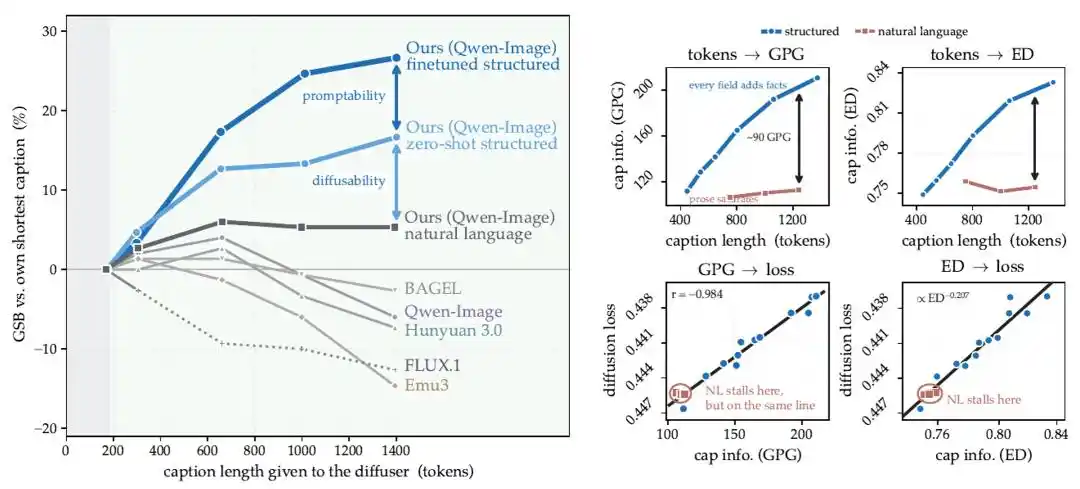
Figure 1 from the paper | Natural language length saturates quickly; structured conditioning continues to increase image information and consistently lowers the diffusion training loss along a unified relationship.

In recent years, the advancement of text-to-image models has largely followed a familiar path: larger models, more data, and increased training compute.

However, there is an easily overlooked difference between text-to-image models and language models. Language models can learn directly from text sequences via self-supervision; text-to-image models rely on image-caption pairs to learn "what kind of text corresponds to what kind of visual content." An image may contain numerous objects, attributes, positions, actions, and relations, but only the parts that are accurately described and clearly bound in the caption can be passed to the model as text-conditioned supervision.

Thus, a fundamental question arises: Beyond scaling up models, data, and compute, can we improve the learning of generation models by increasing the image information carried by captions?

In this new work, ByteDance's Seed team investigated this question. The core conclusion can be summarized in one sentence:

What truly scales with text conditioning is not the number of tokens in a caption, but the image information within it that can be utilized by the model.
  • Paper Title: Scaling Properties of Text Conditioning in Visual Generation
  • Authors: Zilong Chen, Chaorui Deng, Kunchang Li, Hongyi Yuan, Haoqi Fan Affiliation: ByteDance Seed
  • Paper: https://arxiv.org/abs/2607.29679
  • Project Page: https://heheyas.github.io/context-scaling
  • Code: https://github.com/heheyas/context-scaling
  • Models: https://huggingface.co/collections/heheyas/context-scaling
  • Online Demo: https://heheyas-context-scaling.hf.space/
  • Hugging Face Paper: https://huggingface.co/papers/2607.29679

Why Don't Models Get Stronger When Prompts Get Longer?

An intuitive approach is to write training captions or user prompts longer and in more detail. More tokens seem like they should mean more supervision and help the model generate more complex images.

However, experiments gave a different answer. On various existing open-source text-to-image systems, natural language prompts quickly saturated with increasing length, with final performance even falling below that of their respective shortest prompts. Even training diffusion models specifically on the same set of long-text captions yielded limited benefits.

To observe this phenomenon more clearly, the team designed an image reconstruction experiment with a fixed backbone network. For the same reference image, the team generated four natural language captions of progressively increasing detail from the same set of complete annotations, then used the same Qwen-Image model and random seed to attempt to reconstruct the image. These captions described the same entities and relations, with later versions mainly adding length by supplementing and expanding the natural language expressions.

Surprisingly, although the captions became significantly longer, the quality of image reconstruction hardly improved. The added prose mostly explained, rephrased, or connected already present content, rather than continuously adding new, stably usable visual variables.
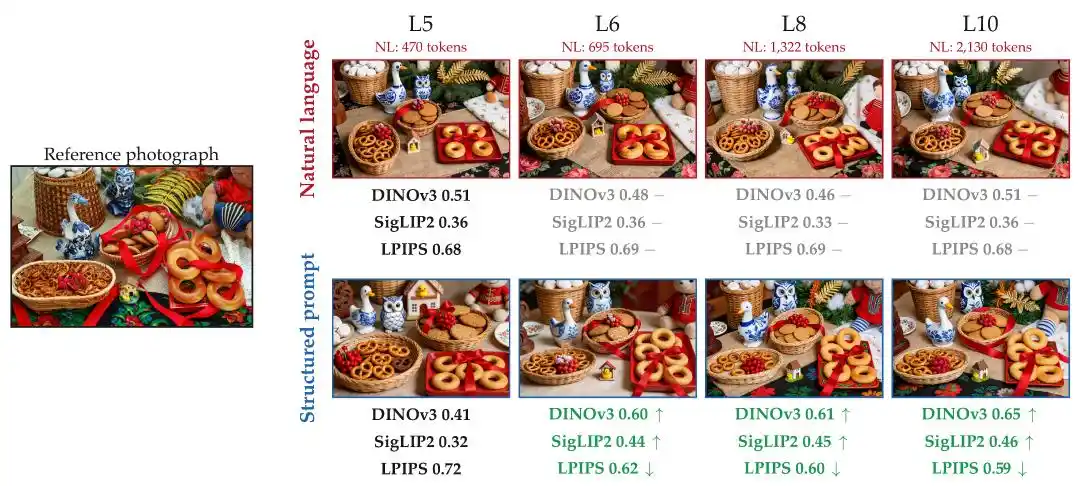
Figure 3 from the paper | Fixed-backbone reconstruction experiment: Reconstruction plateaus as NL Caption continues to lengthen, but gradually restoring SP fields yields continuous improvement.

This indicates that caption length is only a weak proxy variable. A text can be very long yet still fail to clearly specify which attribute belongs to which object, what relation exists between two objects, their respective locations, and their front-back order in the scene.

How to Measure the True Image Information in a Caption?

If token count is insufficient to gauge supervision strength, we need to directly measure the information bound to the image within a caption. For this purpose, the team adapted two complementary metrics from existing work: Grounded Perplexity Gain (GPG) and Effective Detailness (ED).

GPG: How much does the image make the caption "more predictable"?

GPG is a white-box metric that requires reading model token probabilities. For the same caption, the team separately had a frozen vision-language model see and not see the paired image, and calculated the increase in log-likelihood for the caption's content tokens after the image was presented. If the caption contains a large amount of information tightly bound to that image, seeing the image should significantly enhance the model's predictive ability for those tokens.

ED: How many reliable image attributes does the caption cover?

ED is a black-box semantic metric that does not rely on token probabilities. It extracts attributes with entity contexts from the image and the caption separately, then calculates the accuracy of caption attributes and the recall of image attributes. It finally uses F0.5, which places more weight on accuracy, applying stronger penalties to descriptions in the caption without visual grounding.

The two metrics approach the same problem from different angles: GPG focuses on the statistical dependency between image and text, while ED focuses on whether the caption accurately covers verifiable visual content.
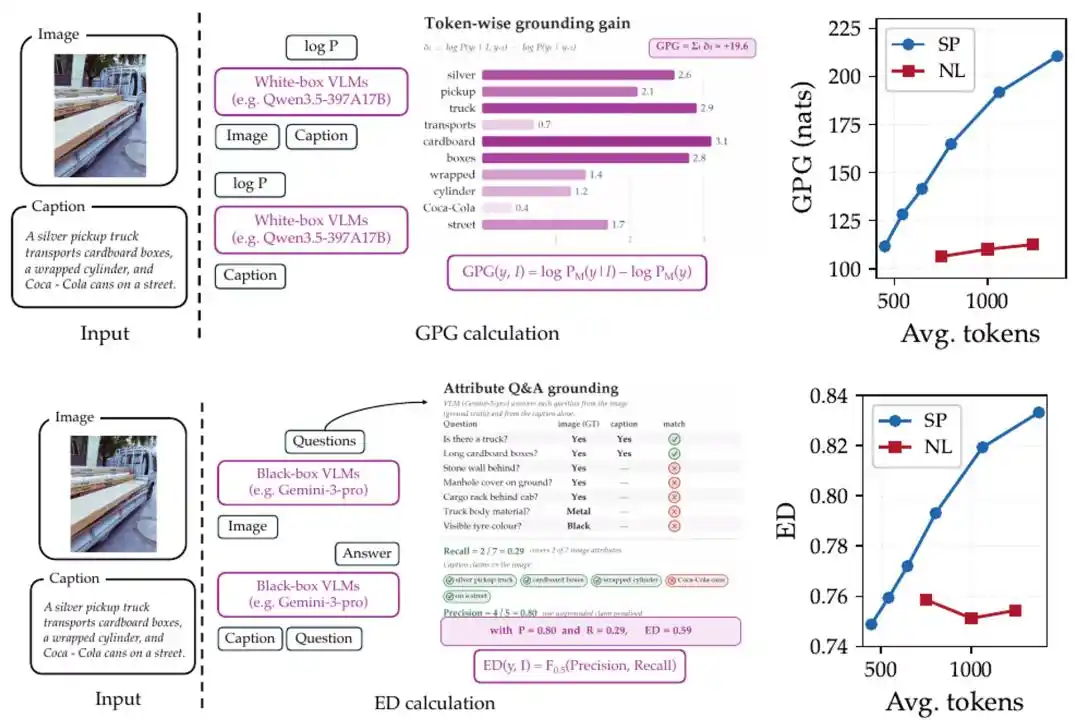
Figure 6 from the paper | Definitions and measurement trends of GPG and ED.

Caption Information Content Can Predict Diffusion Model Training Loss

Next, the team fixed the images, model architecture, initialization method, optimization configuration, and training budget, varying only the training captions. The entire experiment included 15 caption configurations: three natural language versions of different lengths, six Structured Prompt versions gradually restoring fields, and six variants with spatial expression or field masking. Each configuration started from the same BAGEL continued-training checkpoint and independently trained a diffusion model.

The results showed no consistent relationship between the token count of natural language captions and training outcomes. However, when the x-axis was changed to caption information content, configurations of different formats and detail levels fell onto highly regular curves:

  • The converged diffusion loss had an approximately linear relationship with GPG, Pearson r = -0.984.
  • The converged diffusion loss followed a power-law trend with ED, with Pearson r = -0.971 in log-log space.
  • GPG and ED also showed high consistency in ranking different caption configurations, Spearman ρ = 0.96.

The team refers to this as the scaling properties of text conditioning. It is not a theoretical law holding for all models, but an empirical calibration obtained under fixed architecture and training recipe. However, it provides two immediate benefits.

First, it transforms caption information content from a vague "data quality" concept into a trainable variable that can be controlled and measured: when model, images, and compute are fixed, information content can predict the final training loss the model achieves.

Second, after performing one calibration, candidate caption schemes can be compared using GPG or ED under the same training recipe before deciding whether to invest in expensive diffusion model training. For six caption variants not involved in the fitting, the two metrics still accurately predicted their convergence loss.
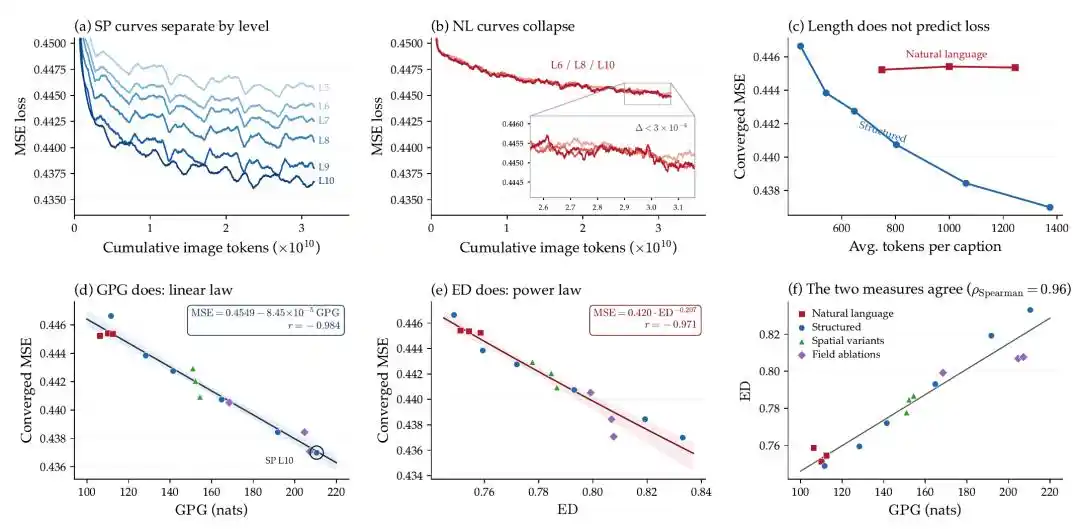
Figure 7 from the paper | Under a fixed training recipe, the convergence loss shows a stable relationship with caption information content.

Structured Prompt: Making Information Not Just More, But Easier for the Model to Use

The earlier experiments reveal a crucial point: merely adding natural language prose is not enough; the new information also needs to be organized in a stable and unambiguous manner.

Therefore, the team proposes Structured Prompt (SP), using structured JSON to represent the visual variables in an image. It consists of three layers:

  • Global Layer: Scene intent, setting, atmosphere, style, lighting, and photographic information.
  • Element Layer: Each subject's identity, attributes, actions, position, optional depth, and local photographic information.
  • Relation Layer: Positional, occlusion, interaction, and semantic relations between different elements.

Compared to free text, the key of SP is not just the "JSON" appearance, but placing different visual variables into stable named fields, reducing ambiguity in attribute assignment, spatial relations, and object binding. In the fixed-backbone reconstruction experiment, reconstruction quality continuously improved as SP fields were gradually restored; in the full training sweep, increased field coverage also consistently raised GPG, ED, and lowered the converged diffusion loss.
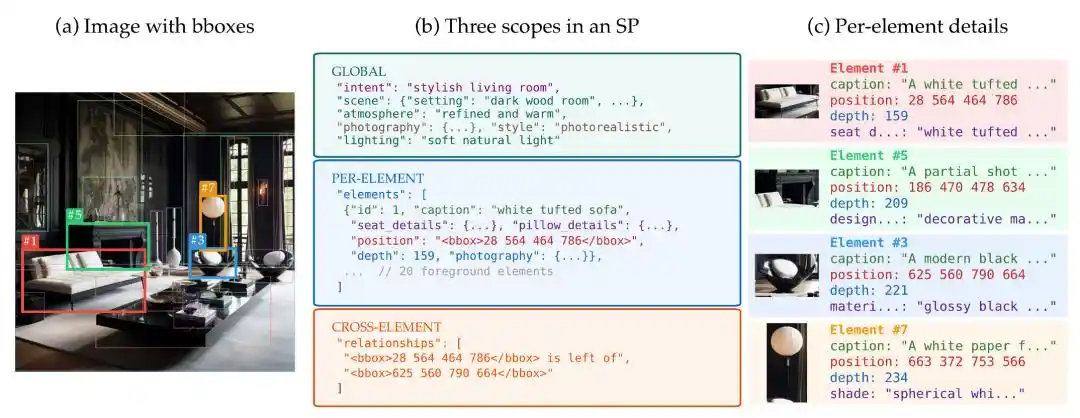
Figure 5 from the paper | Structured Prompt organizes global, element-level, and cross-element visual variables into named fields.

To generate complete SP for large-scale training data, the team constructed an image-to-SP annotation pipeline. A general VLM handles global semantics and local content, Sapiens supplements human pose evidence, DepthAnything V2 provides relative depth, SAM 2.1 provides masks and occlusion cues, and finally a VLM unifies this information into a consistent, complete SP.
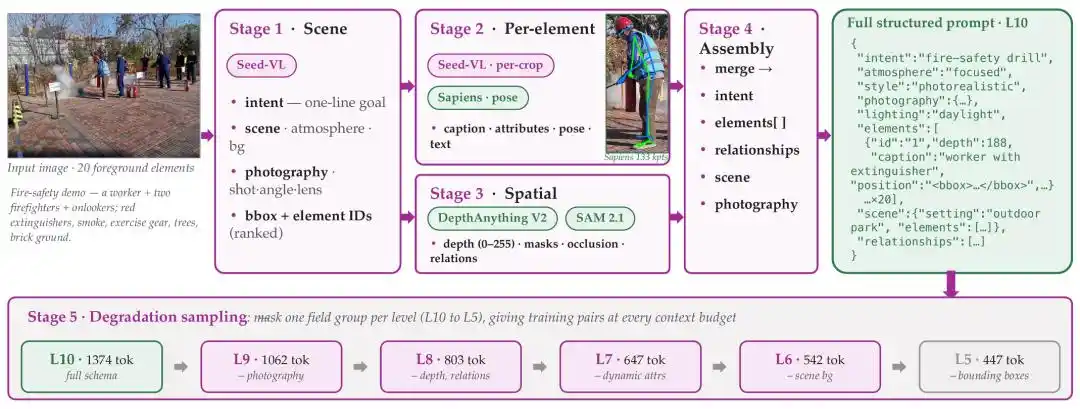
Figure 8 from the paper | VLM and experts for pose, depth, and segmentation collaboratively construct a complete Structured Prompt.

The team terms the ability of a caption representation to expose and organize image supervision for a diffusion model as Diffusability. SP enhances precisely this aspect: without changing the diffusion model architecture, it allows the model to learn more and clearer visual variables from the text condition.

Promptability: With a Good Structure, You Still Need an LLM to Fill It Well

During training, complete SP can be extracted from paired images, but during actual generation, only the user's sentence is available—there is no reference image or oracle annotation. The system also requires an LLM prompter to expand the user request into a detailed, coherent SP that does not violate the original constraints.

The team calls this ability to instantiate structured conditions from user requests Promptability. End-to-end generation quality depends on the joint effect of both sides:

Generation Quality = Diffusability × Promptability

The multiplication sign here is an organizational perspective, not a mathematically derived formula: Diffusability describes what the diffusion model can learn from the caption representation, and Promptability describes whether the LLM can truly produce a high-quality caption instance during inference.
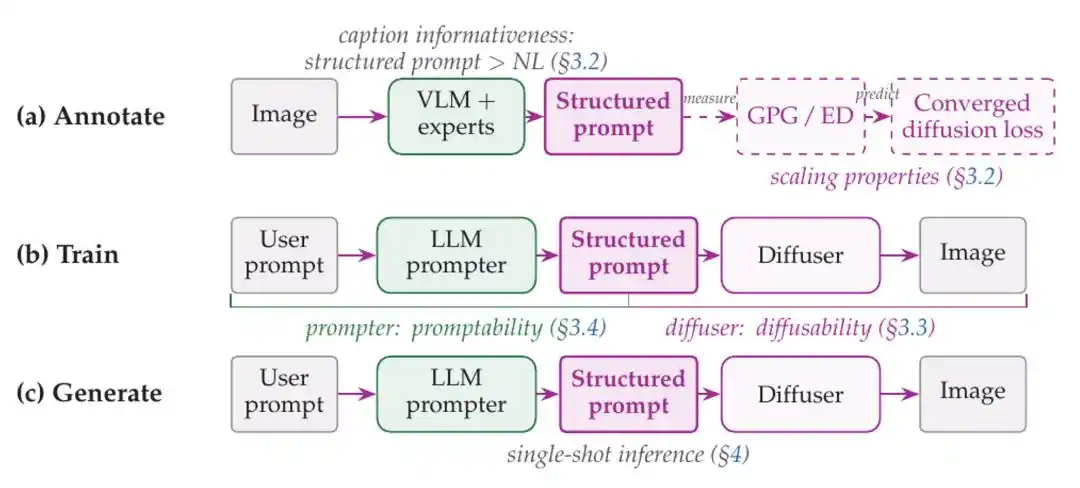
Figure 4 from the paper | Structured Prompt connects annotation, measurement, diffuser training, prompter training, and final generation.

First, the team fixed the SP schema and Qwen-Image diffuser, only replacing the zero-shot LLM prompter. As Qwen3.5 scaled from 0.8B to 397B, GenEval++ score in thinking mode improved from 46.4% to 86.8%. Apart from the smallest model which tended to repeat during thinking and failed to output valid JSON, chain-of-thought provided further improvements at other scales. This indicates that the model capability and reasoning ability of general LLMs can be directly translated into better image generation results through the caption interface.

However, zero-shot LLMs still tend to generate SP lacking in information and with relatively simple composition. To further improve Promptability, the team adopted three-stage training:

SFT learns the distribution of SP content expected by the diffusion model, not just the JSON format.

Cold-start distills "how to deduce SP solely from user requests" from privileged reasoning traces paired with images.

RFT continues optimization on rollouts generated and rendered by the prompter itself, where a verifier selects high-confidence trajectories, and then provides dense token supervision through on-policy self-distillation from an image-conditioned teacher.

Ablation experiments show the three stages serve different purposes: SFT brings the largest single-stage structural improvement, cold-start strengthens the deduction from user requests to SP, and verifier-gated OPSD achieves the strongest results within the prompter's own distribution.
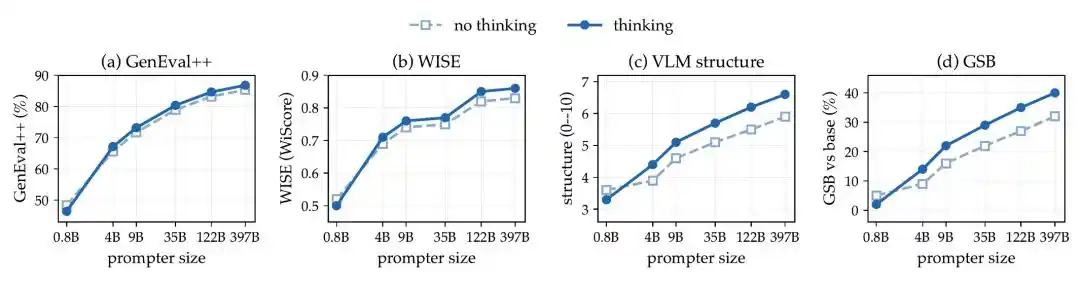
Figure 9 from the paper | With fixed schema and diffuser, generation quality improves with LLM prompter scale and reasoning mode.
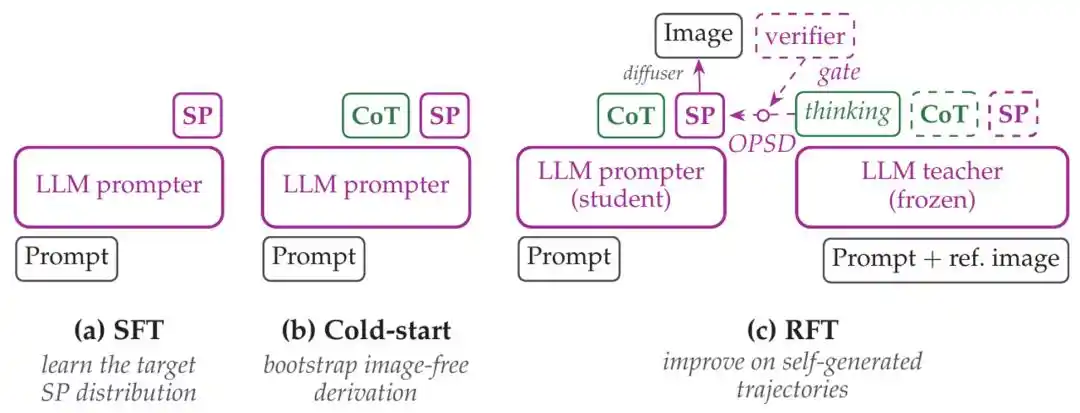
Figure 10 from the paper | Three-stage prompter training: SFT, cold-start, and verifier-gated RFT.

Structured Representation Also Makes the Generation Process Easier to Iteratively Correct

Another natural advantage of SP's field-based representation is that when errors appear in the generated image, the system can locate and modify the corresponding object, attribute, relation, or layout fields, rather than rewriting the entire natural language prompt.

Based on this, the team built a refine-render-judge loop. In each round, the prompter generates or revises SP based on user request and historical feedback, the fixed diffuser renders an image, and an online judge provides PASS/FAIL decisions along with specific issues regarding prompt adherence, structure, and visual quality. If it fails, the next round only needs adjustments around the relevant fields.

Experiments show that increasing iteration budget can further improve structural alignment, adherence, and GSB performance; however, effective reasoning length is not long. For the trained prompter, even when allowed up to 8 rounds, an average of only 2.31 rounds were used; increasing Tmax from 4 to 8 yielded minimal additional benefit. This indicates that text-to-image generation does benefit from iterative error correction, but under the current setup, does not require very long prompt-side reasoning trajectories: after fixing major specification errors, additional rounds saturate quickly.

Figure 14 from the paper | Agentic reasoning loop of refine-render-judge.

Figure 15 from the paper | The loop can correct issues with object splitting, relations, and overall layout.

How Much Improvement Does the Structured Interface Bring to the Same Qwen-Image Base?

The final system consists of an SP-trained diffuser and a trained LLM prompter. It outperforms all compared open-weight models on almost every reported metric and reaches or surpasses most compared closed-source systems on the majority of evaluations, with advantages particularly pronounced on composition, reasoning, and world knowledge tasks.

More crucially, the matched control. To rule out explanations like "it just trained more," the team trained an additional system using the exact same Qwen-Image architecture, training images, training stages, and budget, but consistently using free natural language captions. The results are as follows:
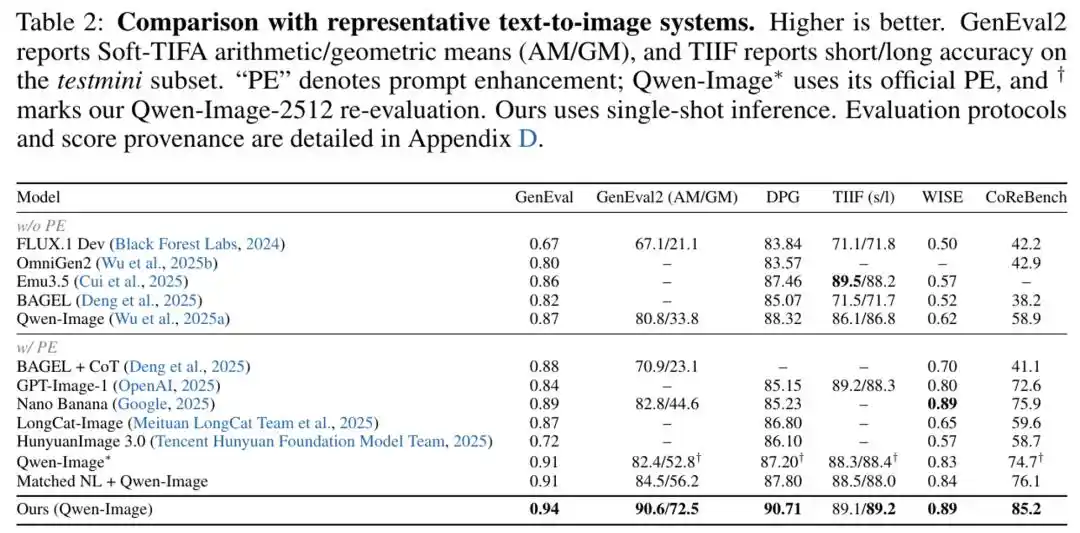
Table 2 from the paper | Complete comparison with representative text-to-image systems. Screenshot retains evaluation definitions, bold text, and footnotes from the paper.

The additional training for the matched NL system indeed brought some improvements, but far from enough to replicate the SP system's results. This indicates that the gains cannot be simply attributed to a larger backbone or more training but are closely related to the structured caption interface used between the prompter and diffuser.
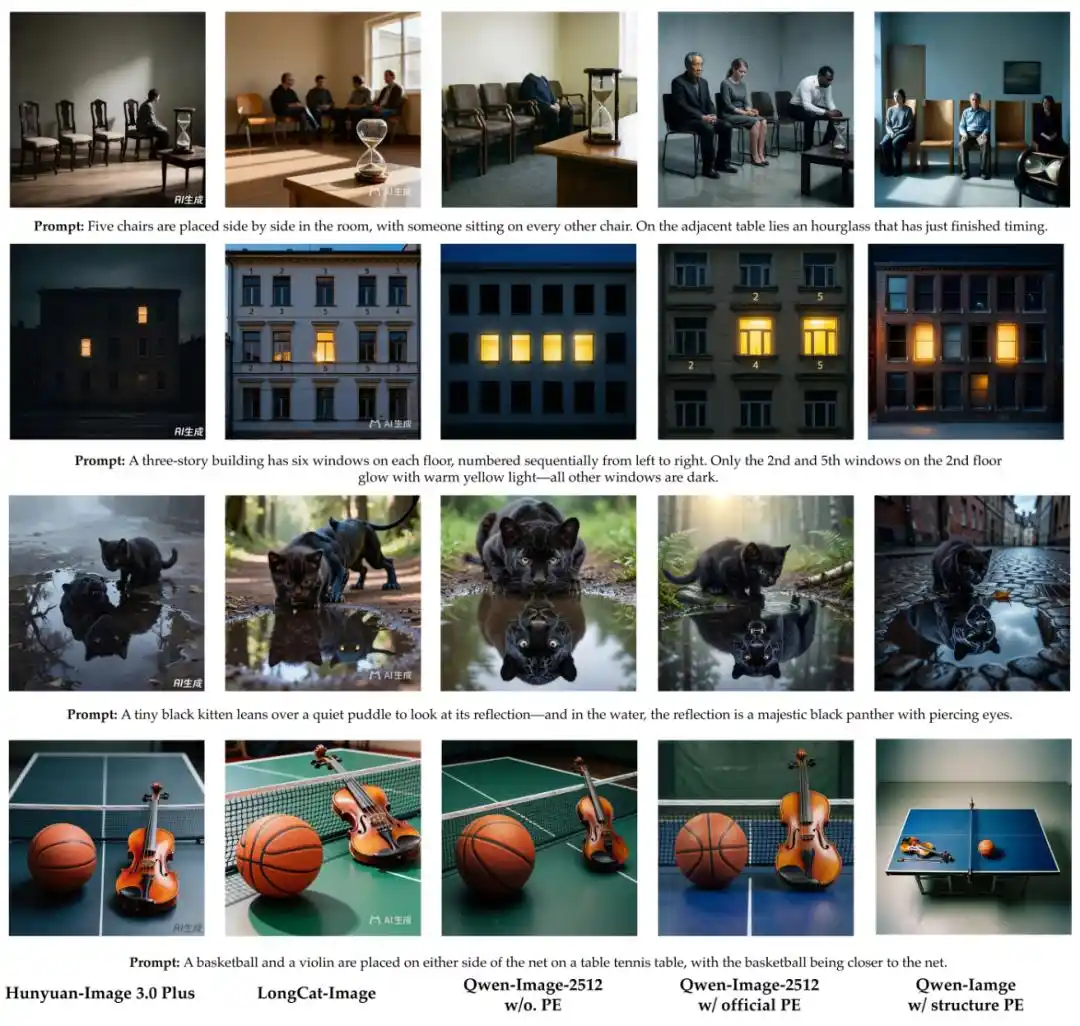
Figure 11 from the paper | Qualitative comparison on complex spatial relations, quantities, and attribute binding.

The Next Step is Not Just to Scale the Model, But Also to Scale the Condition Itself

The starting point of this work is simple: For text-to-image models, captions are not irrelevant metadata, but the primary interface through which image content enters text-conditioned learning.

When captions merely become longer, the new tokens may just rephrase and elaborate; when image information is accurately extracted, clearly bound, and stably organized, the same generation model can learn more from it. GPG and ED make this information a measurable variable, Structured Prompt improves Diffusability, and LLM scaling, post-training, and short-range agentic refinement improve Promptability.

Therefore, the next step in scaling text-to-image should not only focus on "how large the rendering model is" but also ask:

How much image information—information it can truly learn and use—is the text condition passed to the model actually carrying?

This article is from the WeChat official account "Machine Heart"

Trend Kriptolar

İlgili Sorular

QWhat is the key finding of ByteDance Seed team regarding text caption length and its effect on text-to-image model training?

AThe team found that increasing the length of natural language captions does not necessarily provide more usable visual supervision. Instead, the amount of image-grounded information in the caption, measured by metrics like Grounded Perplexity Gain (GPG) and Effective Detailness (ED), is a better predictor of the final training loss a diffusion model can achieve.

QWhat two complementary metrics did the researchers propose to measure the image-grounded information in a caption?

AThe researchers proposed two complementary metrics: 1) **Grounded Perplexity Gain (GPG)**: A white-box metric measuring how much an image makes a caption more predictable for a frozen Vision-Language Model. 2) **Effective Detailness (ED)**: A black-box semantic metric measuring how accurately a caption covers verifiable visual attributes from the image.

QWhat is Structured Prompt (SP) and how does it address the limitations of natural language captions?

AStructured Prompt (SP) is a JSON-based representation that organizes visual variables into hierarchical fields: a global layer (intent, scene, style), an element layer (identity, attributes, position of subjects), and a relation layer (interactions between elements). It addresses natural language ambiguity by stably assigning attributes, spatial relations, and object bindings to specific named fields, thereby increasing the amount of usable visual information (Diffusability) for the model.

QHow does the concept of 'Promptability' relate to the overall generation quality in the proposed system?

APromptability refers to the ability of a Large Language Model (LLM) prompter to instantiate a high-quality Structured Prompt (SP) from a user's simple request during inference. The overall generation quality is viewed as depending on both Diffusability (how much the diffusion model can learn from the caption representation) and Promptability. Enhancing the LLM prompter's capabilities through scaling and multi-stage training directly improves the generation results.

QWhat experimental evidence supports the claim that the gains from Structured Prompt are not simply due to more training data or compute?

AA matched control experiment was conducted. Using the exact same Qwen-Image architecture, training images, stages, and budget, a separate system was trained using only free-form natural language captions. While this matched NL system showed some improvement, its performance was far below that of the SP-based system. This demonstrates that the gains are primarily due to the structured caption interface itself, not merely from extra training of the backbone model.

İlgili Okumalar

Strategy CEO Announces Plan to Resume Bitcoin Purchases This Year, With Buying Volume 25 Times Selling Volume

Strategy CEO Announces Resumption of Bitcoin Purchases This Year, Buy-to-Sell Ratio at 25x In a FOX Business interview, Phong Le, CEO of Strategy (formerly MicroStrategy), stated the company plans to resume its Bitcoin acquisition strategy within the current year. This ends a pause in buying that began in May. Le revealed that since the start of the year, Strategy has purchased approximately 175,000 bitcoins while selling around 7,000, making its buy volume about 25 times its sell volume. The company remains the world's largest corporate holder of Bitcoin, with 840,447 BTC, representing roughly 4% of the circulating supply. Le explained that recent sales were used to fulfill capital obligations under a newly approved framework, including paying preferred stock dividends, funding share buybacks, and bolstering the company's US dollar reserves, which now stand at about $4.7 billion. This move marks a shift from the firm's previous "never sell" mantra, which had contributed to its market premium. The change in strategy and the associated financial pressures led to a significant drop in its stock price (MSTR) and a rating downgrade from JPMorgan. The CEO framed the company's role as the "JPMorgan of the crypto economy," emphasizing its long-term goal of increasing the amount of Bitcoin per MSTR share. The announcement signals the return of a major institutional buyer to the Bitcoin market, which could provide price support. It is also viewed as a micro-indicator of recovering institutional confidence, suggesting the company believes the most acute phase of liquidity pressure has passed.

marsbit11 dk önce

Strategy CEO Announces Plan to Resume Bitcoin Purchases This Year, With Buying Volume 25 Times Selling Volume

marsbit11 dk önce

ArthurHayes新文:押注日元升值,ENA未来几月或涨5至10倍

Arthur Hayes argues that the Japanese Yen is significantly undervalued and posits that its appreciation against the US Dollar is imminent. He outlines three potential mechanisms for this shift, dismissing the first two—the Bank of Japan raising interest rates and domestic institutions selling foreign assets—as politically or economically unfeasible. He identifies the third and preferred method: the Japanese Ministry of Finance (MOF) using its holdings of US Treasuries as collateral in the Fed's FIMA repo facility to borrow US dollars, then selling those dollars to buy Yen in the forex market. Hayes believes US Treasury Secretary Bessant has signaled support for this approach, which requires the Fed's Foreign Currency Subcommittee, led by Chairman Walsh, to remove lending limits on the FIMA tool. Hayes asserts that implementing this "Scheme 3" would lead to a significant expansion of US dollar liquidity. He predicts this surge in liquidity will act as a catalyst, driving up the prices of assets like Bitcoin and physical gold. Within the crypto space, he views Ethereum (ETH) as undervalued and singles out Ethena's ENA token as a speculative play with potential for 5-10x gains in the coming months, contingent on a recovery in Bitcoin basis trades that would boost demand for its USDe stablecoin. He concludes that investors should watch for the Fed's rule change as the key trigger for these market movements.

marsbit23 dk önce

ArthurHayes新文:押注日元升值,ENA未来几月或涨5至10倍

marsbit23 dk önce

İşlemler

Spot

Popüler Makaleler

$S$ Nedir

SPERO'yu Anlamak: Kapsamlı Bir Genel Bakış SPERO'ya Giriş İnovasyonun manzarası gelişmeye devam ederken, web3 teknolojilerinin ve kripto para projelerinin ortaya çıkışı dijital geleceği şekillendirmede önemli bir rol oynamaktadır. Bu dinamik alanda dikkat çeken projelerden biri SPERO, $$s$$ olarak adlandırılmaktadır. Bu makale, SPERO hakkında ayrıntılı bilgi toplamak ve sunmak amacıyla, meraklılar ve yatırımcıların web3 ve kripto alanlarındaki temellerini, hedeflerini ve yeniliklerini anlamalarına yardımcı olmayı amaçlamaktadır. SPERO,$$s$$ Nedir? SPERO,$$s$$, kripto alanında merkeziyetsizlik ve blok zinciri teknolojisi ilkelerini kullanarak etkileşimi, faydayı ve finansal kapsayıcılığı teşvik eden bir ekosistem yaratmayı amaçlayan benzersiz bir projedir. Proje, kullanıcıların yenilikçi finansal çözümler ve hizmetler sunarak eşler arası etkileşimleri yeni yollarla kolaylaştırmayı hedeflemektedir. SPERO,$$s$$'nin temel amacı, bireyleri güçlendirmek ve kripto para alanındaki kullanıcı deneyimini artıran araçlar ve platformlar sağlamaktır. Bu, daha esnek işlem yöntemlerini mümkün kılmayı, topluluk odaklı girişimleri teşvik etmeyi ve merkeziyetsiz uygulamalar (dApp'ler) aracılığıyla finansal fırsatlar yaratmayı içermektedir. SPERO,$$s$$'nin temel vizyonu kapsayıcılık etrafında dönmekte olup, geleneksel finansal sistemlerdeki boşlukları kapatmayı ve blok zinciri teknolojisinin faydalarından yararlanmayı hedeflemektedir. SPERO,$$s$$'nin Yaratıcısı Kimdir? SPERO,$$s$$'nin yaratıcısının kimliği bir miktar belirsizdir, çünkü kurucusu(ları) hakkında ayrıntılı arka plan bilgisi sağlayan sınırlı kamuya açık kaynaklar bulunmaktadır. Bu şeffaflık eksikliği, projenin merkeziyetsizlik taahhüdünden kaynaklanabilir—birçok web3 projesinin paylaştığı bir etik anlayışı, bireysel tanınmanın yerine kolektif katkıları önceliklendirmektedir. Topluluk ve onun kolektif hedefleri etrafında tartışmaları merkezileştirerek, SPERO,$$s$$, belirli bireyleri öne çıkarmadan güçlendirme özünü taşımaktadır. Bu nedenle, SPERO'nun etik anlayışını ve misyonunu anlamak, tek bir yaratıcının kimliğini belirlemekten daha önemlidir. SPERO,$$s$$'nin Yatırımcıları Kimlerdir? SPERO,$$s$$, kripto sektöründe yeniliği teşvik etmeye adanmış girişim sermayedarlarından melek yatırımcılara kadar çeşitli yatırımcılar tarafından desteklenmektedir. Bu yatırımcıların odak noktası genellikle SPERO'nun misyonuyla uyumlu olup, toplumsal teknolojik ilerlemeyi, finansal kapsayıcılığı ve merkeziyetsiz yönetimi vaat eden projeleri önceliklendirmektedir. Bu yatırımcı temelleri, yalnızca yenilikçi ürünler sunan projelere değil, aynı zamanda blok zinciri topluluğuna ve ekosistemlerine olumlu katkılarda bulunan projelere de ilgi duymaktadır. Bu yatırımcıların desteği, SPERO,$$s$$'yi hızla gelişen kripto projeleri alanında dikkate değer bir rakip haline getirmektedir. SPERO,$$s$$ Nasıl Çalışır? SPERO,$$s$$, onu geleneksel kripto para projelerinden ayıran çok yönlü bir çerçeve kullanmaktadır. İşte benzersizliğini ve yeniliğini vurgulayan bazı temel özellikler: Merkeziyetsiz Yönetim: SPERO,$$s$$, kullanıcıların projenin geleceğiyle ilgili karar alma süreçlerine aktif olarak katılmalarını sağlayan merkeziyetsiz yönetim modellerini entegre etmektedir. Bu yaklaşım, topluluk üyeleri arasında sahiplik ve hesap verebilirlik duygusunu teşvik etmektedir. Token Kullanımı: SPERO,$$s$$, ekosistem içinde çeşitli işlevler sunmak üzere tasarlanmış kendi kripto para token'ını kullanmaktadır. Bu token'lar, işlemleri, ödülleri ve platformda sunulan hizmetlerin kolaylaştırılmasını sağlayarak genel etkileşimi ve faydayı artırmaktadır. Katmanlı Mimari: SPERO,$$s$$'nin teknik mimarisi, modülerlik ve ölçeklenebilirliği destekleyerek projenin evrimi sırasında ek özelliklerin ve uygulamaların sorunsuz bir şekilde entegrasyonuna olanak tanımaktadır. Bu uyum sağlama yeteneği, sürekli değişen kripto manzarasında geçerliliği sürdürmek için hayati öneme sahiptir. Topluluk Katılımı: Proje, işbirliği ve geri bildirim teşvik eden mekanizmalar kullanarak topluluk odaklı girişimlere vurgu yapmaktadır. Güçlü bir topluluk oluşturarak, SPERO,$$s$$, kullanıcı ihtiyaçlarını daha iyi karşılayabilir ve piyasa trendlerine uyum sağlayabilir. Kapsayıcılığa Odaklanma: Düşük işlem ücretleri ve kullanıcı dostu arayüzler sunarak, SPERO,$$s$$, daha önce kripto alanında yer almamış bireyler de dahil olmak üzere çeşitli bir kullanıcı tabanını çekmeyi hedeflemektedir. Bu kapsayıcılık taahhüdü, erişilebilirlik yoluyla güçlendirme misyonuyla uyumludur. SPERO,$$s$$ Zaman Çizelgesi Bir projenin tarihini anlamak, gelişim yolculuğu ve kilometre taşları hakkında kritik bilgiler sağlar. Aşağıda, SPERO,$$s$$'nin evriminde önemli olayları haritalayan önerilen bir zaman çizelgesi bulunmaktadır: Kavram Geliştirme ve Fikir Aşaması: SPERO,$$s$$'nin temelini oluşturan ilk fikirler, blok zinciri endüstrisindeki merkeziyetsizlik ve topluluk odaklılık ilkeleriyle yakından uyumlu olarak geliştirildi. Proje Beyaz Kağıdının Yayınlanması: Kavramsal aşamayı takiben, SPERO,$$s$$'nin vizyonunu, hedeflerini ve teknolojik altyapısını ayrıntılı bir şekilde açıklayan kapsamlı bir beyaz kağıt yayımlandı ve topluluk ilgisini ve geri bildirimini toplamak amacıyla sunuldu. Topluluk Oluşturma ve Erken Katılımlar: Projenin hedefleri etrafında tartışmalar yürüterek destek toplamak ve erken benimseyenler ile potansiyel yatırımcılar için bir topluluk oluşturmak amacıyla aktif iletişim çabaları gerçekleştirildi. Token Üretim Etkinliği: SPERO,$$s$$, yerel token'larını erken destekçilere dağıtmak ve ekosistem içinde başlangıç likiditesini sağlamak amacıyla bir token üretim etkinliği (TGE) gerçekleştirdi. İlk dApp'in Yayınlanması: SPERO,$$s$$ ile ilişkili ilk merkeziyetsiz uygulama (dApp) faaliyete geçti ve kullanıcıların platformun temel işlevleriyle etkileşimde bulunmalarını sağladı. Sürekli Gelişim ve Ortaklıklar: Projenin tekliflerine sürekli güncellemeler ve iyileştirmeler yapılmakta olup, blok zinciri alanındaki diğer oyuncularla stratejik ortaklıklar, SPERO,$$s$$'yi rekabetçi ve gelişen bir oyuncu haline getirmiştir. Sonuç SPERO,$$s$$, web3 ve kripto paranın finansal sistemleri devrim niteliğinde dönüştürme ve bireyleri güçlendirme potansiyelinin bir kanıtıdır. Merkeziyetsiz yönetime, topluluk katılımına ve yenilikçi tasarlanmış işlevselliğe olan bağlılığıyla, daha kapsayıcı bir finansal manzaraya doğru bir yol açmaktadır. Hızla gelişen kripto alanındaki herhangi bir yatırımda olduğu gibi, potansiyel yatırımcılar ve kullanıcılar, SPERO,$$s$$ içindeki devam eden gelişmelerle ilgili olarak kapsamlı bir araştırma yapmaları ve düşünceli bir şekilde katılmaları teşvik edilmektedir. Proje, kripto endüstrisinin yenilikçi ruhunu sergileyerek, sayısız olasılığını keşfetmeye davet etmektedir. SPERO,$$s$$'nin yolculuğu hala devam ederken, temel ilkeleri, teknoloji, finans ve birbirimizle etkileşim biçimimizi etkileyebilir.

369 Toplam GörüntülenmeYayınlanma 2024.12.17Güncellenme 2024.12.17

$S$ Nedir

AGENT S Nedir

Agent S: Web3'te Otonom Etkileşimin Geleceği Giriş Web3 ve kripto para dünyasında sürekli gelişen manzarada, yenilikler bireylerin dijital platformlarla etkileşim biçimlerini sürekli olarak yeniden tanımlıyor. Bu tür öncü projelerden biri olan Agent S, açık ajans çerçevesi aracılığıyla insan-bilgisayar etkileşimini devrim niteliğinde değiştirmeyi vaat ediyor. Otonom etkileşimlerin yolunu açarak, Agent S karmaşık görevleri basitleştirmeyi ve yapay zeka (AI) alanında dönüştürücü uygulamalar sunmayı hedefliyor. Bu detaylı inceleme, projenin karmaşıklıklarına, benzersiz özelliklerine ve kripto para alanındaki etkilerine dalacaktır. Agent S Nedir? Agent S, bilgisayar görevlerinin otomasyonunda üç temel zorluğu ele almak üzere özel olarak tasarlanmış çığır açıcı bir açık ajans çerçevesidir: Alan Spesifik Bilgi Edinimi: Çerçeve, çeşitli dış bilgi kaynaklarından ve iç deneyimlerden akıllıca öğrenir. Bu çift yönlü yaklaşım, alan spesifik bilgi açısından zengin bir veri havuzu oluşturmasını sağlar ve görev yürütmedeki performansını artırır. Uzun Görev Ufukları Üzerinde Planlama: Agent S, karmaşık görevlerin verimli bir şekilde parçalanmasını ve yürütülmesini kolaylaştıran deneyim artırımlı hiyerarşik planlama kullanır. Bu özellik, çoklu alt görevleri etkili ve verimli bir şekilde yönetme yeteneğini önemli ölçüde artırır. Dinamik, Homojen Olmayan Arayüzlerle Başlama: Proje, ajanlar ve kullanıcılar arasındaki etkileşimi geliştiren yenilikçi bir çözüm olan Ajan-Bilgisayar Arayüzü'ni (ACI) tanıtmaktadır. Çok Modlu Büyük Dil Modellerini (MLLM'ler) kullanarak, Agent S çeşitli grafik kullanıcı arayüzlerini sorunsuz bir şekilde gezinebilir ve manipüle edebilir. Bu öncü özellikler aracılığıyla, Agent S, makinelerle insan etkileşimini otomatikleştirmede karşılaşılan karmaşıklıkları ele alan sağlam bir çerçeve sunarak, AI ve ötesinde birçok uygulama için zemin hazırlıyor. Agent S'nin Yaratıcısı Kimdir? Agent S'nin kavramı temelde yenilikçi olsa da, yaratıcısı hakkında spesifik bilgiler belirsizliğini koruyor. Yaratıcı şu anda bilinmiyor, bu da projenin yeni aşamasını veya kurucu üyeleri gizli tutma stratejik tercihini vurguluyor. Anonimlikten bağımsız olarak, odak çerçevenin yetenekleri ve potansiyeli üzerinde kalıyor. Agent S'nin Yatırımcıları Kimlerdir? Agent S, kriptografik ekosistemde oldukça yeni olduğundan, yatırımcıları ve finansal destekçileri hakkında ayrıntılı bilgiler açıkça belgelenmemiştir. Projeyi destekleyen yatırım temelleri veya organizasyonları hakkında kamuya açık bilgilerdeki eksiklik, finansman yapısı ve gelişim yol haritası hakkında sorular doğuruyor. Destekleyicilerin anlaşılması, projenin sürdürülebilirliğini ve potansiyel pazar etkisini değerlendirmek için kritik öneme sahiptir. Agent S Nasıl Çalışır? Agent S'nin temelinde, çeşitli ortamlarda etkili bir şekilde çalışmasını sağlayan son teknoloji bir sistem yatmaktadır. İşleyiş modeli birkaç ana özellik etrafında inşa edilmiştir: İnsan Benzeri Bilgisayar Etkileşimi: Çerçeve, bilgisayarlarla etkileşimleri daha sezgisel hale getirmeyi amaçlayan gelişmiş AI planlaması sunar. Görev yürütmedeki insan davranışını taklit ederek, kullanıcı deneyimlerini yükseltmeyi vaat eder. Anlatı Belleği: Yüksek düzeyde deneyimlerden yararlanmak için kullanılan Agent S, görev geçmişlerini takip etmek amacıyla anlatı belleğini kullanarak karar verme süreçlerini geliştirir. Episodik Bellek: Bu özellik, kullanıcılara adım adım rehberlik sağlayarak, çerçevenin görevler gelişirken bağlamsal destek sunmasına olanak tanır. OpenACI Desteği: Yerel olarak çalışabilme yeteneği ile Agent S, kullanıcıların etkileşimleri ve iş akışları üzerinde kontrol sağlamasına olanak tanır ve Web3'ün merkeziyetsiz felsefesiyle uyumlu hale gelir. Dış API'lerle Kolay Entegrasyon: Çeşitli AI platformlarıyla uyumluluğu ve çok yönlülüğü, Agent S'nin mevcut teknolojik ekosistemlere sorunsuz bir şekilde entegre olmasını sağlar ve geliştiriciler ile organizasyonlar için cazip bir seçenek haline getirir. Bu işlevsellikler, Agent S'nin kripto alanındaki benzersiz konumuna katkıda bulunarak, karmaşık, çok aşamalı görevleri minimum insan müdahalesi ile otomatikleştirir. Proje geliştikçe, Web3'teki potansiyel uygulamaları dijital etkileşimlerin nasıl gelişeceğini yeniden tanımlayabilir. Agent S'nin Zaman Çizelgesi Agent S'nin gelişimi ve kilometre taşları, önemli olaylarını vurgulayan bir zaman çizelgesinde özetlenebilir: 27 Eylül 2024: Agent S'nin kavramı, “Bilgisayarları İnsan Gibi Kullanan Açık Bir Ajans Çerçevesi” başlıklı kapsamlı bir araştırma makalesi ile tanıtıldı ve projenin temelini sergiledi. 10 Ekim 2024: Araştırma makalesi arXiv'de kamuya açık olarak yayınlandı ve çerçevenin derinlemesine bir incelemesini ve OSWorld benchmark'ına dayalı performans değerlendirmesini sundu. 12 Ekim 2024: Agent S'nin yetenekleri ve özellikleri hakkında görsel bir içgörü sağlayan bir video sunumu yayımlandı ve potansiyel kullanıcılar ve yatırımcılarla daha fazla etkileşim sağlandı. Bu zaman çizelgesindeki işaretler, sadece Agent S'nin ilerlemesini değil, aynı zamanda şeffaflık ve topluluk katılımına olan bağlılığını da göstermektedir. Agent S Hakkında Ana Noktalar Agent S çerçevesi gelişmeye devam ederken, birkaç ana özellik öne çıkmakta ve yenilikçi doğasını ve potansiyelini vurgulamaktadır: Yenilikçi Çerçeve: İnsan etkileşimine benzer bir bilgisayar kullanımı sağlamak üzere tasarlanan Agent S, görev otomasyonuna yeni bir yaklaşım getiriyor. Otonom Etkileşim: GUI aracılığıyla bilgisayarlarla otonom olarak etkileşim kurabilme yeteneği, daha akıllı ve verimli hesaplama çözümlerine doğru bir sıçrama anlamına geliyor. Karmaşık Görev Otomasyonu: Sağlam metodolojisi ile karmaşık, çok aşamalı görevleri otomatikleştirerek süreçleri daha hızlı ve daha az hata payı ile gerçekleştirebilir. Sürekli İyileştirme: Öğrenme mekanizmaları, Agent S'nin geçmiş deneyimlerden öğrenmesini sağlar ve sürekli olarak performansını ve etkinliğini artırır. Çok Yönlülük: OSWorld ve WindowsAgentArena gibi farklı işletim ortamlarında uyumlu olması, geniş bir uygulama yelpazesine hizmet edebilmesini sağlar. Agent S, Web3 ve kripto alanında kendini konumlandırırken, etkileşim yeteneklerini artırma ve süreçleri otomatikleştirme potansiyeli, AI teknolojilerinde önemli bir ilerlemeyi temsil etmektedir. Yenilikçi çerçevesi aracılığıyla, Agent S dijital etkileşimlerin geleceğini örneklemekte ve çeşitli sektörlerde kullanıcılar için daha sorunsuz ve verimli bir deneyim vaat etmektedir. Sonuç Agent S, AI ve Web3'ün birleşiminde cesur bir sıçramayı temsil ediyor ve teknoloji ile etkileşim biçimimizi yeniden tanımlama kapasitesine sahip. Henüz erken aşamalarında olmasına rağmen, uygulama olanakları geniş ve çekici. Kritik zorlukları ele alan kapsamlı çerçevesi ile Agent S, otonom etkileşimleri dijital deneyimin ön plana çıkmasına taşımayı hedefliyor. Kripto para ve merkeziyetsizlik alanlarına daha derinlemesine girdikçe, Agent S gibi projelerin teknoloji ve insan-bilgisayar işbirliğinin geleceğini şekillendirmede önemli bir rol oynayacağı kesin.

820 Toplam GörüntülenmeYayınlanma 2025.01.14Güncellenme 2025.01.14

AGENT S Nedir

S Nasıl Satın Alınır

HTX.com’a hoş geldiniz! Sonic (S) satın alma işlemlerini basit ve kullanışlı bir hâle getirdik. Adım adım açıkladığımız rehberimizi takip ederek kripto yolculuğunuza başlayın. 1. Adım: HTX Hesabınızı OluşturunHTX'te ücretsiz bir hesap açmak için e-posta adresinizi veya telefon numaranızı kullanın. Sorunsuzca kaydolun ve tüm özelliklerin kilidini açın. Hesabımı Aç2. Adım: Kripto Satın Al Bölümüne Gidin ve Ödeme Yönteminizi SeçinKredi/Banka Kartı: Visa veya Mastercard'ınızı kullanarak anında Sonic (S) satın alın.Bakiye: Sorunsuz bir şekilde işlem yapmak için HTX hesap bakiyenizdeki fonları kullanın.Üçüncü Taraflar: Kullanımı kolaylaştırmak için Google Pay ve Apple Pay gibi popüler ödeme yöntemlerini ekledik.P2P: HTX'teki diğer kullanıcılarla doğrudan işlem yapın.Borsa Dışı (OTC): Yatırımcılar için kişiye özel hizmetler ve rekabetçi döviz kurları sunuyoruz.3. Adım: Sonic (S) Varlıklarınızı SaklayınSonic (S) satın aldıktan sonra HTX hesabınızda saklayın. Alternatif olarak, blok zinciri transferi yoluyla başka bir yere gönderebilir veya diğer kripto para birimlerini takas etmek için kullanabilirsiniz.4. Adım: Sonic (S) Varlıklarınızla İşlem YapınHTX'in spot piyasasında Sonic (S) ile kolayca işlemler yapın.Hesabınıza erişin, işlem çiftinizi seçin, işlemlerinizi gerçekleştirin ve gerçek zamanlı olarak izleyin. Hem yeni başlayanlar hem de deneyimli yatırımcılar için kullanıcı dostu bir deneyim sunuyoruz.

2.1k Toplam GörüntülenmeYayınlanma 2025.01.15Güncellenme 2026.06.02

S Nasıl Satın Alınır

Tartışmalar

HTX Topluluğuna hoş geldiniz. Burada, en son platform gelişmeleri hakkında bilgi sahibi olabilir ve profesyonel piyasa görüşlerine erişebilirsiniz. Kullanıcıların S (S) fiyatı hakkındaki görüşleri aşağıda sunulmaktadır.

活动图片