Turing Award Laureate Sutton's New Work: Using a Formula from 1967 to Solve a Major Flaw in Streaming Reinforcement Learning

marsbit2026-05-10 tarihinde yayınlandı2026-05-10 tarihinde güncellendi

Özet

New research titled "Intentional Updates for Streaming Reinforcement Learning" (arXiv:2604.19033v1), involving Turing Award laureate Richard Sutton, addresses a core challenge in deep reinforcement learning (RL): the "stream barrier." Current deep RL methods typically rely on replay buffers and batch training for stability, failing catastrophically when learning online from single data points (streaming). The authors propose a fundamental shift: instead of prescribing how far to move parameters (a fixed step size), their "Intentional Updates" method specifies the desired change in the function's output (e.g., a 5% reduction in value prediction error). It then calculates the step size needed to achieve that intent. This idea is inspired by the Normalized Least Mean Squares (NLMS) algorithm from 1967. Applied to value and policy learning, this yields algorithms like Intentional TD(λ) and Intentional AC. The method inherently stabilizes learning by adapting the step size based on the local gradient landscape, preventing overshooting/undershooting. In experiments on MuJoCo continuous control and Atari discrete tasks, Intentional AC achieved performance rivaling batch-based algorithms like SAC in a streaming setting (batch size=1, no replay buffer), while being ~140x more computationally efficient per update. The work demonstrates significant robustness, reducing reliance on numerous stabilization tricks. A remaining challenge is bias in policy updates due to action-dependent s...

At the end of 2024, a paper titled "Streaming Deep Reinforcement Learning Finally Works" (arXiv:2410.14606) sparked widespread discussion in the academic community. The authors, from Mahmood's team at the University of Alberta, spent considerable effort describing an embarrassing reality: reinforcement learning, a method that is inherently "learn-as-you-go," has almost become incapable of doing so in the era of deep neural networks. If you simply remove the replay buffer and set the batch size to 1, training collapses. They called this the "stream barrier".

That paper proposed the StreamX series of algorithms, which barely scaled this wall through meticulous tuning of hyperparameters, sparse initialization, and various stabilization techniques.

However, less than a year and a half later, a member of the same research group, along with collaborators from the Openmind Institute, provided a distinctly different answer: the root cause of the stream barrier is not "insufficient data," but "the step size having the wrong unit."

Paper title: Intentional Updates for Streaming Reinforcement Learning

Paper link: https://arxiv.org/pdf/2604.19033v1

Code repository: https://github.com/sharifnassab/Intentional_RL

Stepping on the Gas, How Big a Hole Does It Dig?

Imagine you're learning to parallel park a car. The instructor tells you to "press the gas pedal for 0.1 seconds" each time. The problem is, pressing for the same 0.1 seconds can result in vastly different distances traveled depending on whether you're going uphill, downhill, empty, or fully loaded. Sometimes you're off by a centimeter and park perfectly, other times you're off by 30 centimeters and hit the wall.

Traditional gradient learning step sizes do precisely this: they dictate how much the parameters should move, but exert no control over how much the function's output actually changes. In batch training, the errors of hundreds or thousands of samples are averaged, diluting extreme cases, so the problem isn't obvious. But in a "streaming" environment, where each step involves only one sample, there is no averaging. Once the gradient direction becomes unstable, the magnitude of updates can swing wildly—moving forward 30 cm today, backward 50 cm tomorrow—causing the learning process to collapse amid violent oscillations.

This phenomenon of "overshooting and undershooting" is particularly severe in reinforcement learning because the gradient at each timestep not only varies in magnitude but also changes direction rapidly.

Redefining "How Much a Step Should Do"

In a recent paper, Arsalan Sharifnassab from the Openmind Institute, along with Mohamed Elsayed, A. Rupam Mahmood, and Richard Sutton from the University of Alberta, proposed a solution from a different angle: Instead of specifying how much the parameters should move, directly specify how much the function's output should change.

This idea is not entirely new. In 1967, Japanese scholars Nagumo and Noda, in their paper "A learning method for system identification," proposed the "Normalized Least Mean Squares" (NLMS) algorithm in the field of adaptive filtering; its essence is also using the desired output change to deduce the step size, not the other way around. However, that algorithm was only suitable for simple linear scenarios.

The researchers extended this idea to deep reinforcement learning. They call it "Intentional Updates": before each update, first clarify "what I hope to achieve with this step," then deduce the step size that should be used.

For value learning (i.e., predicting future rewards), their defined intention is: after each update, the prediction error for the current state's value should shrink by a fixed proportion—for example, by 5%, no more, no less. For policy learning (i.e., optimizing decision-making actions), their defined intention is: the probability of selecting the current action is only allowed to change by a "moderate" amount each step.

Using the driving metaphor: this is like the driver deciding before each operation, "I want the car to move forward 20 cm," then automatically calculating how deep to press the gas pedal based on current road conditions (gradient, load), instead of pressing the same depth each time and leaving it to fate.

The Turing Award Laureate and His Puzzle

One of the paper's signatories is Richard S. Sutton—the 2024 Turing Award laureate, widely regarded as the "father of modern reinforcement learning."

Sutton's stature in academia is roughly equivalent to that of Feynman in physics: he not only proposed the Temporal Difference (TD learning) and Policy Gradient frameworks, the foundations of modern reinforcement learning, but also co-authored, with Andrew Barto, the field's most authoritative textbook, "Reinforcement Learning: An Introduction" (now in its second edition, available online for free). He shared the 2024 Turing Award with Barto, with the award citation reading, "for laying the conceptual and algorithmic foundations of reinforcement learning."

After receiving the award, Sutton did not retire but instead invested the prize money into the Openmind Institute he founded, specifically funding young researchers willing to "explore fundamental problems in an environment free from commercial pressure." This new paper emerged from this non-profit institution.

And the paper's first author, Sharifnassab, had recently published the MetaOptimize framework at ICML 2025, researching how to automatically tune learning rates online. The focus of both topics is highly consistent: how to make the step size itself more intelligent.

Algorithm Details: Simpler Than Imagined

The mathematical derivation of "Intentional Updates" is not complex; its core formula can be described in one sentence: the step size equals the "desired output change" divided by the "actual influence of the gradient direction on the output."

In value learning, this "actual influence" is the norm of the gradient vector (essentially measuring how "steep" the current parameter region is): step sizes are smaller in steeper areas and larger in flatter areas, ensuring the impact of each update on the value function remains consistent.

In policy learning, the "desired change" is defined to be proportional to the advantage function: how much better the current action is compared to the average determines how much the policy moves in that direction—normalized in magnitude through a running average, ensuring that over the long term, the magnitude of policy changes remains stable within an interpretable range.

The researchers also combined this core idea with two engineering practices: RMSProp-style diagonal scaling (handling differences in magnitude across parameter dimensions) and eligibility traces (helping reward signals propagate to past timesteps).

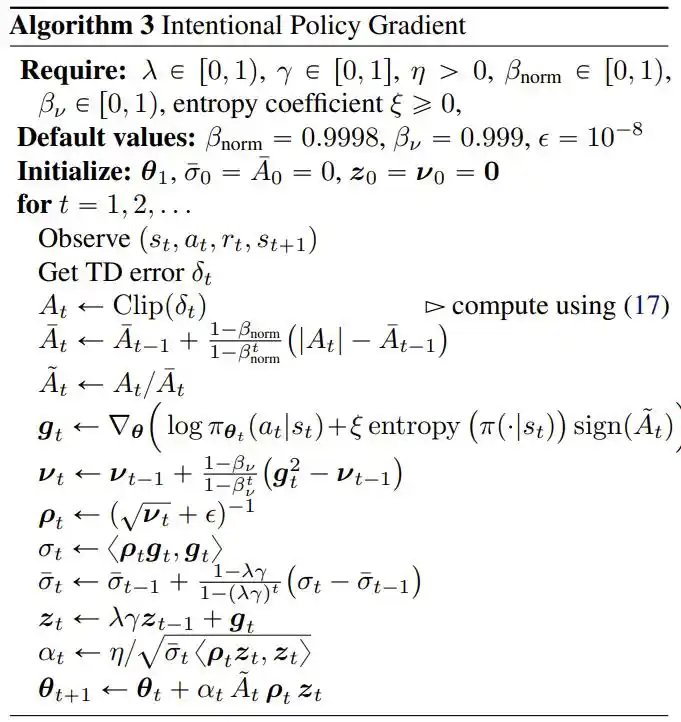
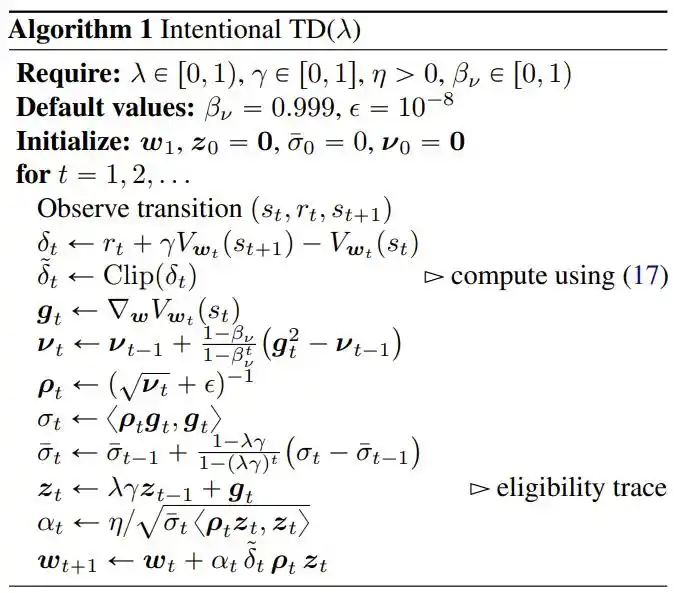
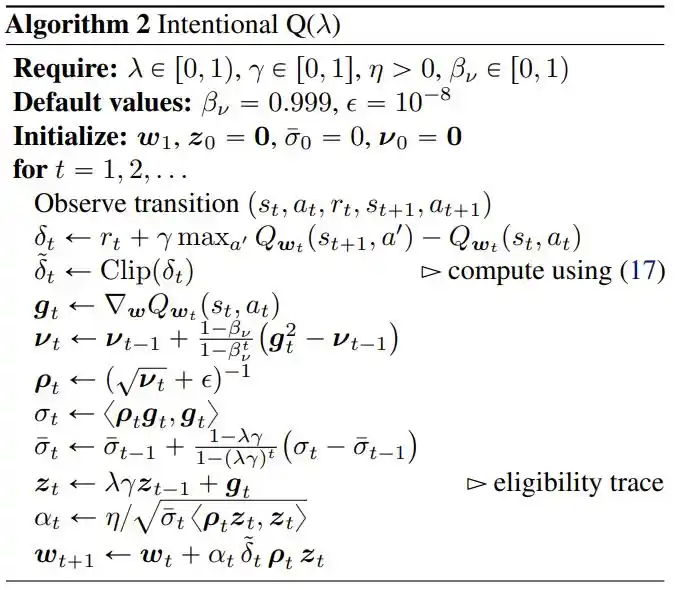
This ultimately forms three complete algorithms: Intentional TD (λ) for value prediction, Intentional Q (λ) for discrete action control, and Intentional Policy Gradient for continuous control.
Experimental Results: Matching SAC Even Without GPUs

The paper evaluated this approach on multiple standard benchmarks, with impressive results.

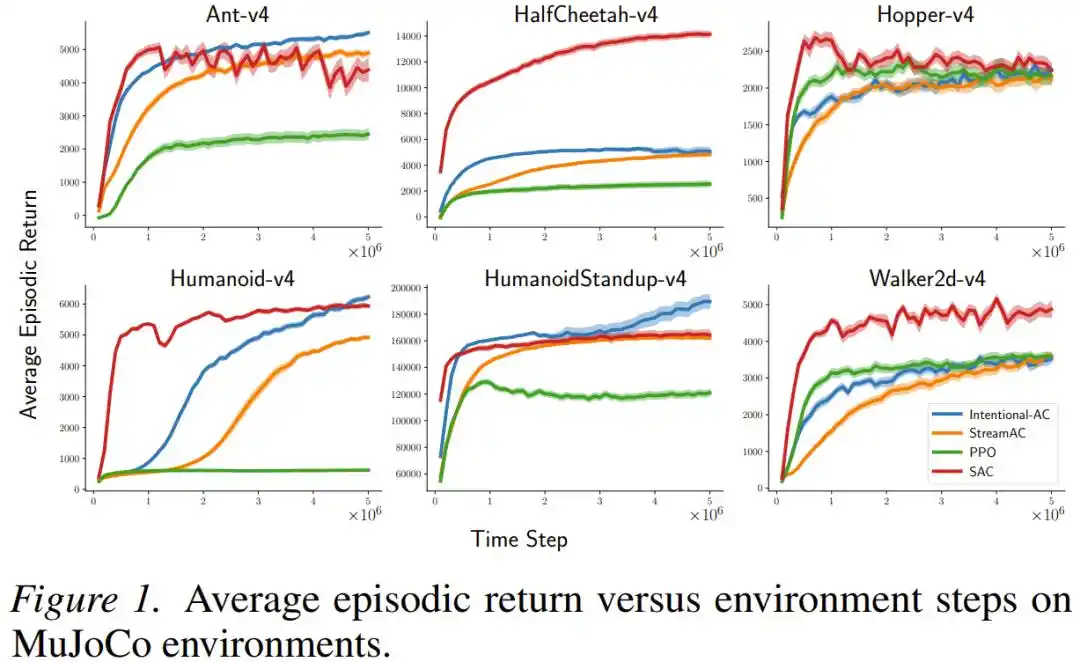
On MuJoCo continuous control tasks (including complex simulated robots like Ant, Humanoid, HalfCheetah), the new method, Intentional AC, in a streaming setup (batch size = 1, no replay buffer), achieved final performance that repeatedly came close to or even matched SAC—an algorithm that uses large-batch replay buffers and is almost the gold standard for current continuous control tasks. In terms of computational cost, each Intentional AC update required only about 1/140th of the floating-point operations of a single SAC update.
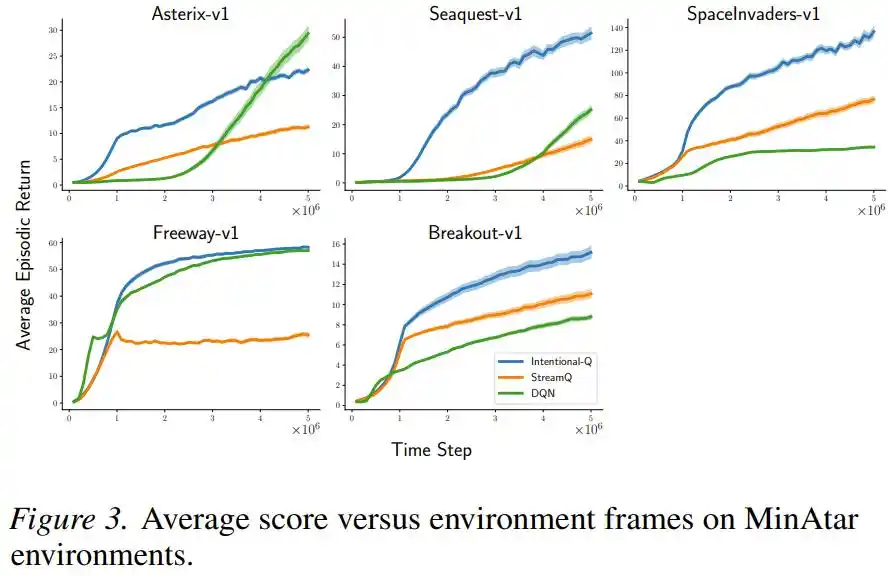
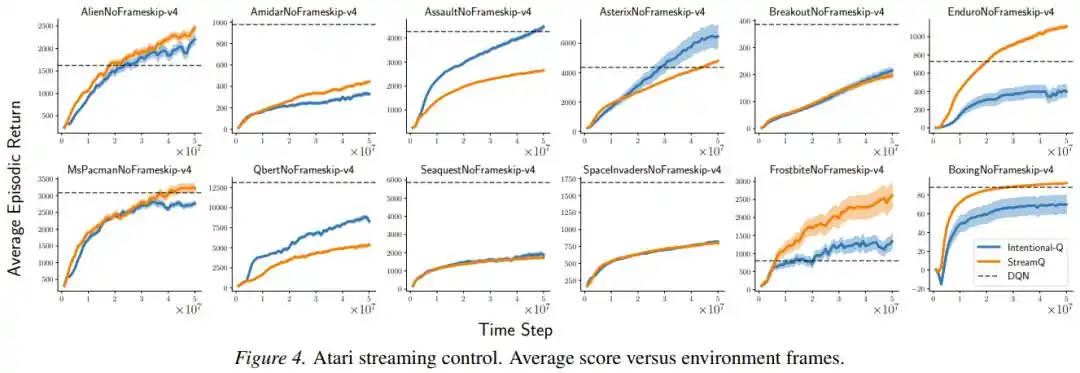
On Atari and MinAtar discrete-action games, Intentional Q-learning performed comparably to DQN, which uses a replay buffer, and successfully ran all tasks with the same set of hyperparameters, without requiring per-task tuning.
The researchers also specifically verified whether the "intention" was truly realized: they measured the ratio of actual update magnitude to intended update magnitude. In a simplified setting with eligibility traces disabled, the standard deviation of this ratio was only 0.016 to 0.029, with the 99th percentile all within 1.07; meaning that in the vast majority of cases, the updates indeed achieved "exactly what they were supposed to do."

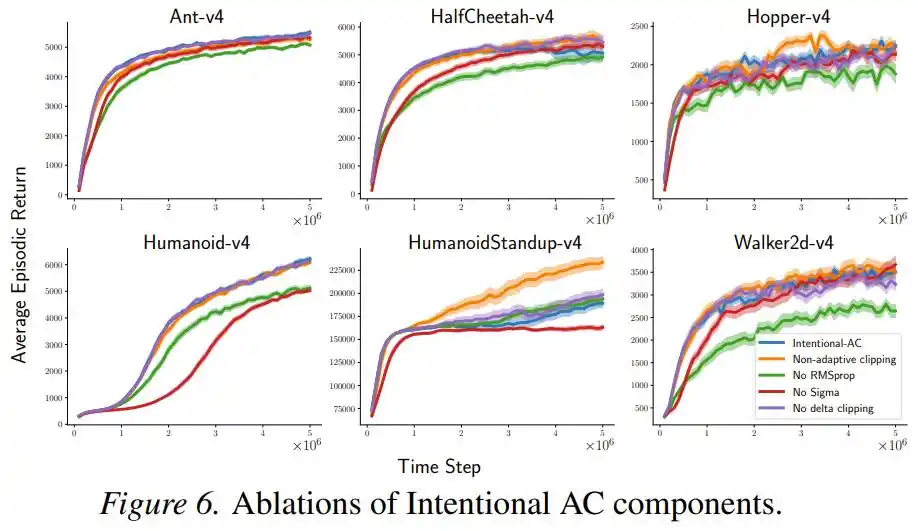
Furthermore, an ablation study showed that performance declined somewhat but remained competitive after removing RMSProp normalization or the σ term, with this "intentional scaling" itself being the primary contributor, while other components were auxiliary.
Problems Remain

The "Intentional Update" framework also demonstrated significant advantages in robustness. When the researchers removed, one by one, the various stabilizing auxiliary techniques (sparse initialization, reward scaling, input normalization, LayerNorm) that the StreamX method relied on, Intentional AC's performance degradation was significantly less than that of the original StreamAC, indicating that intentional scaling reduces reliance on external "crutches" at the root.

However, the paper also candidly addresses a not-yet-fully-resolved issue: in policy learning, the step size depends on the currently sampled action, which implicitly assigns different "weights" to different actions and may alter the expected direction of the policy gradient. In Humanoid and HumanoidStandup tasks, by measuring the cosine similarity of expected update directions, the researchers found this bias was close to 0.96 (almost negligible) during critical learning phases; but in Ant-v4, the alignment dropped to a median of 0.63, indicating the problem cannot always be ignored.

The authors point out that future research should seek step-size selection strategies independent of the action, keeping the "intention" unbiased in expectation as well. This is a clear assignment left for future researchers in this direction.

Conclusion: Enabling AI to Learn Like Humans, On the Job

The current mainstream paradigm for training large models relies on batch digestion of massive data: feeding in all the text and code from the internet, repeatedly iterating until astonishing capabilities emerge. This path has proven effective, but it is fundamentally "learn first, use later": once training is complete, the model is frozen, unable to continuously update from subsequent real-world interactions.

What streaming reinforcement learning pursues is another, completely different learning mode: not relying on massive replay, not relying on huge GPU clusters, converting every single experience immediately into a parameter update, continuously, cheaply, and adaptively. This is closer to how humans and animals actually learn.

From the initial breakthrough of "finally working" by Elsayed et al. in 2024, to the "Intentional Update" principle proposed in this paper, streaming deep reinforcement learning is maturing at a surprisingly rapid pace. It will not replace batch-trained large models, but for applications requiring long-term online adaptation—like robots, edge devices, and any scenario that cannot afford large replay buffers and GPU clusters—this path is becoming increasingly compelling.

The step size is not just a hyperparameter; it is the AI's commitment to "how much it intends to do" with each step. When this commitment finally becomes controllable, learning itself stabilizes.

This article is from the WeChat public account "Almost Human" (ID: almosthuman2014), author: someone interested in RL.


İlgili Sorular

QWhat is the 'stream barrier' problem described in the article?

AThe 'stream barrier' refers to a major difficulty in deep reinforcement learning where the training process collapses when using a streaming setup—meaning no replay buffer and a batch size of one. This prevents the agent from learning effectively from individual, real-time experiences, which is a fundamental characteristic reinforcement learning should possess.

QWhat is the core principle behind the 'Intentional Updates' method proposed in the paper?

AThe core principle of 'Intentional Updates' is to specify how much the function's output (e.g., a value prediction) should change after a parameter update, rather than specifying how much the parameters themselves should move. It inverts the traditional approach by using the desired output change to determine the appropriate step size for the update, leading to more stable learning in a streaming environment.

QHow does the Intentional Updates method relate to historical work from 1967?

AThe idea is conceptually linked to the 1967 Normalized Least Mean Squares (NLMS) algorithm by Nagumo and Noda, which used the expected output change to determine the step size for adaptive filtering. The new paper generalizes this core idea from simple linear settings to the complex, non-linear function approximation context of deep reinforcement learning.

QWhat are some key performance results of the Intentional AC algorithm mentioned in the article?

AIn MuJoCo continuous control tasks with a strict streaming setup (batch size=1, no replay buffer), the Intentional AC algorithm achieved final performance close to or on par with SAC, a state-of-the-art method that uses large batch replay buffers. Furthermore, each Intentional AC update required about 1/140th the floating-point operations (FLOPS) of a single SAC update.

QWhat is a limitation or open problem acknowledged for the Intentional Updates method, particularly in policy learning?

AIn policy learning, the step size depends on the currently sampled action. This can implicitly assign different weights to different actions, potentially biasing the expected direction of the policy gradient. The paper notes that while this bias is negligible in some tasks, it can be more significant in others (e.g., Ant-v4), indicating a need for future research into action-independent step size selection strategies.

İlgili Okumalar

Blocked Its Own Treasure, WeChat AI Steps Up

Tencent's stock surged over 10% on June 2nd amid reports that WeChat, with 1.43 billion monthly users, is finalizing tests for a native AI Agent. The reported feature, accessible by swiping right from the main interface, allows users to issue commands in natural language. The AI then decomposes tasks and automatically calls upon relevant Mini Programs within WeChat to complete actions like ordering food, booking tickets, or making payments, creating a closed-loop service execution system. This strategic shift follows the internal conflict and subsequent "blocking" of Tencent's standalone AI app, Yuanbao, by WeChat for violating sharing rules during a 2026 Spring Festival promotion. The incident highlighted a lack of internal consensus and exposed the weakness of competing in the standalone AI assistant arena against rivals like ByteDance's Doubao (345M MAU) and Alibaba's Qianwen. The new WeChat AI Agent aims to leverage WeChat's unique assets—its massive user base, standardized Mini Program APIs, WeChat Pay, and identity system—to move from simple content generation to actual task execution. Analysts note this changes the competitive landscape from model benchmarks to which AI can connect to more real-world services. However, success depends on key variables: the capability of Tencent's underlying Hunyuan model, managing massive inference costs, and redesigning incentives for Mini Program developers whose traffic might be bypassed. The move is seen as an attempt to keep user service intent within WeChat's ecosystem as AI begins to redefine how users access services.

marsbit50 dk önce

Blocked Its Own Treasure, WeChat AI Steps Up

marsbit50 dk önce

ByteDance Adopts Arm CPUs, Jensen Huang: So Sad I Didn't Buy Arm

**Summary:** At Computex 2026, Arm CEO Rene Haas announced that ByteDance and Oracle have adopted Arm's self-designed Arm AGI data center CPU. The company expects significant revenue growth from this product, projecting $20 billion in demand for the 2027/2028 fiscal years. Haas noted that restricting AI-capable CPUs from the US to China is nearly impossible due to their widespread applications. Arm's stock has surged dramatically this year, notably rising 16% after NVIDIA's Arm-based Vera CPU and RTX Spark announcements. A highlight was the informal, humorous on-stage conversation between Haas and NVIDIA CEO Jensen Huang. Huang joked about NVIDIA's failed attempt to acquire Arm and playfully lamented selling his Arm shares. Both executives showed a clear sense of camaraderie and shared regret over the missed merger. Key technical topics were discussed: 1. **AI PC Design:** Huang explained NVIDIA's RTX Spark superchip (with a 20-core Arm CPU) is designed for future AI agents that will autonomously run and use tools on PCs, blending local and cloud processing. 2. **Agent vs. OS:** Huang emphasized the operating system remains crucial, as AI agents rely on its APIs and tools to function. 3. **Growth Constraints:** He identified the shift to "useful AI" that generates profitable tokens as a primary driver for immense, almost limitless, computational demand. Haas outlined Arm's strategy across PC and data centers. For PCs, Arm collaborates with partners like NVIDIA and MediaTek, offering its compute subsystem (CSS) for custom SoCs. In data centers, its Arm AGI CPU (built on TSMC's 3nm process) has gained major partners including OpenAI, Meta, and now ByteDance and Oracle. Arm presented a multi-year roadmap for its in-house CPU line. The article concludes that while GPUs dominated the AI training race, the explosion of AI agents is shifting significant focus to CPUs for inference, state management, and tool orchestration. The industry is trending towards vertical integration, with companies like cloud providers designing chips and chip/IP firms offering full solutions, all competing to deliver more efficient computing per watt.

marsbit1 saat önce

ByteDance Adopts Arm CPUs, Jensen Huang: So Sad I Didn't Buy Arm

marsbit1 saat önce

New Wall Street Play: Yen Shorts Still Adding, But Japan Stocks Don't Rely on Carry Trade Unwinding

On June 3rd, USD/JPY hit 160.44, its highest level since July 2024, while the Nikkei 225 surged past 68,000 points. Contrary to popular narratives of an imminent "carry trade unwind" akin to August 2024, data reveals a more complex picture. Speculative net short positions in yen futures have actually increased, reaching -114,667 contracts by late May, suggesting traders are doubling down rather than retreating. Meanwhile, Japan's Finance Ministry conducted its largest-ever single-round FX intervention (11.73 trillion yen) in April-May but failed to hold the 160 yen line. The Nikkei's rally is not driven by carry trade dynamics. Foreign investors are aggressively buying Japanese stocks, with net purchases in 2026 running nearly 16 times higher than 2025 levels. This inflow is concentrated in AI and semiconductor-related stocks like SoftBank and Socionext, fueled by positive sector outlooks, rather than being a flight from unwinding yen shorts. Furthermore, the Nikkei has continued climbing despite the Bank of Japan's (BOJ) rate hikes to 0.75%. This disconnect exists because the current equity boom is fueled by AI-driven foreign investment, not reliant on cheap yen funding. However, this relationship remains fragile. Should the BOJ hike rates further (e.g., to 1.0%) while dollar weakness increases carry trade costs, the trajectories of the yen and Japanese stocks could reconverge, potentially triggering volatility.

marsbit1 saat önce

New Wall Street Play: Yen Shorts Still Adding, But Japan Stocks Don't Rely on Carry Trade Unwinding

marsbit1 saat önce

Broadcom's Q3 Guidance Misses Expectations by $12 Billion, After-Hours Trading Plummets Over 13%, AI Narrative "Cooling"?

On June 3, Broadcom released record Q2 FY26 results with revenue of $22.19B, up 48% YoY, and AI chip sales of $10.8B, up 143%. Adjusted EPS of $2.44 beat estimates. However, its Q3 AI semiconductor revenue guidance of $16B, while up over 200% YoY, fell roughly $1.2B (7%) short of analyst consensus expectations of $17.2B. This miss, coupled with slightly weaker-than-expected software revenue, triggered a severe market reaction. CEO Hock Tan maintained the FY26 AI revenue outlook of over $100B but did not raise it, disappointing investors who had priced in more robust growth. The stock plummeted over 13% in after-hours trading, erasing roughly $270B in market cap. The sell-off extended to peers like Marvell. A key concern for markets, particularly for Chinese optical module suppliers, was Tan's comment that the contribution of AI networking (e.g., Ethernet switches, optical interconnect chips) to AI revenue, currently near 40%, is expected to normalize to around 30% over time, signaling a potential peak in growth for that segment. Despite the guidance shortfall, Tan reiterated that AI demand remains "insatiable" and reaffirmed the long-term target of exceeding $100B in AI revenue by FY27. The reaction highlights the heightened sensitivity and premium valuation placed on AI-exposed stocks, where anything less than stellar guidance can prompt significant profit-taking. The broader question is whether this represents a cooling AI narrative or a correction in overstretched valuations.

marsbit1 saat önce

Broadcom's Q3 Guidance Misses Expectations by $12 Billion, After-Hours Trading Plummets Over 13%, AI Narrative "Cooling"?

marsbit1 saat önce

İşlemler

Spot
Futures
活动图片