Trump's 38th Claim of 'Imminent Deal' Sparks TACO-Style Surge in Global Stock Markets

marsbit2026-06-12 tarihinde yayınlandı2026-06-12 tarihinde güncellendi

Özet

Trump claims for the 38th time that a "final deal is imminent," sparking a TACO-style surge in global stock markets. Following the US military's sudden strike on Iran and Trump's subsequent cancellation of promised "tough measures," his latest announcement triggered sharp rallies. US indices (Dow up 1.90%, Nasdaq up 3.42%) and crypto-related stocks rose, while Asian markets like South Korea's KOSPI (up over 6%, briefly triggering a trading halt) and Japan's Nikkei also surged. Oil prices fell 4.3% and gold rebounded 3.1%. The macro backdrop includes potential de-escalation in the US-Iran-Israel conflict, US CPI hitting a 3-year high of 4.2% year-over-year (easing Fed rate hike fears), and heavy retail buying in Asian markets using leveraged accounts. However, the situation remains fragile. Iran denies any breakthrough, and analysts warn of a potential 6-7% correction in the S&P 500 due to overheated sentiment and high valuations. Additionally, the massive SpaceX IPO, with retail demand exceeding $100 billion, is drawing liquidity from the broader market, posing a near-term test for stock prices. In summary, while markets are reacting positively to Trump's statements and macro data, risks persist from geopolitical uncertainty, excessive speculation, and liquidity pressures from major IPOs.

Original|Odaily Planet Daily(@OdailyChina)

Author|Wenser(@wenser2010 )
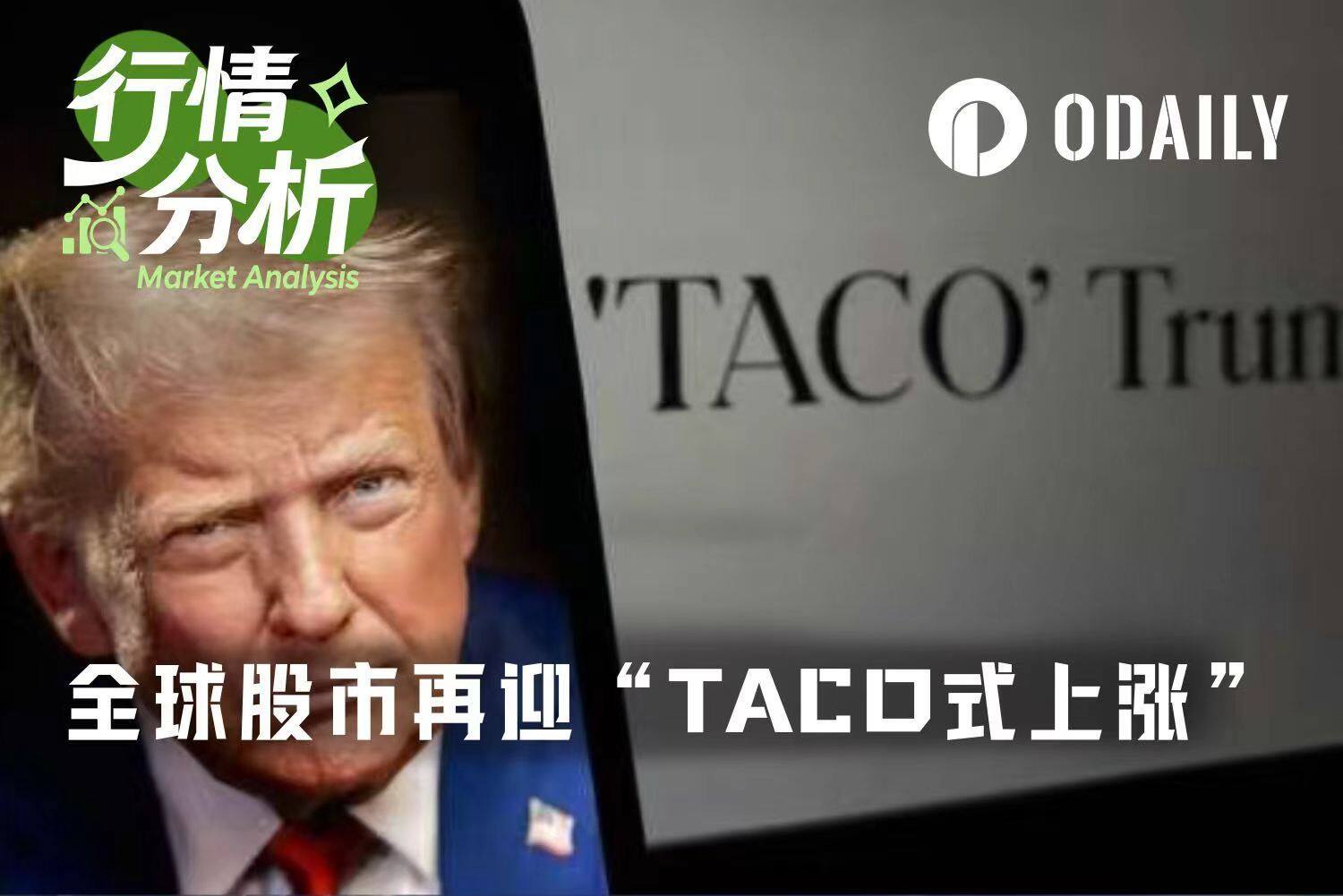
Following a surprise U.S. military attack on Iran and Trump's threats to "take tough action against Iran" which were subsequently called off, Trump has for the 38th time proclaimed that a 'final agreement is imminent'. Global financial markets, including U.S. stocks, have seemingly jolted awake to embrace another 'TACO-style surge'.

This morning, all three major U.S. stock indices closed higher: the Dow rose 1.90%, the Nasdaq surged 3.42%, and the S&P 500 gained 1.73%. Cryptocurrency-related stocks also broadly rose, with COIN up 4.99% intraday and HOOD up 7.40% intraday. Japanese and South Korean markets opened higher. The South Korean KOSPI index opened up 519.25 points, or 6.69%, at 8283.2 points, briefly triggering a trading halt, with subsequent gains expanding to 8%. The Nikkei 225 opened up 880.53 points, or 1.37%, at 65097.80 points. Possibly influenced by this news, oil prices plunged 4.3% while gold prices rebounded 3.1%.

As the U.S.-Israel-Iran conflict enters its fourth month, global financial markets, particularly U.S. equity markets, are pre-pricing potential positives such as an end to the war, leading to a recent series of 'news-driven rallies'.

Macro Background: Trump 'Negotiates for Change', U.S. CPI Hits 3-Year High, Fed Rate Hike Expectations Fade

Overall, the macro backdrop for today's stock market rally primarily involves a turn towards peace talks in the war situation, the release of U.S. CPI data, and diminishing expectations for a Federal Reserve rate hike.

Trump's Remarks Showcase 'TACO Power' Again

According to the latest news overnight, Trump first canceled strikes and bombing operations against Iran that were originally scheduled for that night. Subsequently, he posted online stating that relevant consultations had been submitted to Iran's supreme leadership and approved. The final terms (both in general conception and specific details) have been approved by all relevant parties, including the U.S., Israel, Saudi Arabia, the UAE, Qatar, Turkey, Pakistan, Bahrain, Kuwait, Jordan, Egypt, etc. Although Iran and Israel later denied this, the market accepted it nonetheless.

Furthermore, Trump commented on the Iran issue, saying an 'excellent agreement' had been reached, claiming the relevant documents were in the final drafting stage and could be finalized and signed in the coming days. He also stated the agreement might be signed in Europe, possibly this weekend, with U.S. Vice President Vance in attendance. And that 'once Iran signs the agreement, the Strait of Hormuz will open.' Despite the Iran negotiations taking 'too long', financial markets are currently choosing to 'believe first'.

U.S. Core CPI Annual Rate Hits 3-Year High

This Wednesday, U.S. May CPI data was released, showing:

  • CPI MoM (Seasonally Adjusted): 0.5%, expected 0.50%, previous 0.60%.
  • Core CPI MoM (Seasonally Adjusted): 0.2%, expected 0.30%, previous 0.40%.
  • CPI YoY (Not Seasonally Adjusted): 4.2%, expected 4.20%, previous 3.80%, hitting the highest level since April 2023.
  • Core CPI YoY (Not Seasonally Adjusted): 2.9%, expected 2.90%, previous 2.80%, hitting the highest level since September 2025.

Some analysts believe that with U.S. inflation returning to the '4-handle', the peak of war-related inflation may be past. The third consecutive month of significant CPI increases highlights growing pressure on household spending, with signs that more consumers are tapping into savings to cover expenses. After the data release, the probability of the Fed holding rates steady in June stood at 96.3%, greatly easing previous expectations of a Fed rate hike. Trump boasted about the data, saying: "I love inflation."

Fed Rate Hike Expectations for the Year Ease Significantly

Following the CPI data release, the latest news shows the market no longer fully prices in a Fed rate hike this year.

Seema Shah, Chief Global Strategist at Principal Asset Management, stated, "U.S. inflation remains at an uncomfortable high of 4%, but the weaker-than-expected core data does relieve some pressure. With energy price rises being the main driver and housing costs easing, we haven't seen clear signs of broader second-round effects, which should allow the Fed to remain patient."

Afonso Borges, an analyst at Julius Baer, also noted that a mild rally led by short-term Treasuries after Wednesday's CPI report was 'reasonable' because better-than-expected inflation data should reduce the risk of the Fed hiking later this year.

Japan and South Korea Markets: Retail Investors Borrow to Buy the Dip, Yen Continues to Depreciate

Turning attention to Japanese and South Korean stock markets, they are in a strong rebound phase after recent declines.

On June 10th, Yonhap News reported that due to negative news from U.S. stocks and a sharp drop in semiconductor stocks, the South Korean Composite Stock Price Index (KOSPI) experienced severe adjustments over two days. During this period, overdraft account balances at major commercial banks increased by more than 600 billion won (approximately 2.67 billion RMB). Analysis suggests this is retail investors, anticipating a market rebound after the plunge, beginning to use overdraft accounts for 'borrowing to invest'.

According to Nikkei reports, the Bank of Japan (BoJ) is expected to raise its short-term policy rate from 0.75% to 1.0% at its monetary policy meeting on June 15-16, which would be the highest policy rate level since 1995. Possibly influenced by this news, USD/JPY rose 0.2% intraday, with the current exchange rate at 160.168.

Overall, capital flows in Japanese and South Korean stock markets are still growing steadily, but a BoJ rate hike could gradually tighten liquidity in the Japanese capital market. Bank of America analyst Shusuke Yamada stated that if the BoJ takes a hawkish stance and hikes rates at next week's meeting, it is expected to support the yen. He noted that the market has already priced in the rate hike expectation.

Looking Ahead: War Situation Unclear, Institutions Warn of Deep Correction, Stock Markets Face Liquidity Test

Although today's rally in global stock markets was stimulated by Trump's capricious 'positive news', a closer look at various dynamic factors shows market sentiment remains in a cautiously optimistic stage, wary of a deep correction.

No Turning Point Yet in U.S.-Iran Situation

Ali Akbar Dareini from the Tehran Center for Strategic Studies stated that despite Trump's announcement canceling strikes on Iran, the situation hasn't changed. From Iran's perspective, before any negotiations begin and before Iran is prepared to discuss nuclear issues, the U.S. first needs to take confidence-building measures, which hasn't happened. Reality shows the U.S. has taken no steps to ease tensions. Iran's position is that it will not compromise under coercion.

Institutions Turn Cautious, Warning of Deep Correction

Alex Altmann, Barclays' Head of Global Equity Strategy, who has repeatedly urged 'holding stocks' and accurately timed rebounds during market volatility, recently issued a rare cautionary warning. In his latest market analysis, he stated that due to a combination of technical overbought conditions, overheated sentiment, and macroeconomic pressures, he has turned bearish on the short-term outlook for U.S. stocks. He believes U.S. stocks are currently in the 'midst' of a structural correction, with the biggest current market concern being a severe disconnect between retail sentiment and macro reality. He even bluntly stated, "The S&P 500 could face a total correction of 6%-7%."

Recent American Association of Individual Investors (AAII) sentiment survey data shows the bearish percentage surged to 47.7% over the past week, nearing the year's high of 52% (March 18th) and far above the historical average of 31%.

Additionally, several institutions have recently expressed bearish views: Previously, BofA Securities stated investors should be cautious about U.S. stocks, as increasing bearish signals suggest the market is approaching a top.

A team of strategists led by Savita Subramanian wrote in a report dated June 5th that about 70% of bear market signals have now been triggered, consistent with average levels during historical market tops. The S&P 500 shows statistical overvaluation in 17 out of 20 valuation metrics, with 8 metrics above levels seen during the tech bubble. Furthermore, high P/E stocks significantly outperforming low-valuation stocks is seen by strategists as a sign of excessive speculation. Within the tech sector, the performance gap between the top and bottom quintiles has widened to its highest level since February 2000.

Of course, this view has been openly opposed by the 'new stock god' Serenity, who believes Bank of America's bearish arguments should be viewed cautiously, as a flood of negative news often appears when institutions need liquidity.

Regarding the South Korean stock market, on June 10th, the open interest in put options for the South Korean Kospi 200 index has recently surged sharply relative to call options, nearing levels that have historically foreshadowed market declines. As of the previous trading day's close, the ratio of protective put options to speculative call options was close to 2.5 times, hitting its highest level in five years. This indicator has only breached this threshold a few times before. Notably, South Korean retail investors sold over 1 trillion won worth of overseas stocks in the first week of June, potentially signaling a return of these investors to the domestic stock market.

SpaceX IPO Looms, Testing U.S. Stock Market Liquidity

The latest news states that retail subscription amounts for the SpaceX U.S. IPO have exceeded $100 billion. Combined with previous news that 'SpaceX plans to raise $75 billion, with 30% of shares offered to individual investors', retail subscriptions are already over 4 times oversubscribed.

U.S. investment manager Jim Chanos stated that investors are pricing in grand narratives rather than realistic profit prospects, with SpaceX's valuation multiples far exceeding those of Tesla (TSLA.O). Furthermore, institutions like Franklin Templeton, Saudi and Kuwaiti sovereign wealth funds have joined the IPO subscription wave. According to foreign media reports, several institutional investors have each placed orders for about $10 billion or more in shares. Two days ago, the SpaceX IPO had already attracted over $250 billion in investment demand, exceeding its planned $75 billion fundraising target, making it nearly 4 times oversubscribed; based on market trend projections, the oversubscription ratio could climb to 10 times by this Friday's official listing.

'Wall Street Oracle' and Bitmine Chairman Tom Lee stated that at this stage, U.S. stock investors are actively selling existing holdings and pooling cash to participate in this heavyweight IPO, with the fund diversion effect continuing to ferment, potentially the main culprit behind recent U.S. stock weakness. Christophe Boucher, Chief Investment Officer at ABN Amro Investment Solutions, part of Dutch bank ABN Amro, also said, participating in the SpaceX IPO is similar to buying cryptocurrencies about 15 years ago – you could either lose all your principal or potentially achieve exponential returns.

Although the SpaceX IPO has raised concerns about market liquidity, according to market sources, S&P Dow Jones Indices believes SpaceX is eligible for rapid inclusion in some indices. At that point, SpaceX could become a 'phenomenal giant' in the U.S. stock market.

In summary, global stock markets will continue to face influences from factors such as capital liquidity, domestic market policies, and changes in the global situation like the U.S.-Israel-Iran conflict. In the short term, be wary of Trump staging another round of market manipulation with 'threatening bearishness' and 'TACO-style bullishness'.

İlgili Sorular

QAccording to the article, what triggered the recent 'TACO-style' surge in global stock markets?

AThe surge was triggered by former U.S. President Donald Trump's announcement, for the 38th time, that a 'final agreement' regarding the Iran conflict was 'imminent,' leading markets to price in a potential end to the war.

QWhat were the three main macroeconomic factors mentioned as background for the stock market rise?

AThe three main factors were: 1) A perceived turning point for peace talks in the U.S.-Iran-Israel conflict. 2) The release of U.S. CPI data showing a 3-year high in the annual rate. 3) A significant reduction in market expectations for a Federal Reserve interest rate hike within the year.

QWhat warning did Barclays' global equity strategist Alex Altmann issue about the U.S. stock market?

AAlex Altmann warned that the U.S. stock market is in the 'middle of a structural correction' and could face a deep correction of 6-7% in the S&P 500 index, citing technical overbought conditions, overheated sentiment, and macro pressures.

QHow did the SpaceX IPO potentially impact liquidity in the U.S. stock market according to analysts?

AAnalysts like Tom Lee suggested that investors selling existing stock holdings to raise cash for participating in the heavily oversubscribed SpaceX IPO created a funds分流 effect (capital diversion), which was a contributing factor to recent market weakness due to liquidity concerns.

QWhat contradictory market behavior is highlighted in the Korean stock market section?

AThe article highlights a contradiction where, following a market drop, Korean retail investors increased borrowing via overdraft accounts by over 600 billion won for 'borrowing to invest,' anticipating a rebound. Simultaneously, the put/call option ratio for the Kospi 200 index soared to a 5-year high, signaling strong institutional hedging against a potential decline.

İlgili Okumalar

Preferred Stock Is Not the Trigger for Corporate Bankruptcy, MicroStrategy's Dollar Reserves Can Cover Dividend and Interest Payments Until February 2027

Preferred Shares Are Not the Catalyst for Corporate Bankruptcy; MicroStrategy's Dollar Reserves Can Cover Dividend and Interest Payments Until February 2027. This article analyzes the nature of preferred shares used by MicroStrategy (MSTR). Legally equity but economically similar to debt, these shares, including its Bitcoin-linked STR convertible preferred notes (STRC), offer fixed or floating dividends. Crucially, MicroStrategy's preferred shares lack rigid redemption clauses, meaning they are not classified as traditional debt. This eliminates principal repayment pressure and means missed dividends do not constitute default or trigger bankruptcy, creating a "self-contradictory virtuous cycle." The article clarifies that if funds are short, MicroStrategy can defer or suspend preferred share dividends (except for non-cumulative types like STRD) without immediate risk. The real potential crisis point lies with its convertible bonds. If a prolonged bear market prevents conversion, MicroStrategy might need to sell Bitcoin to repay these bonds starting from the earliest maturity in September 2027, potentially creating a downward spiral. Preferred dividend suspensions would only exacerbate market panic in such a scenario. Recent financial activity shows MicroStrategy strengthened its position through four weeks of common stock (MSTR) issuances, raising over $851 million without issuing new preferred shares. It increased its dollar reserves to approximately $1.4 billion, which is sufficient to cover all preferred share dividends and interest until around March 2027. While Bitcoin purchases slowed recently, this prioritization of cash reserves enhances the company's near-term financial safety. The analysis concludes that if the Bitcoin bear market ends by early 2025 as anticipated, MicroStrategy can resume issuing MSTR stock in a rising market to replenish reserves and manage future dividend obligations, thereby reducing the long-term pressure from its preferred share structure.

marsbit53 dk önce

Preferred Stock Is Not the Trigger for Corporate Bankruptcy, MicroStrategy's Dollar Reserves Can Cover Dividend and Interest Payments Until February 2027

marsbit53 dk önce

Giants Wage the Context War, Reconstructing AI Moats

The article "Giants Launch the Context War, Reconstructing AI's Moat" discusses how leading AI companies—OpenAI, Anthropic, and Google—are shifting their competitive focus from model size to acquiring, managing, and utilizing user context (Context). Initially, Context referred to the length of text a model could process, leading to a "arms race" for longer context windows. However, the competition has evolved through three key phases: expanding text capacity (long context windows), enabling memory across sessions, and finally, integrating AI into real user environments like browsers and desktops to capture dynamic task states. Each company is pursuing a distinct strategy. OpenAI is building Context around the ChatGPT account, turning it into a central hub that accumulates user understanding across various integrated applications and tools. Anthropic, lacking a major user base, focuses on high-value verticals like coding, empowering its Claude model to actively gather Context through GUI interaction (Computer Use) and system connections (MCP protocol). Google, with vast existing user data from products like Search and Gmail, faces the challenge of restructuring this data into actionable, AI-understandable Context for its Gemini model within its ecosystem. The core argument is that the nature of competitive advantage in AI is changing. The internet era prized network effects—connecting more users. The AI era values "individual depth": the ability to build deep, task-specific understanding of a user. This creates a new moat through 1) the compounding value of accumulated Context, 2) deep integration with user tools and permissions, and 3) the establishment of trust for complex tasks. Therefore, the battle for Context is fundamentally about capturing "task entry points" and converting existing digital ecosystems into environments where AI can effectively understand and act, rather than merely scaling user numbers.

marsbit1 saat önce

Giants Wage the Context War, Reconstructing AI Moats

marsbit1 saat önce

Foundation Steps Back, Ethlabs Steps Forward: Ethereum Undergoes Its Largest Restructuring in History

On June 23rd, the Ethereum ecosystem witnessed two major shifts, signaling a significant governance realignment. First, former Ethereum Foundation researchers established Ethlabs, a new independent non-profit. Backed by major ETH holders like Bitmine and SharpLink, Ethlabs aims to address practical needs for institutional adoption, including faster settlement, native asset issuance, cross-chain transactions, and mainnet scaling. Secondly, the Ethereum Foundation announced a major restructuring, laying off 54 employees (20% of its staff) to become a leaner entity focused on protocol governance and maintenance rather than being the primary builder. This move represents a pivotal correction. Criticisms had mounted over the Foundation's perceived slowness, lack of clear strategy, and over-reliance on Vitalik Buterin's influence. Ethlabs emerges as a more execution-oriented, "industrialized" layer focused on market adoption—bridging the gap between research and real-world use. Notably, Vitalik Buterin is absent from its list of supporters, interpreted as an intentional step to avoid excessive personal endorsement and allow the organization to build independent credibility. The Ethereum Foundation's downsizing and redefinition mark a retreat from its former central coordinating role. It now aims to share the "privilege of stewarding Ethereum" with other emerging groups like Ethlabs, the Ethereum Applications Guild, and The Ethereum Economic Zone. Analysts frame this dual shift as the Foundation ensuring Ethereum remains "correct" (credibly neutral), while Ethlabs must prove it remains "effective" (competitive and attractive for capital and adoption). This addresses community "shareholder-like anxiety" about ETH's market performance. While risks exist—such as concerns over shifting from Foundation centrality to large-holder influence—the consensus is that the greater risk for Ethereum was inaction, caught between technical idealism and organizational inertia. These steps aim to create a more multi-stakeholder, execution-driven future for the network.

链捕手9 saat önce

Foundation Steps Back, Ethlabs Steps Forward: Ethereum Undergoes Its Largest Restructuring in History

链捕手9 saat önce

Second Half of U.S. Crypto Policy: The Clarity Act Aims for 60 Votes, CFTC's "One-Person Commission" Becomes Biggest Variable

In a pivotal year for US crypto policy, the "CLARITY Act" is advancing in the Senate but faces a high hurdle, needing 60 votes to pass. Key challenges include bridging partisan divides on ethics and swaying undecided Republican senators within a tight legislative calendar of only about 40 working days. The policy "second half" involves intense negotiations on a broader framework for Web3 and DeFi, including crypto tax reforms and the Blockchain Regulatory Certainty Act. A significant uncertainty is the understaffed CFTC, operating with four commissioner vacancies, which complicates regulatory clarity. Meanwhile, the departure of key "crypto champions"—SEC Commissioner Hester Peirce and Senator Cynthia Lummis—will impact ongoing policy efforts. Industry experts are cautiously optimistic but realistic. Sara K. Weed notes that while progress is being made, CLARITY is unlikely to pass this Congress, pushing agencies like the SEC and CFTC to provide more guidance. Sulolit Mukherjee suggests meaningful crypto tax legislation is more likely to be attached to larger must-pass bills. Rashan Colbert discusses the jurisdictional debate over prediction markets, emphasizing the need for a regulatory framework that fosters their development as financial tools rather than treating them broadly as gambling. The clock is ticking, but opportunities remain for substantive progress through continued bipartisan dialogue and pragmatic efforts.

marsbit11 saat önce

Second Half of U.S. Crypto Policy: The Clarity Act Aims for 60 Votes, CFTC's "One-Person Commission" Becomes Biggest Variable

marsbit11 saat önce

İşlemler

Spot
Futures
活动图片