Preferred Stock Is Not the Trigger for Corporate Bankruptcy, MicroStrategy's Dollar Reserves Can Cover Dividend and Interest Payments Until February 2027

marsbit2026-06-24 tarihinde yayınlandı2026-06-24 tarihinde güncellendi

Özet

Preferred Shares Are Not the Catalyst for Corporate Bankruptcy; MicroStrategy's Dollar Reserves Can Cover Dividend and Interest Payments Until February 2027. This article analyzes the nature of preferred shares used by MicroStrategy (MSTR). Legally equity but economically similar to debt, these shares, including its Bitcoin-linked STR convertible preferred notes (STRC), offer fixed or floating dividends. Crucially, MicroStrategy's preferred shares lack rigid redemption clauses, meaning they are not classified as traditional debt. This eliminates principal repayment pressure and means missed dividends do not constitute default or trigger bankruptcy, creating a "self-contradictory virtuous cycle." The article clarifies that if funds are short, MicroStrategy can defer or suspend preferred share dividends (except for non-cumulative types like STRD) without immediate risk. The real potential crisis point lies with its convertible bonds. If a prolonged bear market prevents conversion, MicroStrategy might need to sell Bitcoin to repay these bonds starting from the earliest maturity in September 2027, potentially creating a downward spiral. Preferred dividend suspensions would only exacerbate market panic in such a scenario. Recent financial activity shows MicroStrategy strengthened its position through four weeks of common stock (MSTR) issuances, raising over $851 million without issuing new preferred shares. It increased its dollar reserves to approximately $1.4 billion, which i...

Author: TVBee

┈➤ Preferred Stock: Both Genius and Rogue

Preferred stock is a very special financing instrument. Its legal status is equity, but economically it carries strong debt-like attributes.

In financial treatment, some are accounted for as liabilities, while others are accounted for as equity.

╰✦ The Debt-Like Aspect

Preferred stockholders do not receive high dividends just because the company makes huge profits. Instead, they receive dividends periodically at a certain dividend rate, similar to debt interest.

STRC is an exception; its dividend rate is floating, but within a certain period, its dividend rate is also fixed.

On the other hand, STRC and common stock dividends work in opposite directions.

When an ordinary company performs well, common stock may pay more dividends. However, when BTC rises, STRC's dividend rate does not need to increase.

Conversely, when BTC falls, MicroStrategy may need to raise STRC's dividend rate to facilitate financing by issuing STRC.

Therefore, STRC, like MicroStrategy's other preferred stocks with fixed dividend rates, has the face of equity but carries strong debt-like attributes underneath.

╰✦ The Equity-Like Aspect

Unless it contains some rigid redemption and payment terms or other debt-like clauses (such preferred stock is classified as a liability in finance), preferred stock is typically included in equity accounts in finance: there is no principal repayment pressure before the company's bankruptcy liquidation, and preferred stock dividends are not mandatory liabilities.

This is the magic of Saylor using preferred stock for financing. Without rigid redemption and payment terms, these types of preferred stock for MicroStrategy are not liabilities in the traditional financial sense.

Thus, MicroStrategy's preferred stock:

Not considered traditional debt → Principal cannot cause insolvency, → Merely suspending dividends does not cause debt default → Does not trigger bankruptcy liquidation → No principal repayment pressure

Equity-class preferred stock itself forms a self-contradictory virtuous cycle, somewhat genius.

Therefore, preferred stock is also jokingly called "perpetual rogue leverage."

┈➤ Can't Afford Preferred Stock Dividends? They Can Accumulate

If, in the short term, MicroStrategy lacks sufficient funds to pay preferred stock dividends, it can simply defer them. STRD dividends are non-cumulative; they can even be suspended outright without accrual.

After BTC resumes its upward trend, MicroStrategy can continue issuing common stock, MSTR, to raise funds for making up the deferred preferred stock dividends.

┈➤ The Key to MicroStrategy's Bankruptcy Lies in Convertible Bonds

Unless BTC remains bearish for an extended period, market sentiment turns very pessimistic, and MicroStrategy is unable to raise funds by issuing MSTR for a long time, until the convertible bonds mature. If the conversion conditions are not met, MicroStrategy would need to repay the convertible bonds. At that point, MicroStrategy might be forced to sell BTC, creating a vicious cycle of selling pressure.

It is during such a convertible bond-induced vicious cycle that preferred stock dividends would exacerbate this death spiral.

Therefore, suspending preferred stock dividends would trigger emotional panic in the BTC market. However, convertible bonds are what would trigger a real crisis.

But the earliest date MicroStrategy's convertible bonds face repayment is September 16, 2027. By that time, the bear market will most likely have ended.

┈➤ MicroStrategy's Dollar Reserves

From June 15 to 21, MicroStrategy raised $335.5 million, all from the issuance of MSTR common stock, with no increase in preferred stock issuance.

After purchasing 520 BTC, its dollar reserves increased from $1.1 billion to $1.4 billion.

Preferred stock dividends can be covered in full until February 2027, and for about half of March 2027.
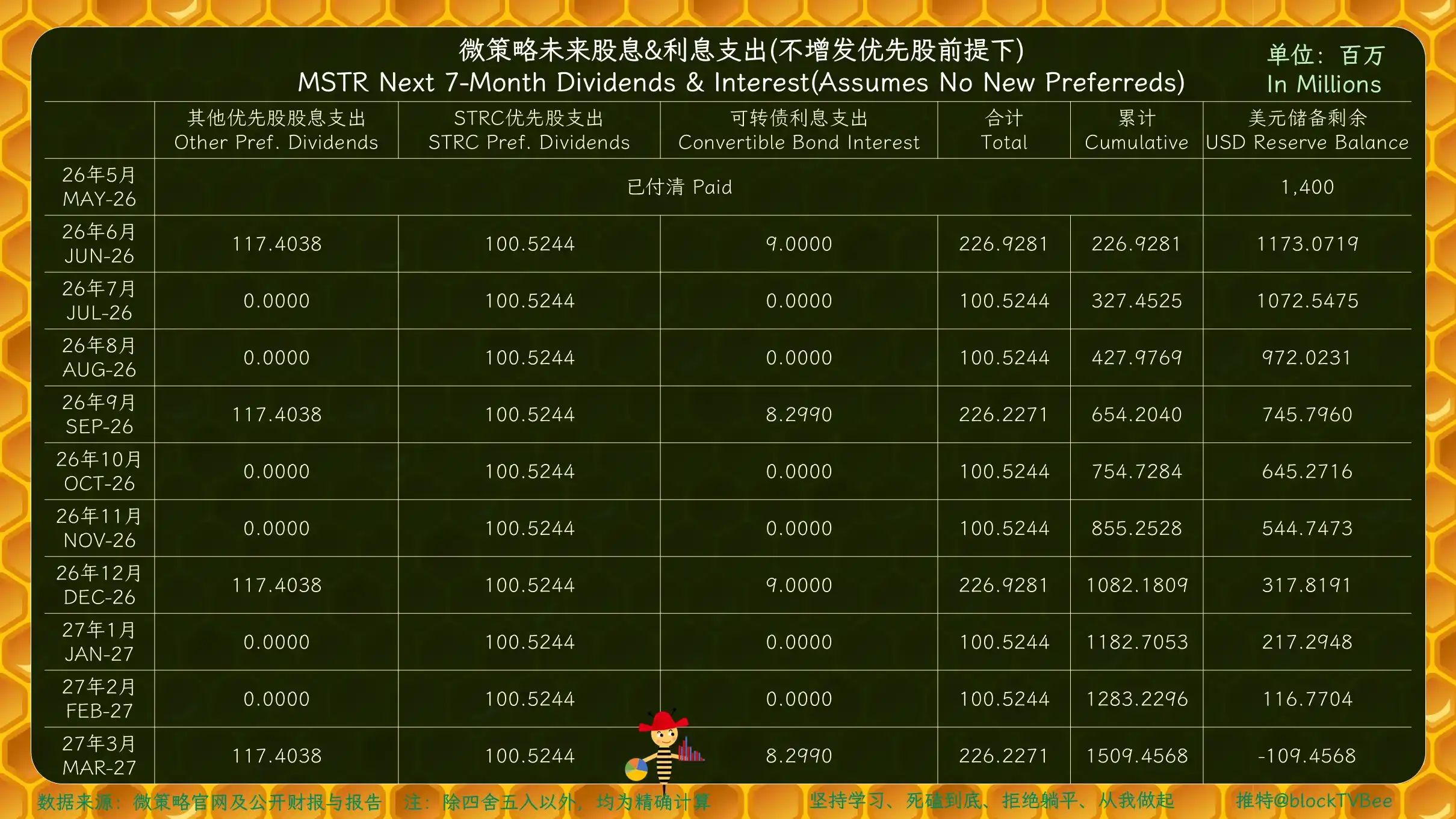
First, over the last 4 weeks, MicroStrategy has not issued any additional preferred stock at all, meaning it has not increased future dividend payments or expanded risk.

Second, over the last 4 weeks, MicroStrategy has strengthened its financing efforts by issuing common stock $MSTR, raising $128.3 million, $181 million, $209 million, and $333.5 million sequentially.

Third, over the last 4 weeks, MicroStrategy's BTC purchases were -32, 1550, 1587, and 520 BTC respectively. Although financing increased, BTC purchases did not rise proportionally, which is somewhat unfavorable for $MSTR in the short term but enhances the overall safety of the MicroStrategy system in the long run.

By March next year, the BTC bear market will most likely have ended. Once BTC and MSTR enter an upward trend, MicroStrategy can continue issuing MSTR to raise funds and use a portion to replenish its dollar reserves to cover future preferred stock dividend payments.

As BTC and MSTR rise, the expenditure and pressure from preferred stock dividends will gradually diminish.


Trend Kriptolar

İlgili Sorular

QWhat is the key characteristic of convertible preferred stock mentioned in the article that makes it a clever financing tool for MicroStrategy?

AThe key characteristic is that these preferred stocks do not have rigid redemption or payment clauses. Therefore, they are not classified as traditional debt on the balance sheet. This means there is no principal repayment pressure, missed dividends do not trigger a debt default, and they do not directly lead to bankruptcy liquidation, creating a self-contradictory but virtuous cycle.

QAccording to the article, what happens if MicroStrategy cannot pay dividends on its preferred stock in the short term?

AIf MicroStrategy lacks sufficient funds to pay preferred stock dividends in the short term, it can defer or suspend the payments. For cumulative preferred stock, the unpaid dividends accumulate. For non-cumulative stock like STRD, dividends can simply be suspended without accruing. It can later resume or pay back dividends when funds are available, for example, by issuing more common stock after a Bitcoin price recovery.

QWhat is identified as the primary potential trigger for a real financial crisis at MicroStrategy, according to the article?

AThe article identifies convertible bonds (可转债) as the primary potential trigger for a real financial crisis. If a prolonged bear market prevents the bonds from meeting conversion conditions by their maturity dates (the earliest being September 16, 2027), MicroStrategy would be forced to repay them, potentially triggering a sell-off of Bitcoin and creating a downward spiral. Preferred stock dividends would only exacerbate this crisis, not initiate it.

QHow did MicroStrategy's recent financing activities (last 4 weeks) impact its financial safety, as described in the article?

AAccording to the article, MicroStrategy's recent activities increased its financial safety in three ways: 1) It did not issue any new preferred stock, avoiding an increase in future dividend obligations. 2) It significantly increased financing by issuing common stock (MSTR), raising hundreds of millions of dollars. 3) It increased its US dollar reserve (from $1.1B to $1.4B in the example week) more than its Bitcoin purchases, which is seen as bolstering the system's long-term safety despite being potentially negative for MSTR's stock price in the short term.

QUntil when can MicroStrategy's current US dollar reserves cover all its preferred stock dividend payments, based on the article's analysis?

ABased on the article's analysis, MicroStrategy's current US dollar reserves can cover all preferred stock dividend payments until February 2027, and approximately half of the payments due in March 2027.

İlgili Okumalar

Interview with NDV Founder Jason Huang: Piercing the AI Bubble and the MicroStrategy Myth, Seeking the Ultimate Edge in the Crypto Market

In a podcast with WuBlockchain, NDV founder Jason Huang discusses recent market dynamics, expressing a bearish outlook on crypto in the near term. He attributes Bitcoin's recent decline to a combination of cyclical selling pressure, the start of a US stock market correction, and liquidity tightening. A key catalyst is the emerging financial strain on MicroStrategy (MSTR). Huang explains that MSTR's model of borrowing to buy Bitcoin created a positive "flywheel" in a bull market. However, with falling BTC prices turning its stock premium into a discount, the model is now under severe stress. While MSTR only sold 32 BTC recently, the market is "front-running" the fear of its massive 80,000+ BTC holdings potentially being liquidated to meet debt obligations. He believes a true market bottom requires a major, capitulation-level event similar to the FTX collapse. Regarding investments, Huang states his fund is up over 20% this year, outperforming Bitcoin by 50-60%. The strategy involves crypto assets and commodities like oil, gold, and silver, but avoids AI stocks due to a perceived lack of trading edge. He is cautious of crowded trades in semiconductors and sees bubbles in the broader market, citing the hype around a potential SpaceX IPO. Despite short-term pessimism, Huang remains long-term bullish on one crypto innovation: stablecoins. He views them as the clearest example of a "faster, better" financial tool with significant room for global adoption. For the future, he is very bearish on Ethereum. For Bitcoin, he anticipates potential for a significant drop below $48,000 before a eventual rebound, but stresses the need to wait for a true panic-driven bottom marked by widespread despair and disinterest in the market.

marsbit2 dk önce

Interview with NDV Founder Jason Huang: Piercing the AI Bubble and the MicroStrategy Myth, Seeking the Ultimate Edge in the Crypto Market

marsbit2 dk önce

Conversation with Jason Huang, Founder of NDV: Puncturing the AI Bubble and the MicroStrategy Myth, Searching for the Ultimate Trump Card in the Crypto Market

In a podcast interview, NDV founder Jason Huang discusses the recent crypto market downturn, attributing the initial phase to typical Bitcoin cycle selling pressure, now compounded by a US stock market correction, tightening liquidity, and MicroStrategy's financial strain. He argues the market hasn't bottomed yet, noting true bear market lows often require a major, despair-inducing event like FTX's collapse. Huang details MicroStrategy's precarious position: its debt-and-equity fueled Bitcoin buying model has reversed into a negative cycle as prices fell. He interprets its sale of just 32 BTC as a signal prioritizing creditors over shareholders, sparking market "front-running" of its larger potential sell-off. A true bottom may arrive only after MicroStrategy resolves its looming debt payments, possibly via a large, private Bitcoin sale. His fund is up ~20% this year, outperforming Bitcoin by 50-60%, by shorting crypto and trading commodities like oil and gold. He avoided AI stocks despite being a heavy user, citing a lack of trading edge in the crowded semiconductor hardware trade, which he views as ripe for a significant correction. Long-term, Huang remains bullish on stablecoins as crypto's clearest, most practical innovation with high growth potential. He is very bearish on Ethereum and skeptical that Bitcoin has found its floor, suggesting $48,000 may not hold. He expects a sharp decline followed by a strong recovery within a year, but only after a major panic event leads to widespread capitulation and despair—the true hallmark of a market bottom.

链捕手8 dk önce

Conversation with Jason Huang, Founder of NDV: Puncturing the AI Bubble and the MicroStrategy Myth, Searching for the Ultimate Trump Card in the Crypto Market

链捕手8 dk önce

U.S. Stocks Trend (June 24): Korean Stock Plunge Ripples Global Chip Sector, Micron Tumbles Over 10%, Long-Term Supply Certainty Faces a 'Hard Test'

US Stock Market Trend (June 24): South Korean Market Plunge Disrupts Global Chips, Micron Drops Over 10%, Long-Term Supply Certainty Faces Hard Test On Monday, the South Korean KOSPI index plunged 10%, with SK Hynix and Samsung dropping over 12%, triggered by rumors that SK Hynix might slow its HBM4 production expansion. This shock quickly spread to the U.S. semiconductor sector. Micron plummeted 13.18% to $1,051.77, SanDisk fell 13.64%, and Marvell declined 8%. The Philadelphia Semiconductor Index closed down 7.87%, while the Nasdaq fell 2.21% to 25,587.04 points. The sell-off particularly hit memory chip stocks. Defensive sectors showed relative resilience, with gains in stocks like IBM and Johnson & Johnson. Market volatility spiked, with the VIX index jumping 12.79%. Commodities weakened, with WTI crude oil hitting a near three-month low and gold falling below $4,100. The core issue is not a challenge to AI demand itself, but a market reassessment of overly optimistic capacity expectations for memory chips, especially HBM. The rumor about SK Hynix undermined perceived certainty in the AI infrastructure cycle. Key upcoming events include Thursday's PCE inflation data, which will influence Fed rate expectations, and Micron's earnings report. The market will focus on Micron's HBM gross margins and its long-term capacity guidance. The shift indicates the AI investment cycle is moving from euphoria to rational pricing. Large institutions are questioning the sustainability of AI-related capital expenditure growth. Micron's repricing from an "AI infrastructure staple" to a more cyclical stock highlights this change. Thursday's data and earnings represent a critical juncture for assessing long-term supply certainty, which has now significantly decreased.

marsbit16 dk önce

U.S. Stocks Trend (June 24): Korean Stock Plunge Ripples Global Chip Sector, Micron Tumbles Over 10%, Long-Term Supply Certainty Faces a 'Hard Test'

marsbit16 dk önce

Giants Wage the Context War, Reconstructing AI Moats

The article "Giants Launch the Context War, Reconstructing AI's Moat" discusses how leading AI companies—OpenAI, Anthropic, and Google—are shifting their competitive focus from model size to acquiring, managing, and utilizing user context (Context). Initially, Context referred to the length of text a model could process, leading to a "arms race" for longer context windows. However, the competition has evolved through three key phases: expanding text capacity (long context windows), enabling memory across sessions, and finally, integrating AI into real user environments like browsers and desktops to capture dynamic task states. Each company is pursuing a distinct strategy. OpenAI is building Context around the ChatGPT account, turning it into a central hub that accumulates user understanding across various integrated applications and tools. Anthropic, lacking a major user base, focuses on high-value verticals like coding, empowering its Claude model to actively gather Context through GUI interaction (Computer Use) and system connections (MCP protocol). Google, with vast existing user data from products like Search and Gmail, faces the challenge of restructuring this data into actionable, AI-understandable Context for its Gemini model within its ecosystem. The core argument is that the nature of competitive advantage in AI is changing. The internet era prized network effects—connecting more users. The AI era values "individual depth": the ability to build deep, task-specific understanding of a user. This creates a new moat through 1) the compounding value of accumulated Context, 2) deep integration with user tools and permissions, and 3) the establishment of trust for complex tasks. Therefore, the battle for Context is fundamentally about capturing "task entry points" and converting existing digital ecosystems into environments where AI can effectively understand and act, rather than merely scaling user numbers.

marsbit2 saat önce

Giants Wage the Context War, Reconstructing AI Moats

marsbit2 saat önce

İşlemler

Spot
Futures

Popüler Makaleler

GENIUS Nasıl Satın Alınır

HTX.com’a hoş geldiniz! Genius (GENIUS) satın alma işlemlerini basit ve kullanışlı bir hâle getirdik. Adım adım açıkladığımız rehberimizi takip ederek kripto yolculuğunuza başlayın. 1. Adım: HTX Hesabınızı OluşturunHTX'te ücretsiz bir hesap açmak için e-posta adresinizi veya telefon numaranızı kullanın. Sorunsuzca kaydolun ve tüm özelliklerin kilidini açın. Hesabımı Aç2. Adım: Kripto Satın Al Bölümüne Gidin ve Ödeme Yönteminizi SeçinKredi/Banka Kartı: Visa veya Mastercard'ınızı kullanarak anında Genius (GENIUS) satın alın.Bakiye: Sorunsuz bir şekilde işlem yapmak için HTX hesap bakiyenizdeki fonları kullanın.Üçüncü Taraflar: Kullanımı kolaylaştırmak için Google Pay ve Apple Pay gibi popüler ödeme yöntemlerini ekledik.P2P: HTX'teki diğer kullanıcılarla doğrudan işlem yapın.Borsa Dışı (OTC): Yatırımcılar için kişiye özel hizmetler ve rekabetçi döviz kurları sunuyoruz.3. Adım: Genius (GENIUS) Varlıklarınızı SaklayınGenius (GENIUS) satın aldıktan sonra HTX hesabınızda saklayın. Alternatif olarak, blok zinciri transferi yoluyla başka bir yere gönderebilir veya diğer kripto para birimlerini takas etmek için kullanabilirsiniz.4. Adım: Genius (GENIUS) Varlıklarınızla İşlem YapınHTX'in spot piyasasında Genius (GENIUS) ile kolayca işlemler yapın.Hesabınıza erişin, işlem çiftinizi seçin, işlemlerinizi gerçekleştirin ve gerçek zamanlı olarak izleyin. Hem yeni başlayanlar hem de deneyimli yatırımcılar için kullanıcı dostu bir deneyim sunuyoruz.

350 Toplam GörüntülenmeYayınlanma 2026.04.29Güncellenme 2026.06.02

GENIUS Nasıl Satın Alınır

Tartışmalar

HTX Topluluğuna hoş geldiniz. Burada, en son platform gelişmeleri hakkında bilgi sahibi olabilir ve profesyonel piyasa görüşlerine erişebilirsiniz. Kullanıcıların GENIUS (GENIUS) fiyatı hakkındaki görüşleri aşağıda sunulmaktadır.

活动图片