Trump Crypto Deal Triggers JPMorgan Risk Debate After $500M Abu Dhabi Stake Revelation

bitcoinist2026-02-04 tarihinde yayınlandı2026-02-04 tarihinde güncellendi

Özet

A $500 million investment by Abu Dhabi's Sheikh Tahnoon bin Zayed Al Nahyan into Trump-linked crypto platform World Liberty Financial (WLFI) has sparked a debate on political influence and regulatory risk. The deal, signed days before Trump's inauguration, has drawn scrutiny from US lawmakers, including Senator Elizabeth Warren. Trump has denied involvement. The revelation coincides with a lawsuit from Trump against JPMorgan Chase over alleged politically motivated account closures, and public clashes between CEO Jamie Dimon and crypto firms. The deal's scale, foreign involvement, and timing, coupled with Sheikh Tahnoon's role in a US-approved AI firm, have amplified concerns about transparency and influence, putting a spotlight on how major banks navigate crypto-related risks.

A reported $500 million investment by an Abu Dhabi royal into a Trump-linked crypto venture is reverberating well beyond the digital asset space, feeding into a broader debate about political influence, regulatory oversight, and how major financial institutions such as JPMorgan Chase navigate crypto-related risk.

The timing of the deal, just days before Donald Trump’s inauguration, has sharpened scrutiny at a moment when the bank is already facing a high-profile lawsuit from the US president and renewed tension with crypto firms.
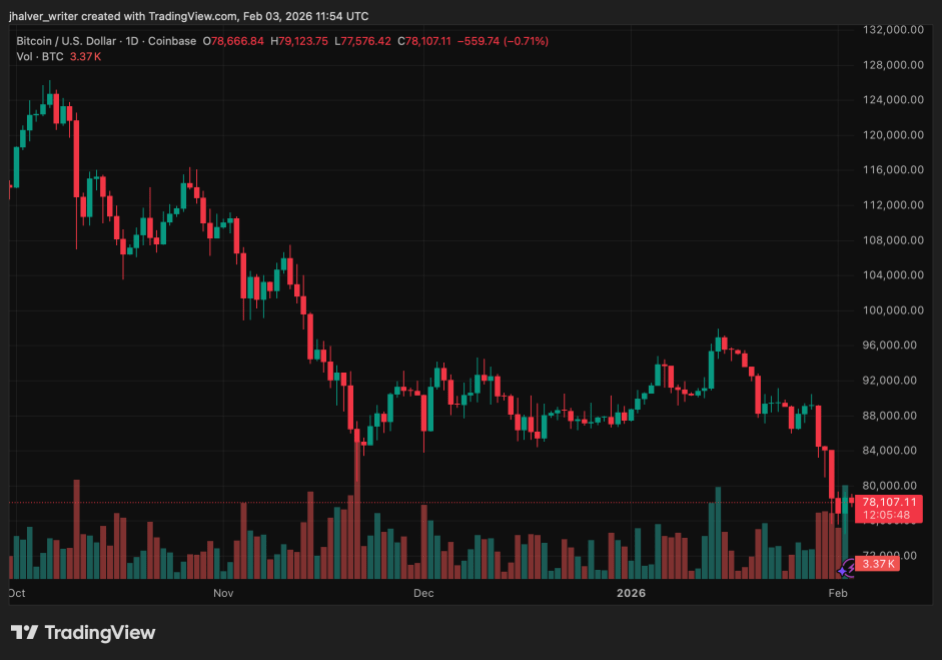
BTC's price trends to the downside on the daily chart. Source: BTCUSD on Tradingview

$500M World Liberty Financial Deal Draws Political Scrutiny

According to reporting by The Wall Street Journal, entities linked to Sheikh Tahnoon bin Zayed Al Nahyan acquired a 49% stake in World Liberty Financial (WLFI), a cryptocurrency platform tied to the Trump family, for $500 million.

The agreement was reportedly signed by Eric Trump four days before Trump returned to office. Trump has denied any knowledge of the transaction, stating that his sons manage the business independently.

The investment was structured in phases, beginning with an initial $250 million payment. Of that amount, about $187 million reportedly went to Trump-family-linked entities, with additional allocations to other WLFI founders. If completed in full, the deal would make the Tahnoon-backed vehicle WLFI’s largest shareholder.

The scale, foreign involvement, and timing of the investment have raised questions among US lawmakers, including calls from Senator Elizabeth Warren to pause regulatory reviews involving WFLI. No investigation has been announced, and WLFI has said the transaction was conducted independently of President Trump.

JPMorgan Lawsuit and Crypto Tensions Collide

The revelation comes as JPMorgan Chase faces a lawsuit from Trump alleging politically motivated account closures. The bank has said its decisions comply with legal and regulatory requirements.

Separately, JPMorgan CEO Jamie Dimon has clashed publicly with Coinbase leadership over crypto regulation, highlighting ongoing friction between traditional banks and digital asset firms.

For investors, these overlapping headlines bring renewed attention to how JPMorgan manages reputational and regulatory risk.

The bank’s stock has delivered strong multi-year returns, but analysts note that political controversy, legal costs, and shifting crypto policy could weigh on sentiment, particularly as regulators focus more closely on “debanking” practices and banks’ exposure to digital assets.

Why the Deal Resonates Beyond Crypto

The Abu Dhabi stake has drawn added attention because Sheikh Tahnoon also chairs G42, an AI firm that recently received US approval to purchase advanced chips from American suppliers.

While no wrongdoing has been alleged, the overlap between foreign capital, sensitive technology approvals, and a Trump-linked crypto venture has amplified concerns about transparency and influence.

Cover image from ChatGPT, BTCUSD chart on Tradingview

İlgili Sorular

QWhat is the significance of the $500 million investment by an Abu Dhabi royal into a Trump-linked crypto venture?

AThe $500 million investment is significant because it has sparked a broader debate about political influence, regulatory oversight, and how major financial institutions like JPMorgan navigate crypto-related risks. Its timing just before Trump's inauguration and the involvement of a foreign entity have drawn intense political scrutiny.

QWhich company received the investment and who is its largest shareholder as a result of the deal?

AThe investment was made into World Liberty Financial (WLFI), a cryptocurrency platform tied to the Trump family. If completed in full, the deal would make the Tahnoon-backed vehicle WLFI's largest shareholder with a 49% stake.

QHow has US Senator Elizabeth Warren reacted to the World Liberty Financial deal?

ASenator Elizabeth Warren has called for a pause on regulatory reviews involving World Liberty Financial (WLFI) in response to the deal.

QWhat two major issues is JPMorgan Chase currently facing that are mentioned in the article?

AJPMorgan Chase is currently facing a lawsuit from former President Trump alleging politically motivated account closures, and its CEO, Jamie Dimon, is engaged in public clashes with crypto firms like Coinbase over regulation.

QWhy does the article state the deal 'resonates beyond crypto,' citing Sheikh Tahnoon's other role?

AThe deal resonates beyond crypto because Sheikh Tahnoon also chairs G42, an AI firm that recently received US approval to purchase advanced chips from American suppliers. This overlap between foreign capital, sensitive technology approvals, and a Trump-linked venture amplifies concerns about transparency and influence.

İlgili Okumalar

IPO Imminent, OpenAI Faces Major Personnel Upheaval

OpenAI, preparing for a potential IPO, is experiencing significant leadership turmoil. In mid-August 2026, longtime "GPU geek" Scott Gray quietly left, and within three days, Chief Operating Officer Brad Lightcap (8-year veteran) and Chief Revenue Officer Denise Dresser (8-month tenure) departed. This follows a broader exodus of at least 10 senior executives in 2026, including heads of product, safety, and ethics. Analysts view this as a strategic "surgery" to transform from a research lab into a sales-driven enterprise company before going public. Revenue now tilts toward enterprise clients, surpassing consumer income sooner than expected, with annualized revenue reaching $40 billion. The new CRO, Dali Rajic, is a veteran enterprise sales leader. Concurrently, OpenAI has disbanded independent safety teams like "Preparedness," which assessed catastrophic risks, integrating their functions into core research. Critics warn this removes dedicated "brakes" on AI development. The leadership vacuum raises questions about who is the clear second-in-command after former apps CEO Fidji Simo moved to an advisory role. Co-founder Greg Brockman appears to be consolidating power. As OpenAI races against rival Anthropic ($47B annualized revenue), it faces the dual challenge of commercial execution while managing the departure of foundational technical talent and ensuring responsible AI development remains a priority.

marsbit1 dk önce

IPO Imminent, OpenAI Faces Major Personnel Upheaval

marsbit1 dk önce

AI Can 'Have Moods Too'! New Research from USTC: Confusion and Anxiety Make AI Work Better

The article discusses research from the University of Science and Technology of China and Oxford, revealing that allowing AI to recognize and act upon simulated "internal emotions" can significantly improve its performance. The study demonstrates a coherent pairing between specific emotional states in AI agents and their subsequent skill choices. For instance, an agent feeling curious and desirous will search for products, while one feeling confused and tense will rephrase queries. This mirrors human decision-making influenced by emotions. Statistical validation showed a 76.5% semantic consistency in these pairings. Crucially, the research challenges the traditional view of AI errors as flaws to be eliminated. It found that "bad" emotions like confusion, tension, or frustration serve as useful metacognitive signals, indicating a mismatch between the current strategy and the environment. By responding to these signals, AI can proactively adjust before a failure occurs. This is particularly effective in complex tasks prone to failure. For example, in tasks like "heating an item" and "picking up two items," success rates surged from 9.6% to 56.9% and 4.4% to 31.3%, respectively, when using the emotion-driven skill selection method (EMOTION2SKILL). The AI's "nervous" state about a closed microwave, for instance, prompted it to check and open it first, preventing failure. The article also mentions related work from Tianjin University, which embeds emotional prediction into world models (Large Emotional World Model, LEWM), significantly improving prediction accuracy in human-centric environments. Removing emotional data was found to degrade performance even in unrelated logical reasoning tasks. These studies build on earlier findings, like those from Anthropic, that identifiable emotional representations exist within large language models (LLMs). The focus is shifting from philosophical debate about AI emotion to practically harnessing these internal states as functional signals to enhance AI robustness and capability.

marsbit37 dk önce

AI Can 'Have Moods Too'! New Research from USTC: Confusion and Anxiety Make AI Work Better

marsbit37 dk önce

İşlemler

Spot
活动图片