Token Going Global: Selling China's Electricity to the World

marsbit2026-02-26 tarihinde yayınlandı2026-02-26 tarihinde güncellendi

Özet

The article "Token Goes Global: Selling Chinese Electricity to the World" draws a parallel between the 19th-century British Empire's control over global telegraph networks and China's emerging dominance in AI model-based token consumption. By 2026, data from OpenRouter shows Chinese models (like MiniMax M2.5, Kimi K2.5, and GLM-5) account for 61% of the top ten models’ token usage, driven by significantly lower costs—sometimes 17 times cheaper than Western alternatives. This shift accelerated with tools like OpenClaw, which increased token consumption exponentially, leading developers to seek affordable alternatives. Chinese models offer competitive performance at a fraction of the price, thanks to lower electricity costs, efficient MoE architectures, and intense domestic competition. The core idea is that token consumption represents a new form of “electricity export.” While physical electricity remains in China, its value is delivered globally via tokens—avoiding traditional trade barriers. This mirrors China’s earlier role in Bitcoin mining, but tokens now offer more practical, embedded value in developer workflows. However, challenges like data sovereignty and U.S. chip restrictions remain. The situation is framed as a new strategic competition between the U.S. and China, akin to the space race, where control over AI infrastructure could shape global digital influence. The token-driven battle is ongoing, silent, and fought on every developer’s machine.

Author:Black Lobster, Deep Tide TechFlow

In the summer of 1858, a copper-core cable was laid across the Atlantic seabed, connecting London and New York.

The significance of this event was never about transmission speed, but about the power structure. Whoever laid the submarine cable could extract value from the flow of information. The British Empire, with this global telegraph network, held in its grasp intelligence from its colonies, cotton prices, and news of wars.

The empire's strength lay not only in its fleet but also in that cable.

Over 160 years later, this logic is replaying itself in an unexpected way.

In 2026, Chinese large language models are quietly devouring the global developer market. The latest data from OpenRouter shows that among the top ten models on the platform by Token consumption, Chinese models account for 61%, with the top three all来自中国。来自中国。Developers in San Francisco, Berlin, and Singapore send API requests daily that traverse Pacific submarine cables to data centers in China, where computing power is consumed, electricity flows, and results are sent back.

The electricity never leaves China's power grid, but its value is delivered cross-border through Tokens.

The Great AI Model Migration

On February 24, 2026, OpenRouter released weekly data: the total Token consumption of the top ten models on the platform was about 8.7 trillion, with Chinese models独占 5.3 trillion, accounting for 61%. MiniMax M2.5 topped the list with 2.45 trillion Tokens, followed by Kimi K2.5 and Zhipu GLM-5, the top three all来自中国。来自中国。
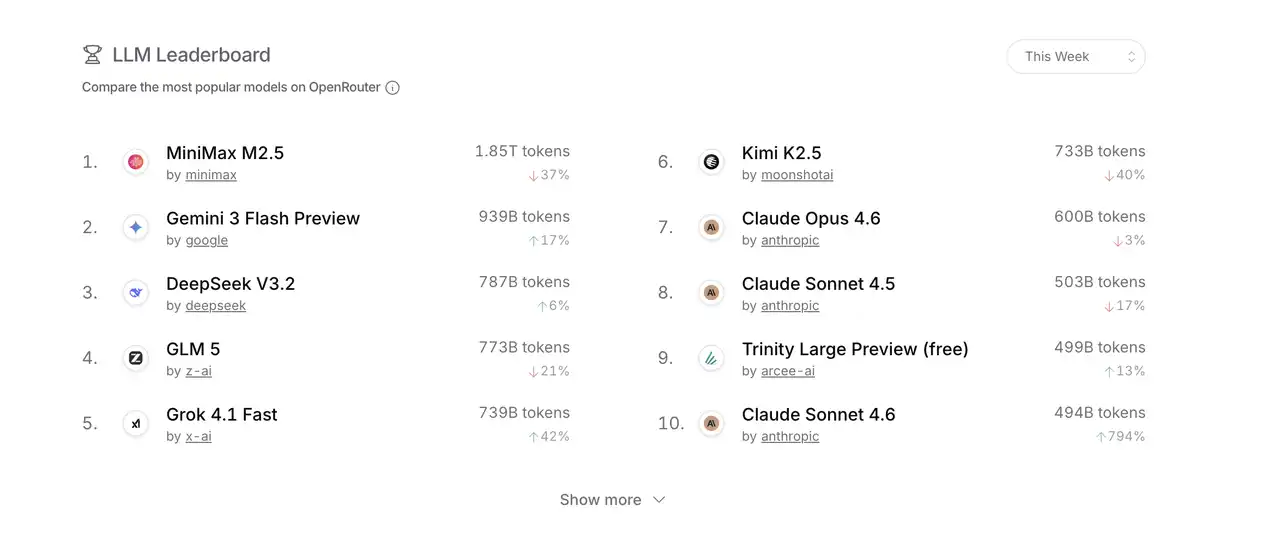
Latest data on February 26

This is no accident; a fuse has been lit.

Earlier this year, OpenClaw emerged, an open-source tool that truly allows AI to "work," capable of directly controlling computers, executing commands, and并行完成复杂工作流。Its GitHub stars surpassed 210,000 within weeks.

John, a finance professional, installed OpenClaw immediately and connected it to the Anthropic API to automatically monitor stock market information and provide trading signals. A few hours later, he stared at his account balance in disbelief: dozens of dollars, gone.

This is the new reality brought by OpenClaw. In the past, chatting with AI consumed a few thousand Tokens per conversation, with negligible cost. After integrating OpenClaw, the AI runs dozens of subtasks in the background, repeatedly calling context and iterating循环。Token consumption isn't linear; it's exponential. The bill is like a car accelerating with the hood open, the fuel gauge dropping, unstoppable.

A "clever trick"随即流传在 developer communities: use OAuth tokens to directly connect Anthropic or Google subscription accounts into OpenClaw, turning the monthly "unlimited" quota into free fuel for AI Agents. This is the method many developers adopted.

Official countermeasures随即到来。

On February 19, Anthropic updated its agreement, explicitly prohibiting the use of Claude subscription credentials for third-party tools like OpenClaw. To access Claude's functionality, one must use the API billing channel. Google更是大面积封禁了 subscription accounts connected to Antigravity and Gemini AI Ultra via OpenClaw.

"The world has long suffered under Qin," John随即投入了国产大模型的怀抱。

On OpenRouter, the国产大模型 MiniMax M2.5 scores 80.2% on software engineering tasks, while Claude Opus 4.6 scores 80.8%, a negligible difference. But the prices are worlds apart: the former costs $0.3 per million input Tokens, the latter $5, a difference of about 17 times.

John switched over. The workflow still ran, but the bill shrunk by an order of magnitude. This migration is happening simultaneously worldwide.

OpenRouter's COO, Chris Clark, put it bluntly: Chinese open-source models have captured a large market share because they account for an unusually high proportion of the agent workflows run by US developers.

Electricity Going Global

To understand the essence of Token出海, one must first understand the cost structure of a Token.

It seems light; one Token is roughly equal to 0.75 English words. An ordinary conversation with AI consumes only a few thousand Tokens. But when these Tokens stack up in trillions, the underlying physical reality becomes heavy.

Breaking down the cost of a Token, there are only two core components: computing power and electricity.

Computing power is the depreciation of GPUs. You buy an NVIDIA H100 for about thirty thousand dollars; its lifespan amortized over each inference is the depreciation cost. Electricity is the fuel for the continuous operation of data centers. A GPU at full load consumes about 700 watts, and加上冷却系统的开销, the annual electricity bill for a large AI data center can easily exceed hundreds of millions of dollars.

Now, map this physical process.

A US developer in San Francisco sends an API request. The data travels from California, via Pacific submarine cables, to a data center somewhere in China. The GPU cluster starts working; electricity flows from China's power grid to those chips. The inference is completed, and the results are sent back. The entire process也许只用了一两秒。

The electricity never leaves China's power grid, but the value of the electricity is delivered cross-border through Tokens.

There is something magical here that ordinary trade cannot achieve: Tokens have no physical form, do not need to go through customs, are not subject to tariffs, and are almost invisible in any current trade statistics. China exports a large amount of computing power and electricity services, but it is almost隐形 on official merchandise trade data.

Tokens have become derivatives of electricity. Token出海 is essentially electricity出海。

This also benefits from China's relatively low electricity prices, about 40% lower than the US on average. This is a physical cost difference that competitors cannot easily replicate.

Additionally, Chinese AI models have algorithmic and "involution" advantages.

DeepSeek V3's MoE architecture activates only a portion of parameters during inference. Independent tests show its inference cost is about 36 times lower than GPT-4o. MiniMax M2.5 similarly activates only 10B out of 229B total parameters.

On top of this is involution: Alibaba, ByteDance, Baidu, Tencent, Moonshot AI, Zhipu, MiniMax... over a dozen companies are trampling on each other on the same track. Prices have long fallen below reasonable profit margins; losing money to gain market share is already the industry norm.

Look closely, this is just like Chinese manufacturing going global, utilizing supply chain advantages and industry involution to drive down Token prices hard.

From Bitcoin to Token

Before Tokens, there was another form of electricity出海。

Around 2015, power station managers in Sichuan, Yunnan, and Xinjiang began to receive some strange visitors.

These people rented abandoned factory buildings, filled them with dense rows of machines, and powered them 24/7. The machines produced nothing but continuously solved a mathematical problem, occasionally calculating a Bitcoin from this endless equation.

This was the first-generation form of electricity出海: converting cheap hydropower and wind power, via the hash calculations of mining rigs, into globally circulating digital assets, which were then cashed out into dollars on exchanges.

The electricity never crossed any border, but the value of the electricity, embodied in Bitcoin, flowed to the global market.

During those years, Chinese computing power once accounted for over 70% of global Bitcoin mining算力。China's hydropower and coal power, in this roundabout way, participated in a global redistribution of capital.

In 2021, this came to an abrupt halt. Regulatory hammers fell, miners scattered, and算力 migrated to Kazakhstan, Texas, USA, and Canada.

But the logic itself never disappeared; it was just waiting for a new shell. Until ChatGPT emerged, large models became the new battlefield, the former Bitcoin mining farms transformed into AI data centers, mining rigs became computing GPUs, the once-produced Bitcoin became Tokens. The only constant is the electricity.

Bitcoin出海 and Token出海 are isomorphic in their underlying logic, but Tokens have more commercial value today.

Mining with rigs is pure mathematical calculation; the output, Bitcoin, is a financial asset whose value comes from scarcity and market consensus, having nothing to do with "what was calculated." The computing power itself is not productive; it's more like a byproduct of a trust mechanism.

Large model inference is different. GPUs consume electricity and output real cognitive services: code, analysis, translation, creativity. The value of a Token comes directly from its utility to the user. This is a deeper embedding. Once a developer's workflow relies on a certain model, the cost of switching increases over time.

Of course, there is another key difference: Bitcoin mining was驱逐出去的 by China, while Token出海 is being主动选择的 by global developers.

Token War

The submarine cable laid in 1858 represented the British Empire's sovereignty over the information highway. Whoever owned the infrastructure could define the rules of the game.

Token出海 is also an undeclared war, fraught with resistance.

Data sovereignty is the first wall. An API request from a US developer is processed by a Chinese data center; the data physically flows through China. For individual developers and small applications, this is not a problem. But for scenarios involving sensitive corporate data, financial information, or government compliance, this is a hard stop. This is why the penetration rate of Chinese models is highest in development tools and personal applications, with almost no presence in core enterprise systems.

The chip ban is the second wall. China's AI development faces export controls on NVIDIA's high-end GPUs. MoE architecture and algorithm optimization can only partially offset this disadvantage; the ceiling still exists.

But the current resistance is just the prologue. A larger battlefield is taking shape.

Tokens and AI models have become a new strategic dimension of博弈 between China and the US, no less important than semiconductors and the internet in the 20th century, or even closer to an older analogy: the space race.

In 1957, the Soviet Union launched Sputnik 1, shocking the United States, which随即启动 the Apollo program, pouring resources equivalent to hundreds of billions of dollars today to绝不落败 in the space race.

The logic of the AI hegemony race is strikingly similar, but its intensity will far exceed the space race. Space is, after all, physical; ordinary people don't feel it. AI渗透的是经济的毛细血管; behind every line of code, every contract, every government decision-making system, a certain country's large model could be running. Whose model becomes the default infrastructure option for global developers gains structural influence over the global digital economy无形中。

This is what truly makes Washington uneasy about China's Token出海。

When a developer's codebase, Agent workflow, and product logic are all built around the API of a certain Chinese model, the migration cost increases exponentially over time. By then, even if the US legislates restrictions, developers will resist with their feet, just as no programmer can abandon GitHub today.

Today's Token出海 might just be the opening chapter of this long game. Chinese large models don't claim to颠覆什么; they simply deliver services to every global developer with an API Key at a lower price.

This time, those laying the cables are the engineering teams writing code in Hangzhou, Beijing, and Shanghai, and the GPU clusters operating day and night in some southern province.

This hegemony has no countdown; it happens 24 hours a day, measured in Tokens, on the battlefield of every developer's terminal.


Trend Kriptolar

İlgili Sorular

QWhat is the core concept behind 'Token出海' (Token going global) as described in the article?

AThe core concept is that Chinese AI models are exporting computational power and electricity globally through the delivery of AI-generated tokens. The physical electricity never leaves China's grid, but its value is transmitted internationally via tokens, which represent AI inference services consumed by global developers.

QWhat key event in 2026 triggered a massive shift of global developers to Chinese AI models according to the article?

AThe release of OpenClaw, an open-source tool that allows AI to perform complex workflows and control computers, led to exponentially higher token consumption. When Western providers like Anthropic and Google banned its use with their subscription services, developers switched to cheaper, similarly capable Chinese models on platforms like OpenRouter.

QWhat are the two main physical cost components that determine the price of a token?

AThe two main cost components are computational power (the depreciation cost of GPUs like the H100 used for inference) and electricity (the power required to run the data centers and their cooling systems).

QHow does the article draw a parallel between the historical 'Bitcoin出海' (Bitcoin going global) and the current 'Token出海'?

AThe article states that both are forms of 'power export' where China's cheap electricity is converted into a globally traded digital asset (first Bitcoin, now AI tokens). However, Token出海 is seen as more valuable because the computation produces useful cognitive services (code, analysis) that create user dependency, unlike Bitcoin mining which was a purely mathematical process producing a financial asset.

QWhat does the article identify as the major potential obstacles or 'walls' for the continued expansion of Chinese AI token exports?

AThe major obstacles are data sovereignty concerns (sensitive foreign data physically flowing through Chinese data centers) and the chip ban (export controls on high-end NVIDIA GPUs limiting China's AI development ceiling).

İlgili Okumalar

Six Years Later, UNI Finally Welcomes Its Own "Buyback Bull"

After years of debate, Uniswap's UNI token has finally entered a 'buyback bull' phase following the long-awaited activation of its fee-switch mechanism. The UNIfication proposal, executed in December 2025, redirected a portion of protocol fees from select pools and Unichain sequencer revenue into a treasury (TokenJar) dedicated to buying back and permanently burning UNI. Initial market reaction was muted due to modest early burn rates. A significant shift occurred in July 2026 with the launch of Robinhood Chain. Uniswap's immediate deployment there skyrocketed trading volume, making it a top fee-generator. Subsequently, governance votes extended the fee mechanism to v4 pools and Robinhood Chain, causing protocol revenue to nearly triple. Daily funds directed to UNI burns rose sharply, with Robinhood Chain contributing over half. This transitioned UNI's narrative from a governance token to a cash-flow asset backed by a perpetual automatic buyer. UNI's price, which had languished around $2.30 in early June, nearly doubled to approach $4.60 by late July. Analysts credit this to the tangible cash flow from fees rather than mere speculation. Unlike many newer projects where buybacks are offset by large investor unlocks, UNI's six-year history has resulted in a widely distributed and relatively clean supply, allowing the buyback pressure to effectively impact the secondary market. The key test will be whether trading activity, particularly on Robinhood Chain, sustains after its initial gas subsidies expire.

marsbit2 dk önce

Six Years Later, UNI Finally Welcomes Its Own "Buyback Bull"

marsbit2 dk önce

Only 153 Venture Capital Firms Invested in July: Is the Crypto VC Industry Experiencing a 'Mass Extinction'?

In July 2026, only 153 unique venture capital firms participated in disclosed crypto funding rounds, marking the lowest monthly count since November 2020. This figure represents an 87% decline from the peak of 1,177 firms in 2022. Overall, the first seven months of 2026 saw crypto projects raise approximately $11.78 billion across 481 rounds. This crypto VC contraction contrasts sharply with the broader venture capital landscape, where global VC investment reached a record $560.4 billion in H1 2026, heavily fueled by major AI company financings. This shift in capital allocation has drawn funds away from the crypto sector. Within crypto, funding is highly concentrated. Trading platforms, prediction markets, and payment sectors absorbed 53% of the total capital. While early-stage deals remain frequent, the largest sums flow to a few late-stage rounds and mergers & acquisitions, which surged to $7.23 billion in Q2 2026. The market is consolidating around top funds like a16z crypto and Dragonfly, which successfully raised new multi-billion dollar funds, while many smaller firms have retreated. Analysts describe this as a "great extinction" for crypto VCs, where capital is becoming more selective, favoring proven business models and assets over early-stage speculation. This raises the bar for project quality, funding efficiency, and viable exit paths.

marsbit23 dk önce

Only 153 Venture Capital Firms Invested in July: Is the Crypto VC Industry Experiencing a 'Mass Extinction'?

marsbit23 dk önce

Strategy's Loss in the Second Quarter Reaches $8.22 Billion Amid Bitcoin Decline

Strategy, the largest corporate holder of Bitcoin, reported a net loss of $8.22 billion for the second quarter. This loss was primarily driven by an $8.32 billion unrealized loss on its Bitcoin holdings due to a decline in the asset's price during the period. Despite these paper losses, the company increased its Bitcoin holdings to 843,775 BTC, a 25% growth since the start of the year. As part of a new monetization strategy, Strategy sold approximately $218.4 million worth of Bitcoin, mainly to fund dividends for preferred shareholders, with $216 million of that sold after Q2 ended. The company also built a $3.75 billion cash reserve, which it claims is sufficient to cover over two years of dividend and interest payments, aiming to insulate itself from Bitcoin's volatility while meeting obligations. Following the earnings release, Strategy's stock (MSTR) rose 4.7% in regular trading but corrected slightly after-hours. This pattern reflects how the company's accounting results are heavily tied to Bitcoin's price swings, even as its long-term strategy remains unchanged. The report indicates that Strategy is maintaining its core strategy of accumulating Bitcoin while building a financial buffer. This quarterly loss follows a recognizable pattern, with the company posting significant unrealized losses in previous quarters (e.g., $12.4 billion in Q4 2025 and ~$12.5 billion in Q1 2026) due to fair-value accounting. A key technical shift is its new monetization program, which introduces periodic selling pressure on the market, transitioning Strategy from a pure accumulator to a participant that occasionally adds supply. A critical question remains: how long can the cash reserve cover dividend obligations if a Bitcoin price downturn persists beyond two years?

cryptonews.ru43 dk önce

Strategy's Loss in the Second Quarter Reaches $8.22 Billion Amid Bitcoin Decline

cryptonews.ru43 dk önce

Will Terrorist Durov Ban Russian Officials?

Telegram founder Pavel Durov publicly reacted to being labeled a "terrorist" by Russian authorities, stating the designation came after he refused demands for mass surveillance and censorship on the platform. In a Telegram post, he highlighted that this status formally bans him from "publishing information online." Durov concluded with a statement widely circulated: Russian officials "clearly don't understand who can ban whom on the internet." This remark suggests Durov could potentially restrict official Russian government and officials' channels on Telegram, which continue to operate on the platform despite its formal blocking in Russia. The situation parallels previous, slow-moving state directives, like switching officials to domestic cars, contrasted with the current push to migrate all government communication to the Russian-made messenger MAX by 2030. However, reports indicate many officials still use Telegram via workarounds, fearing surveillance on MAX, while alternatives like BiP and KakaoTalk recently became inaccessible in Russia without a VPN. Durov has not specified any immediate actions against state channels. His statement is an initial response, with further developments depending on the authorities' reaction. The dynamic differs from 2020 when Russian regulators lifted a block on Telegram; now, Durov implies control from within the platform itself over the official accounts that persisted through that earlier blockade.

cryptonews.ru43 dk önce

Will Terrorist Durov Ban Russian Officials?

cryptonews.ru43 dk önce

İşlemler

Spot

Popüler Makaleler

CORE Nasıl Satın Alınır

HTX.com’a hoş geldiniz! CORE (CORE) satın alma işlemlerini basit ve kullanışlı bir hâle getirdik. Adım adım açıkladığımız rehberimizi takip ederek kripto yolculuğunuza başlayın. 1. Adım: HTX Hesabınızı OluşturunHTX'te ücretsiz bir hesap açmak için e-posta adresinizi veya telefon numaranızı kullanın. Sorunsuzca kaydolun ve tüm özelliklerin kilidini açın. Hesabımı Aç2. Adım: Kripto Satın Al Bölümüne Gidin ve Ödeme Yönteminizi SeçinKredi/Banka Kartı: Visa veya Mastercard'ınızı kullanarak anında CORE (CORE) satın alın.Bakiye: Sorunsuz bir şekilde işlem yapmak için HTX hesap bakiyenizdeki fonları kullanın.Üçüncü Taraflar: Kullanımı kolaylaştırmak için Google Pay ve Apple Pay gibi popüler ödeme yöntemlerini ekledik.P2P: HTX'teki diğer kullanıcılarla doğrudan işlem yapın.Borsa Dışı (OTC): Yatırımcılar için kişiye özel hizmetler ve rekabetçi döviz kurları sunuyoruz.3. Adım: CORE (CORE) Varlıklarınızı SaklayınCORE (CORE) satın aldıktan sonra HTX hesabınızda saklayın. Alternatif olarak, blok zinciri transferi yoluyla başka bir yere gönderebilir veya diğer kripto para birimlerini takas etmek için kullanabilirsiniz.4. Adım: CORE (CORE) Varlıklarınızla İşlem YapınHTX'in spot piyasasında CORE (CORE) ile kolayca işlemler yapın.Hesabınıza erişin, işlem çiftinizi seçin, işlemlerinizi gerçekleştirin ve gerçek zamanlı olarak izleyin. Hem yeni başlayanlar hem de deneyimli yatırımcılar için kullanıcı dostu bir deneyim sunuyoruz.

387 Toplam GörüntülenmeYayınlanma 2024.12.13Güncellenme 2026.06.02

CORE Nasıl Satın Alınır

Tartışmalar

HTX Topluluğuna hoş geldiniz. Burada, en son platform gelişmeleri hakkında bilgi sahibi olabilir ve profesyonel piyasa görüşlerine erişebilirsiniz. Kullanıcıların CORE (CORE) fiyatı hakkındaki görüşleri aşağıda sunulmaktadır.

活动图片