Third Quarter Beijing Office Market: Investment and Owner-occupier Acquisition Demand to Recover in Parallel

marsbit2026-08-10 tarihinde yayınlandı2026-08-10 tarihinde güncellendi

Özet

Third Quarter Beijing Office Market: Investment and Owner-Occupier Acquisition Demand to Recover in Parallel Structural shifts in the domestic economy are reshaping office leasing demand. While expansion in high-tech sectors like AI, semiconductors, and new energy will drive demand, traditional industries may downsize to cut costs. Rents are expected to continue declining due to new supply and landlords' concessions, but prime submarkets attracting high-tech tenants will see slower rental declines and faster absorption. Tenants increasingly favor submarkets with strong industry clusters and supportive policies. The adoption of AI may also lead some firms to reduce their office footprint as they optimize workforce efficiency. The investment sales market is showing signs of recovery. Investor-buyers are becoming more active, targeting properties with stable rental income in key tech hubs. Simultaneously, owner-occupier demand is emerging from high-tech firms seeking headquarters. They prefer buildings in relevant industry locations with good renovation potential. Market Strategy for Q3 2026: * For Tenants: Those for whom office image is critical should consider prime buildings in the CBD. Leverage strong brand positions to negotiate favorable terms, including landlord contributions to fit-out costs. * For Landlords: Transition to service providers by offering industry-specific support like financing connections. Proactively engage expiring tenants with renewal incentive...

1. Reshaping of Demand Structure: Industry Sentiment Divergence Widens Resilience Gap Between Business Districts

The structural divergence of the domestic economy is reshaping the leasing demand side of the office market: the continuous expansion of high-tech industries such as AI, semiconductors, and new energy will drive the release of leasing demand from related companies; traditional domestic demand sectors, under operational pressure, are likely to generally reduce leased areas to optimize operating costs.

Influenced by the gradual entry of new supply within the year and landlords continuing to retain tenants through price concessions, rents will remain on a downward trajectory. However, business districts capable of attracting tenants from high-tech industries will see faster office absorption rates compared to others, leading to a gradual narrowing of their rent declines.

2. Evolution of Leasing Demand: Dual Impact of Industrial Clustering and Workforce Efficiency Upgrades

Current tenants tend to favor business districts with concentrated industrial resources, clusters of upstream and downstream companies, and supportive industrial policies, aiming to leverage the industrial ecosystem and policy benefits within the district for further development.

Furthermore, the large-scale application of AI will reshape corporate human resource configuration needs. Some companies leveraging AI to optimize workforce efficiency will reduce their leased office space.

3. Resurgence in the Bulk Market: Parallel Recovery of Investment and Owner-occupier Acquisition Demand

The increased activity of investment-oriented buyers in the bulk transaction market is expected to inject confidence into the market. Office assets with stable rental cash flow and located in sci-tech innovation hubs will be the preferred targets for investment-oriented acquirers.

Benefiting from the development of high-tech industries, demand from related companies to acquire office buildings for their own headquarters will be released. Office buildings whose location and industrial attributes highly match their own business and have sufficient renovation potential will become the favored targets for this type of owner-occupier acquirer.

2026 Q3 Beijing Office Market Strategy

Recommendations for Tenants: Select Quality Projects Based on Needs, Optimize Terms Leveraging Brand Strength

For tenants whose business operations are highly dependent on office image, flagship buildings within the Guomao (CBD) business district are the preferred relocation choice. When selecting a location, such tenants should also focus on comparing the hardware facilities and service standards of the buildings to meet the needs of innovative office, efficient collaboration, business reception, and negotiation scenarios driven by new organizational and business models.

Leading tenants can leverage their brand influence to occupy a strong position in lease negotiations, thereby securing more favorable leasing terms. Tenants can also negotiate with landlords to have the landlord bear the one-time capital expenditure for office space fit-out.

Recommendations for Landlords: Build Industrial Support Services, Provide Dedicated Operations to Retain Tenants

Landlords should transform into enterprise service providers, establishing a complete suite of industrial support services, such as investment and financing connections, industry salons, etc., to empower tenant development.

For tenants with leases expiring soon, landlords can proactively engage them in advance, offering lease renewal incentive packages while simultaneously opening up benefits like floor upgrades; and assign dedicated account managers to provide one-on-one service, responding efficiently to tenant needs.

Recommendations for Acquirers: Anchor Acquisition Targets, Conduct Targeted Screening

It is recommended that investment-oriented acquirers prioritize considering the acquisition of office buildings in the Zhongguancun business district already occupied by leading companies with stable occupancy rates exceeding 90%; simultaneously, verify tenants' remaining lease terms, creditworthiness, etc., to ensure the project has stable rental income.

Owner-occupier acquirers with backgrounds in high-tech industries can consider acquiring office buildings with well-developed surrounding industrial infrastructure but whose owners face financial pressure, potentially acquiring assets at lower prices; and focus on assessing hardware renovation costs, selecting projects that can be adapted at low cost to meet industrial development needs.

Q2 Market Performance

Overview of Beijing Grade A Office Leasing Market

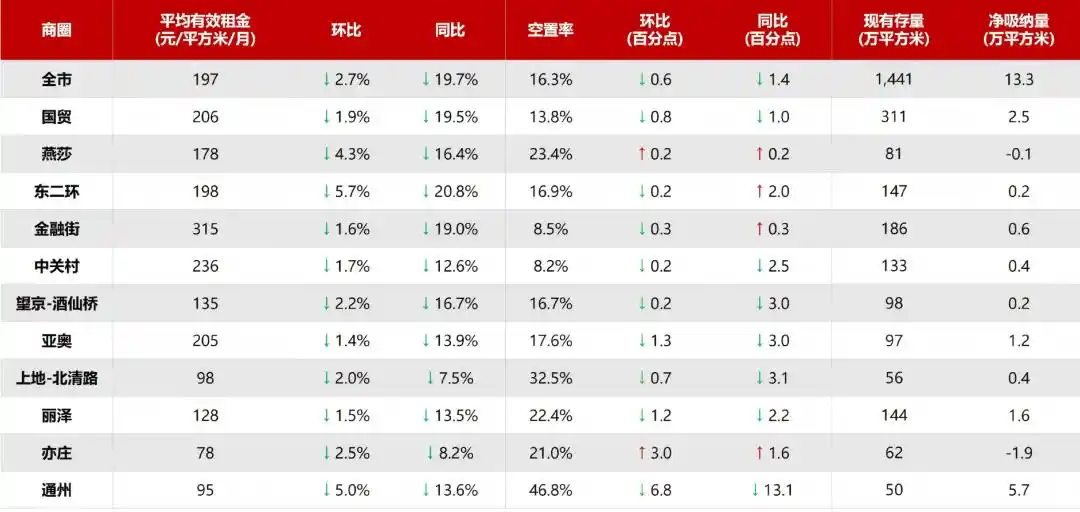
In Q2 2026, the average effective rent in Beijing's Grade A office leasing market remained on a downward trend, decreasing by 2.7% quarter-on-quarter to RMB 197 per square meter per month. The vacancy rate dropped by 0.6 percentage points quarter-on-quarter to 16.3%, but still remained at a high level. Coupled with the gradual entry of new supply during the year, absorption pressure in the leasing market remains significant.

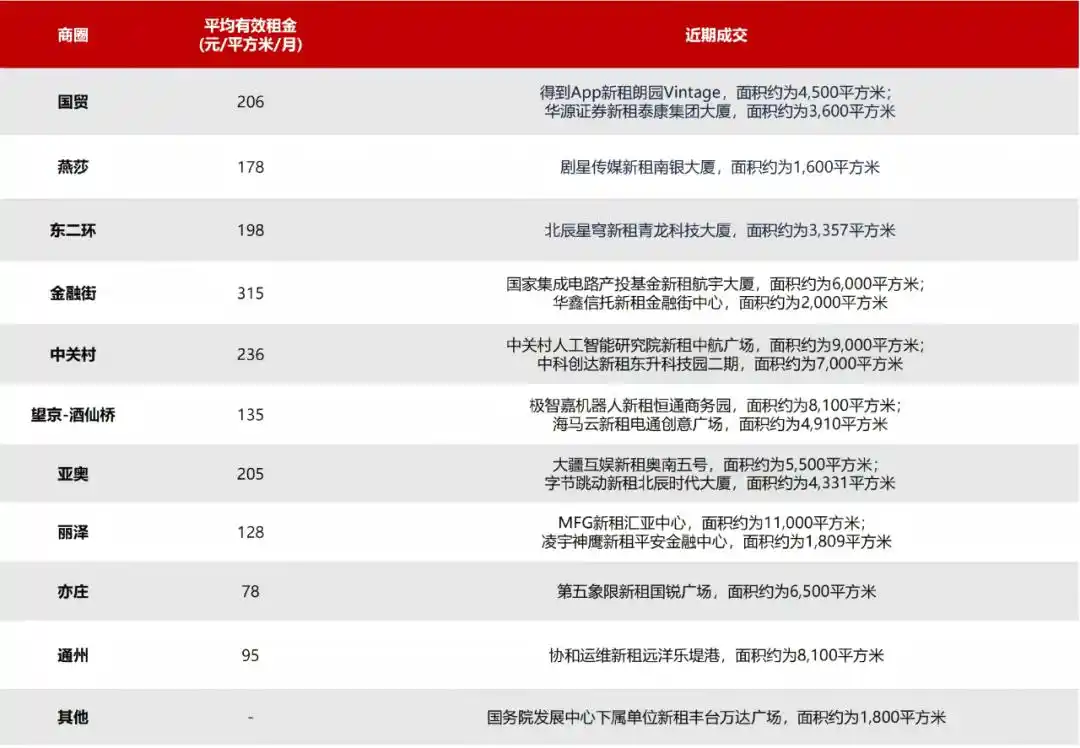
Business districts favored by high-tech industry tenants, such as Zhongguancun and Wangjing-Jiuxianqiao, recorded large-scale office leasing transactions: Thundersoft newly leased approximately 7,000 square meters in Dongsheng Science Park Phase II in Zhongguancun; Geek+ newly leased approximately 8,100 square meters in Hengtong Business Park in Wangjing-Jiuxianqiao. This confirms that the rich industrial resources within business districts and the high-standard hardware facilities of office buildings have become important advantages in attracting high-tech industry tenants.

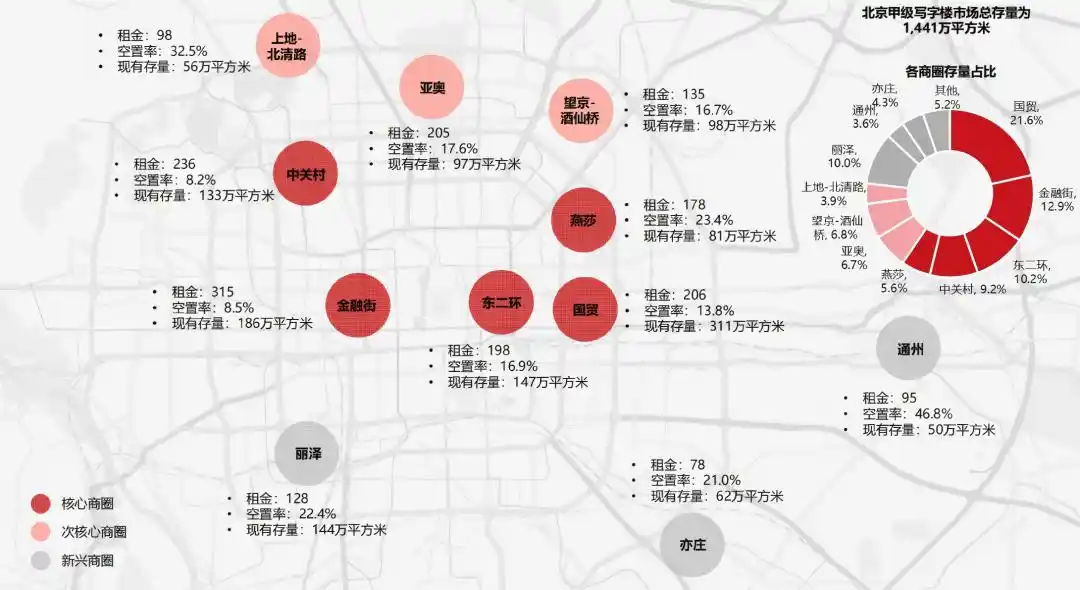
Overview of Beijing Grade A Office Leasing Market by Business District
Beijing Business District Leasing Transaction Highlights
Performance of the Office Bulk Transaction Market

In Q2 2026, the transaction volume of Beijing's office bulk transaction market reached RMB 14.2 billion, with two factors driving transaction activity: On one hand, the divergence in industry structure, the low-interest-rate environment, and the launch of commercial property REITs are driving investment-oriented acquirers to actively deploy in office buildings located in business districts rich in high-tech industry resources; on the other hand, policies supporting the development of high-tech industries are boosting demand from owner-occupier acquirers in related sectors to purchase office buildings for their own headquarters.

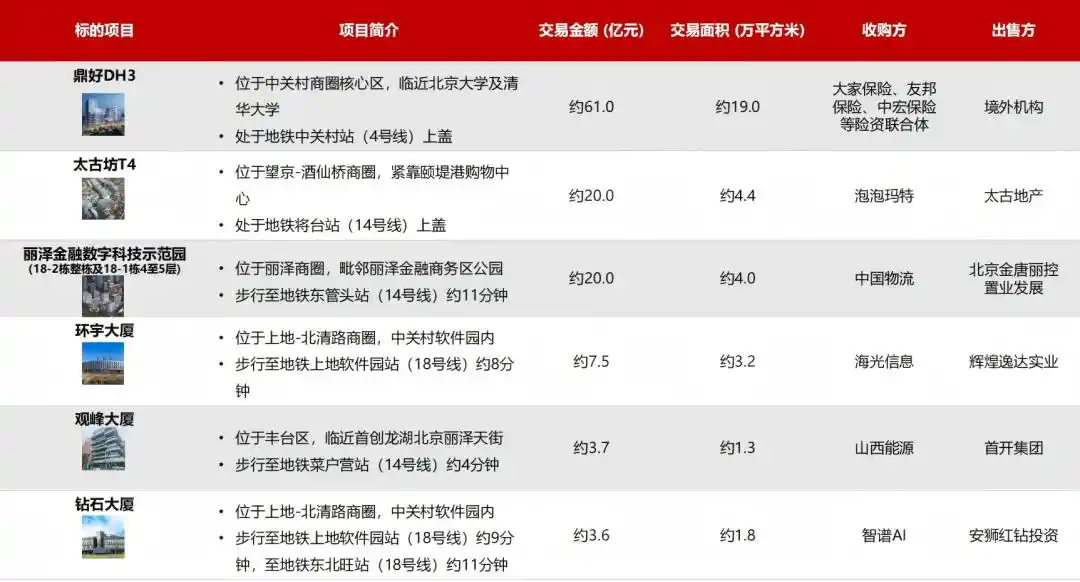
Zhongguancun business district recorded the highest-value office bulk transaction of the quarter: Dajia Life Insurance and other insurers jointly established a special fund of RMB 6.1 billion to acquire Dinghao DH3. This transaction reflects investment-oriented acquirers' recognition of the long-term value of the Zhongguancun business district. Additionally, the stable rental cash flow generated by the project's quality tenants is a core factor for the investment-oriented acquirers' purchase.

Trends in Average Selling Price and Rent-to-Price Ratio for Office Bulk Transactions
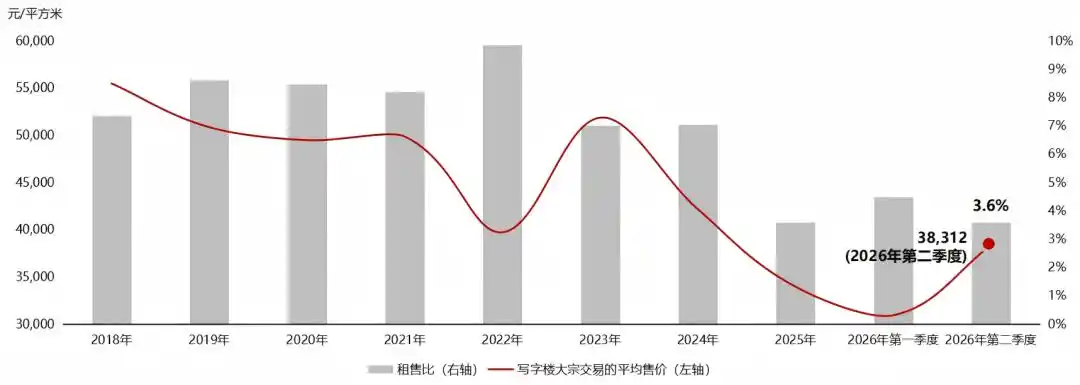
The average selling price for office bulk transactions this quarter rose by 24% quarter-on-quarter to RMB 38,312 per square meter. The significant increase in average price stemmed from owner-occupier acquirers purchasing office buildings in the Financial Street South Extension Area and Lize business districts at average prices above RMB 50,000 per square meter. This indicates that companies with demand for self-owned office space are actively acquiring quality office assets, taking advantage of the current price window.

Beijing Bulk Transaction Market Case Studies
RET Research Center of Commercial Real Estate

This article is from the WeChat public account "RET", author: Here is

İlgili Sorular

QWhat are the two main types of acquisition demand expected to recover in the Beijing office market in Q3 2026?

AInvestment-type acquisitions and end-user (owner-occupier) acquisitions are expected to recover in parallel.

QWhat key factor is contributing to the continued downward trend in effective rents for Beijing Grade A offices in Q2 2026?

ALandlords are still adopting a strategy of lowering prices to retain tenants, coupled with the gradual entry of new supply into the market.

QWhich type of office building is the primary target for investment-type buyers, according to the article?

AOffice buildings with stable rental cash flow and located in science and technology innovation hubs.

QAccording to the article, what is a major reason some tenants might reduce their office leasing area?

AThe large-scale application of AI, which allows companies to optimize workforce efficiency and thus reduce their required office space.

QWhat strategic advice is given to property owners to help retain tenants whose leases are nearing expiration?

AProperty owners should proactively engage these tenants, offer preferential renewal terms, provide benefits like floor upgrades, and assign dedicated account managers for one-to-one service.

İlgili Okumalar

When 'Odysseus' Encounters the Algorithm

Christopher Nolan's "Odyssey," a $250 million IMAX epic, premiered in July 2026, quickly grossing over $1 billion and setting box office and critical records. The film's production was defined by its physical scale: shooting across six countries with practical effects, custom-built IMAX cameras, and extensive use of film. Concurrently, the AI-generated film "Odysseus: The Fall," created by the independent studio Fountain0 for just $50,000, demonstrated the technical feasibility of AI in long-form filmmaking. This stark 5,000x cost difference highlights a broader industry conflict between traditional, experience-driven production and algorithmic efficiency. While the AI film achieved technical success, it revealed current limitations, such as unstable long shots, inconsistent characters, and a lack of nuanced emotional performance. More importantly, its infinite, low-cost nature lacks the scarcity and immersive "event" status that fuels the theatrical premium for films like Nolan's. The market strongly favored the traditional model's brand security, physical assets, and premium theatrical experience. The analysis suggests AI will not replace auteurs like Nolan but will significantly disrupt mid-tier productions and technical, labor-intensive roles (e.g., pre-visualization, VFX). This could erode the career pathways for future directors. Paradoxically, as AI content proliferates, the perceived value of "handcrafted," physically-shot cinema may rise, akin to artisanal goods. The core tension is framed as the irreconcilable conflict between algorithmic "efficiency logic" and cinematic "experience logic." Ultimately, the enduring human preference may be for the unique, difficult journey of traditional storytelling over the predictable, algorithmically smooth path.

marsbit46 dk önce

When 'Odysseus' Encounters the Algorithm

marsbit46 dk önce

Wall Street 'Conspiracy Theory': Did Powell Deliberately Push Up Long-Term U.S. Treasury Yields?

Bank of America refutes market speculation that Federal Reserve Chair Warsh deliberately pushed up long-term U.S. Treasury yields via press conferences to tighten financial conditions. Their report argues such action contradicts the Fed's established policy framework and would lack FOMC support. According to the report, some market participants interpreted the post-July FOMC meeting rise in long-end yields and inflation breakevens as a deliberate strategy by Warsh to combat inflation by tightening financial conditions. Analysts Mark Cabana and Aditya Bhave directly reject this, stating the FOMC's core policy tool remains the federal funds rate, as outlined in its long-term strategy statements. They emphasize Warsh cannot unilaterally alter the Fed's operational approach, which would require full FOMC consensus—a high bar. The analysis highlights the Fed's precise control over overnight rates versus its limited, indirect influence on long-term yields, which operate through policy expectations and the hard-to-manage term premium channel. The recent sharp move in long-end rates serves as a reminder of the risks of operating outside the Fed's direct control. The report concludes the FOMC is unlikely to abandon its proven, controllable tools for unverified methods, dismissing the "four-dimensional chess" theory of long-rate manipulation as market overinterpretation.

marsbit49 dk önce

Wall Street 'Conspiracy Theory': Did Powell Deliberately Push Up Long-Term U.S. Treasury Yields?

marsbit49 dk önce

BofA Research Report Insights: Bull & Bear Indicator Rises to 9.7, Liquidity Backstop and Midterm Elections Form Market's Core Contradiction

Bank of America's Bull & Bear indicator rose to 9.7 in early August, its highest since 2021 and nearing a "sell" signal. Weekly flows showed $52.9B into cash, $32.9B into equities, and $23.1B into bonds. The report highlights a core market contradiction: clear policy intent to backstop financial conditions (evidenced by recent coordinated FX intervention, termed a "poor man's LTCM event") versus extreme bullish sentiment, widening credit spreads for AI mega-cap firms, and rising political uncertainty ahead of the midterm elections. Fund flows were mixed: while equity inflows are on a record annualized pace, the tech sector saw its first outflow in six weeks. Bank of America's strategy advises a "summer retreat or rotation"—exiting risk assets or rotating into defensive sectors (consumer staples), duration assets (REITs, small caps, biotech), and the USD to hedge against potential financial tightening. The midterm election is identified as the key macro variable for H2 2026, acting as a referendum on populist fiscal policies. A Republican-held Senate is viewed as market-positive. The report also notes that AI capital expenditure momentum requires the Mag 7 index to recover above 50 to counter threats from cheap Chinese computing. Near-term market direction may hinge on July payroll data, influencing the Fed's Jackson Hole stance. Overall, while liquidity backstops provide downside protection, the extreme Bull & Bear reading suggests limited upside.

marsbit53 dk önce

BofA Research Report Insights: Bull & Bear Indicator Rises to 9.7, Liquidity Backstop and Midterm Elections Form Market's Core Contradiction

marsbit53 dk önce

İşlemler

Spot
活动图片