The US Dollar Challenges Japan's Intervention Threshold: Will the Carry Trade Collapse Again?

marsbit2026-06-23 tarihinde yayınlandı2026-06-23 tarihinde güncellendi

Özet

The U.S. dollar remains strong, with the Dollar Index holding above 101 as Federal Reserve policy expectations turn more hawkish. The 2-year Treasury yield is near highs from early 2025, boosting the dollar's appeal against currencies like the euro and pound. The USD/JPY pair is approaching a critical level near 161.96, which would mark the yen's weakest point since December 1986. This pressure stems from the widening interest rate differential between the U.S. and Japan. Japanese authorities have issued verbal warnings about potential intervention to support the yen, but uncertainty remains over if and when action will be taken. Oil prices rebounded after a recent drop, introducing renewed inflation concerns. While not the main driver, higher oil prices could further fuel expectations that the Fed will maintain a restrictive policy. Market focus centers on three key issues: whether the Fed will follow through on rate hike expectations, the possibility of Japanese FX intervention, and the trajectory of oil prices. The resolution of these factors will determine whether the current strong dollar trend persists or gives way to increased volatility.

During the session on June 23rd, the US Dollar Index remained above 101, with USD/JPY approaching a key level near 161.96. This level is under scrutiny because a break above it would send the yen into its weakest territory since December 1986. The main theme in the forex market is tightening: Fed policy expectations have turned hawkish again, short-term US Treasury yields are elevated, and the yen's weakness is pushing the question of potential Japanese intervention to the forefront for traders. For investors, this isn't just about a stronger dollar; it's about global funding costs, carry trades, and pressure on Asian currencies.
Fed Expectations Turn Hawkish, Dollar Holds Above 101

As of the June 23rd session, the US Dollar Index was around 101.01, not far from the week's high of 101.13. The DXY, which measures the dollar against a basket of major currencies, regained strength, with the most direct driver being a shift in Federal Reserve policy expectations.

According to Reuters, the Fed held the federal funds rate steady at 3.50% to 3.75% on June 17th, but the latest dot plot showed that nine officials project a rate hike before the end of 2026. The statement also removed wording hinting at a rate cut this year. This change made it harder for markets to continue trading on easing expectations, and futures markets have significantly increased bets on the possibility of a hike within the year or before September.

Short-term US Treasury yields provided concurrent support. The 2-year yield hovered between 4.22% and 4.23% during the session, near its highest level since February 2025. For forex markets, rising short-end yields increase the appeal of dollar-denominated assets, especially when the policy outlooks of other major economies like Japan and Europe remain relatively dovish.

OCBC FX strategist Sim Moh Siong believes that rising yields and more hawkish Fed expectations are jointly supporting the dollar. If the dollar index further breaks above its 14-month high of 101.97, the dollar could gain fresh upward momentum. This level makes the area above 101 not just a simple integer threshold but a technical zone for short-term funds to observe whether the dollar can continue strengthening.

Other major currencies are also under pressure. During the session, the euro was around 1.1423, sterling around 1.3246, and the Australian and New Zealand dollars around 0.6991 and 0.5704, respectively. Remarks from ECB President Lagarde downplaying secondary inflation concerns and political changes in the UK affecting sterling did not alter the day's main theme. The market focused more on whether US rate expectations would continue to rise.

Yen Approaches 161.96, Japan's Verbal Warnings Intensify

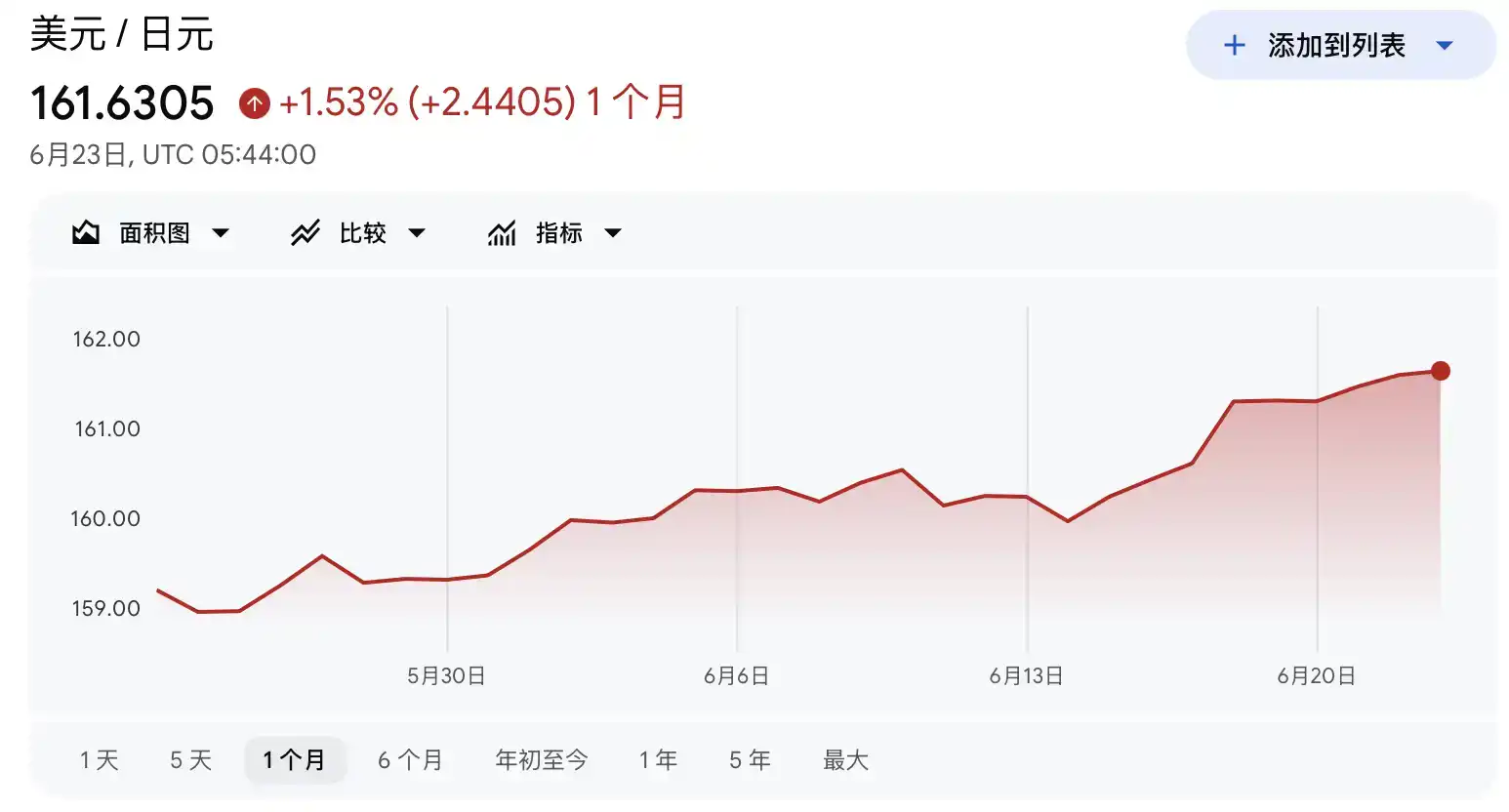
The yen is one of the most sensitive assets in this round of dollar strength. As of the June 23rd session, USD/JPY was around 161.59, having touched 161.93 intraday, just a step away from the 161.96 level. According to The Japan Times and Reuters, a break above approximately 161.95 to 161.96 would mean the yen falls to its lowest level since December 1986.

The core reason for the yen's sustained pressure remains the US-Japan interest rate differential. Renewed bets on US rate hikes, coupled with the relatively slow pace of policy normalization by the Bank of Japan, have widened the yield advantage for investors holding dollar assets, increasing selling pressure on the yen. A weak yen benefits Japanese exporters' profit conversion but also raises import costs, particularly for energy and food, putting pressure on household purchasing power and inflation expectations.

Therefore, the stance of Japan's Ministry of Finance has become a market focus. Japanese Finance Minister Katayama Satoki recently issued verbal warnings about yen volatility, stating that Japan is prepared to act if necessary. This has led traders to speculate that Japanese authorities might intervene in the currency market by buying yen and selling dollars as it nears historic lows.

However, intervention remains at the expectation stage and is not a confirmed policy action. Historical experience shows that Japanese FX intervention can typically create sharp volatility in the short term, forcing short-covering. If the US-Japan yield gap continues to widen, a single intervention is unlikely to fundamentally change the USD/JPY trend. Japanese authorities are more likely to alter the pace of appreciation rather than completely reverse the trend.

This makes the area near 161.96 a dual threshold. On one side, yield differentials and dollar strength continue to push USD/JPY higher; on the other, the closer it gets to the nearly 40-year low, the higher the policy intervention risk. For short-term traders, this level is not only a technical point but also a policy risk point.

Oil Price Rebound Brings Inflation Concerns Back into Trading

Beyond forex, oil prices also re-entered the market spotlight during the same trading session. According to Reuters, oil prices fell about 4% on June 22nd on news of progress in US-Iran talks and related reports about the opening of the Strait of Hormuz passage. The subsequent rebound in oil prices shows the market is still waiting for clearer geopolitical and supply signals.

The Strait of Hormuz is one of the world's most crucial oil transport chokepoints, with about one-fifth of seaborne oil passing through it. Once expectations for resumed passage strengthen, oil supply risks decrease, typically pressuring prices. However, as long as progress in talks, shipping security, and actual supply restoration are not fully confirmed, oil prices are prone to fluctuate between news headlines.

The reason oil prices affect dollar trading is that they re-enter inflation expectations and central bank policy assessments. If the oil price rebound persists, markets will find it harder to believe inflationary pressures have subsided, and the Fed's rationale for maintaining higher rates or even hiking would strengthen. If oil prices decline again, some inflation concerns might ease.

Currently, oil prices are more of a supplementary clue alongside the dollar and US Treasury yields rather than the main theme in the forex market that day. However, in an environment where Fed expectations have already turned hawkish, any sustained energy price rebound could amplify market sensitivity to inflation.

The Strong Dollar Trade Still Hinges on Three Unresolved Questions

The market's most immediate question is whether the Fed will actually hike rates within the year or before September. Futures market bets have clearly heated up, but this is not a Fed commitment and ultimately depends on upcoming inflation, employment, and growth data. If data continues to support a hawkish stance, the dollar may find further support. If inflation falls or employment weakens, rate hike bets could cool rapidly.

The second question lies with Japan. The closer USD/JPY gets to 161.96, the stronger intervention expectations become. However, whether Japanese authorities will act, the scale of any action, and whether the US will cooperate all remain uncertain. What the market truly worries about is not the verbal warnings themselves but the potential for instant volatility that intervention could bring.

The third question comes from oil prices. There is still distance between expectations regarding US-Iran talks, the Strait of Hormuz passage opening, and actual supply restoration. If oil prices continue to rebound, they will rekindle inflation concerns, in turn supporting US Treasury yields and the dollar.

For now, this market move is still primarily driven by US rate expectations. Whether the dollar index can break above 101.97, whether USD/JPY will surpass 161.96, and whether Japanese authorities will move from verbal warnings to concrete action will determine whether the forex market continues with a strong dollar or enters a period of more intense two-way volatility.


İlgili Sorular

QWhy is the 161.96 level particularly significant for USD/JPY?

AThe 161.96 level is significant because if USD/JPY breaks above it, the yen would enter its weakest trading range since December 1986. This makes it a key technical level and a potential trigger for intervention by Japanese authorities.

QWhat are the main drivers behind the recent strengthening of the US dollar?

AThe main drivers are a shift towards more hawkish Federal Reserve policy expectations, with market pricing indicating increased chances of a rate hike later in the year, and high short-term US Treasury yields (like the 2-year), which enhance the appeal of dollar-denominated assets.

QWhat is the market's primary concern regarding a potential Japanese intervention in the FX market?

AThe primary concern is not the intervention itself, but the sharp and volatile price swings it could cause in the short term, forcing traders to quickly adjust their positions. The market doubts a single intervention could sustainably reverse the USD/JPY trend if the US-Japan interest rate differential continues to widen.

QHow does the oil price factor into the current market dynamics for the dollar?

AOil price rebounds can reintroduce inflation concerns into the market. In an environment where the Fed has already turned more hawkish, rising oil prices could amplify these concerns, potentially providing further support for the case for higher US interest rates and, by extension, the US dollar.

QWhat three unresolved questions are currently key for the strong dollar trade according to the article?

A1. Whether the Federal Reserve will actually hike rates later this year. 2. Whether and how Japanese authorities will intervene as USD/JPY approaches key historical levels. 3. The direction of oil prices, as sustained increases could reinforce inflation fears and support the dollar.

İlgili Okumalar

Claude Accused of Becoming Dumber by the Entire Internet, Anthropic Steps In to Reveal: It’s Not the Model That’s Tricking You

When users complained that Claude was "getting dumber," the root cause wasn't the AI model itself. In an official blog post, Anthropic clarified the critical difference between two key settings in Claude Code: Model and Effort. Model refers to the core "brain"—the fixed, trained weights of a specific AI (like Sonnet, Opus, or Fable). Changing the Model addresses *capability* ("can it do this?"), but its knowledge is static post-training. Effort, however, controls the AI's *approach and thoroughness* for a specific task. A higher Effort level instructs Claude to read more files, run tests, perform verification, and complete multi-step reasoning before responding, significantly increasing its "work output" for that job. Conversely, low Effort leads to quicker, less thorough replies. This distinction explains the March 2024 uproar where users experienced a sudden drop in Claude's performance. The cause was not a model change but Anthropic quietly lowering the *default* Effort setting from "high" to "medium" to reduce latency, which was later reverted. The key insight is that a smaller, capable model (like Sonnet) on high Effort can often outperform a larger, more powerful model (like Opus) on low Effort for many tasks. The article provides a practical troubleshooting framework: if Claude makes an error, first check the context and instructions. If it seems to skip necessary steps or validations, increase Effort. If it diligently attempts the task but fails conceptually or makes consistent factual errors despite good context, then consider switching to a more capable Model. The takeaway is a shift in focus: effective AI programming is less about always choosing the "strongest" model and more about intelligently *orchestrating* models and effort levels—acting like a project manager to assign the right "brain" with the right level of diligence for each job, optimizing both results and cost.

marsbit34 dk önce

Claude Accused of Becoming Dumber by the Entire Internet, Anthropic Steps In to Reveal: It’s Not the Model That’s Tricking You

marsbit34 dk önce

Will the Ethereum Foundation Evolve into a 'Mascot'? Diversified Organizations Are Fragmenting Its Functions

The Ethereum Foundation (EF) is undergoing significant internal turmoil and functional erosion. Following its largest-ever layoff of 54 staff (20% of its workforce) and a major organizational restructuring announced in June, its Protocol Support Team has been officially dissolved. This comes alongside the high-profile resignation of key figures like co-executive director Xiaowei Wang, bringing senior departures this year to at least eight. Criticism of EF's rigid structure, opaque decision-making, and perceived lack of a clear value narrative for ETH has intensified within the community. The layoffs have catalyzed the emergence of independent, non-profit organizations like Ethlabs and Ethereum Institutional, founded by former EF researchers and members. These entities are now taking on core functions such as protocol research/development and institutional adoption, effectively fragmenting the EF's traditional leadership role. Concurrently, EF's security team is adapting to technological change, deploying specialized AI agents to audit Ethereum's codebase, which successfully discovered a critical vulnerability (CVE-2026-34219). While EF states AI complements rather than replaces researchers, it signals a potential future shift in its operational model. Faced with these challenges—internal restructuring, talent drain, the rise of competing organizations, and AI integration—the Ethereum Foundation appears to be stepping back from a central commanding role. Analysts and community observers speculate it may increasingly transition towards a symbolic "ecosystem mascot" function, while decentralized initiatives drive Ethereum's future growth and institutional adoption.

marsbit1 saat önce

Will the Ethereum Foundation Evolve into a 'Mascot'? Diversified Organizations Are Fragmenting Its Functions

marsbit1 saat önce

Nearly a Hundred Players Rush into Embodied Data: With 4.47 Billion Yuan in Financing in One Year, Who Can Really Make Money by 'Selling Data'?

The domestic embodied AI data industry has attracted nearly 100 players, with 70 focused on data collection and 27 on data infrastructure. In the past year, 15 independent embodied data service providers raised approximately 4.47 billion yuan. Despite this growth, the sector remains early-stage, fragmented, and faces significant challenges. Data collection methods are diverse, categorized into four main routes: teleoperation of real robots, human demonstration without a robot (using motion capture, exoskeletons, etc.), simulation synthesis, and distillation from internet videos. Most companies (43%) adopt hybrid approaches, combining multiple routes, as no single method can meet all training needs. Teleoperation alone is pursued by 31% of players, often by state-owned platforms and robot companies, while newer firms favor asset-light, no-hardware human demonstration. Independent data service providers now form the largest player group (40%), indicating the emergence of a distinct industry segment rather than just a subsidiary function for robot makers. Two-thirds of all players are "embodied-native" startups, while one-third are companies that pivoted from fields like AI data annotation, which are more prevalent in the data infrastructure layer. Current annual industry capacity is estimated at 1.6-1.8 million hours plus 70-80 million data points, with a short-term goal to increase this 15-20 fold within 1-3 years. Data collection factories are spread across 20 provinces in China, concentrated in the Yangtze River Delta, Beijing-Tianjin-Hebei, and Pearl River Delta regions. Financially, the 4.47 billion yuan raised in the past year pales compared to the 43.8 billion yuan raised by the broader embodied intelligence sector in just the first half of 2026, highlighting that data remains a less "sexy" bet for investors. The 15 funded independent providers show clear stratification: a top tier led by a unicorn (Lightwheel Intelligence, 3.1 billion yuan), a middle tier of 11 firms raising tens to hundreds of millions, and an early-stage tier of 3 companies. Sixty-nine investment institutions have participated, but none have made concentrated bets, reflecting uncertainty about viable business models. Over half of these funded companies are less than a year old, most are at pre-A or A rounds, and profitability remains largely unproven. In summary, the embodied data industry has become an independent track creating jobs and local economic activity. However, it is still nascent, with unformed consensus, unsolved problems, and unproven business models. The coming 1-2 years will be a critical validation window to see if companies can build sustainable, profitable businesses purely by "selling data."

marsbit4 saat önce

Nearly a Hundred Players Rush into Embodied Data: With 4.47 Billion Yuan in Financing in One Year, Who Can Really Make Money by 'Selling Data'?

marsbit4 saat önce

İşlemler

Spot
活动图片