
Does switching to a larger model mean it’s smarter?
【Introduction】 Does switching to a larger model mean it’s smarter? This might be the deepest misunderstanding among Claude Code users. Many have switched all the way to the most expensive Fable for this reason. Recently, Anthropic personally clarified this misconception.
Have you ever had this moment: Claude Code messes up writing code, and your first reaction is to quickly switch to a more powerful model.
But this move often doesn't work and may even be a waste of money.
Recently, Anthropic officially published a lengthy article specifically addressing this.
Anthropic Official Long Article
The reason is that too many people confuse two options in Claude Code:
One is the model selection (Model), and the other is the effort level (Effort).
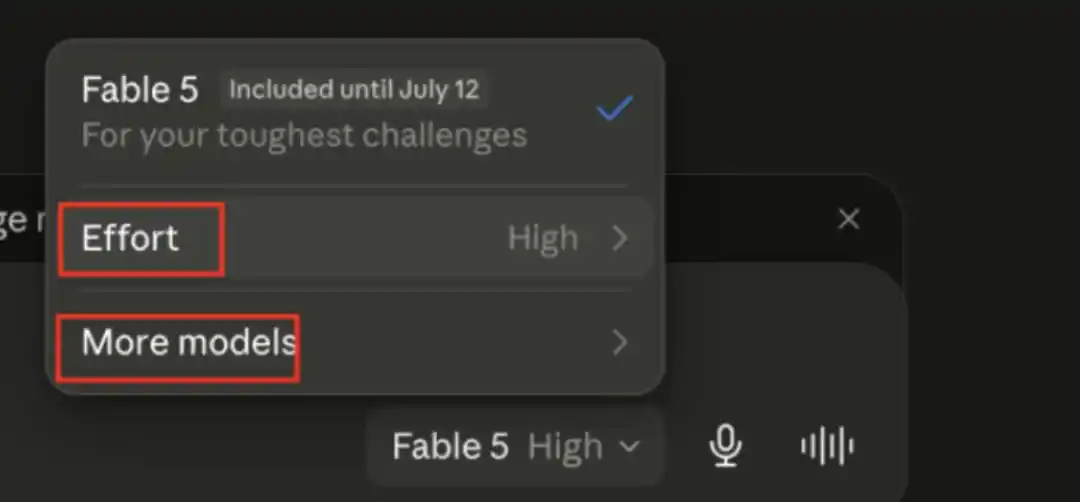
Anthropic Official Long Article
Previously, everyone’s understanding of these two options was simple: switch to a larger model, and the AI gets smarter; turn up the Effort, it just makes the AI think a bit longer.
And it was this misunderstanding that caused considerable chaos back in March of this year.
At that time, many developers found that their Claude Code had suddenly "become dumber." It didn’t read files it should, didn’t run tests it should, quit halfway through tasks, and instead asked you for more information.
Thus, complaints flooded GitHub.
The harshest blow came from AMD's AI lead, Stella Laurenzo.
She pulled logs from 6852 sessions on GitHub, measured that Claude's "thinking quantity" had dropped by 67% compared to before February, and left this comment:
Claude can no longer be trusted to handle complex engineering tasks.

Claude can no longer be trusted
At first, everyone thought they hadn't written their prompts well or configured something incorrectly. After much struggle, it dawned on them: the problem wasn’t on their end; it was Anthropic quietly changing a setting.
On March 4th, to reduce latency, they lowered the default Effort level in Claude Code from high to medium.
The official changelog mentioned it, but most people didn’t notice. They just felt that the model in their hands had inexplicably become dumber.
After holding out for a month, Anthropic finally reverted the default level on April 7th and reset the usage quota for all subscribed users.
And it was only then that most people realized this switch had always been right beside them, secretly determining whether the AI would give its full effort for you.
Model changes the brain, Effort changes the attitude
Anthropic's official breakdown can be simply summarized in one sentence:
Model changes the brain, Effort changes the attitude.
First, Model changes the brain.
Each model is backed by a set of "frozen weights"; its capabilities and knowledge are essentially welded in place the moment training ends: read-only, unmodifiable.
This means that the prompts you feed during inference, CLAUDE.md, and the code pasted into the context cannot alter this set of weights: you can guide it, but you cannot "train" it.
Switching models essentially means swapping in a whole new set of weights to handle your task, so it addresses the question of "can it do it."
A library that didn't exist during the model's training—you can feed it the entire documentation, and it can learn on the fly and use it, but that only works for that one request; the model itself doesn't remember a single word and forgets it immediately.
The same principle explains why it occasionally invokes a non-existent API with a straight face. That’s not a knowledge gap; it’s the weights piecing something together based on old patterns from training.
Looking a bit deeper makes it even clearer. Your written const x = await fetch is first broken down into tokens by the model, each replaced by a number in the vocabulary.
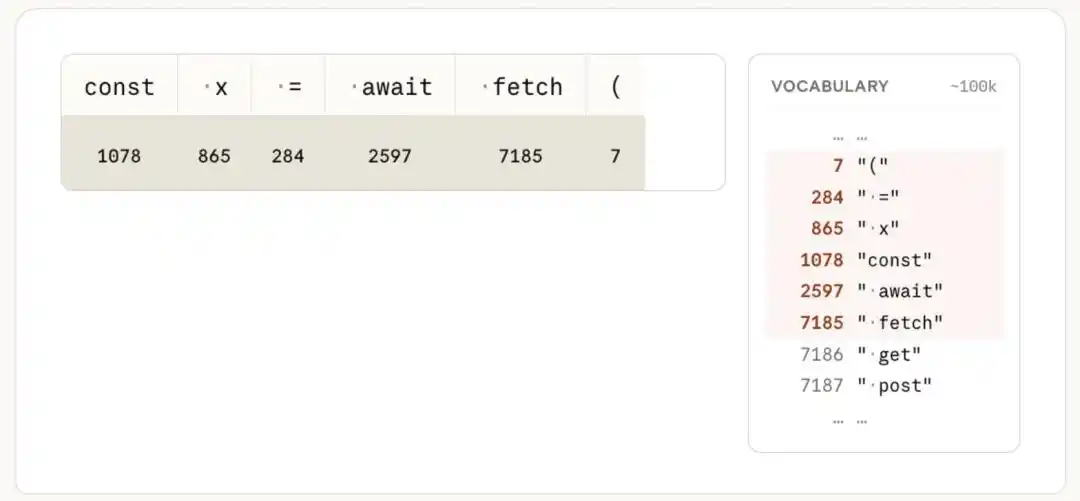
Source: Anthropic Official Blog Post
A line of code you write, after being tokenized, corresponds to integers in the vocabulary: "const" is 1078, "await" is 2597. The vocabulary is about 100k tokens. The model never receives text; it gets this sequence of numbers.
The model doesn’t spit out the entire answer in one go. It predicts only one token at a time, appends it, recalculates the whole sequence, and predicts the next one. A 200-token reply is 200 full computations.
The time you wait and the money you burn are mostly consumed in this loop.
Now, Effort changes the "attitude."
Many think high Effort means "think a few more seconds." Wrong.
It governs how much workload Claude invests in this task: how many files to read, whether to run tests, whether to perform extra verification, whether to push a multi-step task all the way through before coming back to you.
Simply put: low Effort Claude tends to reply quickly and then ask you for more context, avoiding action if possible; high Effort Claude tends to go look for information itself, call tools multiple times, and complete long task chains in one go.
Effort in Claude Code is divided into several levels; don’t think of it as a rigid token budget line.
It’s a behavioral signal, telling Claude how thoroughly and confidently this job needs to be done before it's considered complete. Text replies, tool calls, extended thinking—all fall under its purview.
The official article also includes an illustrative chart: with the same prompt, high Effort can generate about 7 times more tokens than low Effort. The extra tokens are all spent on reading files, running verifications, and repeated confirmations.
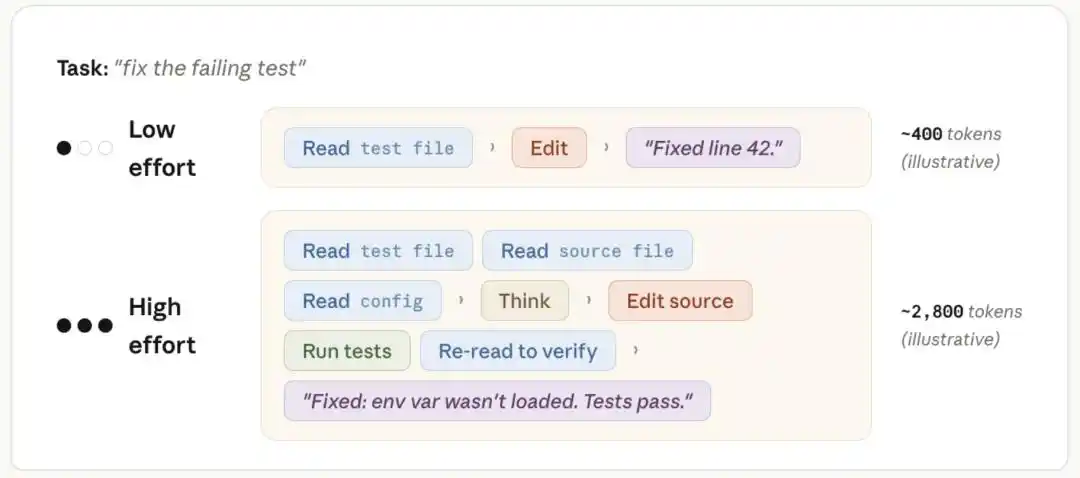
Source: Anthropic Official Blog Post
The same prompt: the high Effort path generates about 7 times the tokens of the low Effort path. The extra tokens are all spent on reading files, running verifications, and repeated confirmations.
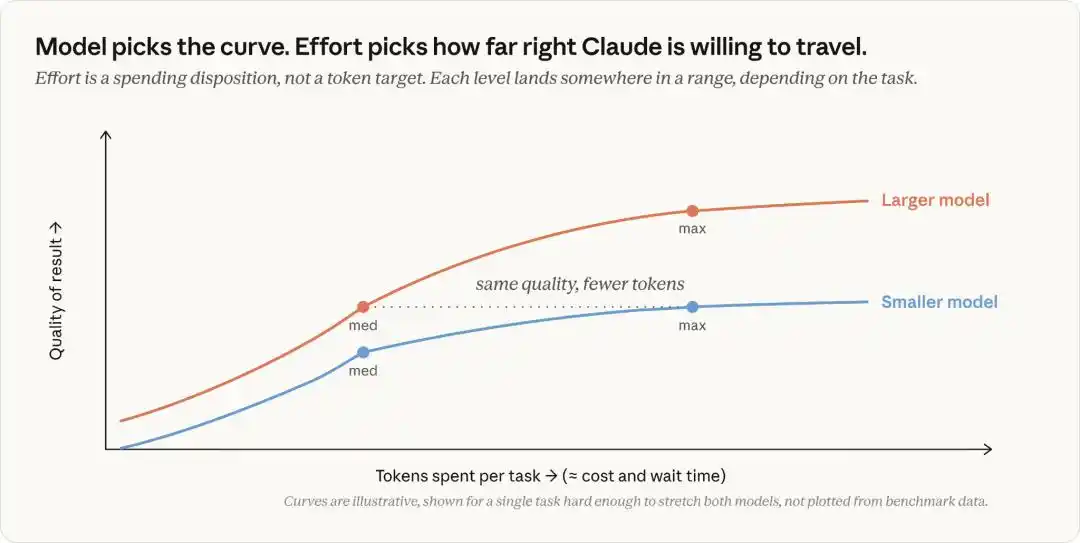
This hides a counterintuitive conclusion: a small model with high Effort can very well outperform a large model with low Effort.
Incapable, or Not Trying Hard Enough
Understanding the division of labor is useful, but what’s truly helpful is the judgment framework given by the official source.
Source: Anthropic Official Blog Post
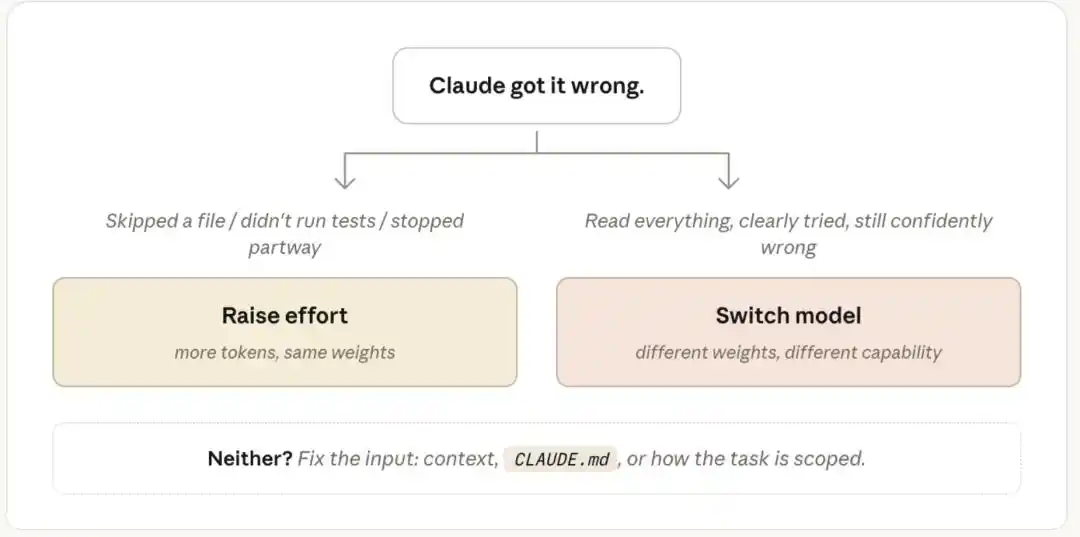
Official judgment framework: When Claude makes a mistake, first ask if it’s not smart enough or not trying hard enough, then decide whether to change the model or increase Effort.
When Claude messes up, don’t rush to touch the model option.
The first step is always to review the context: Was the prompt clear? Were the necessary tools provided? Was CLAUDE.md paired correctly? Most instances of so-called "AI getting dumber" have their root here, not in the model option.
If the context is indeed fine and it still makes mistakes, ask yourself: Is it incapable, or not trying hard enough?
"Not trying hard enough" is easy to judge: It skipped files it should have read, didn’t run tests, stopped a refactoring halfway to ask you questions. What it lacks isn’t brains; it’s effort.
This is a matter for Effort; you can turn it up a notch.
If it’s "incapable," it’s a different scenario: You provided sufficient context, it clearly tried its best, yet still got it wrong. Trying different phrasings yields the same wrong result.
At this point, no amount of added Effort will help; this is a model issue: you need to switch to a stronger one.
The official article also provides a very understandable analogy.
Sonnet is an all-rounder with an entire afternoon at its disposal.
It will read your code from start to finish, run it, verify it again, and genuinely understand your piece of work.
Opus is an expert who gives you only five minutes. It brings experience that simply isn’t in your codebase: pitfalls seen, mines to avoid, all intuitions built from solving a pile of similar problems. But five minutes is short; it’s only enough for a glance, not enough to scan every file.
Fable is the specialist you call in only when everyone is stuck. Even with just five minutes, it can spot the one flaw no one else saw.
Of course, this expert also costs the most per token, so it should be reserved for the truly tough nuts that nobody else can crack.
Hence, that counterintuitive conclusion:
A Sonnet on high Effort can genuinely handle more tasks in many jobs than an Opus on low Effort. A small model paired with ample context and high investment can tackle far more than you might imagine.
Source: Anthropic Official Blog Post
On long, multi-step tasks, Fable shows the biggest gap. In official tests, some tasks were beyond the reach of Opus and Sonnet at any Effort level.
After Racing Model Leaderboards, Assigning Tasks to AI Becomes a Hard Skill
On the surface, this official explanation teaches you parameter tuning, but behind it lies an important shift:
The competition in AI programming is moving from "whose model is stronger" to "who is better at orchestrating agents."
It used to be simple: pick the strongest model, and leave the rest to it.
Now it’s different. You have to act like a project manager, assigning different roles and effort levels to different models:
Simple modifications go to Sonnet on low setting—instant replies and cost-saving; major refactoring uses a strong model on high setting; agent tasks that need to run independently for a long time get a strong model with full Effort.
These operations not only get the job done better but also save real money on the token bill.
The extra level, ultracode, in Claude Code's Effort menu, builds this "orchestration" into the product.
Selecting it gives Claude the firepower of xhigh, plus authorization: when encountering substantial work, it can decide whether to spin up a team of agents, split the task, and work in parallel.
Looking back at the "getting dumber" incident in March.
The fact that it alarmed the entire community precisely shows that most people were still stuck in the old mindset of "switching models," completely unaware of the more critical Effort option right beside them.
The era of only looking at model rankings is passing. Orchestrating models is becoming the core skill.
Whoever learns to assign tasks to AI first will be one step ahead, using the Claude that is truly willing to work hard for you. Otherwise, the most expensive model in your hands is just a more expensive search box.
This way, every token you burn is truly spent on the cutting edge.
References:
https://claude.com/blog/claude-model-and-effort-level-in-claude-code
https://x.com/ClaudeDevs/status/2074900291062034618?s=20
https://platform.claude.com/docs/en/managed-agents/multi-agent
Editor: Yuanyu
This article is from the WeChat public account "XinZhiYuan," author: ASI Revelation.