The Man Who Best Promoted SOL Exits the Crypto World

marsbit2026-02-05 tarihinde yayınlandı2026-02-05 tarihinde güncellendi

Özet

Kyle Samani, co-founder and managing partner of Multicoin Capital, has stepped down from his daily operational and management roles at the crypto-focused venture firm and transitioned to an advisory position. Known as one of the most vocal proponents of Solana, Samani was instrumental in Multicoin’s early and heavy investments in the blockchain, famously declaring “Solana is always the answer” and publicly criticizing Bitcoin and Ethereum. Under his leadership, Multicoin achieved extraordinary returns from Solana, though the fund also faced significant losses during market downturns. Despite his exit from Multicoin, Samani remains committed to the crypto space, particularly Solana, and will continue personal investments in the ecosystem. He will retain his role as chairman of Forward Industries, a digital asset treasury company heavily invested in SOL. Samani plans to redeem his Multicoin stake not in cash but in shares and warrants of Forward Industries to increase his exposure. His departure is driven by a growing interest in emerging technologies such as AI, longevity science, and robotics. Samani has indicated he will take time to explore these areas but remains a firm believer in crypto’s potential to reshape global finance.

Original | Odaily Planet Daily (@OdailyChina)

Author | Azuma (@azuma_eth)

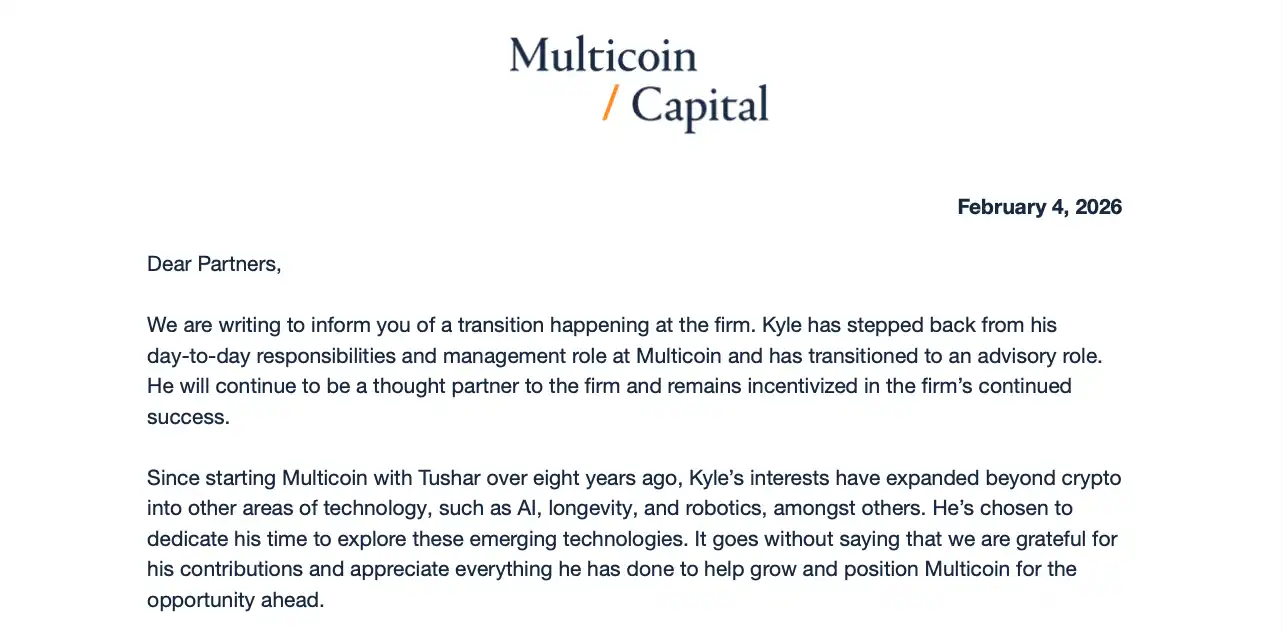
On February 4 local time, the well-known venture capital firm Multicoin Capital wrote to LPs stating that co-founder and managing partner Kyle Samani has stepped down from his daily duties and management role at Multicoin and transitioned to an advisory role.

Tushar Jain, another co-founder of Multicoin, said that Samani's interests have expanded from the cryptocurrency field to cutting-edge directions such as AI, longevity technology, and robotics, and therefore he has decided to devote more time to exploring these emerging technologies.
The Man Who Best Promoted SOL

Since co-founding Multicoin with Tushar in 2017, Samani has been one of the most active investors in the cryptocurrency field. His most classic achievement is his疯狂押注 on Solana.

Multicoin was the first venture capital firm to heavily invest in Solana. Between 2018 and 2021, Multicoin led Solana's first three rounds of financing, and Samani himself took on the role of evangelizing Solana to the crypto world. Samani is extremely adept at promoting Solana in a high-profile and provocative manner. He has publicly criticized Bitcoin for lacking practical utility, criticized Ethereum for being structurally bloated and slow to scale, emphasized that "Solana is always the answer," and firmly believed that SOL would outperform BTC and ETH in the long run.

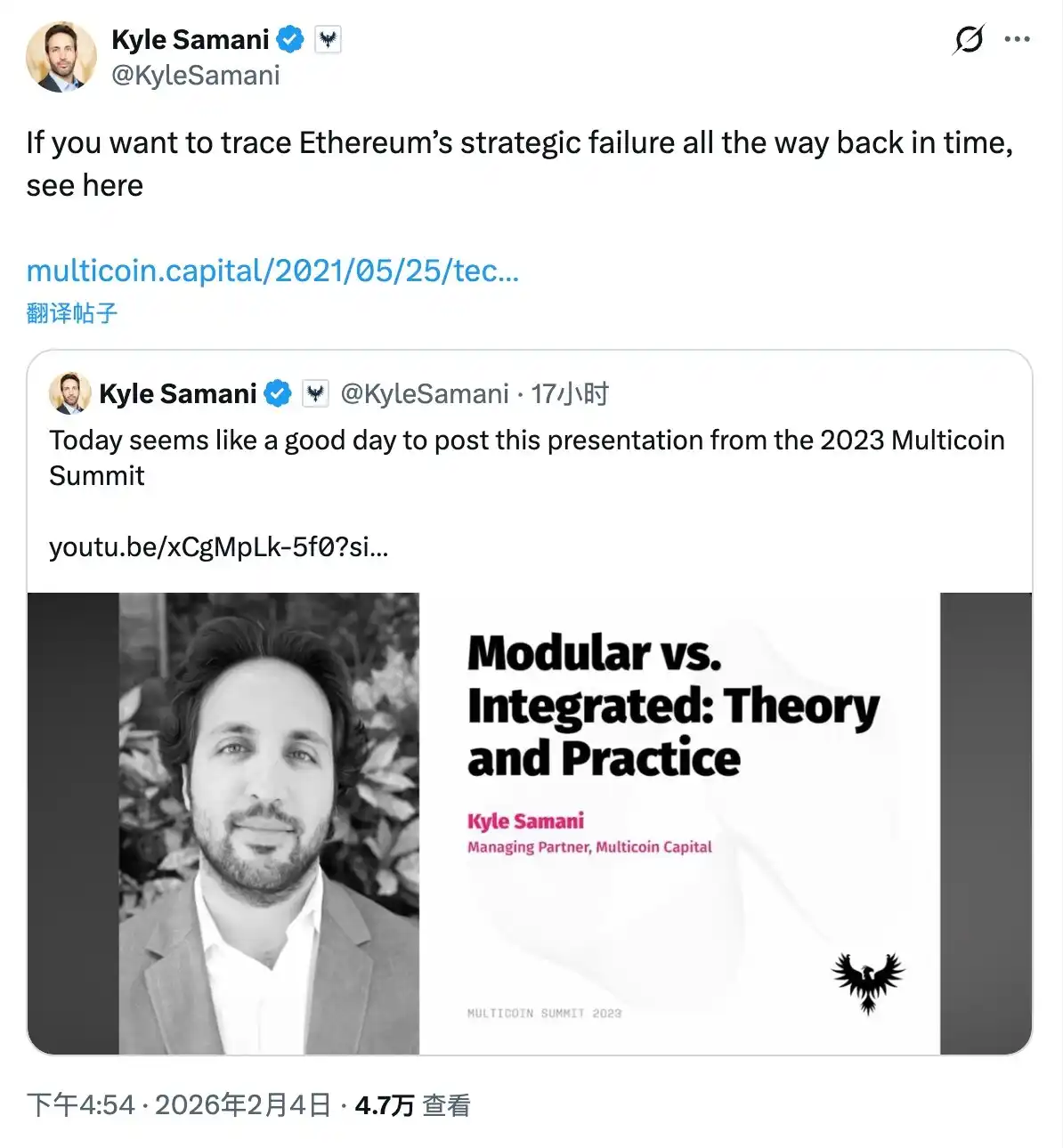
A recent example is that yesterday, Vitalik publicly admitted that Ethereum's Layer2 historical路线 had errors. Samani specifically reposted an article he wrote in 2021 comparing Ethereum and Solana's scaling paths and commented, "This is the beginning and end of Ethereum's strategic failure."
Multicoin's bet on Solana was a huge success. At the end of 2021, Samani said on The Wolf Of All Streets podcast that the firm had made an astonishing profit of 614,000% on Solana.

However, after the collapse of FTX, the entire Solana ecosystem was hit hard, and SOL一度跌至 $8, plunging the project into its darkest moment. Multicoin's profits also experienced a huge drawdown — the fund lost about 91.4% in 2022, its worst performance since inception.

But Samani and Multicoin showed an even more courageous side at this time. Instead of abandoning Solana, they continued to be driven by faith, firmly evangelizing Solana and increasing investment in Solana ecosystem projects. The final result was that Solana achieved the most amazing涅槃重生 in cryptocurrency history, and Samani and Multicoin also "regained lost ground" as SOL recovered.

After the rise of Digital Asset Treasuries (DAT) in 2025, Multicoin, together with Galaxy Digital and Jump Crypto, jointly led a $1.65 billion financing round for the DAT company Forward Industries. Forward Industries is now the largest SOL DAT on the market (holding 6.82 million SOL, worth approximately $626 million). Samani himself serves as the chairman of the board of this company.

A Madman in the Eyes of Ordinary People, the Best Investor in the Eyes of Peers

Because Samani prefers contrarian investments and his言论过于高调且极具煽动性, he is often accompanied by considerable controversy (mainly from the Ethereum ecosystem).

But in the eyes of a few VC peers, Samani is the best investor in the entire cryptocurrency field. Dragonfly Capital partner Hasseb Qureshi once said that as competitors, Dragonfly and Multicoin are always at odds, but experts recognize experts. Investment is like a sport, and Samani is the highest scorer of all time, unmatched by anyone.

Hasseb added: "This doesn't mean you have to like him. I often find him reckless and even annoying. I also often disagree with him... But Samani is a true contrarian thinker. He bets where others are unwilling to bet... Ultimately, this is the reason investors exist—to allocate capital to undervalued ideas, and Samani is one of the few non-consensus investors in our industry."

Personal Statement: Not Completely Leaving the Circle

After Multicoin's letter to LPs was announced, Samani himself also explained his job change on X.

Samani emphasized that his faith in cryptocurrency and Solana remains unchanged — "After nearly a decade of working deeply in the cryptocurrency industry, I am more convinced than ever that crypto technology will fundamentally reshape the financial system. I believe the Clarity Act will attract new participants like a tide,催生 an unprecedented wave of applications. I am still long-term bullish on the crypto field, especially the Solana ecosystem, and plan to continue making personal investments in the field while supporting companies in Multicoin's portfolio."

In addition, although he will gradually step down from Multicoin, Samani will continue to serve as chairman of the board of Forward Industries. Furthermore, Samani also mentioned that he intends to submit a redemption request to the Multicoin main fund on March 31, 2026, but will not request cash. Instead, he will redeem in kind with Forward Industries shares and warrants, to significantly increase his personal exposure to Forward Industries.

Future Direction Exploration

Multicoin's letter to LPs mentioned several new directions Samani is interested in — AI, longevity technology, and robotics.

Although it is not yet clear which specific directions Samani has identified (Samani said he will take a break for now), yesterday he reposted an article by Shayon, another partner at Multicoin, about AI titled "Disrupting the Human-AI Relationship." The core idea of the article is that instead of苦苦思索 "what AI can assist humans with," a more economically efficient direction is "how humans should assist AI," and what new investment opportunities will emerge around this shift in thinking.

Interested readers can read the original article, which may serve as a window into Samani's future thinking.


İlgili Sorular

QWho is Kyle Samani and what is his role change at Multicoin Capital?

AKyle Samani is the co-founder and managing partner of Multicoin Capital. He has stepped down from his day-to-day duties and management role at Multicoin and transitioned into an advisory role.

QWhat was Kyle Samani's most notable investment success in the crypto space?

AKyle Samani's most notable investment success was Multicoin Capital's heavy investment in Solana (SOL), which yielded a profit of 614,000% by late 2021.

QWhy did Kyle Samani decide to reduce his role at Multicoin Capital?

AKyle Samani decided to reduce his role because his interests have expanded beyond cryptocurrency to include emerging technologies such as AI, longevity tech, and robotics.

QWhat is Forward Industries, and what is Kyle Samani's involvement with it?

AForward Industries is a Digital Asset Treasury (DAT) company with significant holdings in SOL. Kyle Samani serves as the Chairman of the Board for Forward Industries and plans to increase his personal exposure to the company through in-kind redemptions from Multicoin's main fund.

QDespite stepping back, what does Kyle Samani plan to continue in the crypto space?

AKyle Samani plans to continue his personal investments in the crypto space, particularly in the Solana ecosystem, and will continue to support companies in Multicoin's investment portfolio.

İlgili Okumalar

Has the 'Digital Gold' Narrative for BTC Failed?

**Title: Has the "Digital Gold" Narrative for Bitcoin Failed?** The article argues that Bitcoin's "digital gold" narrative remains valid despite a recent sharp price decline (from a peak near $126k in Oct 2025 to briefly under $61k in Feb 2026). It presents a long-term investment framework based on three core points: **1. Viewing Bitcoin as an Asset:** Bitcoin is presented as a superior potential store of value compared to gold. Key arguments are its absolute scarcity (21 million cap), superior portability, and transparent auditability via its public ledger. While acknowledging its current use in early, volatile stages (~3-4% global adoption), the author draws parallels to the early, disruptive phases of the internet and e-commerce. **2. Understanding the Recent Downturn:** The current ~50% correction is framed as a predictable, consensus-driven cycle following its post-halving peak (the 2024 halving preceded the Oct 2025 high). A crucial factor is a historic "changing of hands": the influx of new institutional buyers via ETFs allowed early, low-cost holders (miners, OG believers) to take profits. The author notes that while severe, Bitcoin's historical drawdowns (e.g., 93% in 2011, 77% in 2021-22) have been progressively smaller, suggesting maturing holder structure and decreasing volatility over time. **3. The Long-Term Perspective:** The long-term thesis hinges on Bitcoin capturing a portion of gold's market value. With Bitcoin's market cap at ~$1.4 trillion (at $70k) versus gold's ~$20 trillion, significant upside potential exists if the "digital gold" narrative is partially realized. However, the author strongly cautions that short-term risks remain, the bottom is unpredictable, and high volatility is inherent. The real risk is not Bitcoin failing but poor personal position management (over-leverage, wrong capital) and a lack of deep understanding, which can force investors out during severe downturns. The conclusion uses Amazon's 95% crash post-2000 dot-com bubble and subsequent 42x recovery as an analogy. The ultimate question is not if Bitcoin's price will rise, but if an investor's strategy and conviction can withstand the volatility to see the long-term play out. The recent divergence (gold up, Bitcoin down) is posed not as a narrative failure, but as potential evidence of this ongoing, painful transition from a speculative asset to a mainstream allocation.

marsbit3 saat önce

Has the 'Digital Gold' Narrative for BTC Failed?

marsbit3 saat önce

Has BTC's 'Digital Gold' Narrative Failed?

The article discusses Bitcoin's "digital gold" narrative, its recent price drop, and long-term outlook through the perspective of "Jason". It argues the narrative is not a failure but that Bitcoin represents a superior, new asset class due to its fixed supply (21 million), portability, and auditability. The piece compares its current ~3-4% global adoption rate to early internet/e-commerce, suggesting significant growth potential. Regarding the 2025-2026 price decline (from ~$126k to briefly under $61k), the author views it as a predictable, consensus-driven sell-off within Bitcoin's ~4-year cycle post-halving, exacerbated by a major "handover" from early, low-cost holders to new institutional buyers via ETFs. A key observation is that historical peak-to-trough drawdowns have lessened over time (e.g., 93% in 2011 to ~50% in 2026), indicating maturing volatility as holder structure changes. For the long term, the author uses a simple framework: Bitcoin's total market cap (~$1.4T at $70k) is only about 7% of gold's (~$20T). Even capturing 30-50% of gold's value would imply substantial upside. However, the article strongly cautions against viewing this as investment advice, emphasizing extreme volatility and the critical importance of risk management, position sizing, and deep fundamental understanding to survive severe drawdowns. It concludes by drawing a parallel to Amazon's 95% crash in 2000 and subsequent 42x recovery, stressing that the key is surviving market cycles to realize long-term potential.

链捕手3 saat önce

Has BTC's 'Digital Gold' Narrative Failed?

链捕手3 saat önce

From Code to Cognition: A Ten-Thousand-Word Guide to the Evolution of the Robot Brain

"From Code to Cognition: The Evolution of Robot Brains" The journey of robotic intelligence has shifted dramatically from manually coded systems to AI-driven brains. For decades, robots relied on layered software stacks—perception, state estimation, planning, control—each handcrafted. While predictable, they lacked adaptability. The 2010s saw deep learning revolutionize perception (e.g., object detection) and control (via reinforcement learning), but learned skills remained narrow. The arrival of Large Language Models (LLMs) marked a turning point. LLMs acted as high-level planners, interpreting natural language instructions and generating sequences of actions for traditional robotic systems to execute. However, true integration came with Visual-Language-Action (VLA) models, which fused vision, language, and motion prediction into a single network. Pioneered by models like RT-2 and open-source projects like OpenVLA, VLAs enable robots to reason and act directly from visual input and commands. The most advanced humanoid robots now employ a "dual-brain" architecture: a slow-thinking, large VLA (System 2) for reasoning and planning, and a fast-reacting, small network (System 1) for high-frequency motion control, sometimes with an even lower-level System 0 for balance. This split balances cognition with the physics of real-time movement. Computation is split between onboard hardware (e.g., NVIDIA Jetson) for safety-critical control loops and cloud/edge servers for non-critical tasks like learning and interfaces. A crucial driver is the open-source ecosystem—models like GR00T and OpenVLA allow startups to build upon pre-trained brains and fine-tune them with their own data, accelerating development. Despite progress, current systems struggle with recovery from errors, sample inefficiency, and long-horizon tasks. This has spurred the rise of **World Models**—neural networks that predict the consequences of actions. By simulating possible futures before acting (like NVIDIA Cosmos or Meta V-JEPA), robots can plan, recover, and generalize better. This represents the next frontier: shifting intelligence from learned reactions to an internal model of physics and cause-and-effect. The field is rapidly evolving. While not yet at its "ChatGPT moment," the convergence of cheaper hardware, scalable simulation, and world models points toward robots that are increasingly capable, adaptive, and useful. The question is shifting from "what can robots do?" to "what *should* they do?"

marsbit4 saat önce

From Code to Cognition: A Ten-Thousand-Word Guide to the Evolution of the Robot Brain

marsbit4 saat önce

AI Bubble Is Bursting

The AI Bubble is Bursting: A Necessary Purge on the Path to Ubiquitous Intelligence Market volatility has reignited debates about an AI bubble, with figures like Ray Dalio pointing to high valuations. However, this parallels the dot-com bubble, which, despite its crash, laid the physical infrastructure for today's internet era. The current AI investment frenzy, with tech giants planning trillions in infrastructure spending far outstripping current AI application revenues, appears similarly imbalanced. This 'bubble' is seen as an inevitable phase for a disruptive technology, paying the "innovation tax." Critically, AI inference costs have plummeted over 99.7% since 2023, making intelligence nearly free at the margin. This hasn't reduced spending but has instead unlocked massive new demand, as seen in enterprise AI cloud expenditure tripling. This follows the Jevons Paradox: efficiency gains lead to greater total consumption. The market is now entering a cleansing phase, weeding out speculative ventures lacking real moats. The deeper shift is a move from capital expenditure (CapEx) on hardware to value creation in operational expenditure (OpEx) through AI applications that solve real industry problems. While infrastructure valuations are high, rapid earnings growth from widespread AI adoption across sectors—from manufacturing and finance to law and healthcare—may digest these valuations over time. Ultimately, this creative destruction will leave behind robust infrastructure and optimized models, cheaply powering an AI-augmented future for all industries, much as the internet became indispensable after its own bubble burst. The core productive potential remains undiminished.

链捕手4 saat önce

AI Bubble Is Bursting

链捕手4 saat önce

İşlemler

Spot
Futures
活动图片




