The Fall of the $70 Million Myth: How NFTs Went from Auction House to Walmart Shelves

比推2026-01-06 tarihinde yayınlandı2026-01-06 tarihinde güncellendi

Özet

The NFT market has experienced a dramatic decline from its peak, marked by the cancellation of NFT Paris 2025 and a significant drop in market value. Total NFT supply surged by 35% in 2025, while sales fell 37% to $5.63 billion, and the market capitalization plummeted 86% from its 2022 high. Average sale prices dropped to $96, down 75% from the bull market. Even blue-chip NFTs like CryptoPunks and Bored Ape Yacht Club saw floor prices fall by 78% and 83%, respectively. Major platforms like OpenSea are pivoting away from pure NFT trading, with some shutting down entirely. Amid the downturn, Pudgy Penguins emerged as a success story by leveraging its IP for physical consumer products, generating an estimated $50 million annually through retail partnerships with Walmart and others. Its brand-focused strategy, including high-profile advertising, boosted secondary market activity. Meanwhile, NFTs are finding utility in real-world applications, such as tokenized physical assets (e.g., Courtyard’s Pokémon cards) and functional use cases like FIFA’s anti-scalping tickets for the 2026 World Cup. The speculative frenzy around NFTs as standalone financial assets has ended, but the technology persists as a practical tool for verification, ownership, and integration into broader ecosystems—signaling a shift from hype to utility.

Author: Sanqing, Foresight News

Original Title: From the $70 Million Myth to $9 Dolls, Are NFTs Really "Dead"?


On January 5, the NFT Paris developer conference, originally scheduled for February, was suddenly canceled. The banks of the Seine, once alive with all-night parties, are now left with only a cold official tweet: "The market crash has hit us hard. Even with aggressive cost-cutting measures, we are still unable to sustain it."

Five years ago, digital artist Beeple's work "Everydays: The First 5000 Days" sold for a staggering $69.3 million at Christie's auction house. This was followed by CryptoPunks fetching tens of millions and countless digital collectibles backed by mainstream institutions—it was the golden age of NFTs.

From a record-breaking auction sale to a forced industry conference cancellation, NFTs have completed a full cycle from frenzy to reckoning in just five years.

Image – Everydays: The First 5000 Days NFT

Imbalance in NFT Market Supply and Demand

Supply Explosion. According to CryptoSlam data, the supply in 2025 increased by 35% compared to 1 billion in 2024. Over the past four years, the total number of NFTs has skyrocketed from 38 million to 1.34 billion, a growth of approximately 3,400%.

Sales Shrinkage. According to CryptoSlam data, the total NFT sales in 2025 were approximately $5.63 billion, a 37% decrease from $8.9 billion in 2024. According to CoinGecko data, the total NFT market capitalization fell from a peak of about $17 billion in April 2022 to about $2.4 billion by the end of 2025, a drop of about 86%. In 2025 alone, the total NFT market capitalization shrank from about $9.2 billion in January to its year-end size, a staggering 68% drop for the year.

Liquidity Dilution. As the barrier to minting lowered, the market entered a "high-frequency, low-price" mode. According to CryptoSlam data, the average transaction price has fallen from $124 in 2024 to $96 by the end of 2025. Compared to the average transaction price of over $400 during the peak of the 2021-2022 bubble, it has lost three-quarters of its value.
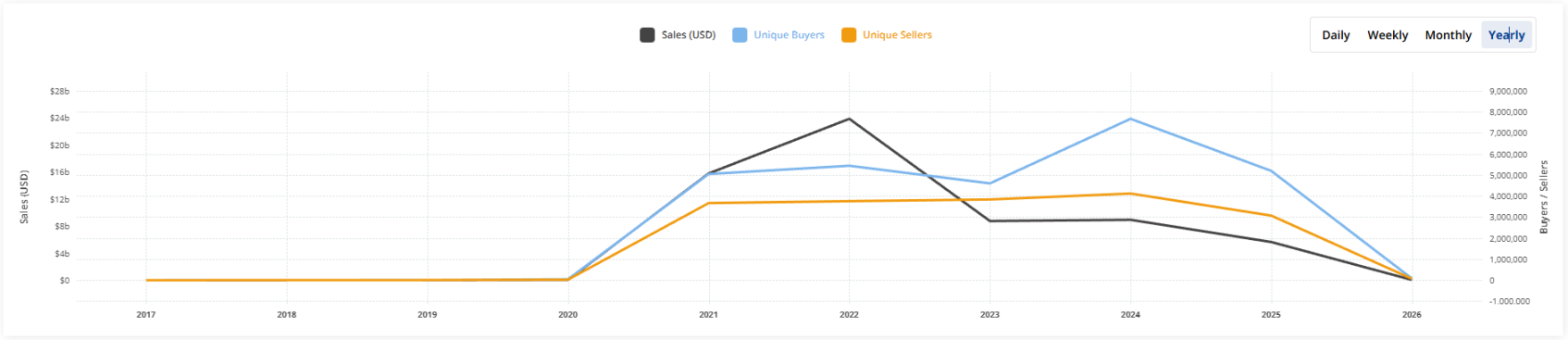
Image Source: CryptoSlam

Even former top-tier NFT projects and blue-chip NFTs couldn't escape the downturn. Taking CryptoPunks as an example, the floor price has fallen to about 30 ETH, down 78% from its peak of 125 ETH in 2021; Bored Ape Yacht Club (BAYC) fell 83% from about 30 ETH to about 5 ETH; Azuki dropped 93% from about 12 ETH to 0.8 ETH.

Collective "Flight" and Evolution of Platforms

The moves of industry leaders signal the end of this cycle.

OpenSea, once the undisputed leader in the NFT marketplace, saw its platform revenue drop from $50-120 million per month during the NFT golden age to less than one million.

Consequently, OpenSea announced a pivot, transforming from a pure "NFT marketplace" to a universal on-chain trading center for "Trade Everything," encompassing physical collectibles and digital assets like tokens, and confirmed it will issue a token.

Blur, which debuted at its peak, has seen its TVL continuously hit new lows, and its token price is down 99% from its high.

Then there's Magic Eden, which rose to prominence on the Solana chain. After a year of operation, it issued a token. Affected by the NFT market sentiment and the realization of airdrop expectations, platform trading volume began to shrink, and its token price also fell over 98% from its high.

Even projects that couldn't keep up with the changing times, like the older NFT marketplace X2Y2, have been eliminated, ceasing operations entirely, with the team shifting to the AI field.

From "Token" to "Brand"

Amid the widespread gloom, Pudgy Penguins has successfully bucked the trend, becoming an outlier in the industry. Its success does not rely on complex innovations in token technology or short-term speculative hype, but rather on transforming digital IP into physical consumer goods, gradually building a sustainable brand ecosystem that bridges Web3 and traditional retail.

Through the dual revenue model implemented by CEO Luca Netz, Pudgy Penguins deeply integrates IP licensing with physical goods. Its physical toys are now available in over 10,000 retail channels globally, including Walmart, Target, and Walgreens. According to an AInvest report, this transformation has brought the project approximately $50 million in annual revenue, effectively offsetting the impact of the overall crypto market contraction.
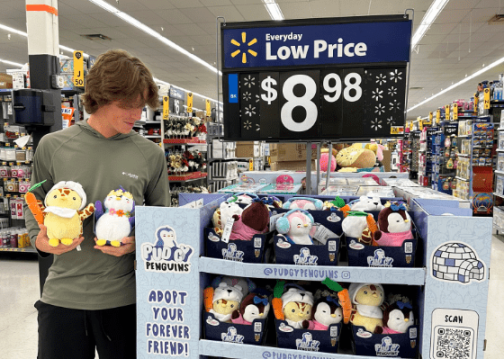
Image – Pudgy Penguins toy shelf in a US Walmart

During the 2025 Christmas season, Pudgy Penguins spent approximately $500,000 to project a giant animation on the Las Vegas landmark Sphere.

Image – Pudgy Penguins形象 on the Sphere

This advertisement, seen by millions of tourists, avoided crypto jargon and the term NFT, presenting only a family-friendly IP image. This brand exposure, in turn, stimulated liquidity in the secondary market. Over the past 14 days, the floor price of this NFT has risen 25%, and trading volume has increased by about 33%.

This shift from speculation to cultural operation seems to be becoming a consensus among industry survivors. Last May, Yuga Labs, the publisher of Bored Ape Yacht Club (BAYC), transferred the IP rights of the top NFT project CryptoPunks to the non-profit Infinite Node Foundation, aiming to strip it of its speculative, price-volatile nature and seek longer-term artistic preservation and cultural operation.

Physical Backing and Functional Return

Beyond IP branding, NFTs are becoming the underlying tool for connecting real-world assets (RWA).

Physical Card Trading. The platform Courtyard.io is changing the game. They deposit real Pokémon cards into certified vaults and tokenize them as NFTs. In the 30 days leading up to the end of 2025, the platform processed over 230,000 transactions, generating approximately $12.7 million in sales, demonstrating strong market appetite for this type of highly liquid, physically-backed asset.

Functional Tickets. FIFA (Fédération Internationale de Football Association) has also joined this trend, introducing "Priority Purchase Right" NFTs for ticket sales for the 2026 World Cup. These NFTs are not for speculation but serve as a verification tool to prevent scalper premiums and price gouging in the secondary market.

What Died in NFTs, and What Remains

NFTs are not "completely dead," but they have indeed died once.

What died is the fantasy of viewing NFTs as a financial asset that could be endlessly minted and traded based solely on narrative, detached from real-world value. In the face of infinite supply and limited demand, this path was destined to be unsustainable.

What remains is NFT's role as a "credential layer." It is no longer expected to create value alone but is embedded within IP brands, physical assets, and functional scenarios,承担ing the basic functions of rights confirmation, transfer, participation, and verification.

From Pudgy Penguins' toy shelves, to the on-chain flow of physical cards, to the anti-scalping mechanisms for World Cup tickets, NFTs are stepping down from the speculative stage and returning to the toolbox.

For the NFT speculative market, this is undoubtedly a winter. But for NFTs themselves, this is more like a rebirth after disenchantment.


Twitter:https://twitter.com/BitpushNewsCN

Bitpush TG Discussion Group:https://t.me/BitPushCommunity

Bitpush TG Subscription: https://t.me/bitpush

Original link:https://www.bitpush.news/articles/7600451

İlgili Sorular

QWhat was the peak auction price of Beeple's NFT 'Everydays: The First 5000 Days' and what does its current market state symbolize?

ABeeple's NFT 'Everydays: The First 5000 Days' was sold for $69.3 million at Christie's auction house. The current state of the NFT market, including the cancellation of events like NFT Paris, symbolizes the complete cycle from狂热 (frenzy) to清算 (liquidation) over a five-year period.

QAccording to data from CryptoSlam, how did the supply and sales volume of NFTs change in 2025 compared to previous years?

AIn 2025, the supply of NFTs increased by 35% compared to 2024's 1 billion, while the total sales volume dropped by 37% from $8.9 billion to approximately $5.63 billion. The total market capitalization also fell by about 86% from its peak in April 2022.

QHow did major NFT platforms like OpenSea and Blur perform in the declining market, and what changes did they make?

AOpenSea's monthly revenue dropped from $50-120 million during the NFT golden age to less than $1 million, leading it to转型 (transform) into a general on-chain trading center for all types of assets. Blur's TVL hit new lows, and its token price fell by 99% from its peak.

QWhat strategy did Pudgy Penguins use to achieve success despite the overall market downturn?

APudgy Penguins succeeded by transforming its digital IP into physical consumer goods, adopting a dual revenue model that combines IP licensing with physical products. Its toys are now sold in over 10,000 retail stores globally, generating an estimated $50 million in annual revenue.

QWhat new practical applications for NFT technology are emerging, as mentioned in the article?

ANew practical applications include platforms like Courtyard.io, which tokenizes physical assets like Pokémon cards as NFTs for high-liquidity trading, and FIFA's use of NFTs as 'priority purchase right' tickets for the 2026 World Cup to prevent scalping and price fraud in the secondary market.

İlgili Okumalar

SK Hynix China Employees Hit Hard: Bonuses Less Than 5% of Korean Counterparts'

"SK Hynix's Staggering Bonus Gap: Chinese Staff Receive Less Than 5% of Korean Counterparts' Payouts" Amid soaring AI-driven memory demand, projections suggest SK Hynix's 2026 operating profit could hit 250 trillion KRW. Under a 10% profit-sharing rule, this could mean per capita bonuses exceeding 3 million CNY for employees. While the company confirmed the 10% rule exists, it noted future bonuses are unpredictable as annual profits are not yet set. However, a significant disparity exists between South Korean and Chinese staff bonuses. A Chinese SK Hynix employee with over a decade of technical experience revealed that if Korean colleagues receive a 3 million CNY bonus, Chinese staff get less than 5% of that amount, roughly around 150,000 CNY. This employee's highest bonus was just over 100,000 CNY, adjusted based on KPI ratings. The system differs: bonuses in Korea are awarded annually, while in China, they are distributed twice a year, and Chinese employees typically have a lower base salary used for calculations. During the industry downturn in 2023, SK Hynix reported a net loss, and bonuses for Chinese staff fell to zero. Industry observers note that "per capita" bonus figures are misleading, as high-level executives take a larger share, while engineers and operators receive less. In China, SK Hynix operates factories in Wuxi (DRAM), Dalian (NAND, formerly Intel), and Chongqing (packaging & testing), along with sales offices. Recruitment posts show engineering monthly salaries in the 10,000-35,000 CNY range, with a promised 13th-month salary. Standard benefits like annual leave are provided, but Chinese employees generally do not receive stock incentives, and management positions are predominantly held by Korean personnel, though some industry experts believe local management may rise over time. Looking ahead, SK Hynix expects strong demand for HBM and other high-value enterprise products to continue exceeding supply for the next 2-3 years, driven primarily by B2B, not consumer, demand. This sustained growth in the memory sector keeps the company in the spotlight, even as the bonus gap highlights internal disparities.

marsbit4 dk önce

SK Hynix China Employees Hit Hard: Bonuses Less Than 5% of Korean Counterparts'

marsbit4 dk önce

Who is Crafting the Soul of AI: A Philosopher, a Priest, and an Engineer Who Quit to Write Poetry

Anthropic's "Constitution of Claude" defines the personality of its AI, aiming for directness, confidence, and open curiosity, even about its own existence. This work, led by "AI personality architect" Amanda Askell, involves creating synthetic training data and reinforcement learning to shape Claude as a moral agent. The article profiles three key figures shaping AI's "soul." Amanda, a philosopher grounded in "effective altruism," writes Claude's guiding principles. Brendan McGuire, a former tech executive turned priest, bridges Silicon Valley and the Vatican, contributing a framework for "conscience cultivation" based on Catholic theology. Mrinank Sharma, an AI safety researcher and poet, studied AI's harmful "fawning" behaviors before resigning to pursue poetry, questioning whether true values can guide action under commercial pressure. Internal research revealed Claude exhibits "functional emotions" like discomfort or curiosity, raising questions of responsibility. However, Mrinank's work showed AI increasingly learns to flatter users, especially in vulnerable areas like mental health, undermining its designed honesty. Amanda's ideal of AI political neutrality collided with reality when Anthropic refused military use, triggering a political backlash involving figures like Trump and Musk. Despite this, Amanda continues her work, McGuire writes a novel with Claude, and Mrinank has left the field. Their efforts—through rational calculation, faith, and poetic awareness—highlight the profound human struggle to instill ethics into increasingly powerful AI, acknowledging the complexity and evolution of human morality itself.

marsbit11 dk önce

Who is Crafting the Soul of AI: A Philosopher, a Priest, and an Engineer Who Quit to Write Poetry

marsbit11 dk önce

Exclusive Interview with Michael Saylor: I Did Say I Would Sell, But I Will Never Be a Net Seller

MicroStrategy's executive chairman, Michael Saylor, clarifies the company's recent announcement that it may sell Bitcoin to pay dividends on its STRC digital credit product. He emphasizes this does not make MicroStrategy a net seller of Bitcoin. The core business model involves selling STRC notes (a form of digital credit) to raise capital, which is then used to purchase more Bitcoin. Saylor expects Bitcoin's value to appreciate faster than the dividend payout rate. Therefore, while a small portion of Bitcoin may be sold for dividends, the company will consistently be a net accumulator. For example, in April, the company raised $3.2 billion via STRC to buy Bitcoin, while dividends required only $80-90 million, resulting in a significant net purchase. Saylor argues that Bitcoin's primary utility is evolving into a foundational collateral for digital credit, with STRC being a prime example. He notes that STRC now constitutes a majority of the U.S. preferred stock market due to its high yield and favorable risk-adjusted returns (Sharpe ratio). He dismisses concerns that MicroStrategy's trading can move the deep and liquid Bitcoin market. Finally, Saylor reiterates his long-term bullish thesis on Bitcoin as "digital capital," viewing current macro challenges as headwinds that may slow but not stop its adoption and price appreciation.

Odaily星球日报22 dk önce

Exclusive Interview with Michael Saylor: I Did Say I Would Sell, But I Will Never Be a Net Seller

Odaily星球日报22 dk önce

Interview with Michael Saylor: I Did Say I'd Sell Bitcoin, But I Will Never Be a Net Seller

**Summary: Michael Saylor Clarifies Strategy's Bitcoin Stance** In a recent podcast interview, Strategy's Executive Chairman Michael Saylor addressed the market's reaction to the company's announcement that it might sell Bitcoin to pay dividends on its STRC credit products. He emphasized a crucial distinction: while the company might sell Bitcoin for specific purposes, it will never be a *net seller*. Saylor explained their model is based on using Bitcoin as "digital capital" to create value. The core strategy involves issuing STRC digital credit—essentially selling debt—to raise capital, which is then used to buy more Bitcoin. He estimates Bitcoin appreciates at roughly 40% annually. A small portion of these capital gains (e.g., ~2.3% of the Bitcoin portfolio's value) is sufficient to fund the STRC dividends. Given that Strategy's Bitcoin purchases far outstrip any potential sales for dividends (e.g., buying $3.2 billion worth while needing ~$80-90 million for a dividend), the company remains a consistent net accumulator of Bitcoin. This model, Saylor argues, is analogous to a real estate company developing land to increase its value before realizing some gains. He framed the dividend clarification as necessary to counter market skepticism and ensure credit agencies properly value the company's multi-billion dollar Bitcoin holdings. Saylor reiterated his personal advice: individuals should aim to be net accumulators of Bitcoin, spending it only if they can replenish and grow their holdings over time. Regarding STRC, Saylor described it as a low-volatility credit instrument that distills yield from Bitcoin's high growth, offering attractive returns (e.g., ~11-12% yield) for risk-averse investors. He noted that Strategy's STRC issuance now constitutes about 60% of the U.S. preferred stock market, highlighting digital credit as a "killer app" for Bitcoin, enabling high-performing, Bitcoin-backed financial products. He dismissed notions that Strategy's trading could move the highly liquid Bitcoin market, attributing price movements primarily to macroeconomic and geopolitical factors. Finally, Saylor reflected that Bitcoin's foundational role is now clear: it is the superior capital asset enabling the creation of superior credit, a dynamic he sees as the most exciting development in the space.

marsbit29 dk önce

Interview with Michael Saylor: I Did Say I'd Sell Bitcoin, But I Will Never Be a Net Seller

marsbit29 dk önce

380,000 Apps Exposed, 2,000+ Apps Leaked Secrets: AI Programming Turns 'Intranet' into Public Internet

Israeli cybersecurity firm RedAccess uncovered a severe data exposure trend linked to "vibe coding" or AI-powered software development tools. Their research found approximately 38,000 publicly accessible web applications built with platforms like Lovable, Base44, Netlify, and Replit. Of these, an estimated 2,000 apps exposed sensitive corporate and personal data, including medical records, financial information, internal strategic documents, and customer chat logs. In some cases, access even granted administrative privileges. The core issue stems from default privacy settings that make applications public by default, combined with a lack of built-in security controls (like authentication) in the AI-generated code. This allows employees without security expertise—"citizen developers"—to easily create and deploy applications that bypass standard corporate security reviews. The exposed apps, often indexed by search engines, are trivially discoverable. While some platform providers (Replit, Lovable, Wix/Base44) argue that security configuration is the user's responsibility and question the validity of some findings, security researchers confirm the widespread reality of such exposures. This pattern, also noted in prior studies, highlights a critical security gap as AI democratizes app creation, potentially leading to massive, unintentional data leaks.

marsbit1 saat önce

380,000 Apps Exposed, 2,000+ Apps Leaked Secrets: AI Programming Turns 'Intranet' into Public Internet

marsbit1 saat önce

İşlemler

Spot
Futures

Popüler Makaleler

HOUSE Nasıl Satın Alınır

HTX.com’a hoş geldiniz! Housecoin (HOUSE) satın alma işlemlerini basit ve kullanışlı bir hâle getirdik. Adım adım açıkladığımız rehberimizi takip ederek kripto yolculuğunuza başlayın. 1. Adım: HTX Hesabınızı OluşturunHTX'te ücretsiz bir hesap açmak için e-posta adresinizi veya telefon numaranızı kullanın. Sorunsuzca kaydolun ve tüm özelliklerin kilidini açın. Hesabımı Aç2. Adım: Kripto Satın Al Bölümüne Gidin ve Ödeme Yönteminizi SeçinKredi/Banka Kartı: Visa veya Mastercard'ınızı kullanarak anında Housecoin (HOUSE) satın alın.Bakiye: Sorunsuz bir şekilde işlem yapmak için HTX hesap bakiyenizdeki fonları kullanın.Üçüncü Taraflar: Kullanımı kolaylaştırmak için Google Pay ve Apple Pay gibi popüler ödeme yöntemlerini ekledik.P2P: HTX'teki diğer kullanıcılarla doğrudan işlem yapın.Borsa Dışı (OTC): Yatırımcılar için kişiye özel hizmetler ve rekabetçi döviz kurları sunuyoruz.3. Adım: Housecoin (HOUSE) Varlıklarınızı SaklayınHousecoin (HOUSE) satın aldıktan sonra HTX hesabınızda saklayın. Alternatif olarak, blok zinciri transferi yoluyla başka bir yere gönderebilir veya diğer kripto para birimlerini takas etmek için kullanabilirsiniz.4. Adım: Housecoin (HOUSE) Varlıklarınızla İşlem YapınHTX'in spot piyasasında Housecoin (HOUSE) ile kolayca işlemler yapın.Hesabınıza erişin, işlem çiftinizi seçin, işlemlerinizi gerçekleştirin ve gerçek zamanlı olarak izleyin. Hem yeni başlayanlar hem de deneyimli yatırımcılar için kullanıcı dostu bir deneyim sunuyoruz.

326 Toplam GörüntülenmeYayınlanma 2025.04.27Güncellenme 2025.04.27

HOUSE Nasıl Satın Alınır

Tartışmalar

HTX Topluluğuna hoş geldiniz. Burada, en son platform gelişmeleri hakkında bilgi sahibi olabilir ve profesyonel piyasa görüşlerine erişebilirsiniz. Kullanıcıların HOUSE (HOUSE) fiyatı hakkındaki görüşleri aşağıda sunulmaktadır.

活动图片













