The Eve of the Storm: Powell Holds Rates, Trump Announces New Fed Chair?

Odaily星球日报2026-01-28 tarihinde yayınlandı2026-01-28 tarihinde güncellendi

Özet

The Federal Reserve is widely expected to hold interest rates steady in its first policy decision of 2026, with markets pricing in a near-100% probability of no change. While this outcome is largely anticipated, the focus has shifted to future policy direction and the potential announcement of a new Fed Chair by former President Trump. Key uncertainties remain regarding the pace of potential rate cuts in 2026. Although the Fed began a rate-cutting cycle in late 2025 due to a softening labor market, persistent inflation at 2.8%—above the 2% target—has led to a more cautious stance. The composition of the voting members on the Federal Open Market Committee (FOMC) has also shifted, with two new "hawkish" regional bank presidents joining, which may influence future decisions. Chair Powell’s post-meeting remarks will be closely watched for signals on the duration of the pause and the likelihood of further easing. Simultaneously, Trump has indicated he may soon nominate a new Fed Chair, with candidates narrowed down to four individuals. Rick Rieder, BlackRock’s Global Chief Investment Officer of Fixed Income and a proponent of lower rates, is currently the betting favorite. Trump may choose to announce his nominee around the time of the FOMC meeting to shift market attention away from any potentially hawkish signals from Powell and instead emphasize a more dovish long-term outlook. The timing and choice of nominee could significantly influence market sentiment and expectations fo...

Original | Odaily Planet Daily (@OdailyChina)

Author | Golem (@web 3_golem)
At 3:00 AM Beijing time on January 29 (this Thursday), the Federal Reserve is set to announce its first interest rate decision of 2026; half an hour later, current Fed Chair Jerome Powell will hold a monetary policy press conference. However, there is little suspense surrounding this Fed rate decision, as the market widely expects the Fed to keep rates unchanged. Data from Polymarket shows that the probability of maintaining rates is close to 100%.
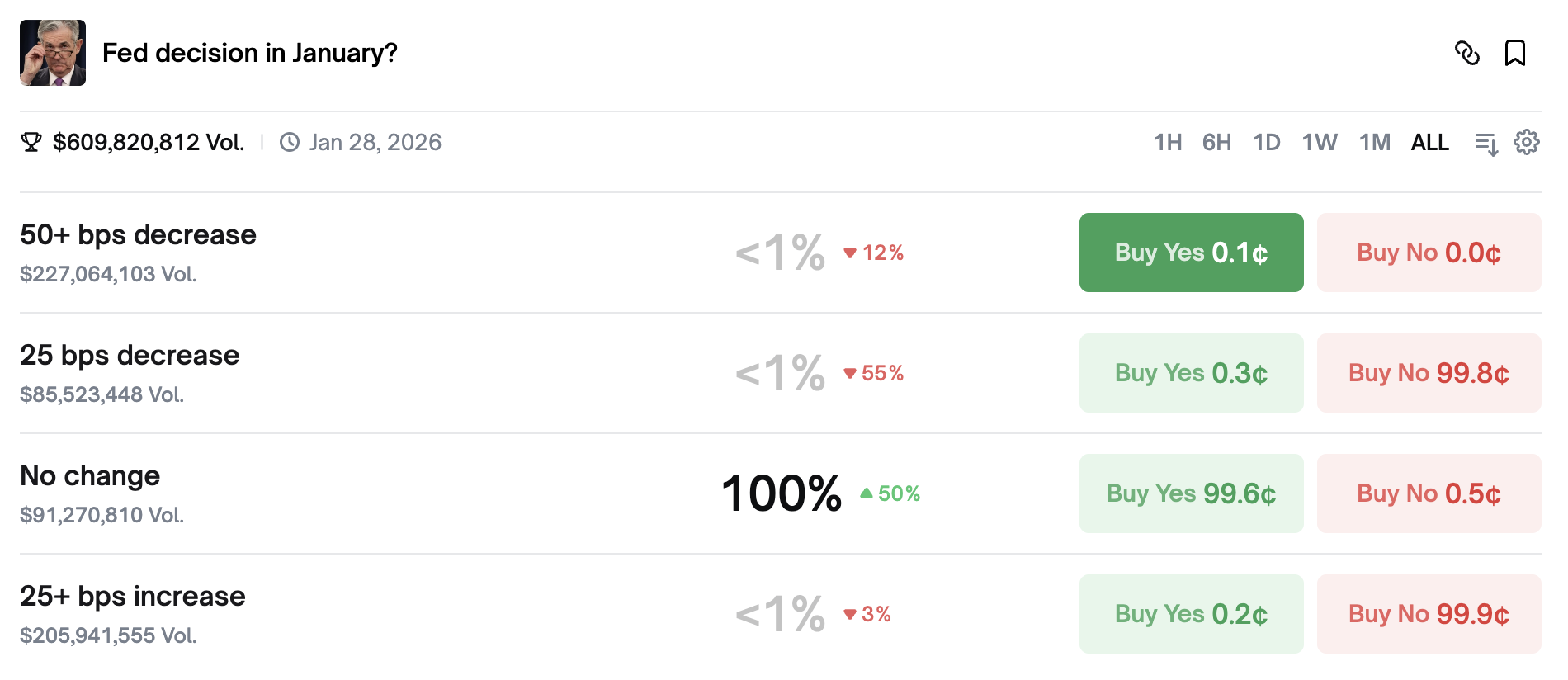
Such a high probability has allowed the market to digest in advance the negative impact of the Fed's announcement of "no rate cut" this time. OKX data shows that BTC has fallen by only 0.39% in the past 7 days, basically in a sideways trend, but this period of market "silence" may be broken tonight.

On one hand, although the market almost unanimously believes the Fed will keep rates unchanged this week, there is significant divergence regarding the fiscal path for the remainder of 2026, making this still an important meeting to watch. The Fed's future key policy tendencies, such as whether it will continue to cut rates in 2026 and the frequency of cuts, will affect the market. Should Powell make hawkish remarks like "further observation is needed" during his speech, the market might "drop in response."

On the other hand, the announcement of the successor to the Fed Chair will also have a long-term impact on the market. The shortlist has been narrowed down to four individuals. Trump previously stated he has a preferred candidate but is waiting for the right time to announce, and this right time could very well be tonight.

2026 Rate Cut Direction Remains Uncertain

Since last September, the Federal Reserve initiated a new rate-cutting cycle, implementing three consecutive rate cuts. If rates are held unchanged this week, it would be the first pause since the cycle began. At this point, the market is not concerned about the reasons for holding rates steady, but rather whether this is a brief pause to observe before continuing rate cuts, or the beginning of a prolonged pause, or even the start of a rate-hiking cycle?

Previously, the general market view was that 2026 would be a year of further quantitative easing by the Fed.

Reason one: From a data perspective, the US labor market indeed shows signs of weakness. Non-farm payrolls increased by only 50,000 in December 2025, with an unemployment rate of 4.4%. While there hasn't been "massive layoffs," it remains in a state of "low hiring and cooling demand." Reason two: The Fed might still believe that Trump's tariff policies will not have a long-term impact on inflation (Odaily: Powell cut rates in September 2025 based on this factor). Reason three: Trump has publicly stated that he would choose a "dovish" figure as the next Fed Chair.

However, some in the market believe there is uncertainty about the Fed continuing to cut rates in 2026. Some analysts argue that unless the job market deteriorates significantly, it will be difficult to see rate cuts before mid-year, as the pace of inflation decline is not sufficient to convince hawkish members.

The Fed's mandate, simply put, is to curb inflation and promote employment. However, in 2025, the US experienced a phenomenon of both a weak labor market and high inflation. The Fed ultimately chose to prioritize the employment issue, thus initiating the rate-cutting cycle. Yet, the reality is that the US inflation rate remains stuck at 2.8%, far above the Fed's 2% target, forcing the Fed to reconsider the impact of tariffs on inflation. Holding rates unchanged this week would also indicate the Fed is beginning to "observe."

Furthermore, although the next Fed Chair chosen by Trump is destined to be "dovish," the new rotating chairs of the Fed's rate-setting committee are predominantly "hawkish." At the beginning of each year, four of the 12 regional Fed presidents rotate onto the rate-setting committee and gain voting rights for the next eight policy meetings. This year's rotating members include Dallas Fed President Lorie Logan, Cleveland Fed President Loretta Mester (referred to as Hammack in the text, likely a reference to Mester's previous role or a mistranslation; Mester is known as a hawk), Philadelphia Fed President Patrick Harker (referred to as Paulson in the text, likely a mistranslation; Harker is considered moderate), and Minneapolis Fed President Neel Kashkari.

Among them, Logan and Mester are seen as "hawkish" figures, both having publicly stated that the Fed should focus on inflation. Harker is seen as "dovish," having expressed a "cautiously optimistic attitude" towards inflation. Kashkari's stance is relatively neutral. The addition of new "hawkish" members might disrupt the previous balance of policy inclinations within the Fed. Even if Trump chooses a "dovish" Chair, they may not be able to sway the entire rate-setting committee.

Moreover, the Fed Chair might not completely follow Trump's wishes in leading rate cuts. Years ago, Trump personally appointed Powell as Fed Chair, but last year, even though Trump promoted Powell, Powell did not "repay" Trump with sustained and significant rate cuts. Under US law, the Fed is independent and can make interest rate decisions based on the current economic situation, not government wishes. Therefore, even if the new Fed Chair promises Trump rate cuts, they might "go their own way" once in office.

This kind of meaningless "political promise" is also a concern for Trump. Last week, Trump said in a speech at the World Economic Forum in Davos, Switzerland, "It's amazing how people change once they get this job," meaning candidates say what sounds good during the interview but emphasize their independence once confirmed.

Considering these factors, Powell's speech after tonight's FOMC meeting will also be closely watched by investors for hints on how long the Fed might pause rate cuts.

This Week's FOMC Meeting Could Be One of the Best Times for Trump to Announce the Fed Chair Successor

Besides this week's FOMC meeting, the successor to the Fed Chair is another macro event that can influence the market. The shortlist has been narrowed down to four: Kevin Hassett, Kevin Warsh, Rick Rieder, and Christopher Waller. According to Polymarket data, Rick Rieder currently has the highest probability of being nominated by Trump at 47%; Kevin Hassett has the lowest probability at 6%.
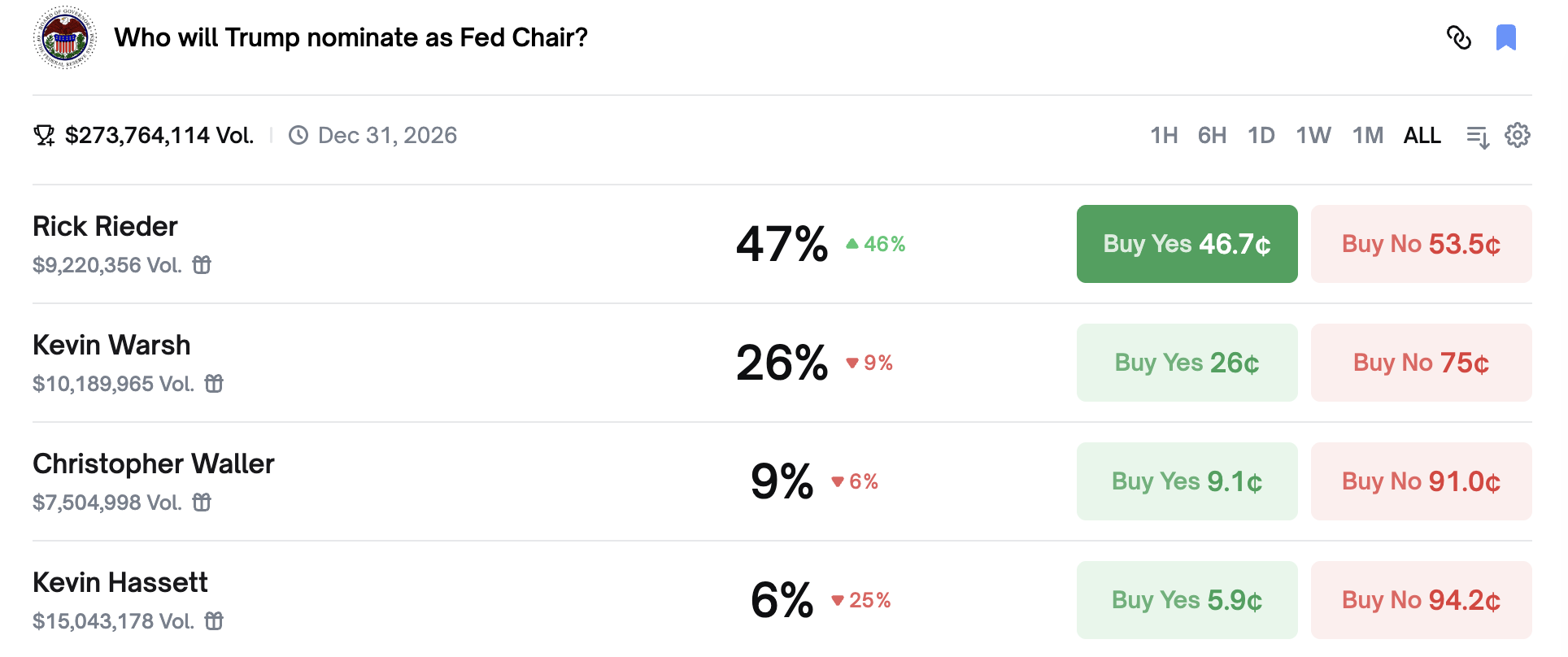
Rick Rieder is BlackRock's Chief Investment Officer of Global Fixed Income. Although he doesn't have much government experience, he has consistently advocated for supporting low interest rates based on his understanding of the market rather than politics. This resume might attract Trump, who is worried about the new Fed Chair becoming "disobedient" upon taking office. Economists at Evercore ISI, including Krishna Guha, even believe that "if Rick Rieder becomes the new Fed Chair, he might advocate for three rate cuts this year." (Odaily Note: For more information on Rick Rieder, read 《The Last Seat on the Fed Chair Candidate List, What is Rick Rieder's Attitude Towards Crypto?》)

Hassett was once considered the most likely candidate to become the new Fed Chair, with a probability一度 (once) over 80%. But Hassett is Trump's economic advisor, and there were外界 (external) concerns that nominating Hassett would damage the Fed's independence. Additionally, Trump publicly stated that he did not want to lose Hasset within his administration. Therefore, Hassett's probability of selection has declined, though some still believe his nomination probability is higher than 6%.

Trump has repeatedly publicly stated that he would announce his nominee in January. In late December 2025, Trump told reporters in Florida that he would announce the next Fed Chair人选 (candidate) sometime in January; On January 14, 2026, Trump said in an interview with Reuters that he would announce the candidate within the next few weeks; Two weeks later, on January 27, Trump said in a speech in Iowa that he would announce the new Fed Chair candidate soon, but has not done so yet.

Although Trump's answers have been vague each time, it is almost certain that the probability of an announcement in January is very high, and the best timing for the announcement could very well be during this week's FOMC meeting.

As mentioned earlier, Powell's speech tonight will be a key focus for investors. If Powell does not make dovish-leaning remarks, financial markets could suffer, a scenario Trump显然 (obviously) does not want to see. Therefore, if Trump wishes to shift market attention away from the uncertain Powell, he might announce his nominee for the next Fed Chair during tonight's FOMC meeting. This would release the positive news of a "dovish chair" to the market, reducing attention on Powell's speech or mitigating potential negative market impacts.

Tonight, let's wait and see!

İlgili Sorular

QWhat is the market's expectation for the Federal Reserve's interest rate decision on January 29, 2026, and why?

AThe market widely expects the Federal Reserve to maintain the current interest rate, with Polymarket data showing the probability of no rate change is close to 100%. This is because the decision is highly anticipated and already priced in by investors.

QWhat are the two main factors discussed in the article that could break the market's 'silent period'?

AThe two main factors are: 1) The future policy direction for the remainder of 2026, including the frequency of potential rate cuts, which could cause market volatility if Chair Powell's remarks are perceived as hawkish. 2) The announcement of the new Federal Reserve Chair nominee by former President Trump, which could have long-term market impacts.

QAccording to the article, who is the most likely candidate to be nominated as the next Federal Reserve Chair based on Polymarket data, and what is his background?

ABased on Polymarket data, Rick Rieder is the most likely candidate with a 47% probability. He is the Chief Investment Officer of Global Fixed Income at BlackRock, advocates for low interest rates based on market understanding rather than politics, and has limited government experience.

QWhy might the Federal Reserve's decision to pause rate cuts be more than just a temporary观望, according to the analysis in the article?

AThe pause might not be temporary due to persistent inflation at 2.8% (above the 2% target), leading the Fed reassessing the impact of tariffs on inflation. Additionally, new 'hawkish' members rotating into the利率决策委员会 could shift internal policy balance, making further rate cuts less likely.

QWhy does the article suggest that Trump might announce his Fed Chair nominee during the FOMC meeting?

ATrump might announce the nominee during the FOMC meeting to shift market attention away from any potentially hawkish or uncertain remarks by Chair Powell. This could release a 'dovish'利好 to the market, mitigating potential negative impacts and reducing focus on Powell's speech.

İlgili Okumalar

GPT-5.6 Countdown: Abandon the Illusion of a Single API, Computational Iteration Can't Outpace a Single Page of Compliance

In mid-June, three seemingly independent industry events—the compliance-driven throttling of Fable 5, the open-sourcing of GLM-5.2, and the leaked release timeline for GPT-5.6—are pushing the global AI industry toward a watershed moment. These shifts signal a fundamental restructuring of the industry's underlying logic. First, **"usability" has substantially overtaken "advanced capabilities"** as the primary weight, pushing the global large language model (LLM) supply chain into a "dual-track" phase of controlled closed-source and local open-source coexistence. Second, **the competitive moats of closed-source giants are shifting**. Their technical focus is moving from "language intelligence" toward "spatial intelligence (world models)"—a domain heavily reliant on computing power. Third, faced with常态化 transnational compliance risks, **a "model-agnostic" decoupled design has become a survival necessity for application-layer developers to maintain business continuity.** The article details how Anthropic's Fable 5, despite its advanced engineering feats, was restricted for non-U.S. citizens within 72 hours of launch, highlighting how geopolitical compliance can instantly limit even the most advanced models. In response, the open-source camp, exemplified by Zhipu AI's MIT-licensed GLM-5.2, is gaining market share by offering stable performance improvements and significant cost advantages (up to 70% savings for enterprises), while achieving full adaptation with domestic semiconductor platforms. Meanwhile, closed-source leaders like OpenAI are pivoting. The anticipated GPT-5.6 reportedly shifts focus from language to spatial intelligence and world models, aiming to rebuild a generational gap in areas like 3D understanding, simulation, and industrial design that demand immense compute. The core conclusion is that the LLM supply chain's logic has changed. Enterprises must now evaluate infrastructure based on a composite of technical performance and policy compliance. For developers, complete reliance on a single closed-source API poses unacceptable risk. Implementing a truly model-agnostic architecture—enabling swift switches to compliant, locally deployable open-source alternatives—is no longer just good practice but a fundamental baseline for business continuity.

marsbit1 saat önce

GPT-5.6 Countdown: Abandon the Illusion of a Single API, Computational Iteration Can't Outpace a Single Page of Compliance

marsbit1 saat önce

Is the 'Token Subsidy War' Among AI Giants Almost Over?

The article discusses the ongoing "token subsidy war" among AI giants like OpenAI and Anthropic, questioning whether it's nearing its end. It reveals that current AI subscription prices are heavily subsidized, with some plans offering tokens at up to 70 times the actual cost to attract and retain heavy users, especially developers and enterprises. This strategy mirrors past internet-era subsidy battles, but with a key difference: AI tokens lack "lock-in" effects. Unlike ride-hailing or food delivery apps, users can easily switch between AI providers as APIs become standardized, making it difficult for companies to raise prices post-subsidy. The piece highlights a structural asymmetry in the competition. Giants like Google, with massive advertising revenue, can afford to subsidize tokens indefinitely, akin to using "tokens as a weapon." In contrast, venture-backed companies like OpenAI and Anthropic face pressure to become profitable, especially as they approach IPO. The article cites Google Ventures founder Bill Maris, who suggests Google could slash token prices by 80%, putting immense pressure on competitors. Two potential endgames are presented: the "internet service" model (subsidize, monopolize, then raise prices) and the "utility" model (tokens become a standardized, low-margin commodity like electricity). Given the low switching costs, the latter seems more likely. The competition may not have a single winner but could instead accelerate AI's evolution into a foundational, infrastructure-level technology, akin to a public utility. For now, users continue to benefit from heavily subsidized token costs.

marsbit1 saat önce

Is the 'Token Subsidy War' Among AI Giants Almost Over?

marsbit1 saat önce

Beyond the Stadium: The Profitable Games Surrounding the World Cup

"Beyond the Pitch: The Profit Game Around the World Cup" The FIFA World Cup transcends being a sporting spectacle, evolving into a massive global arena for speculation and profit-seeking. The 2026 tournament has amplified this dynamic, creating a multi-layered ecosystem of financial opportunism alongside the football. **Prediction markets** have surged into the mainstream. Platforms like Polymarket and Kalshi saw trading volumes for World Cup contracts soar, attracting new users with their financial trading model and high-profile, chain-based wealth stories that overshadow traditional sports betting in terms of growth and narrative. However, **traditional sportsbooks** remain the dominant force, leveraging established user habits, legal markets, and comprehensive product offerings to handle the vast majority of speculative wagers, with projections suggesting record-breaking betting volumes. Capital markets also react. **"Concept stocks"** in countries like South Korea and Japan experience volatile price swings based on team performance and anticipated fan spending on items like chicken, beer, and viewing parties, effectively becoming a stock market reflecting fan sentiment. The **ticket resale market** has become a sophisticated arena for arbitrage. Prices fluctuate wildly based on team draws and star power, with sellers sometimes listing tickets they don't yet own in a practice akin to short-selling, while FIFA's own "Right to Buy" tokens add another layer of speculative trading. **Collectibles and merchandise** offer another avenue. Panini sticker albums, with their inherent scarcity and nostalgic value, can become high-value collectibles. Limited-edition or locally themed jerseys command significant premiums on secondary markets, and even counterfeit vendors profit from fans' desire for affordable match-day identity. The **cryptocurrency** space has seen a frenzy of speculative, unauthorized World Cup-themed meme coins on chains like Solana. These tokens, often exploiting team names and player imagery, experience extreme pump-and-dump cycles, creating stories of massive gains for a few early entrants and steep losses for many others. Finally, an entire industry thrives on **providing information and tools** to other speculators. Developers create platforms like SeatSidekick to track ticket inventory and prices, while paid Telegram groups and subscriptions sell betting tips and predictions, monetizing the widespread desire for an informational edge. In essence, the World Cup has become a compressed, global laboratory for speculation. While the games determine champions on the field, a parallel, complex network of financial transactions—spanning prediction contracts, bets, stocks, tickets, collectibles, crypto, and information services—settles its own scores in the global market.

marsbit2 saat önce

Beyond the Stadium: The Profitable Games Surrounding the World Cup

marsbit2 saat önce

How Does Codex Use a Computer? Three Entry Points and Permission Boundaries

This article explains the three primary methods for Codex to interact with a computer, each with distinct use cases, permission boundaries, and trust levels. **1. Computer Use:** This offers the broadest access, allowing Codex to visually control and interact with the graphical user interface of authorized macOS/Windows apps, system settings, and even iOS simulators. It's ideal for tasks lacking APIs or structured tools, such as operating legacy software or multi-app workflows. However, it's the slowest method and has the widest permission scope, requiring careful supervision for sensitive actions. **2. Chrome Extension:** This grants Codex access to the user's logged-in Chrome browser state, including cookies, profiles, and open tabs. It's best for tasks requiring user identity across websites like Gmail, LinkedIn, Salesforce, or internal dashboards. Its key advantage is multi-tab control for complex workflows. While more powerful for browser-based tasks than Computer Use, it carries higher sensitivity as actions are performed under the user's identity. **3. In-App Browser:** This is a browser isolated within the Codex thread, separate from the user's personal browsing data. It excels in web development and debugging scenarios—previewing local servers, testing responsive layouts, or annotating designs directly on the page. Its isolation is a strength for development but a limitation for tasks requiring login sessions. The core principle is to choose the narrowest, safest, and most structured interface for the task. Use plugins or MCPs first, resort to visual control (Computer Use) only for GUI-dependent tasks, employ the Chrome extension for identity-reliant browser work, and prefer the In-App Browser for isolated development. **Appshots** are clarified as a fourth, complementary tool for *inputting* context—capturing a screenshot of a window to point Codex to something—rather than a method for Codex to *act*. Together, this layered approach highlights a key to AI agent productization: not granting unlimited permissions, but constraining them within clear boundaries for specific tasks while preserving user oversight.

marsbit3 saat önce

How Does Codex Use a Computer? Three Entry Points and Permission Boundaries

marsbit3 saat önce

İşlemler

Spot
Futures
活动图片