‘Tax headache eased?’ IRS extends crypto relief to end of 2026

ambcrypto2026-03-19 tarihinde yayınlandı2026-03-19 tarihinde güncellendi

Özet

The U.S. IRS has extended temporary tax relief for cryptocurrency investors until the end of 2026, allowing them to use alternative methods to calculate capital gains instead of relying solely on broker-submitted reports. This is the second such extension and aims to reduce tax burdens for investors. Previously, the mandatory FIFO (first-in, first-out) method often resulted in higher taxes by requiring the sale of older, more appreciated coins first. The alternative methods enable investors to potentially report more recent, lower-gain or loss-making sales. The relief also addresses operational challenges for crypto exchanges, which faced significant compliance burdens under the stricter reporting rules. The IRS is gradually phasing in reporting requirements and has proposed making electronic submission the default for tax documents.

The U.S. tax season is here, and there is some sigh of relief for crypto holders using centralized exchanges.

In its latest guidance, the U.S. Internal Revenue Service (IRS) gave crypto holders a free pass to use alternative methods to identify crypto sales for tax purposes instead of relying on their broker-submitted reports.

This is the second time the watchdog has extended the relief, and it could again help lower the tax bill for crypto investors. Initially, the agency mandated crypto exchanges to adopt the FIFO (first-in, first-out) method to track investors’ buy and sell prices for each coin.

For users, this meant that the oldest coins, which were acquired cheaply and have since appreciated significantly, should be reported first. This would result in a higher tax bill due to a higher capital gains tax.

With alternative reporting methods, however, you could include the most recently acquired coins that haven’t rallied much or are in the red.
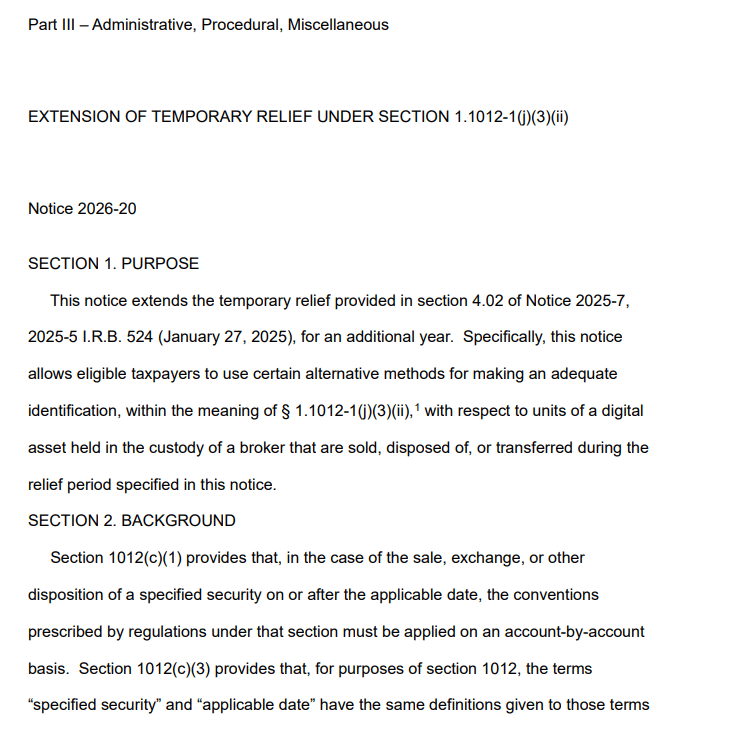
Source: IRS

U.S. crypto tax compliance burden

According to Shehan Chandrasekera, head of tax at Coin Tracker, the IRS guidance will offer incredible relief to investors, albeit with a few friction points.

He said,

The IRS just quietly saved crypto investors from a massive tax headache by issuing Notice 2026-20.

The temporary relief will be extended up to the end of 2026. But the move isn’t out of just goodwill from the taxman.

Its strict crypto reporting regime has a compliance burden on operators. Notably, crypto exchanges must report the cost basis for each coin bought by each investor to the IRS, along with other data.

At the same time, a duplicate of the report should be given to the customer or physically mailed if the customer hasn’t opted for digital copies. Most brokers have complained that this would be a massive operational burden.

To alleviate this, the agency opted for phased-in reports, starting with only gross proceeds or total crypto sales in reports submitted in 2025. For crypto assets bought in 2026, cost basis data was included in the submitted reports (Form 1099-DA).

Earlier this month, the IRS proposed scrapping physical copies sent to customers and making ‘electronic submission’ the default for tax reports.


Final Summary

  • The IRS will allow crypto investors to use their reporting methods for crypto taxes until the end of the year, rather than relying on the strict broker-submitted reports.
  • The move comes as the agency grapples with ways of lowering tax compliance burdens for crypto investors and brokers.


İlgili Sorular

QWhat relief has the IRS extended to crypto holders until the end of 2026?

AThe IRS has extended temporary relief allowing crypto holders to use alternative methods to identify crypto sales for tax purposes instead of relying strictly on broker-submitted reports.

QWhy was the FIFO method problematic for crypto investors?

AThe FIFO method required reporting the oldest coins first, which were often acquired cheaply and had appreciated significantly, resulting in higher capital gains taxes.

QWhat is the IRS's motivation for extending this relief, according to the article?

AThe move isn't just out of goodwill; the strict crypto reporting regime places a significant compliance burden on both operators (exchanges) and investors, and the IRS is grappling with ways to reduce these burdens.

QWhat change did the IRS propose earlier this month regarding tax report delivery?

AThe IRS proposed scrapping physical copies of tax reports sent to customers and making 'electronic submission' the default method.

QWhat did Shehan Chandrasekera say about IRS Notice 2026-20?

AShehan Chandrasekera stated that 'The IRS just quietly saved crypto investors from a massive tax headache by issuing Notice 2026-20.'

İlgili Okumalar

Vitalik: We Need to Create Sanctuaries, Not Fight AI

In a recent interview, Vitalik Buterin, founder of Ethereum, addresses the central anxiety of the AI era. He argues the primary risk isn't AI's intelligence, but human passivity—ceding decisions, privacy, and agency to centralized systems or "super AIs" for a sense of "disempowering safety." His solution is not to fight AI, but to build "sanctuary technologies." These are optional, non-totalizing spaces that protect users while preserving their sovereignty and privacy. Ethereum is presented as a prime example, offering a parallel financial system one can freely choose, not a fix for the old one. Reflecting on his journey from a 19-year-old on "autopilot" to an active "pilot," Vitalik notes the world reinvents itself every 5-10 years. To keep up, individuals must actively pilot their lives, not be passive passengers. He stresses that active learning vastly outperforms passive learning, even with equal time invested. His practical advice for builders and individuals in the AI age includes: periodically forcing oneself to do tasks manually to keep the mind engaged; prioritizing active learning and verification over outsourcing answers; building tools that help retain human agency; not outsourcing all strategic thinking to AI; and preserving serendipity through real-world interactions. Ultimately, Buterin redefines Ethereum/crypto's role: not to win against or fix the old world, but to provide a free, optional alternative. The core message is that as AI grows more powerful, the truly scarce resource will be proactive humans who retain their sovereignty, privacy, and capacity for independent thought. The era demands not less tool use, but more intentional and active use of technology.

链捕手51 dk önce

Vitalik: We Need to Create Sanctuaries, Not Fight AI

链捕手51 dk önce

Conversation with Patagon Founder: Revealing the Inside Story of Anthropic's Secondary Market

**Summary: Inside Anthropic's Massive, Opaque Secondary Market** In a revealing interview, Patagon founder Dio Casares pulls back the curtain on the booming, high-risk secondary market for shares in companies like Anthropic. This private market, fueled by companies staying private longer and massive funding rounds, is estimated to involve hundreds of billions of dollars. Casares distinguishes between two types of "secondary" trading: 1. **Company-approved SPV (Special Purpose Vehicle) sales:** Where new capital flows into the company, often facilitated by select private equity firms. Anthropic supports this to manage liquidity and pre-IPO selling pressure. 2. **The "gray" market:** Platforms like Hive and Forge that match buyers and sellers, often creating pricing confusion and competing with official funding rounds. These intermediaries are widely disliked by companies. The market structure is complex and fragmented, relying heavily on personal connections. Brokers connect buyers and sellers, often layering multiple SPVs to pool capital, with single transaction fees as high as 10%. Strikingly, some finance professionals earn more from this trading than from their primary investment roles. **Key risks highlighted include:** * **High Fraud Rates:** An estimated 10-20% of transactions involve fake stock certificates or sellers who take payment without having the shares. * **Complex, Risky Structures:** Nested SPVs, "forward contracts" on employee equity, and tokenized private equity create layers of opacity. This is exemplified by a recent incident where an xAI employee's shares were revoked after an espionage allegation, leaving buyers empty-handed. * **Post-IPO "Settlement Hell":** After an IPO, delays in distributing shares through multiple SPV layers and decisions by fund managers to hold onto shares could trigger years of lawsuits as downstream investors are locked out. **For small investors** holding positions through tokenized vehicles or layered SPVs, it's often impossible to verify the underlying asset. Casares advises caution: if the investment feels wrong, consider exiting. As the private market now surpasses IPO fundraising, this "wild west" ecosystem faces a looming reckoning. While it will likely professionalize, the post-IPO period for a company like Anthropic could unleash a wave of disputes, exposing the vulnerabilities built into this frenzied, largely unregulated marketplace.

marsbit2 saat önce

Conversation with Patagon Founder: Revealing the Inside Story of Anthropic's Secondary Market

marsbit2 saat önce

İşlemler

Spot
Futures
活动图片




