# Qualcomm İlgili Makaleler

HTX Haber Merkezi, kripto endüstrisindeki piyasa trendleri, proje güncellemeleri, teknoloji gelişmeleri ve düzenleyici politikaları kapsayan "Qualcomm" hakkında en son makaleleri ve derinlemesine analizleri sunmaktadır.

Qualcomm: AI Hype Subsides, When Will Smartphones Emerge from the Gloom?

Qualcomm reported its Q3 FY2026 results (ending June 2026), with revenue of $9.95B, down 4% YoY but above expectations. Gross margin declined to 53.1%, pressured by rising costs across manufacturing and memory. Key business segments showed mixed performance: Handset revenue fell 19.6% YoY to $5.09B, dragged by an 11% decline in non-Apple Android shipments and weaker high-end mix. Conversely, Automotive revenue surged 61% to $1.59B, and IoT grew 9% to $1.83B. Core operating profit dropped 41% YoY due to margin compression and higher expenses. Management's Q4 FY2026 guidance projects revenue of $9.7B-$10.5B, in line with consensus, but Non-GAAP EPS guidance of $2.05-$2.25 fell short of expectations. Amidst persistent weakness in its core handset market, Qualcomm is pursuing growth in AI, focusing on Edge AI (smartphones, PCs, automotive) and Data Center AI. Its data center strategy includes four pillars: AI accelerators (e.g., AI200), commercial CPUs (Dragonfly C1000), custom silicon, and connectivity solutions. While these initiatives initially boosted its stock, concerns over AI capital expenditure sustainability have since erased those gains. The company targets $5B in data center revenue for FY2027 and $15B for FY2029. The report concludes that with the traditional handset business still under pressure, the data center opportunity is currently viewed as a longer-term option, and a more conservative valuation based on core operations may be warranted until AI contributions materialize.

marsbitDün 00:13

Qualcomm: AI Hype Subsides, When Will Smartphones Emerge from the Gloom?

marsbitDün 00:13

Qualcomm Chip Price Hike Deals a Blow to Android Phones

Qualcomm has officially announced a new round of price increases for its entire chip portfolio, effective September 1. The hikes, reaching up to 18% for the flagship Snapdragon 8 Elite Gen 6 Pro, follow similar moves by MediaTek, intensifying cost pressures on the already strained smartphone industry. CEO Cristiano Amon confirmed the plan, citing the need to offset rising industry-wide costs and restore declining profit margins. Qualcomm's Q3 FY2026 results showed a 25% drop in net profit, with mobile revenue plunging 20% year-over-year, hitting its lowest level since 2021. The surge in AI computing demand has led memory manufacturers to prioritize HBM production, creating a shortage in general-purpose DRAM and NAND Flash chips. Their prices soared by 93%-98% and 55%-60% respectively in Q1 2026, causing the memory cost share in smartphones to jump from 10%-15% to over 30%. Coupled with the soaring cost of advanced nodes like TSMC's 2nm and packaging, overall chip costs have reached historic highs. These upstream pressures are forcing downstream smartphone brands like Xiaomi, OPPO, and vivo to cut orders for mid-to-low-end models by up to 20% and use cost-saving measures like older chipsets. Reportedly, the Snapdragon 8E5 will be repurposed as a "long-lasting" chip for sub-brand phones in H2 2026. Amid this cost crisis, the Android market remains sluggish. Q2 2026 smartphone shipments in China fell 4.3% year-over-year, marking five consecutive quarters of decline. Major Android brands saw market share drop, while Huawei and Apple, with their in-house chip advantages, gained share. Qualcomm is diversifying into automotive and IoT sectors to reduce reliance on smartphones, but these new segments cannot yet fill the mobile revenue gap. Industry observers warn that the full impact of component cost hikes will hit in the second half of 2026, likely leading to higher-than-expected price increases for Android flagships and a further contraction in the Chinese smartphone market.

marsbit07/31 01:26

Qualcomm Chip Price Hike Deals a Blow to Android Phones

marsbit07/31 01:26

September 1st, A Major Chip Price Hike

On July 29, 2026 (US time), Qualcomm reported its Q3 FY2026 (Q2 CY) results. Revenue reached $9.95 billion, up 4% and beating estimates, but net profit fell 25% YoY to $2 billion. The "revenue up, profit down" trend is attributed to rising costs across semiconductor manufacturing, testing, packaging, and materials. In response, CEO Cristiano Amon announced price increases for all chip products, effective September 1, to pass on costs and restore historical profit margins. The stock fell over 5% in after-hours trading due to weaker-than-expected Q4 profit guidance. Qualcomm's core chip business (QCT) revenue was $8.5 billion, down 5% YoY. Handset revenue dropped 20% to $5.09 billion, reflecting a weak global smartphone market with declining shipments. In contrast, Automotive revenue surged 61% to $1.59 billion, marking 23 consecutive quarters of double-digit growth, and IoT revenue grew 9% to $1.83 billion. The licensing division (QTL) revenue was $1.28 billion, down 3%. Facing smartphone headwinds and a reduced component share in future iPhones, Qualcomm is aggressively diversifying. It is betting heavily on the data center AI market, maintaining a target of $5 billion in data center revenue for FY2027. The company completed the acquisition of AI software firm Modular to build an open software platform for generative AI. For Q4 FY2026, Qualcomm forecasts revenue between $9.7B and $10.5B, roughly in line with expectations. However, non-GAAP EPS guidance of $2.05-$2.25 fell short of the $2.36 analyst consensus. Management expects the chip price increases to gradually improve margins after September 1, but near-term profitability pressure from costs and the weak handset market persists.

marsbit07/30 08:11

September 1st, A Major Chip Price Hike

marsbit07/30 08:11

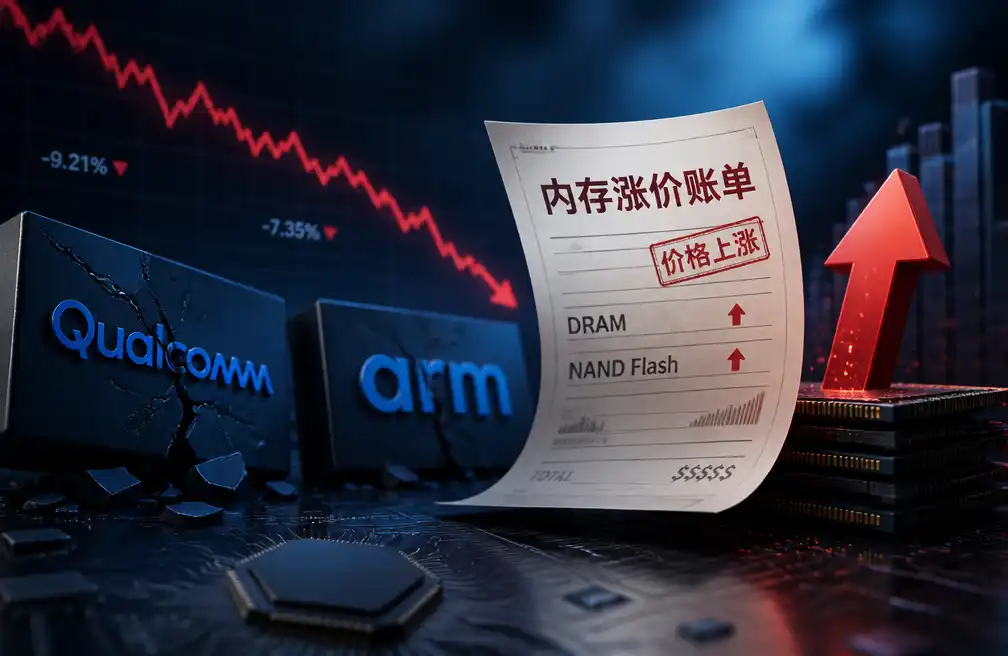
Qualcomm and Arm Fall Together: The Bill for Memory Price Hikes Finally Arrives at Mobile Chip Companies

After posting Q2 FY2026 results, Qualcomm and Arm both saw their shares decline, reflecting the impact of memory price increases on the smartphone chip sector. Qualcomm's revenue of $9.95B slightly beat expectations, but EPS of $2.21 fell short. More concerning was its guidance for next quarter, with EPS projections below analyst estimates. The company directly attributed a >$1.50 per share annual EPS headwind to rising memory costs and supply constraints in Android phones, prompting planned price hikes. While automotive revenue grew 61% and is approaching one-third of phone revenue, the mobile segment declined 20%. Qualcomm also confirmed a significant reduction in its modem share for the upcoming iPhone and outlined a plan for data center revenue to replace all Apple-related income by FY2027. Arm's results surpassed expectations with revenue of $1.29B and EPS of $0.45, and its guidance was also strong. However, its stock fell. Key concerns included royalty revenue failing to set a new record and a downward revision to full-year royalty growth guidance from ~20% to the high-teens, citing weak smartphone demand and high memory prices. Despite robust growth in its data center business, Arm's premium valuation (over 100x forward P/E) means even beating expectations isn't enough to push the stock higher, as any sign of uncertainty is magnified. Ongoing global antitrust investigations add another risk factor. The situation highlights a broader shift. Memory price surges, which boosted Samsung's profits, are now pressuring chip designers. Meanwhile, the semiconductor sector saw significant corrections in July, with the hardest-hit stocks often being those with the biggest AI-driven gains year-to-date. Qualcomm, lacking such a premium, was an exception.

marsbit07/30 02:41

Qualcomm and Arm Fall Together: The Bill for Memory Price Hikes Finally Arrives at Mobile Chip Companies

marsbit07/30 02:41

$10 Billion, Qualcomm to Acquire Chip Legend Jim Keller's Company

Global mobile chip giant Qualcomm is in advanced talks to acquire AI chip startup Tenstorrent in a deal valued between $8-10 billion, according to media reports. This potential acquisition would be one of the largest in the AI chip sector in recent years. Tenstorrent, led by legendary chip architect Jim Keller, has gained prominence for its RISC-V architecture and AI accelerator designs. The move highlights Qualcomm's strategic push to diversify beyond its core smartphone chip business. As the smartphone market matures, Qualcomm is aggressively targeting growth in automotive, data center, and cloud AI. Acquiring Tenstorrent would allow Qualcomm to rapidly enter the high-end AI computing market, bypassing lengthy in-house development cycles. Tenstorrent's cost-effective system architecture, which avoids expensive HBM memory and relies on standard Ethernet for clustering, offers a potential alternative to Nvidia's costly solutions. Furthermore, Tenstorrent's high-performance RISC-V CPU technology and its focus on the automotive and edge computing segments align with Qualcomm's strategic goals, including its "Snapdragon Digital Chassis" platform. Despite the strategic rationale, the high valuation has sparked some investor caution. The successful integration of Tenstorrent's open-source culture and independent team into Qualcomm's organization, along with the commercialization of its technology, remains a key challenge.

marsbit06/18 11:16

$10 Billion, Qualcomm to Acquire Chip Legend Jim Keller's Company

marsbit06/18 11:16

活动图片