# Points İlgili Makaleler

HTX Haber Merkezi, kripto endüstrisindeki piyasa trendleri, proje güncellemeleri, teknoloji gelişmeleri ve düzenleyici politikaları kapsayan "Points" hakkında en son makaleleri ve derinlemesine analizleri sunmaktadır.

$50 Million Funding Ignites Airdrop Anticipation, Variational Becomes New Focus of Perp DEX

Variational, a perpetual decentralized exchange (Perp DEX) on Arbitrum, has become a focal point in the crypto community after announcing a $50 million Series A funding round led by Dragonfly Capital, with participation from Bain Capital Crypto and Coinbase Ventures. This news caused a significant pre-listing price surge and increased predictions of a high fully diluted valuation (FDV) upon launch. A key feature of Variational is its zero-trading-fee model. It differentiates itself by aggregating multi-source liquidity, including traditional and crypto-native market makers, to address on-chain liquidity challenges. According to DefiLlama, it ranks fourth among Perp DEXs by open interest and is notable as the only top-five platform yet to issue a token. The primary way for users to engage is through its "Trade-to-Earn" Omni Points program. Points are awarded weekly based on trading activity, with bonuses for early users and a tiered reward system that incentivizes higher trading volumes. The program also includes a referral system offering USDC rewards and extra points. The design emphasizes organic trading over mere volume farming. While an exact Token Generation Event (TGE) date for the VAR token is not confirmed, official documentation states the points program will run at least until the end of Q3 2026. Community and prediction market sentiment generally expects the TGE to occur in Q3 or Q4 of this year.

Odaily星球日报5 saat önce

$50 Million Funding Ignites Airdrop Anticipation, Variational Becomes New Focus of Perp DEX

Odaily星球日报5 saat önce

A Brief History of Web3 Airdrops: A Review of Twelve Iconic 'Rug Pull' Projects

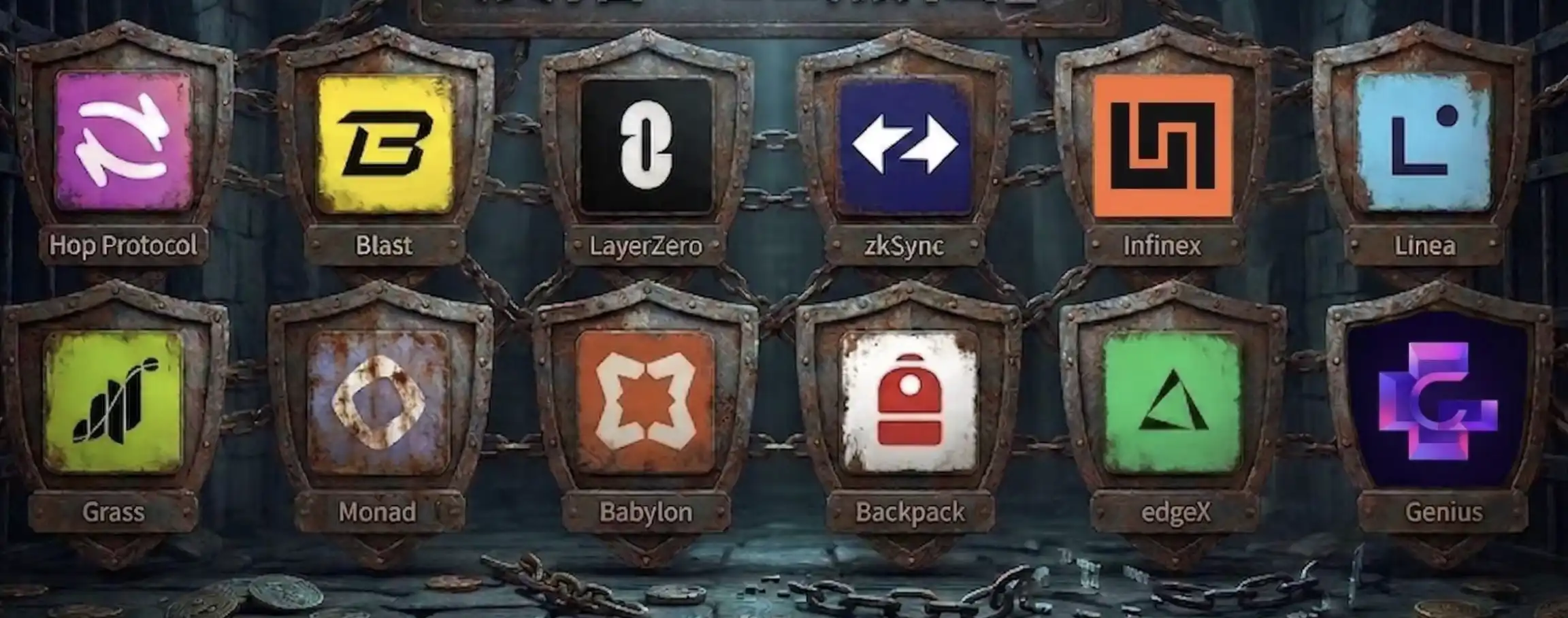
**Summary: A History of Web3 Airdrop "Rug Pulls" – 12 Iconic Cases** The era of Web3 airdrops has shifted from a golden age of mutual benefit between early users and projects to a landscape dominated by systematic exploitation. This article reviews 12 infamous "anti-airdrop" projects that eroded user trust: 1. **Hop Protocol (HOP):** Pioneered a "community witch-hunt" model, encouraging users to report Sybil addresses to claim their rewards, fostering a toxic environment of mutual harm. 2. **Blast:** Introduced the exploitative "points system," locking user funds for meager returns that often underperformed risk-free yields, turning airdrop hunting into a rigged casino. 3. **LayerZero (ZRO):** After 18 months of user-funded gas fees, it implemented a harsh "guilty until proven innocent" Sybil filter, forcing users to "self-confess" or face zero rewards, destroying multi-chain interaction narratives. 4. **zkSync (ZK):** Prioritized "funds held at a specific time" over long-term activity, betraying early contributors who spent significant gas and rewarding insiders, crushing L2 airdrop expectations. 5. **Infinex:** Lured users with NFT and point systems, only to announce a high FDV, a mandatory 1-year lockup, and chaotic rules at its public sale, betraying its community. 6. **Linea:** Perfected user exploitation with endless, grueling Galxe Odyssey tasks and KYC requirements, reducing airdrop hunting to a low-wage, full-time job. 7. **Grass:** Exploited users' physical resources (bandwidth/IP) for DePIN data, rewarding them with tokens worth less than the electricity and proxy costs incurred. 8. **Monad:** Allocated a mere ~3.3% of its airdrop to the community after extensive testnet participation, favoring KOLs and insiders and dampening enthusiasm for new L1s. 9. **Babylon:** Forced Ethereum-style staking onto Bitcoin, causing users massive losses from failed transactions due to high fees and network congestion, damaging trust in L2s. 10. **Backpack:** Encouraged massive trading volume for points, then applied strict KYC and Sybil rules last minute, resulting in massive losses for users and cementing a negative stereotype for projects with Chinese founders. 11. **EdgeX:** Perpetual DEX users lost significant fees for minimal rewards, while "insider" addresses received enormous allocations, exposing blatant corruption and killing the Perp DEX airdrop narrative. 12. **Genius:** The final straw: users were forced to choose between immediately claiming only 30% of their airdrop, locking tokens for a year for 100%, or a 100% burn for a gas fee refund, shattering trust in "elite-backed" narratives. **Conclusion** marks the painful end of the airdrop era. This collective "rug pull" was a co-created disaster of speculation and greed. The collapse, while brutal, forces a return to fundamentals: sustainable products with real product-market fit are paramount. This is not just the end of airdrops but a potential rebirth for Web3, weeding out exploitative projects and rewarding those that build genuine community value.

marsbit04/14 03:14

A Brief History of Web3 Airdrops: A Review of Twelve Iconic 'Rug Pull' Projects

marsbit04/14 03:14

Six-Year Evolution of Web3 Airdrops: From Uniswap to Monad, How Should Ordinary People Properly 'Farm Airdrops' in 2026?

Web3 airdrops have evolved significantly from Uniswap's 2020 genesis event, where early users were simply rewarded for protocol usage, to complex systems emphasizing genuine participation, identity verification, and attention economics. Key phases include: - **Phase 1 (2020)**: DeFi airdrops like Uniswap, with no Sybil resistance or tasks—pure reward for usage. - **Phase 2 (2021)**: ENS introduced the concept of "users as shareholders," focusing on governance and contribution. - **Phase 3 (2022-2023)**: Airdrops became growth hacking tools (e.g., Aptos, Arbitrum, Celestia), using multi-tier scoring and cross-ecosystem criteria. - **Phase 4 (2024-2026)**: Points systems (e.g., Blast, EigenLayer) prioritize TVL, duration, and liquidity locking over transaction volume. Future trends indicate: - Chain-level airdrops are declining; ecosystem-level airdrops (e.g., restaking, lending) will dominate. - Rising capital requirements and AI-driven allocation using on-chain reputation and behavior analysis. - A shift from rewards to attention economics, where community influence and identity matter most. For 2026, focus on: - Technical contributions (e.g., testnet nodes). - Completed quests and points systems. - Active community engagement (Discord, social media). - Long-term participation and identity building. Airdrops are no longer just token distributions but tools for user acquisition, governance, and community building. Success requires strategy升级: avoid meaningless farming, contribute value, and maintain a persistent, authentic presence.

marsbit04/09 03:13

Six-Year Evolution of Web3 Airdrops: From Uniswap to Monad, How Should Ordinary People Properly 'Farm Airdrops' in 2026?

marsbit04/09 03:13

活动图片