# Commodities İlgili Makaleler

HTX Haber Merkezi, kripto endüstrisindeki piyasa trendleri, proje güncellemeleri, teknoloji gelişmeleri ve düzenleyici politikaları kapsayan "Commodities" hakkında en son makaleleri ve derinlemesine analizleri sunmaktadır.

US Jobs, China PMI, and Inflation on Stage: Can Global Growth Maintain Resilience?

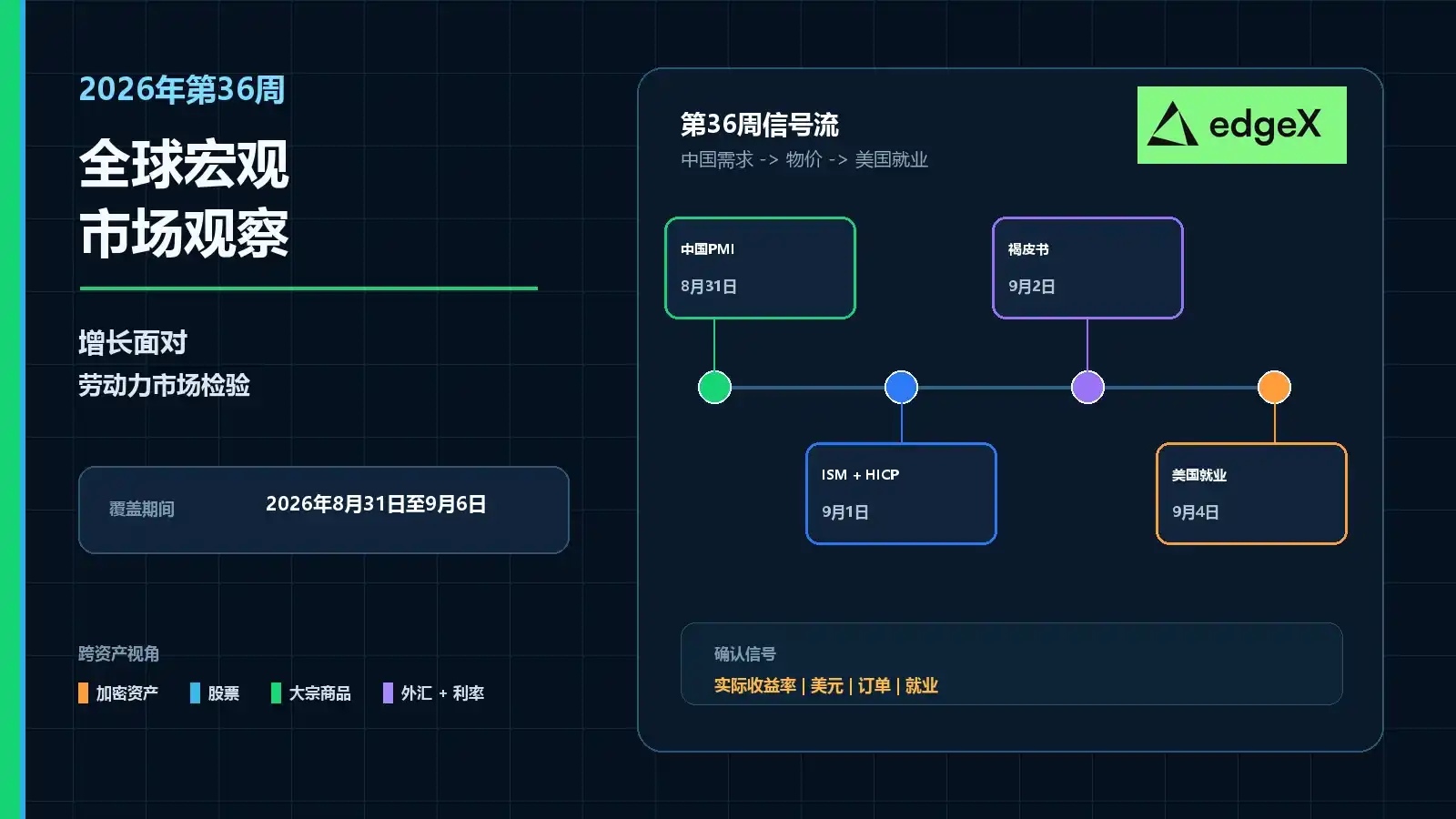
**Week 36 Macro Outlook: Key Data to Test Global Growth Resilience** The week from August 31 to September 6 will shift focus from policy discussions to a critical test of global economic activity. The sequence of events is key, starting with China's official August PMI on Aug 31, which will provide early signals on factory orders, services, and employment following July's contraction. The data flow then broadens. On September 1, US ISM Manufacturing PMI and the Eurozone's flash inflation estimate will offer simultaneous checks on demand, prices, and regional divergence. The subsequent US Federal Reserve Beige Book on September 2 adds granular, qualitative evidence on consumer spending, wages, and regional conditions. Australian Q2 GDP and Canadian trade and jobs data will test resilience in other major economies. The week's pivotal event, however, is the US August employment report on September 4. It will decisively influence expectations for interest rates, the US dollar, and broader risk appetite, acting as a final cross-check for the preceding data. The core question for markets is whether global growth can remain resilient. An ideal outcome would combine a rebound in China's PMI, stable US jobs growth, cooling inflation, and signs of a gradual demand slowdown. Conversely, weak Chinese manufacturing, sticky Eurozone prices, and disappointing US non-farm payrolls would create a more complex scenario of reduced corporate confidence and limited room for aggressive monetary easing, increasing pressure on cyclical assets. Investors should monitor the breadth of improvements—such as new orders and employment—rather than headline PMI figures alone. Confirmation across different data points is crucial. A positive combination of steady activity and disinflation could support equities, industrial commodities, and risk assets like crypto. However, if a growth slowdown triggers lower yields, it must be distinguished from a scenario of rising recession risks that would pressure corporate earnings, potentially limiting rallies. The market's final reaction will hinge on whether the week's signals align to either reinforce or challenge the current growth narrative.

marsbit22 saat önce
US Jobs, China PMI, and Inflation on Stage: Can Global Growth Maintain Resilience?

marsbit22 saat önce

U.S. Market Trend (August 20): U.S. Treasury Intervention Halts Stock Decline; Moderna's Cancer Vaccine Breakthrough Sparks 180% Surge

U.S. Stocks Rebound on Treasury Intervention; Moderna Soars 180% on Cancer Vaccine Breakthrough Key Points: • U.S. stocks ended a three-day decline, with the rebound driven primarily by the U.S. Treasury Department's move to significantly increase its long-term bond repurchase ceiling. This action briefly pushed the 30-year Treasury yield down by about 10 basis points, easing long-term interest rate pressures. • Despite this, the market faced a countervailing force from the hawkish July FOMC meeting minutes, which revealed broader support for potential rate hikes among officials due to lingering inflation concerns. • Moderna shares skyrocketed nearly 180% after announcing positive Phase 3 trial results for its personalized mRNA cancer vaccine in partnership with Merck, which also rose nearly 13%. This fueled a major rally in the healthcare sector. • Contrary to the broader market, the Philadelphia Semiconductor Index fell over 2%, highlighting persistent pressure on the AI hardware chain. Concerns include AI's potential inflationary impact and questions about application-side cash flows supporting high capital expenditures. • Commodities and cryptocurrencies rallied alongside the equity rebound, supported by a weaker dollar and lower long-term yields. Geopolitical risks continued to underpin oil prices. Outlook: Market focus shifts to whether long-term bond yields stabilize post-intervention, upcoming U.S. economic data (jobless claims, Philly Fed index), and the impact of SK Hynix's massive share buyback plan on the memory chip sector. The tech sector's full recovery remains contingent on the semiconductor index's performance.

marsbit08/20 01:36

U.S. Market Trend (August 20): U.S. Treasury Intervention Halts Stock Decline; Moderna's Cancer Vaccine Breakthrough Sparks 180% Surge

marsbit08/20 01:36

Metrics Ventures Market Observation: Talk is Cheap

This monthly market analysis extends its timeline to incorporate critical July comments from the Fed Chair, noting that bond markets have already priced in perceived policy shortcomings. The report observes a growing divergence: equity markets, after some deleveraging, continue a "trust-based" rally, while bond and currency markets signal persistent distrust. Precious metals bottoming suggests a central bank consensus that the era of "competitive currency devaluation" is ending, with verbal interventions losing power. Looking forward to Q3-Q4, the analysis remains bullish on supply-constrained global resources like copper and power, as well as gold, which prices ongoing monetary失信. It argues that digital assets are unlikely to see major outperformance until excess liquidity is released and AI growth rates are fully priced. Key market views include: 1. Commodities like gold remain primary liquidity absorbers over Bitcoin, with recent consolidation seen as healthy. 2. The bull trend for RMB-denominated assets (e.g., STAR 50 Index) is firmly established. 3. Key resource country indices and currencies are near inflection points, with spot copper already at new highs. The report suggests resource equities, particularly in China's market, are at the end of their consolidation phase, offering attractive valuations with embedded optionality on rising metal prices. It highlights the predictive significance of recent US-Japan FX interventions and Treasury-Fed dynamics, suggesting a shift towards less communication and data management to maintain stability. A long position in resource assets is presented as a positive expected-value strategy over a multi-year horizon.

marsbit08/15 05:21

Metrics Ventures Market Observation: Talk is Cheap

marsbit08/15 05:21

Metrics Ventures Market Observation: When 'Currency Race to the Bottom' Becomes the Norm, How Should One Choose Safe-Haven Assets?

Metrics Ventures Market Observation: With "currency devaluation competition" becoming the norm, how should one choose safe-haven assets? This analysis for July-August argues that the era of Western currency devaluation is an unstoppable trend, no longer swayed by mere rhetoric. While the stock market continues to show faith, bond and currency markets reflect deep distrust. Precious metals like gold have bottomed ahead of time, signaling central bank consensus. Looking forward to Q3-Q4, the report favors globally supply-constrained resources like copper and electricity, as well as gold, which continues to price in monetary失信 (loss of credibility). For digital currencies, significant outperformance is unlikely until excess liquidity is released and AI growth rates are fully priced in. Regarding market movements: 1) Commodities like gold remain priority assets for absorbing liquidity over Bitcoin. 2) The bullish trend for RMB-denominated assets (e.g., STAR 50 Index) remains intact. 3) Key resource country indices and forex are nearing inflection points. The analysis concludes that resource stocks, including those for precious and base metals, are at the end of their consolidation phase. Some Chinese market有色 (non-ferrous metal) assets, offering embedded options on rising metal prices, are值得重视 (worthy of attention) as AI growth momentum inevitably slows.

marsbit08/15 02:55

Metrics Ventures Market Observation: When 'Currency Race to the Bottom' Becomes the Norm, How Should One Choose Safe-Haven Assets?

marsbit08/15 02:55

Companies have begun tokenizing metals - even those not yet mined

In 2026, mining and tech companies are increasingly launching tokens backed by metals like gold, copper, uranium, nickel, and cobalt to attract crypto investors to the commodities market, reports the FT. These tokenization projects aim to simplify retail investor access to physical metals, allow crypto capital to diversify through real-world assets (RWA), and create a new funding mechanism for mining projects. This trend aligns with the broader adoption of blockchain in traditional finance. However, the tokenized metals market is still nascent. For example, the total value of gold ETFs was around $530 billion last month, while the two largest gold-backed tokens had a combined market cap of only about $4.6 billion. Proponents argue blockchain simplifies access to commodities. Platform Metals.io has issued tokens for uranium, nickel, and cobalt, which can be exchanged for physical metal under certain conditions. Some firms, like Datavault AI, are even tokenizing metals not yet mined, using a model compared to futures contracts. The growth occurs alongside a general RWA expansion, with the total market cap exceeding $43 billion. Yet, risks persist. Challenges include investors needing to understand the origin and quality of physical metals, market fragmentation with tokens traded on different platforms, and a lack of interoperability. Experts warn the market is in early stages but believe blockchain's ability to record information will drive eventual widespread adoption.

cryptonews.ru08/13 16:16

Companies have begun tokenizing metals - even those not yet mined

cryptonews.ru08/13 16:16

活动图片