Stocks slide while crypto steadies — is market correlation starting to break?

ambcrypto2026-03-31 tarihinde yayınlandı2026-03-31 tarihinde güncellendi

Özet

Stocks are undergoing a controlled correction with the S&P 500 trending lower amid cooling risk appetite, while the crypto market has stabilized and entered a consolidation phase instead of continuing its decline. This divergence suggests a potential short-term loosening of the historically strong correlation between the two asset classes. Although both remain influenced by broader macroeconomic conditions, equities are currently pricing in uncertainty through a gradual pullback, whereas crypto may have already absorbed significant risk during its earlier drop. The current price action indicates a period of positioning rather than strong directional momentum in crypto markets.

A divergence is emerging between traditional equities and the crypto market, with recent price action suggesting a subtle shift in how both asset classes are responding to broader macro conditions.

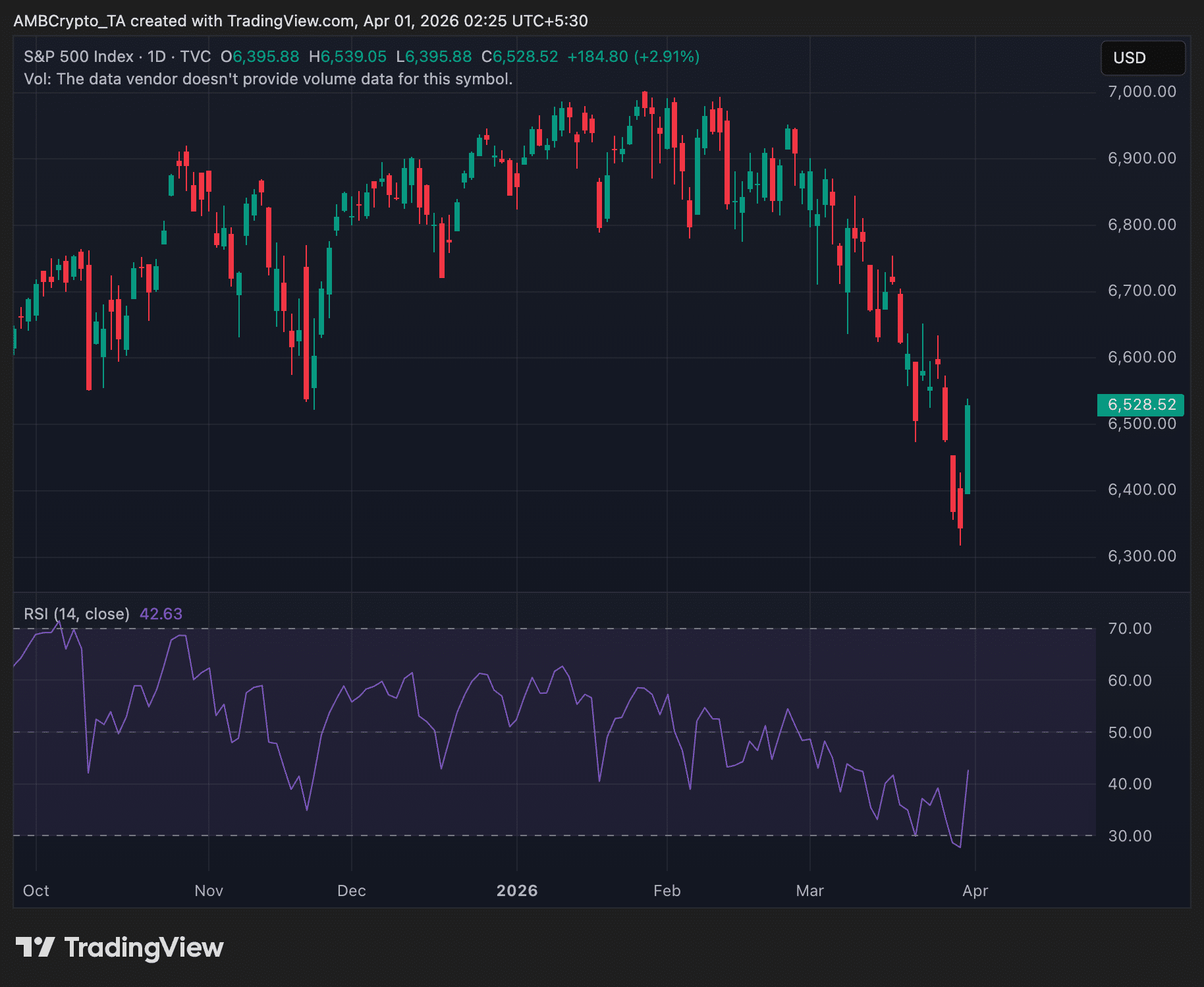
The S&P 500 has entered a corrective phase, trending lower from its recent highs amid building selling pressure across major sectors.

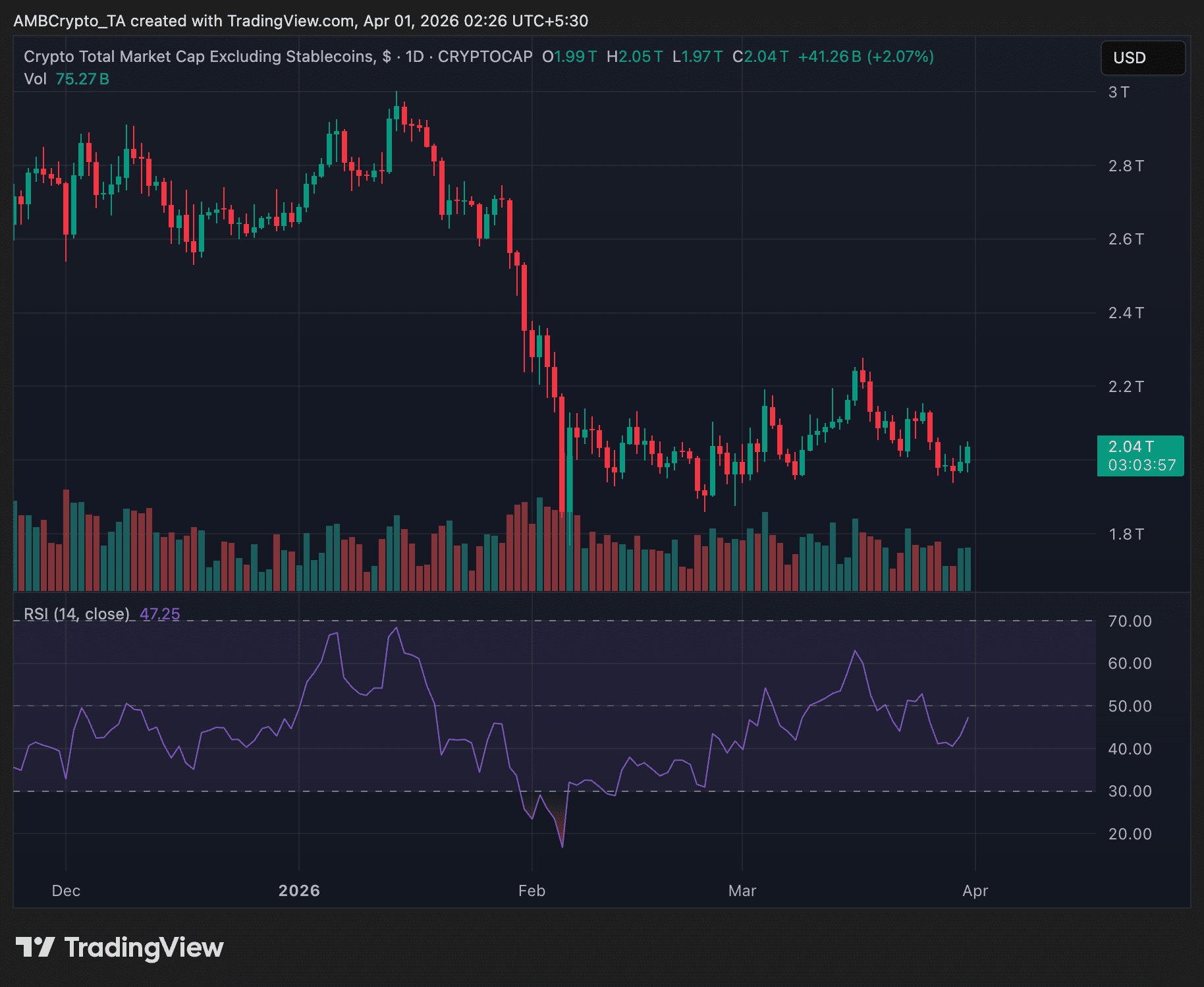
In contrast, the broader crypto market — measured by total market capitalization excluding stablecoins — has entered a period of consolidation rather than continuing its earlier decline.

Equities show signs of a controlled correction

The S&P 500’s recent structure reflects a gradual deterioration in momentum, with a series of lower highs and lower lows forming since late February.

While the pullback has not yet turned disorderly, the trend indicates a cooling of risk appetite in traditional markets.

Momentum indicators such as the Relative Strength Index [RSI] have also declined toward neutral levels after previously signaling overbought conditions.
Source: TradingView

As of this writing, it was trading up almost 3% to over $6,500. However, the trend suggests that equities are undergoing a controlled reset, rather than a sharp risk-off event.

Crypto market stabilizes after sharp drop

In contrast, crypto markets appear to be entering a holding pattern. As of this writing, the market capitalization was around 2.03 trillion, up over 2% in the last 24 hours.
Source: TradingView

After a steep decline earlier in the quarter, total crypto market capitalization has largely stabilized within a defined range. Price action has remained contained between key support and resistance zones, while RSI readings hover near neutral levels.

This lack of follow-through selling indicates that downside momentum has weakened, with the market neither committing to a recovery nor extending its decline.

A subtle shift in correlation dynamics

Historically, crypto has behaved as a high-beta extension of equities, often amplifying moves seen in traditional markets.

However, the current setup presents a more nuanced picture. While equities continue to trend downward, crypto markets have not mirrored the move with equivalent intensity. Instead, they have transitioned into sideways consolidation.

This divergence may signal a loosening of the correlation, at least in the short term.

What this means for market structure

The divergence does not necessarily imply that crypto is immune to broader macro pressures. Instead, it suggests that markets may be in different phases of adjustment.

Equities are pricing in macro uncertainty through a steady correction, while crypto markets may have already absorbed a significant portion of that risk during earlier declines.

As a result, current price action in crypto could reflect a phase of positioning and balance rather than directional conviction.


Final Summary

  • Equities are trending lower in a controlled correction, while crypto markets are consolidating rather than extending losses.
  • The divergence suggests a potential short-term loosening of correlation, though both markets remain influenced by broader macro conditions.


İlgili Sorular

QWhat is the main divergence observed between traditional equities and the crypto market according to the article?

AThe main divergence is that traditional equities (like the S&P 500) are trending lower in a controlled correction, while the crypto market has entered a period of consolidation and stabilization instead of continuing its decline.

QWhat does the current price action in the crypto market suggest about its downside momentum?

AThe current price action, characterized by consolidation within a defined range and RSI readings near neutral levels, suggests that the downside momentum has weakened significantly.

QHow has the historical correlation between crypto and equities potentially changed based on recent activity?

AThe recent activity suggests a potential short-term loosening of the correlation. Crypto is not mirroring the equity market's downward trend with equivalent intensity but is instead moving sideways, indicating a more nuanced relationship.

QWhat is the article's explanation for why crypto markets might be stabilizing while equities correct?

AThe article suggests that crypto markets may have already absorbed a significant portion of the macro risk during their earlier steep declines, and are now in a phase of positioning and balance rather than directional conviction.

QWhat key technical indicator is mentioned as having declined toward neutral levels for the S&P 500?

AThe Relative Strength Index (RSI) is mentioned as having declined toward neutral levels for the S&P 500 after previously signaling overbought conditions.

İlgili Okumalar

Can Generative Models Finally Be Trained End-to-End? The Core Is a For Loop

This article introduces a novel training paradigm for generative models called Explorative Modeling (XM), which enables true end-to-end training. Traditionally, powerful generative models like autoregressive and diffusion models are not trained end-to-end. They are trained to predict a single small step but require iterative multi-step sampling for inference. This "exposure bias" leads to error accumulation and limits performance. The core challenge XM addresses is "mode blurring." In generative tasks, a single input (e.g., "generate a dog") corresponds to many valid outputs (multiple modes). Standard training objectives like reconstruction loss force the model to average these modes, producing unrealistic, blurry outputs. To avoid this, existing models break generation into many small, almost deterministic steps, sacrificing end-to-end training. XM tackles this by restructuring the training loop itself. Its key insight is to amplify "generative expressivity." For each training input, instead of generating one sample, the model generates K candidate outputs. Only the candidate closest to the real data is used for computing the loss and updating the model via backpropagation. This simple "best-of-K" mechanism is implemented as a short for-loop. By exploring multiple possibilities, the model learns to distribute its guesses across different modes rather than collapsing to their uninformative average. The paper demonstrates that "exploration" acts as a new, powerful scaling axis. Gains from XM increase with model size, data scale, and compute. Experiments show improvements in FID scores for image generation and significant efficiency gains, sometimes outperforming larger models without exploration. When pushed to the limit, XM enables fully single-step, end-to-end generative models. In robotics tasks, an "Explorative Policy" matched the performance of a 100-step Diffusion Policy with a single forward pass, drastically improving inference speed. While the best-of-K concept is not entirely new, the authors' contribution lies in formally understanding it as a direct method to boost generative expressivity without fragmenting the generation process. This work suggests that as models scale, enhancing exploration during training may become crucial for overcoming fundamental performance bottlenecks.

marsbit49 dk önce

Can Generative Models Finally Be Trained End-to-End? The Core Is a For Loop

marsbit49 dk önce

Annual Salary of Millions Competing for Electricians, Meta Rushes to Open Its Own Technical School

The AI boom is facing an unexpected bottleneck: a severe shortage of skilled construction workers and electricians. As tech giants like Meta, OpenAI, and Alphabet race to build massive data centers—such as OpenAI's $16 billion "Stargate" project—they are hitting a critical labor wall. The U.S. needs an estimated 130,000 more electricians, 240,000 construction workers, and 150,000 supervisors by 2030 for AI infrastructure alone, but tens of thousands of electrician jobs go unfilled each year. While AI companies offer high premiums, with electricians earning up to $280,000 annually, worker scarcity still causes massive losses—delays on a single project can cost $14.2 million per month. The complexity of building AI data centers, which require immense power (equivalent to powering hundreds of thousands of homes), sophisticated electrical systems, and advanced liquid cooling solutions, demands highly skilled technicians who are in short supply. To combat this, companies are investing heavily in training. Meta has committed $115 million to a free training school offering tuition, housing, and stipends, targeting 5,000 new workers. OpenAI is partnering with unions to secure skilled labor. These efforts are paying off, with a significant rise in Gen Z interest in trade schools over college. However, the power demands are staggering. AI data centers are driving a rapid surge in electricity consumption, projected to account for up to 12% of U.S. power use by 2028 and raising costs for consumers. Furthermore, the construction boom is project-based, leading to a potential future glut of trained workers once building peaks, which could depress wages industry-wide. The race for AI supremacy now depends as much on skilled hands as on advanced chips.

marsbit2 saat önce

Annual Salary of Millions Competing for Electricians, Meta Rushes to Open Its Own Technical School

marsbit2 saat önce

İşlemler

Spot
活动图片