Stablecoins could reach $1.5 quadrillion by 2035 – Here’s how

ambcrypto2026-04-09 tarihinde yayınlandı2026-04-09 tarihinde güncellendi

Özet

Stablecoin usage has surged over the past decade, with significant growth accelerated by the passage of the GENIUS Act in 2025, pushing the stablecoin value to $319 billion. According to Chainalysis, adjusted volume rose 133% from 2023 to reach $28 trillion in 2025, with monthly volume hitting a record $7.2 trillion—surpassing major traditional payment channels like U.S. ACH and Visa. Transaction volume exceeded 8.1 trillion through March 2026, and active addresses grew to 51.6 million. Chainalysis projects that, if current growth continues, stablecoin volume could exceed $1.5 quadrillion by 2035, driven by generational wealth transfers ($80–100 trillion moving to crypto-friendly younger generations) and point-of-sale adoption. This would surpass the estimated $1 quadrillion in global cross-border payments. Further adoption, including real-world asset tokenization and supportive legislation like the Clarity Act, could accelerate this trajectory.

Stablecoin usage has surged over the past decade with rising adoption and mainstream acceptance. The passage of the GENIUS Act by the U.S. Congress in 2025 accelerated this growth, pushing stablecoin value to $319 billion.

This global financial shift is driving the integration of traditional and decentralized finance, with stablecoins at the center of market transformation and projected to outpace traditional finance.

Stablecoin monthly volume hits $7.2T

According to the Chainalysis report, Stablecoin Adjusted Volume rose 133% from 2023 to hit $28 trillion in 2025. This showed extensive growth in the economic value of stablecoins.
Source: Chainalysis

At press time, monthly volume reached a historical high of $7.2 trillion, surpassing major traditional payment channels such as U.S. ACH and Visa.

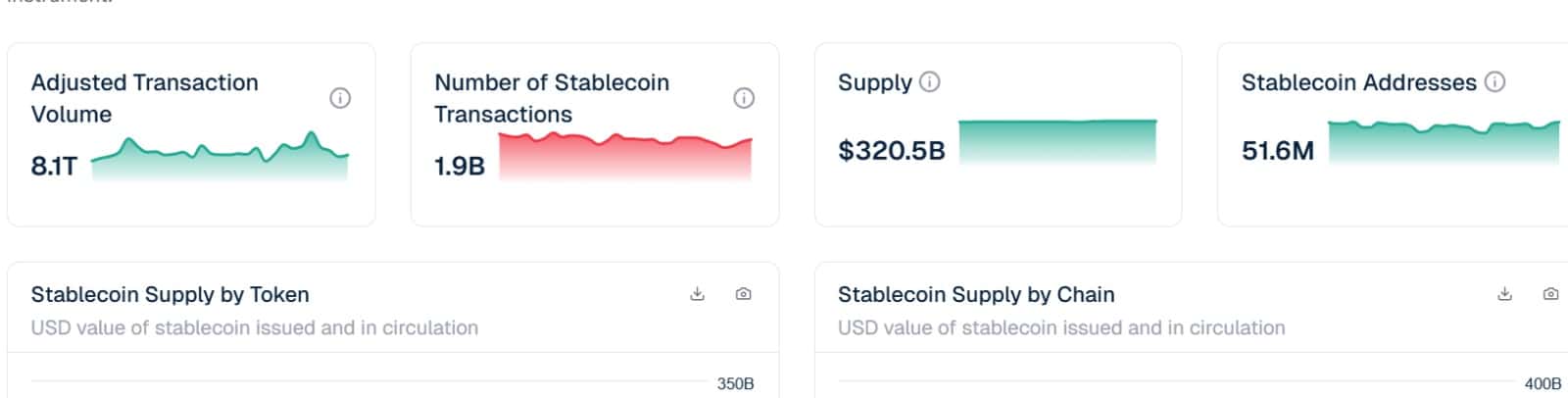
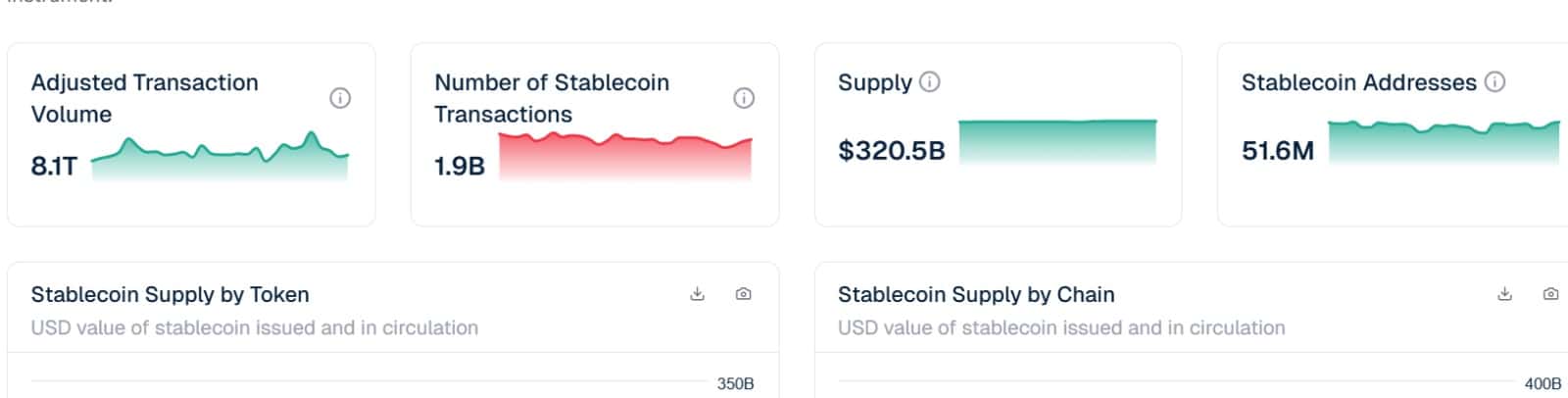
The growth has indicated the extensive usage of stablecoin in everyday life across all walks of life. In fact, Artemis data showed that both transactions and addresses have also risen significantly.
Source: Artemis

Adjusted Transaction Volume exceeded 8.1 trillion through March 2026, with the number of transactions nearing 2 trillion. At the same time, Stablecoin Addresses have surged to 51.6 million over the last 30 days, reflecting this sustained usage.

Usage to surpass $1.5 quadrillion by 2035

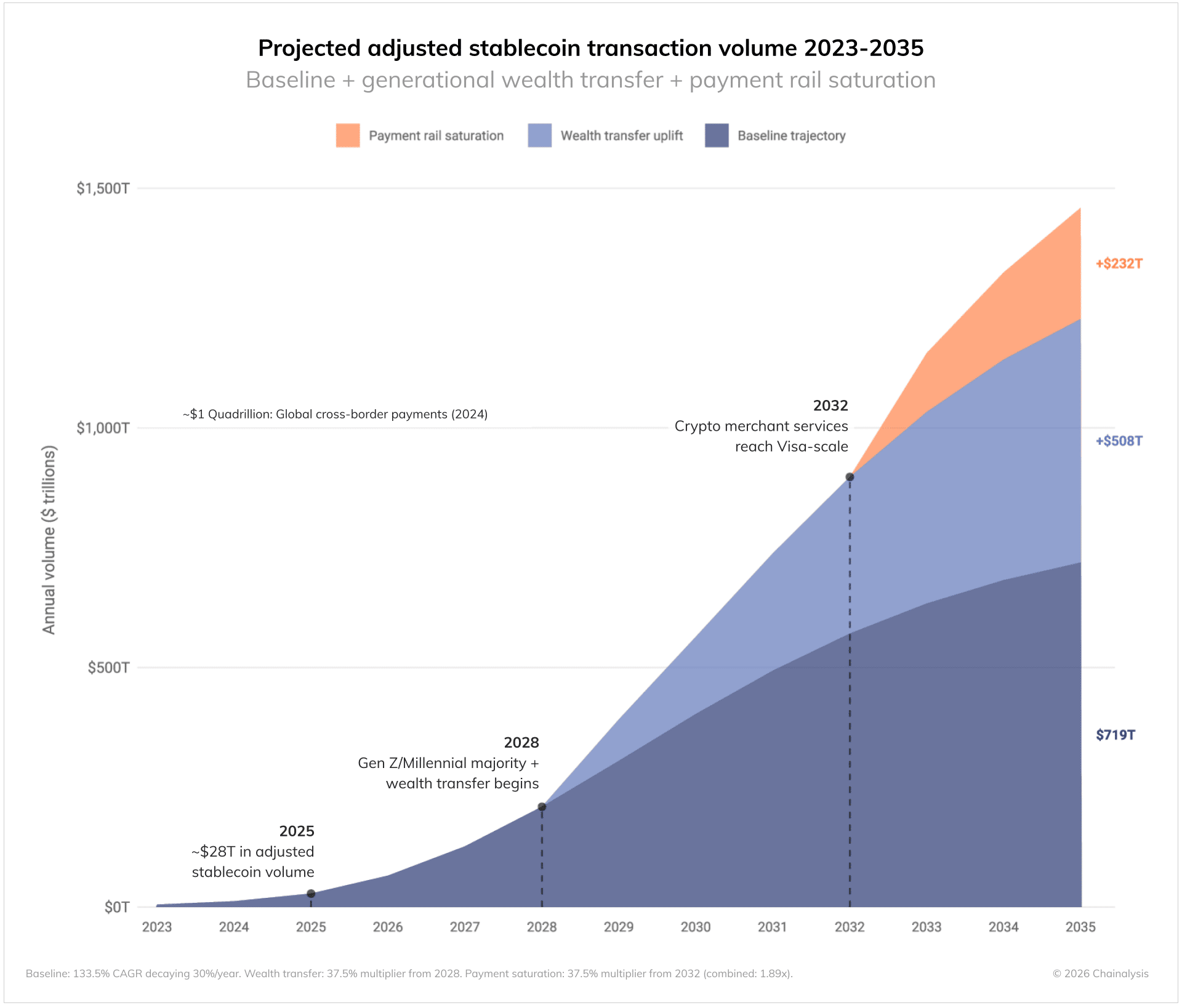
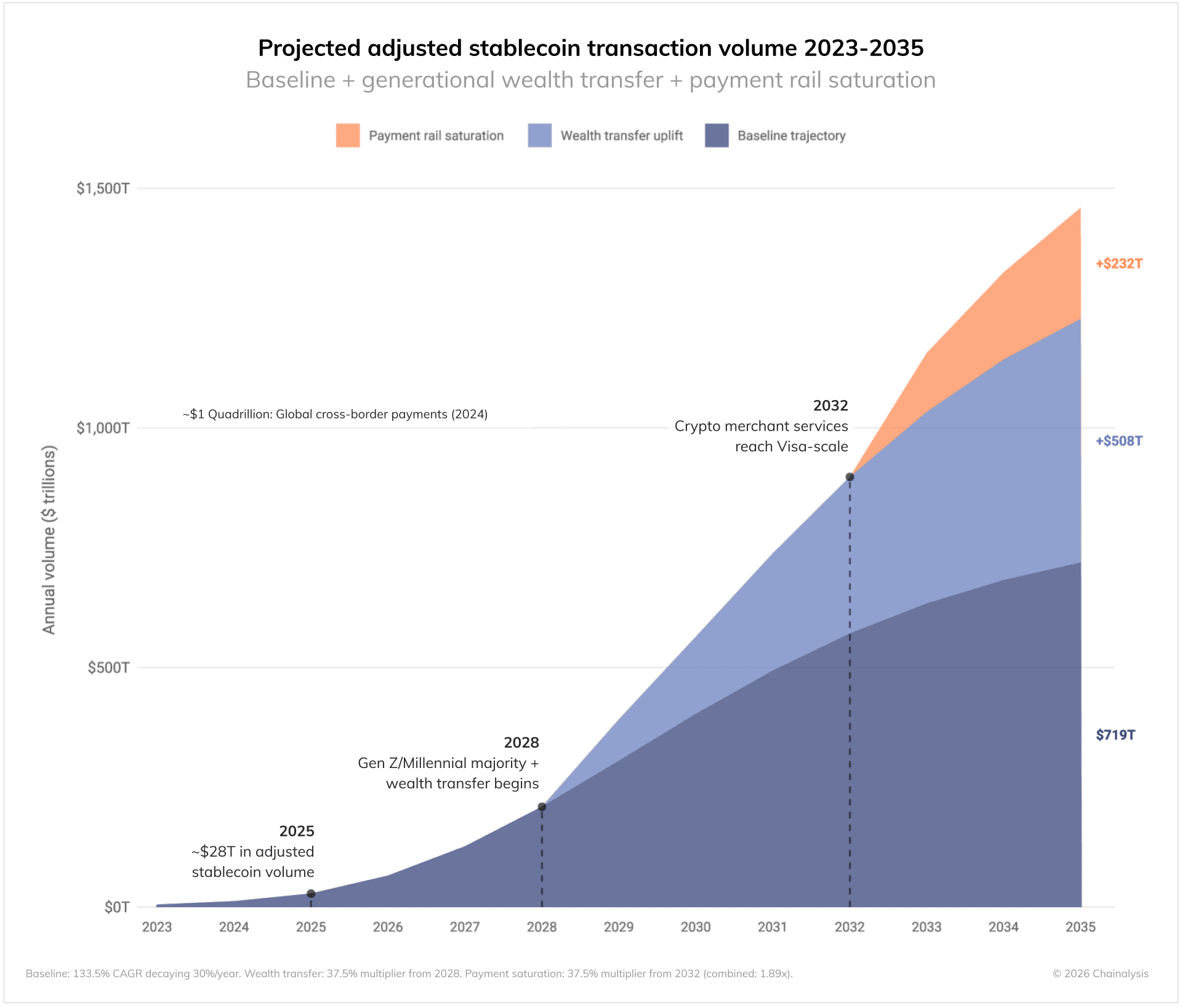
Chainalysis projects that if current growth continues, stablecoin volume could exceed $719 trillion by 2035. Notably, two key drivers are generational wealth transfers and point‐of‐sale adoption. Between $80 and $100 trillion in wealth is expected to move from boomers to millennials and Gen Z, nearly half of whom already hold crypto.

This transition alone could add more than $508 trillion in stablecoin transaction volume. At the same time, stablecoins may become default payment systems, further accelerating growth. Together, these forces could push stablecoin volume to $1.5 quadrillion by 2035, surpassing the estimated $1 quadrillion in global cross‐border payments.
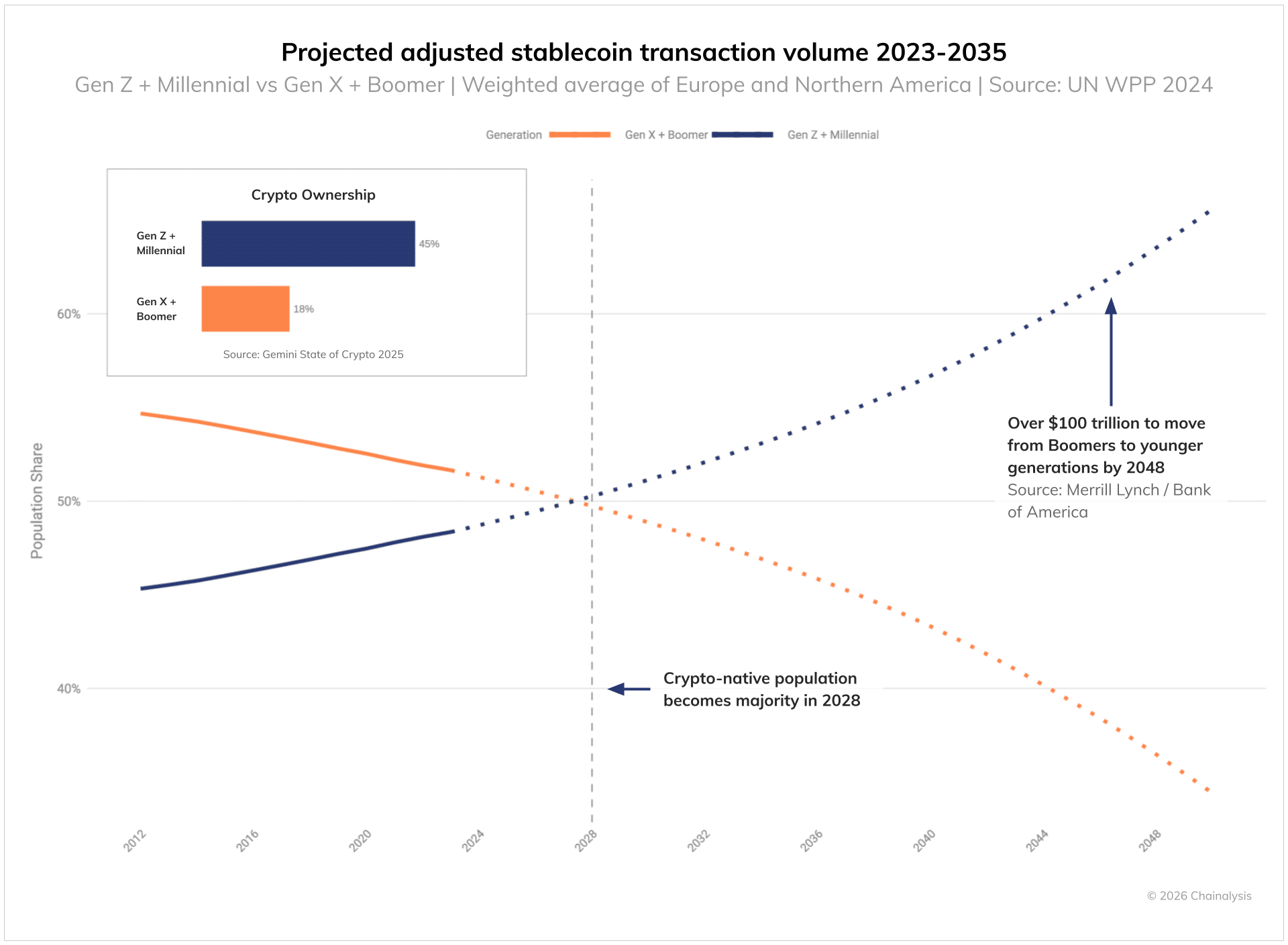
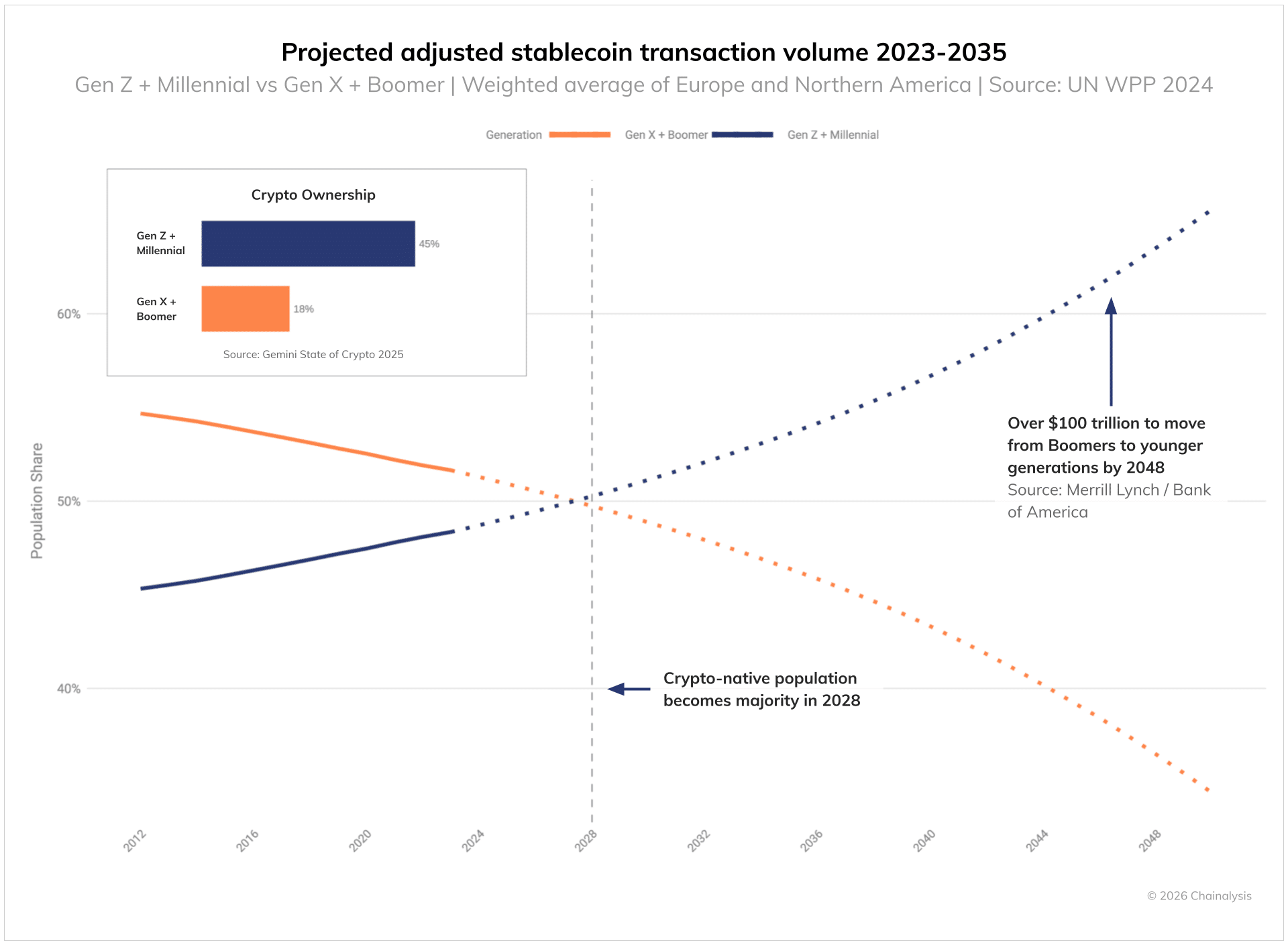
Source: Chainalysis

Even more importantly, intergenerational wealth transfers and shifts in payment infrastructure could accelerate adoption. This will see a surge in real-world asset tokenization, prediction markets, and other TradFi-to-crypto products.

Institutions and other players in TradFi will be left at a crossroads: either fully embrace crypto or see assets migrate. As many users continue to adopt stablecoin, the growth is barely starting.

Finally, if the Clarity Act, currently stalled in the U.S. Senate, is passed, stablecoins will gain a clearer growth path.


Final Summary

  • Stablecoin Adjusted Volume rose 133% from 2023 to hit $28 trillion in 2025, with a monthly volume of $7.2 trillion.
  • Stablecoin volume is projected to hit $1.5 quadrillion by 2035, surpassing the estimated $1 quadrillion in global cross-payments


İlgili Sorular

QWhat was the percentage increase in Stablecoin Adjusted Volume from 2023 to 2025, and what was the total value reached in 2025?

AStablecoin Adjusted Volume rose 133% from 2023 to hit $28 trillion in 2025.

QWhat is the projected total stablecoin transaction volume by 2035, and how does it compare to the estimated value of global cross-border payments?

AStablecoin volume is projected to reach $1.5 quadrillion by 2035, surpassing the estimated $1 quadrillion in global cross-border payments.

QWhat are the two key drivers identified by Chainalysis that could push stablecoin volume to $1.5 quadrillion by 2035?

AThe two key drivers are generational wealth transfers (from boomers to millennials and Gen Z) and the adoption of stablecoins as a default payment system at the point-of-sale.

QWhat recent U.S. legislation is credited with accelerating the growth of stablecoins, and what is the name of the act currently stalled in the Senate that could provide further clarity?

AThe GENIUS Act, passed by the U.S. Congress in 2025, accelerated stablecoin growth. The Clarity Act is currently stalled in the U.S. Senate and could provide a clearer growth path if passed.

QWhat does the article state about the current monthly stablecoin volume compared to traditional payment channels like U.S. ACH and Visa?

AAt press time, the monthly stablecoin volume reached a historical high of $7.2 trillion, surpassing major traditional payment channels such as U.S. ACH and Visa.

İlgili Okumalar

380,000 Apps Exposed, 2,000+ Apps Leaked Secrets: AI Programming Turns 'Intranet' into Public Internet

Israeli cybersecurity firm RedAccess uncovered a severe data exposure trend linked to "vibe coding" or AI-powered software development tools. Their research found approximately 38,000 publicly accessible web applications built with platforms like Lovable, Base44, Netlify, and Replit. Of these, an estimated 2,000 apps exposed sensitive corporate and personal data, including medical records, financial information, internal strategic documents, and customer chat logs. In some cases, access even granted administrative privileges. The core issue stems from default privacy settings that make applications public by default, combined with a lack of built-in security controls (like authentication) in the AI-generated code. This allows employees without security expertise—"citizen developers"—to easily create and deploy applications that bypass standard corporate security reviews. The exposed apps, often indexed by search engines, are trivially discoverable. While some platform providers (Replit, Lovable, Wix/Base44) argue that security configuration is the user's responsibility and question the validity of some findings, security researchers confirm the widespread reality of such exposures. This pattern, also noted in prior studies, highlights a critical security gap as AI democratizes app creation, potentially leading to massive, unintentional data leaks.

marsbit27 dk önce

380,000 Apps Exposed, 2,000+ Apps Leaked Secrets: AI Programming Turns 'Intranet' into Public Internet

marsbit27 dk önce

Attracting Global Capital, Asia's New 'Super Cycle' Is Unfolding

Investors are turning to Asia as the next frontier for global equity growth, with a new "super cycle" unfolding across the region. Driven by the AI revolution, Asian markets, particularly South Korea, have seen significant rallies. According to Morgan Stanley analysis, the underlying drivers of Asia's industrial cycle are shifting from traditional sectors like real estate and manufacturing to massive investments in AI infrastructure, energy security and transition, and supply chain resilience. Fixed asset investment in Asia is projected to grow from around $11 trillion in 2025 to $16 trillion by 2030, with a 7% annual growth rate from 2026-2030. The AI wave is a primary catalyst, driving immense capital expenditure for chips, servers, data centers, and power systems. Asia is central to this hardware supply chain. In China, AI investment is focused on building a full-system domestic capability, with the local AI chip market potentially reaching $86 billion by 2030. Beyond AI, China's export story is expanding from EVs and batteries to robotics. The country already captures about half of new global industrial robot demand and over 90% of humanoid robot shipments. This growth phase mirrors the early stages of China's EV export boom. Simultaneously, energy security investments, spurred by AI's massive power needs, are rising, with China benefiting from its leadership in solar, batteries, and EVs. Regional defense spending is also increasing structurally, supporting demand for advanced manufacturing. The main beneficiaries are China, South Korea, and Japan, positioned in core supply chain areas. However, risks remain, including potential overcapacity, profit margin pressures from competition, persistent technological restrictions, geopolitical friction, and workforce displacement due to AI-driven automation. Market volatility is also expected to increase as investor expectations diverge on the realization of these capital investment and export themes.

marsbit28 dk önce

Attracting Global Capital, Asia's New 'Super Cycle' Is Unfolding

marsbit28 dk önce

Funding Weekly Report | 14 Public Funding Events, Kalshi Completes $10B New Funding Round at $220B Valuation Led by Coatue Management

Weekly Funding Roundup: 14 Deals and $10.49B+ in Total Funding, Led by Kalshi's $1B Round Last week (5.4-5.10) saw 14 notable funding events in the global blockchain ecosystem, raising over $10.49 billion in total. Key highlights include Kalshi, a prediction market platform, securing a $1 billion round led by Coatue Management, reaching a $22 billion valuation. The platform now boasts ~2 million MAUs and $178B in annualized trading volume. In DeFi, regulated on-chain reinsurer OnRe raised $5 million in Series A funding, and Bitcoin-backed credit protocol Saturn Credit completed a $2 million seed round. For Infrastructure & Tools, OpenTrade raised $17 million to expand its stablecoin yield infrastructure, and RWA platform Balcony secured $12.7 million to deploy its property settlement service in the US. Centralized Finance saw one deal: AI-driven trading platform Stockcoin.ai completed a seed round led by Amber Group. In the prediction market sector alongside Kalshi, AI-powered platform Elastics raised $2 million. Other notable deals include SC Ventures' strategic investment in crypto market maker GSR and Centrifuge securing a "seven-figure" investment from Coinbase to become a core RWA partner for Base. On the investor side, Haun Ventures raised a new $1 billion fund targeting crypto and AI, and Multi Investment raised ~$616 million to focus on blockchain and Web3 investments.

marsbit1 saat önce

Funding Weekly Report | 14 Public Funding Events, Kalshi Completes $10B New Funding Round at $220B Valuation Led by Coatue Management

marsbit1 saat önce

İşlemler

Spot
Futures
活动图片