South Korea To Review Seized Crypto Custody Practices After Recovery Phase Leak Incident

bitcoinist2026-03-03 tarihinde yayınlandı2026-03-03 tarihinde güncellendi

Özet

South Korean financial authorities, led by Deputy Prime Minister and Finance Minister Koo Yun-cheol, have pledged to review and strengthen the management of seized crypto assets after a series of security incidents resulted in losses of nearly $30 million. This decision follows a recent leak by the National Tax Service, which accidentally exposed a wallet’s recovery seed phrase in a press release, leading to the theft of $4.8 million in tokens. The government plans to collaborate with agencies like the Financial Services Commission to enhance security measures and prevent future breaches. This incident is part of a broader pattern, including earlier losses of $21 million in Bitcoin from a prosecutor’s office and $1.4 million from a police station, highlighting systemic vulnerabilities in the custody of digital assets by public institutions.

South Korean financial authorities have pledged to revise their crypto custody practices following public scrutiny over multiple incidents that led to the loss of nearly $30 million in seized digital assets over the past few months.

Authorities Move To Enhance Crypto Custody Practices

South Korea’s Deputy Prime Minister and Minister of Finance, Koo Yun-cheol, affirmed that authorities will review their management practices of seized crypto assets by government and public authorities, and develop measures to prevent the theft and loss of these assets.

“In response to the recent digital asset information leak incident at the National Tax Service (NTS), the government will promptly review the status and management practices of digital assets held and managed by government and public institutions—such as those seized from delinquent taxpayers—in collaboration with relevant agencies, including the Financial Services Commission (FSC) and the Financial Supervisory Service (FSS),” the finance minister wrote in a Sunday X post.

“We will also swiftly develop and implement measures to prevent recurrence, including strengthening digital asset security management,” he continued, noting that the South Korean government only holds crypto assets acquired through legal enforcement actions, such as seizure.

The upcoming review and Koo’s statement follow a wave of criticism over the authorities’ practices and management of crypto assets after the tax agency exposed the recovery seed phrase of a seized wallet, leading to unauthorized access and theft of the tokens inside it.

As reported by Bitcoinist, South Korea’s National Tax Service recently published an official press release to highlight its crackdown on tax nonpayers, but accidentally shared a full wallet seed phrase in the process.

The Thursday press release was reportedly part of a broader NTS enforcement campaign targeted at people who owed taxes, showing seized crypto assets as evidence of the agency’s efforts.

Nonetheless, it included an image of two Ledger cold wallets alongside a handwritten sheet of paper that exposed the wallets’ complete mnemonic recovery phrases.

Soon after, one of the confiscated wallets’ entire balance, 4 million Pre-Retogeum (PRTG) tokens worth around $4.8 million, was transferred to another address, blockchain researchers found, but noted that the cryptocurrency has extremely low liquidity.

According to Professor Cho Jae-woo of Hansung University’s Blockchain Research Institute, the other wallets with seed phrases visible in the same image did not appear to carry significant risk, as the leaked tokens are also difficult to convert into cash.

The expert criticized the incident, but shared his hope that it “serves as a turning point for the establishment of a robust virtual asset management system within Korea’s public sector.”

South Korea’s Custody Mishaps

Last week’s incident is the latest in a series of security breaches that have led to the loss of around $27 million in seized crypto assets under the government’s custody since the start of the year.

In January, the Gwangju District Prosecutors’ Office faced backlash after discovering that 320 Bitcoin (BTC), worth around $21 million, had gone missing months ago. According to local reports, authorities only discovered the theft during a routine check of seized financial assets held as criminal evidence.

Prosecutors found that the crypto assets, first seized in 2021, were lost to a scam in August while authorities were handling the assets. Notably, a malicious actor drained the wallets after investigators mistakenly accessed a phishing website.

In an unexpected turn of events, the hacker returned the stolen Bitcoin in mid-February, the Gwangju District Prosecutors’ Office confirmed, vowing to continue to track down the malicious actors involved while conducting related investigations and inspections.

The incident led to a nationwide review, which revealed another security breach at the Seoul Gangnam Police Station last month. The Gangnam station announced it had lost 22 BTC, worth around $1.4 million at the time, that were voluntarily submitted to authorities during an investigation in November 2021.

Local news outlets reported that the leak had not been detected until recently, as the investigation into that case had been suspended. The inspection revealed that the cold wallet storing the Bitcoin was not stolen. However, the assets stored inside had vanished without a trace, deepening concerns about local authorities’ knowledge of cryptocurrencies and proper measures to handle and custody seized digital assets.
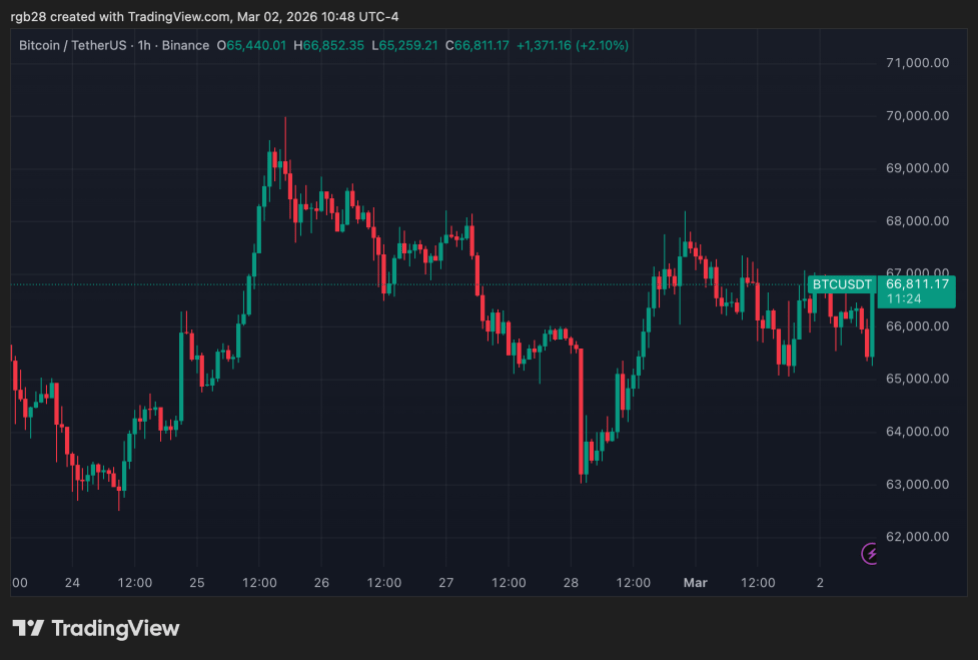
Bitcoin trades at $66,811 in the one-week chart. Source: BTCUSDT on TradingView

İlgili Sorular

QWhat prompted South Korean financial authorities to review their crypto custody practices?

AThe review was prompted by a series of security incidents, most recently the National Tax Service's accidental leak of a wallet's recovery seed phrase, which led to the theft of seized crypto assets and public scrutiny over the loss of nearly $30 million.

QHow much in Pre-Retogeum (PRTG) tokens was stolen from the seized wallet after the NTS leak, and what was its approximate value?

A4 million Pre-Retogeum (PRTG) tokens, worth approximately $4.8 million, were stolen from the seized wallet.

QWhat was the significant Bitcoin-related security breach that occurred at the Gwangju District Prosecutors' Office earlier this year?

AIn January, the Gwangju District Prosecutors' Office discovered that 320 Bitcoin (BTC), worth around $21 million, had been stolen from a seized wallet months earlier after investigators mistakenly accessed a phishing website.

QAccording to Finance Minister Koo Yun-cheol, what type of crypto assets does the South Korean government hold?

AThe South Korean government only holds crypto assets that have been acquired through legal enforcement actions, such as seizure.

QWhat was the outcome of the Bitcoin theft from the Gwangju District Prosecutors' Office?

AIn an unexpected turn of events, the hacker returned the stolen Bitcoin in mid-February.

İlgili Okumalar

Fu Peng's First Public Speech in 2026: What Exactly Are Crypto Assets? Why Did I Join the Crypto Asset Industry?

Fu Peng, a renowned macroeconomist and now Chief Economist at New火 Group, delivered his first public speech of 2026 at the Hong Kong Web3 Festival. He explained his perspective on crypto assets and why he joined the industry, framing it within the context of macroeconomic trends and financial evolution. Fu emphasized that crypto assets are transitioning from an early, belief-driven phase to a mature, institutionally integrated asset class. He drew parallels to the 1970s-80s, when technological advances (like computing) revolutionized traditional finance, leading to the rise of FICC (Fixed Income, Currencies, and Commodities). Similarly, current advancements in AI, data, and blockchain are reshaping finance, with crypto assets becoming part of a new "FICC + C" (C for Crypto) framework. He noted that institutional capital, including traditional hedge funds, avoided early crypto due to its speculative nature but are now engaging as regulatory clarity emerges (e.g., stablecoin laws, CFTC classifying crypto as a commodity). Fu predicted that 2025-2026 marks a turning point where crypto becomes a standardized, financially viable asset for diversified portfolios, akin to commodities or derivatives in traditional finance. Fu defined Bitcoin not as "digital gold" in a simplistic sense but as a value-preserving, financially tradable asset. He highlighted that crypto's future lies in regulated, institutional adoption, moving away from retail-dominated trading. His entry into crypto signals this maturation, where traditional finance integrates crypto into mainstream asset management.

marsbit9 dk önce

Fu Peng's First Public Speech in 2026: What Exactly Are Crypto Assets? Why Did I Join the Crypto Asset Industry?

marsbit9 dk önce

Justin Sun Sues Trump Family: What $75 Million Bought Was Only a Blacklist

Justin Sun, founder of Tron, has filed a lawsuit in federal court against World Liberty Financial (WLF), alleging he was made the "primary target of a fraudulent scheme" after investing $75 million. Sun claims the investment secured him an advisor title and WLFI tokens, which were later frozen by WLF, causing "hundreds of millions in losses." The dispute began in late 2024 when Sun's investment helped revive WLF's struggling token sale, which ultimately raised $550 million. Shortly after, the SEC dropped its lawsuit against Sun following Donald Trump's inauguration. However, relations soured when Sun refused WLF's demands for additional funding. In August 2025, WLF added a "blacklist" function to its smart contract, allowing it to unilaterally freeze tokens. Sun's holdings, worth approximately $107 million, were frozen, and he was threatened with token destruction. The lawsuit highlights WLF's structure, which directs 75% of token sale profits to the Trump family, who had earned $1 billion by December 2025. WLF's CEO is Zach Witkoff, son of U.S. Middle East envoy Steve Witkoff. The project faces scrutiny for opaque operations, including a controversial loan arrangement on the Dolomite platform, co-founded by a WLF advisor. Despite Sun's history with the SEC, the case underscores centralization risks within DeFi, as WLF controls governance and holds powers to freeze assets arbitrarily. Sun's tokens remain frozen as legal proceedings begin.

marsbit17 dk önce

Justin Sun Sues Trump Family: What $75 Million Bought Was Only a Blacklist

marsbit17 dk önce

$500 to Buy OpenAI Stock: Silicon Valley's Most Respectable Liquidity Invitation

Silicon Valley's largest venture capital platform, AngelList, has launched a new fund called USVC, allowing U.S. retail investors to buy into high-profile AI companies like OpenAI, Anthropic, and xAI with a minimum investment of $500—no accredited investor status required. Promoted by AngelList co-founder Naval Ravikant, the fund is framed as an opportunity for ordinary people to access high-growth private tech investments traditionally reserved for VCs. However, critics argue it functions more like an exit vehicle for early insiders. USVC acquires shares not through primary rounds but largely via secondary transactions—purchasing stakes from early investors, VC funds, and employees looking to cash out at peak valuations. With companies like xAI heavily weighted in the portfolio, the fund effectively channels retail money into providing liquidity for insiders who entered at much lower valuations. The fund’s structure raises concerns: shares are illiquid, with no secondary market, and buybacks are limited and discretionary. The actual annual fee reaches 3.61%, far above the advertised 1% management fee. This model parallels the "low float, high fully diluted valuation" strategy seen in crypto, where early investors profit by selling to latecomers at inflated prices. The timing—alongside similar moves by platforms like Robinhood—suggests that Silicon Valley’s sudden interest in retail inclusion may be less about democratizing access and more about securing exits for insiders.

marsbit48 dk önce

$500 to Buy OpenAI Stock: Silicon Valley's Most Respectable Liquidity Invitation

marsbit48 dk önce

İşlemler

Spot
Futures
活动图片