Justin Sun Sues Trump Family: What $75 Million Bought Was Only a Blacklist

marsbit2026-04-23 tarihinde yayınlandı2026-04-23 tarihinde güncellendi

Özet

Justin Sun, founder of Tron, has filed a lawsuit in federal court against World Liberty Financial (WLF), alleging he was made the "primary target of a fraudulent scheme" after investing $75 million. Sun claims the investment secured him an advisor title and WLFI tokens, which were later frozen by WLF, causing "hundreds of millions in losses." The dispute began in late 2024 when Sun's investment helped revive WLF's struggling token sale, which ultimately raised $550 million. Shortly after, the SEC dropped its lawsuit against Sun following Donald Trump's inauguration. However, relations soured when Sun refused WLF's demands for additional funding. In August 2025, WLF added a "blacklist" function to its smart contract, allowing it to unilaterally freeze tokens. Sun's holdings, worth approximately $107 million, were frozen, and he was threatened with token destruction. The lawsuit highlights WLF's structure, which directs 75% of token sale profits to the Trump family, who had earned $1 billion by December 2025. WLF's CEO is Zach Witkoff, son of U.S. Middle East envoy Steve Witkoff. The project faces scrutiny for opaque operations, including a controversial loan arrangement on the Dolomite platform, co-founded by a WLF advisor. Despite Sun's history with the SEC, the case underscores centralization risks within DeFi, as WLF controls governance and holds powers to freeze assets arbitrarily. Sun's tokens remain frozen as legal proceedings begin.

Author: Ada, Deep Tide TechFlow

Justin Sun invested $75 million and got an advisor title, a pile of frozen tokens, and a federal court lawsuit in return.

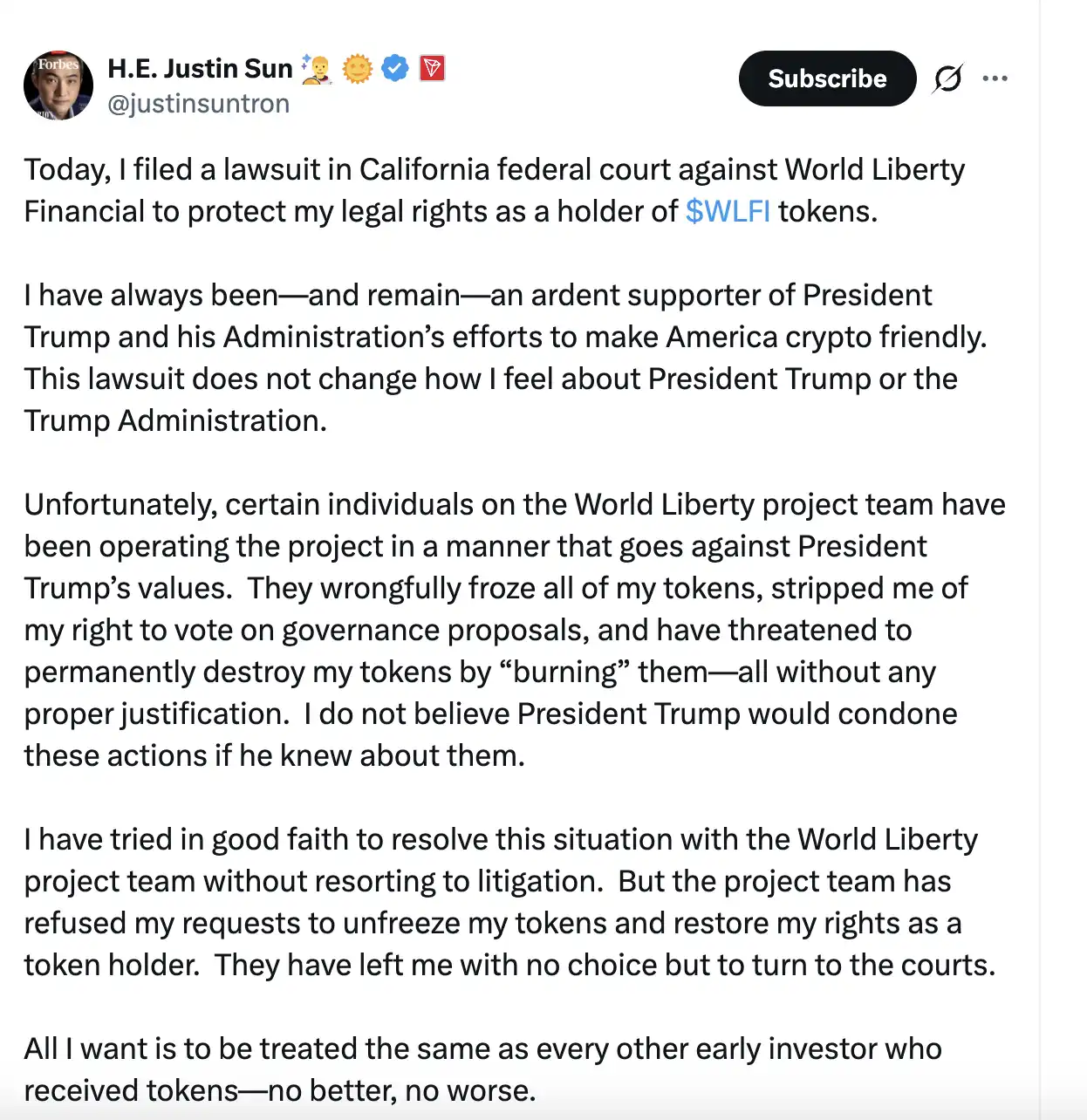
On April 22, the founder of Tron formally sued World Liberty Financial in San Francisco federal court, accusing it of making him "the primary target of its fraudulent scheme," causing him and his companies to suffer "losses amounting to hundreds of millions of dollars." He also accused WLF of being currently "on the verge of collapse" and "severely insolvent," and planning to pay 95% of the token sale proceeds to "company insiders."

The person in the crypto circle best at calculating got calculated this time.
The $75 Million "Pledge of Allegiance"

Rewind to the end of 2024.

World Liberty Financial had just launched the sale of WLFI tokens, and the scene was embarrassingly quiet, with only $22 million in sales in the first month.

Justin Sun stepped in. First, he threw in $30 million, later increased to $45 million, plus 1 billion tokens received for advisory services, totaling an investment of approximately $75 million. He became World Liberty's largest public investor.

After Sun bought, other investors followed, and the project ultimately raised about $550 million. World Liberty Financial later publicly admitted that Sun helped the project "come back to life."

At that time, the SEC was suing Sun, accusing him of market manipulation, selling unregistered securities, and paying celebrities to promote without disclosure. However, after Trump took office in January 2025, the SEC voluntarily suspended its lawsuit against Sun. In March 2026, the two sides settled for $10 million, with Sun not admitting any wrongdoing.

A $30 million investment got rid of a lawsuit that could have bankrupted him. Sun calculated this account very clearly.

Refused to Inject More Capital, Immediately Blacklisted

The honeymoon period was short.

According to the complaint, World Liberty Financial continuously asked Sun to make additional investments throughout 2025, including asking him to mint World Liberty Financial's USD1 stablecoin on the Tron network. Sun refused.

By July 2025, the relationship completely broke down.

What happened next was less a commercial dispute and more an on-chain manhunt.

In August 2025, World Liberty Financial modified the WLFI token's smart contract, inserting a "blacklist" function. The project team could unilaterally freeze any holder's tokens without notice, without reason, and without a governance vote.

A month later, Sun tried to transfer his WLFI tokens. But his wallet was blacklisted, and approximately $107 million worth of governance tokens were frozen, with voting rights revoked.

Later, World Liberty Financial threatened to "burn" (destroy) his tokens. In the blockchain world, burn means permanent eradication; the asset ceases to exist.

Sun claimed he had tried to "resolve the matter amicably," but the other party refused to unfreeze the tokens and restore his rights.

"They left me with no choice but to turn to the courts," he wrote on X.

World Liberty Financial CEO Zach Witkoff responded that Sun's allegations were "completely without merit" and said Sun had engaged in "improper conduct," forcing World Liberty Financial to take action to "protect itself and its users."

No one explained what this "improper conduct" specifically was.

The President's ATM

To understand why Sun was frozen, one must first see what World Liberty Financial really is.

On the surface, it is a "decentralized finance" project, claiming to let small investors control their own funds. It has a governance token WLFI, a stablecoin USD1, and DeFi lending products.

But peel back this layer, and the core structure is a profit pipeline.

The Trump family receives 75% of the net proceeds from WLFI token sales. By December 2025, the family had already profited $1 billion from this, while holding $3 billion worth of unsold tokens. The reserve assets for the USD1 stablecoin are invested in U.S. Treasury bonds, and the interest income generated also flows to family entities. Based on a market cap of $4.2 billion and current Treasury yields, the stablecoin alone could generate approximately $160 million in annual income.

This doesn't even include the biggest chunk.

In January 2025, just four days before Trump's inauguration, an investment entity of Abu Dhabi royal family member Sheikh Tahnoon bin Zayed acquired a 49% stake in World Liberty Financial for $500 million. The agreement was signed by Eric Trump. $187 million flowed directly into entities controlled by the Trump family, and at least $31 million went to entities linked to the Witkoff family.

Zach Witkoff, CEO and co-founder of World Liberty Financial. His father, Steve Witkoff, is the U.S. Special Envoy to the Middle East.

Senator Elizabeth Warren called it "blatant corruption." The House of Representatives subsequently launched an investigation. Trump himself said he was "unaware" of the deal.

Dolomite: Borrowing Your Own Money

In early 2026, on-chain data showed World Liberty Financial deposited 5 billion of its own WLFI tokens into the DeFi lending platform Dolomite as collateral, borrowing approximately $75 million in stablecoins. Over $40 million of this was transferred to Coinbase Prime, which usually means the tokens were converted into fiat currency.

And Dolomite's co-founder, Corey Caplan, is simultaneously an advisor to World Liberty Financial.

Your own tokens, deposited into a platform run by your own advisor, borrowing your own issued stablecoins, and then converting to cash.

This operation pushed the utilization rate of Dolomite's USD1 lending pool to 100%. Ordinary depositors were locked in, unable to withdraw their funds. And World Liberty Financial's collateral accounted for 55% of Dolomite's total value locked (TVL).

World Liberty Financial's response: "We, as an anchor borrower, created attractive yields for the platform."

In other words, they used their own issued tokens as collateral on their advisor's platform to borrow their own issued stablecoins. In traditional finance, this is called a related-party transaction, requiring separate auditing and disclosure. In DeFi, there wasn't even an announcement.

Sun publicly challenged this on April 12, saying the World Liberty Financial team treated users as a "personal ATM" and that he was the "first and biggest victim." Three days later, World Liberty Financial introduced a governance proposal.

Ultimatum

The governance proposal on April 15 was nominally about "governance restructuring." The actual content: 6.228 billion WLFI tokens (62% of the total supply) would be subject to a new unlocking schedule. The 45.2 billion tokens held by founders, team, and advisors needed to accept a 10% burn (approx. 4.52 billion tokens), then enter a 2-year lock-up period followed by 3-year linear release.

Holders who did not accept the new terms would have their tokens frozen indefinitely.

Sun called this proposal "one of the most ridiculous governance scams I have ever seen." But he couldn't vote against it because his tokens were already frozen.

Look at the distribution of voting power. In a USD1 governance proposal passed in January 2026, the top nine wallets controlled nearly 60% of the voting power.

WLFI's price action says it all. It hit an all-time high of $0.46 in September 2025 and has been falling since. On April 11, it touched an all-time low of $0.0767, down 84% from its high.

Early buyers who got in at $0.015 still have paper gains. But if you're Justin Sun, your $75 million investment bought tokens once worth over $1 billion, but now they are frozen and potentially facing permanent destruction.

The Same Mirror

Justin Sun is no innocent victim.

He has been accused by the SEC of market manipulation and fraud, and his investment timing precisely coincided with his legal troubles.

Precisely because he is not innocent, this case is interesting.

A person who made his fortune by "rug pulling" is treated with the same tactics by a larger power structure. The contrast here speaks volumes, more than any whitepaper.

World Liberty Financial promised "decentralized finance," user control over assets, no middlemen, no censorship.

But in reality, the smart contract has a backdoor, the project team can freeze your tokens at any time, governance votes are controlled by nine wallets, and the founders use your deposits to lend to themselves.

Sun's original words on X were: "Unfortunately, certain individuals within the World Liberty Financial project team are operating the project in a manner inconsistent with President Trump's values."

Even at the moment of filing the lawsuit, he was still saving face for Trump. A person who spent $75 million, after having all his assets frozen, still carefully distinguished between "President Trump" and "certain individuals within the project team" in the complaint.

The most interesting part of this case is not whether Sun can get his tokens back. It's how the court will characterize WLFI. If it is a security, then World Liberty Financial's act of modifying the contract and freezing holder assets without a vote could constitute fraud under federal securities law.

WLFI is currently quoted at $0.078, down about 84% from its high. The adequacy of the USD1 stablecoin reserve is being questioned. The risk in Dolomite's lending pool remains unresolved. The House investigation is ongoing. But the Trump family has already cashed out over $1 billion.

The earliest maturity window for Sun's convertible bonds is in 2027. Court scheduling could take over a year. During this time, WLFI tokens will continue to unlock, and more people will be forced to accept the choice of "either agree to the new terms or be frozen forever."


Trend Kriptolar

İlgili Sorular

QWhat is the core allegation in Justin Sun's lawsuit against World Liberty Financial?

AJustin Sun alleges that World Liberty Financial made him 'the primary target of its fraudulent scheme,' causing him and his companies to suffer 'hundreds of millions of dollars in losses.' He also claims the company is 'on the brink of collapse' and 'severely insolvent,' with plans to pay '95% of the token sale proceeds to company insiders.'

QWhat specific action did World Liberty Financial take that led to Justin Sun's assets being frozen?

AIn August 2025, World Liberty Financial modified the WLFI token's smart contract to include a 'blacklist' function. This allowed the project to unilaterally freeze any holder's tokens without notice, reason, or a governance vote. Sun's tokens, worth approximately $107 million, were frozen when he tried to transfer them a month later.

QHow is the Trump family financially connected to World Liberty Financial according to the article?

AThe Trump family receives 75% of the net proceeds from WLFI token sales, having already profited $1 billion by December 2025. They also hold $3 billion in unsold tokens. Furthermore, interest income from the USD1 stablecoin's treasury reserves flows to family entities, generating an estimated $160 million annually.

QWhat controversial transaction involving Dolomite is described in the article?

AWorld Liberty Financial deposited 5 billion of its own WLFI tokens into the DeFi lending platform Dolomite as collateral to borrow approximately $75 million in stablecoins. Over $40 million of this was transferred to Coinbase Prime, likely to be converted to cash. This is controversial because Dolomite's co-founder is also an advisor to World Liberty Financial, creating a clear conflict of interest.

QWhat was the 'ultimatum' presented to token holders in the April 15th governance proposal?

AThe proposal required that 45.2 billion tokens held by founders, team, and advisors be subject to a 10% burn (approx. 4.5 billion tokens) and then locked for 2 years with a 3-year linear release schedule. Holders who did not accept these new terms would have their tokens frozen indefinitely.

İlgili Okumalar

Within Strategy's Framework, STRC's Dividend Yield Remains at 12% as Share Price Stays Below Par Value

Michael Saylor, Executive Chairman of Strategy (MSTR), confirmed that the dividend rate for its STRC perpetual preferred shares will remain at 12.00% through August 2026. The rate has increased from 9% at its July 2025 launch to the current high via a "ratchet" mechanism, which permanently raises the rate by 0.5% whenever the share price falls below $95. This mechanism is intended to push the price back toward its $100 par value and support Strategy's "at-the-market" (ATM) program for issuing new shares to fund Bitcoin purchases. However, the mechanism has not worked as intended. STRC shares closed at $89.46 on July 31, remaining about 10-11% below par value despite the record-high dividend. Competition from rival Strive's higher-yielding SATA securities has pressured demand. The persistent discount has forced Strategy to suspend new STRC issuances via its ATM program, limiting this funding channel for Bitcoin acquisitions. STRC's struggles reflect Bitcoin's own volatility, as the preferred shares historically move in tandem. Analysts have warned the ratchet structure carries long-term, one-way risk. A law firm is investigating Strategy's ability to maintain dividend payments if Bitcoin's price stays low. Retail investors own roughly 83% of outstanding STRC shares, a group seen as prone to panic selling during downturns. In response, Strategy has established financial reserves, including a liquidity cushion covering about 26 months of dividend/interest obligations, and a $2 billion share buyback program alongside a Bitcoin monetization framework, though the company emphasized it is not obligated to sell any Bitcoin.

cryptonews.ru5 dk önce

Within Strategy's Framework, STRC's Dividend Yield Remains at 12% as Share Price Stays Below Par Value

cryptonews.ru5 dk önce

Analyst: Bitcoin's Price Will Drop to $60k in August, Then Rebound to $70k

Financial analyst Andrey Poroshin has provided a new forecast for Bitcoin's price dynamics in August. Poroshin, an analyst at the Bitbanker exchange, expects the cryptocurrency market to experience a downturn this month, with prices retesting the $60,000 level due to a lack of supportive macroeconomic catalysts. He noted that the recent US Federal Reserve decision to hold interest rates did not significantly impact the market, while inflation remains above the 2% target. Poroshin stated that Bitcoin is ending July under pressure from moderate volatility and a lack of new macroeconomic stimuli, leading to continued market caution. According to his base scenario, Bitcoin will drop to a range of $60,000 to $62,000 before recovering to $70,000. He pointed out that even $70,000 remains below the cost of mining in the US, which has prompted some miners to shift towards AI data center operations. Poroshin cited the winding down of BitMEX's operations as a potential catalyst for a price rebound, suggesting the exit of weaker players often coincides with market reversals and reduced short-term selling pressure. He believes Bitcoin is currently less susceptible to geopolitical shocks, such as the Iran-US conflict, and does not expect significant market changes in August related to the pending CLARITY Act. Looking ahead, Poroshin forecasts that September will bring more active price fluctuations driven by potential Fed rate decisions and possible discussions or approval of the CLARITY Act.

cryptonews.ru5 dk önce

Analyst: Bitcoin's Price Will Drop to $60k in August, Then Rebound to $70k

cryptonews.ru5 dk önce

In Jinjiang, Fujian, a Storage Super Unicorn Lies Quiet

In Fujian's Jinjiang, a city known for sportswear, lies a quiet semiconductor giant: Fujian Jinhua Integrated Circuit Co. (JHICC). Once a promising domestic DRAM manufacturer alongside Yangtze Memory and ChangXin Memory Technologies (CXMT), its journey was derailed in 2018 when the U.S. placed it on an Entity List and filed criminal charges for alleged trade secret theft. This halted production for years. A turning point came in February 2024 when a U.S. federal court found JHICC not guilty. However, it had lost crucial time. While CXMT soared to become a top-valued A-share company in 2024, JHICC, with an estimated valuation of 80 billion RMB, was just restarting. Its current output is primarily customized DDR4 chips, not the advanced DDR5/HBM demanded for AI, but it still benefits from the broader memory chip upcycle. JHICC's story is tied to Chen Zhengkun, a veteran engineer who left Micron to lead the venture. Founded in 2016 with state-backed funding, JHICC partnered with Taiwan's UMC to develop DRAM technology. Rapid progress was cut short by the U.S. actions, which Micron initiated, partly due to its heavy reliance on the Chinese market. Post-sanctions, Chen's team worked to rebuild the production line with reduced reliance on U.S. technology. According to its records, JHICC achieved small-scale production and revenue growth under immense pressure. It now focuses on the stable "niche" DRAM market (e.g., TVs, routers) with a monthly capacity of ~40,000 wafers, aiming for 60,000 by 2026. It holds over 1,000 patents but remains on the Entity List. For Jinjiang, investing in JHICC was a bold industrial leap. The local government provided unwavering financial and logistical support during the crisis, helping the company survive. JHICC has become the anchor for a growing local semiconductor cluster. Though its scale lags behind domestic peers, JHICC's persistence symbolizes a hard-won foothold in a global market long dominated by Samsung, SK Hynix, and Micron. Having missed one boom, it seeks a place in the new AI-driven memory supercycle.

marsbit2 saat önce

In Jinjiang, Fujian, a Storage Super Unicorn Lies Quiet

marsbit2 saat önce

İşlemler

Spot

Popüler Makaleler

SUN Nasıl Satın Alınır

HTX.com’a hoş geldiniz! SUN (SUN) satın alma işlemlerini basit ve kullanışlı bir hâle getirdik. Adım adım açıkladığımız rehberimizi takip ederek kripto yolculuğunuza başlayın. 1. Adım: HTX Hesabınızı OluşturunHTX'te ücretsiz bir hesap açmak için e-posta adresinizi veya telefon numaranızı kullanın. Sorunsuzca kaydolun ve tüm özelliklerin kilidini açın. Hesabımı Aç2. Adım: Kripto Satın Al Bölümüne Gidin ve Ödeme Yönteminizi SeçinKredi/Banka Kartı: Visa veya Mastercard'ınızı kullanarak anında SUN (SUN) satın alın.Bakiye: Sorunsuz bir şekilde işlem yapmak için HTX hesap bakiyenizdeki fonları kullanın.Üçüncü Taraflar: Kullanımı kolaylaştırmak için Google Pay ve Apple Pay gibi popüler ödeme yöntemlerini ekledik.P2P: HTX'teki diğer kullanıcılarla doğrudan işlem yapın.Borsa Dışı (OTC): Yatırımcılar için kişiye özel hizmetler ve rekabetçi döviz kurları sunuyoruz.3. Adım: SUN (SUN) Varlıklarınızı SaklayınSUN (SUN) satın aldıktan sonra HTX hesabınızda saklayın. Alternatif olarak, blok zinciri transferi yoluyla başka bir yere gönderebilir veya diğer kripto para birimlerini takas etmek için kullanabilirsiniz.4. Adım: SUN (SUN) Varlıklarınızla İşlem YapınHTX'in spot piyasasında SUN (SUN) ile kolayca işlemler yapın.Hesabınıza erişin, işlem çiftinizi seçin, işlemlerinizi gerçekleştirin ve gerçek zamanlı olarak izleyin. Hem yeni başlayanlar hem de deneyimli yatırımcılar için kullanıcı dostu bir deneyim sunuyoruz.

719 Toplam GörüntülenmeYayınlanma 2024.12.12Güncellenme 2025.03.21

SUN Nasıl Satın Alınır

Tartışmalar

HTX Topluluğuna hoş geldiniz. Burada, en son platform gelişmeleri hakkında bilgi sahibi olabilir ve profesyonel piyasa görüşlerine erişebilirsiniz. Kullanıcıların SUN (SUN) fiyatı hakkındaki görüşleri aşağıda sunulmaktadır.

活动图片












