"Six Walnuts" Diversifies into AI Investment, Stock Price Triples in One Year

marsbit2026-06-24 tarihinde yayınlandı2026-06-24 tarihinde güncellendi

Özet

"Six Walnuts," a popular Chinese beverage brand under Yangyuan Food and Beverage, has pivoted aggressively into AI and semiconductor investments. Despite its core walnut milk drink business facing sustained decline—with revenues shrinking 41% over a decade—the parent company has channeled nearly all its annual profits for three consecutive years into a 40 billion yuan investment fund targeting AI hardware, chips, and storage. This bold move has transformed the firm into an AI-themed stock, propelling its share price up nearly 300% in one year, even as consumer stocks broadly struggled. A key bet is a 1.6 billion yuan investment in memory chipmaker Yangtze Memory, whose potential IPO could deliver substantial returns. Other investments span AI vision, edge AI chips, and GPUs, though many remain unrealized or at a paper loss. While maintaining its beverage base, Yangyuan is pursuing a dual-track strategy: steady income from its traditional business and high-risk, high-reward exposure to hard tech. Its future valuation now heavily depends on the success of these tech investments, particularly Yangtze Memory's listing. Failure could lead to significant market correction as AI expectations unwind.

Author: Think AI, Aaron

"Use your brain often, drink more Six Walnuts" is a well-known advertising slogan.

As the blockbuster beverage of Yangyuan Beverage Company, Six Walnuts once swept across the country. Few would have imagined that this beverage company would be linked to AI chips.

In fact, the parent company of Six Walnuts is almost all-in on AI, having invested nearly its entire annual net profit into AI-related industries for three consecutive years.

Although it hasn't yet made actual money from the AI industry, its stock price soared from around 17.7 yuan at the beginning of last year to a high of 52 yuan in May, a 293% increase, nearly tripling.

The market already views Yangyuan Beverage as an AI concept stock.

In contrast, similar consumer stocks have had a terrible year over the same period. Across the A-share market, 1653 individual stocks hit new lows for the year, with consumer sector stocks accounting for a very high proportion. "Six Walnuts" has become a bright spot in the market.

Why has the parent company of Six Walnuts continued to ramp up investments in hard-tech sectors like AI since 2021? If these investments fail, what will the future hold?

Main Business Shrinking, Founding Team Needs Imagination

There was a time when Yangyuan Beverage was a dominant force. In 2015, its revenue reached a historical peak of 9.1 billion yuan, making founder Yao Kuizhang the richest person in Hebei province that year.

From 2015 to 2018, Yangyuan maintained rapid development, with net profit reaching a historical maximum of 2.8 billion yuan in 2018.

At that time, Yangyuan held a 90% market share in the walnut milk industry, almost monopolizing the entire sector.

Annual net profits exceeding 2 billion yuan also made the company a cash cow.

But by the present, in 2025, Yangyuan's revenue is only around 5.3 billion yuan, a 41% decline over 10 years, and profits have halved to just 1.2 billion yuan compared to the peak.

More troubling is that the decline is not isolated. Yangyuan is under pressure in its main sales regions like East China, Central China, and North China, with declines in regions like Northeast and Northwest China even exceeding 30%. Traditional peak seasons have also failed to reverse the downturn.

Yangyuan heavily relies on core products like Six Walnuts, with walnut milk accounting for over 80% of all product sales.

New products have remained lukewarm, while walnut milk itself is losing market share to alternatives like nut milks and oat milk. The gifting attribute of Six Walnuts has also gradually weakened, placing the main business in a long-term shrinking track.

Faced with weak products, the company did not choose to increase R&D efforts, innovate with new products, or compete on the product front.

Instead, it chose a more imaginative route of AI investment. Yangyuan's overall investment philosophy is relatively simple: invest in whatever is hot.

Setting aside the question of right or wrong, let's first look at which sectors Yangyuan has heavily entered, what results it has achieved, and then we will predict Yangyuan's possible endgame.

Cross-Border Gambling Spree

Since 2021, Yangyuan Beverage has focused on laying out the upstream and downstream of AI hardware. It launched a 3-billion-yuan fund, later expanding it by another 1 billion yuan in October last year, continuously increasing bets on AI, semiconductors, and new energy.

So far, 2.95 billion yuan has been spent, with 1.05 billion yuan still idle, awaiting new projects to invest in.
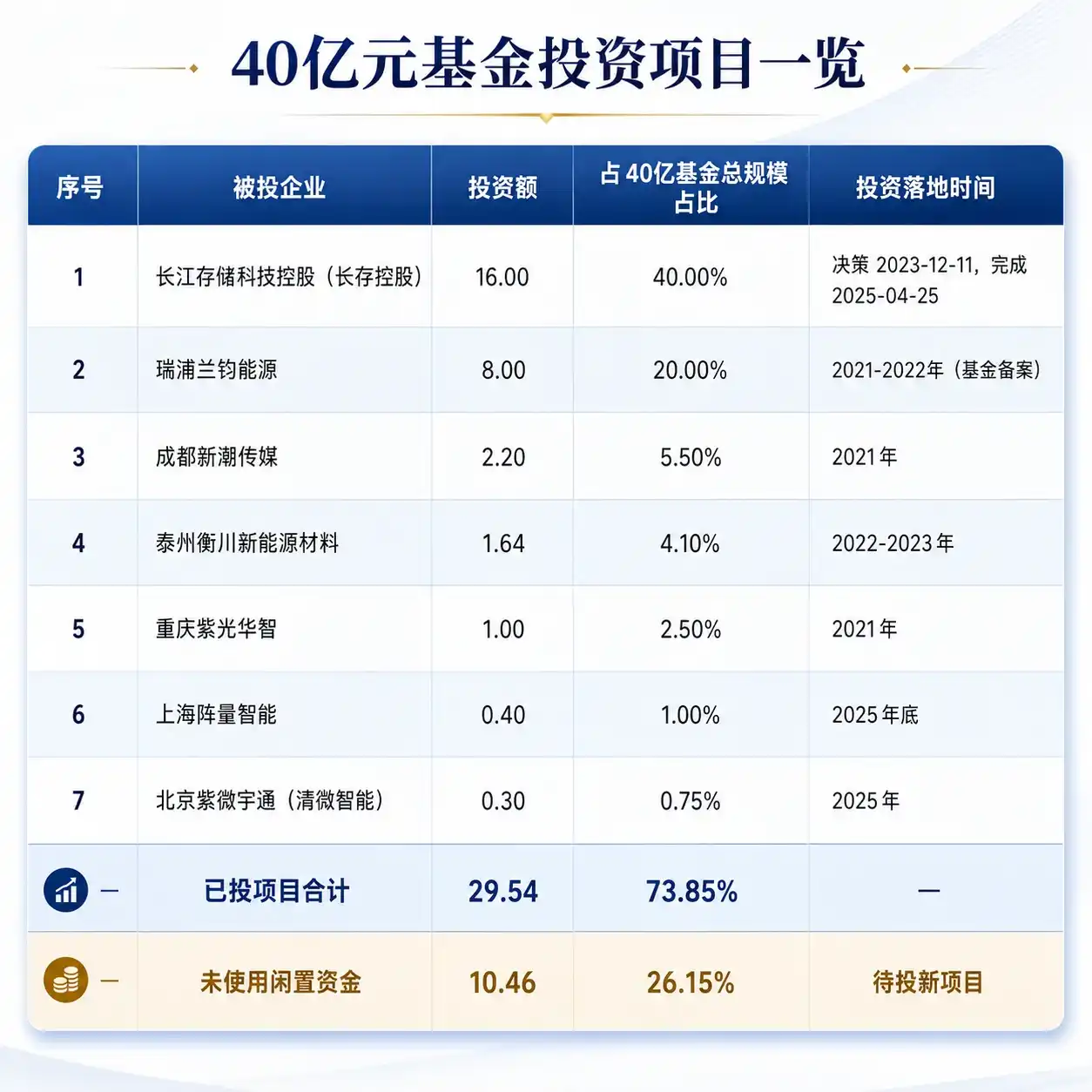
Among its 4-billion-yuan fund, one major investment drew attention: a 1.6-billion-yuan investment completed in April last year into Yangtze Memory Technologies Co., Ltd. (YMTC), acquiring a 0.99% equity stake.

1.6 billion yuan is equivalent to Yangyuan's entire annual profit. Investing the whole amount into a long-cycle industry like memory storage shows the company's boldness.

And YMTC has become hot this year, with reports of a potential domestic IPO and valuations ranging from 500 billion to 1 trillion yuan. Compared to last year's investment valuation, this represents a tripling in value.

If YMTC can successfully list, this single investment will mark the success of Yangyuan's industrial investments.

Because most of the other investments are currently at a floating loss, but Yangyuan has not exited, opting to continue holding long-term.

Among them, an 800-million-yuan investment in REPT Battero, a new energy power battery company, was fully cashed out after its 2023 Hong Kong IPO, realizing a book gain of approximately 241 million HKD.

The acquisition of Xinchao Media by Focus Media was valued at only 8.3 billion yuan, far below the 16.1 billion yuan valuation at the time of investment. Exit has not been executed yet, the fund still holds the equity, and it is currently at a floating loss.

The other AI-related companies are concentrated in areas like AI vision, edge-side AI chips, and GPUs for large model training, forming a relatively complete AI industry chain layout.

What's Next for Yangyuan?

In the coming years, Yangyuan Beverage is unlikely to completely transform into a VC company. Instead, it will likely maintain a dual-wheel model of "consumer main business as the foundation, equity investments for elasticity."

Six Walnuts will still be the company's basic business, but the walnut milk category has passed its high-growth period and will find it difficult to return to its past peak of 10 billion yuan annual revenue.

The 4-billion-yuan Quanhong Fund will remain an industrial fund worth watching.

Yangyuan's future capital will likely continue to flow into the upstream of AI computing power, including hard-tech directions like memory storage, edge-side AI chips, and industrial vision. Non-core tracks like new energy and media will gradually be marginalized.

If YMTC successfully lists, the investment gains could rewrite the income statement in one go, transforming the company's valuation from a traditional beverage stock to a dual pricing of "consumer + hard-tech shadow stock."

Conversely, if YMTC's listing is delayed or the semiconductor cycle turns cold, the stock price could also sharply retreat due to unmet tech expectations.


Trend Kriptolar

İlgili Sorular

QWhat is the main reason behind Yangyuan Beverage's (parent company of 'Six Walnuts') heavy investment in AI and related industries since 2021?

AThe primary reason is the continuous decline of its core beverage business, 'Six Walnuts.' The company faces shrinking revenues and profits in its main product line, with market share being eroded by alternatives like nut milk and oat milk. Instead of intensifying product R&D, the company has chosen to invest in high-growth, high-imagination sectors like AI to seek new growth drivers and boost its market valuation.

QWhat was the most significant AI/hard tech investment made by Yangyuan Beverage's fund, and what is its current status?

AThe most significant investment was a 1.6 billion RMB injection into Yangtze Memory Technologies Co., Ltd. (YMTC) in April of last year, acquiring a 0.99% stake. YMTC is reportedly planning a domestic IPO with a valuation estimated between 500 billion and 1 trillion RMB. If successful, this investment could triple in value and be a major success for Yangyuan's industrial investment strategy.

QHow has Yangyuan Beverage's stock price performed following its shift towards AI investments, and how does this contrast with the broader market?

AYangyuan Beverage's stock price surged from a low of around 17.7 RMB in early last year to a high of 52 RMB in May, representing a gain of approximately 293% (nearly tripling). This performance starkly contrasts with the broader A-share consumer sector, where many stocks hit yearly lows, making 'Six Walnuts' a standout performer in the market.

QAccording to the article, what is the likely future business model for Yangyuan Beverage?

AThe article suggests Yangyuan Beverage will likely maintain a dual-wheel business model: its traditional consumer beverage business (primarily 'Six Walnuts') as a stable foundation, combined with equity investments (particularly in AI and hard tech via its Quanhong Fund) to seek higher growth and valuation elasticity. It is not expected to transform completely into a venture capital firm.

QWhat are the potential risks for Yangyuan Beverage if its major AI/hard tech investments, like in YMTC, do not meet expectations?

AIf key investments like YMTC face delays in their IPO or if the semiconductor industry cycle turns downward, Yangyuan Beverage could experience a significant drop in its stock price as market expectations for tech-driven growth fail to materialize. This would lead to a sharp valuation correction. The company's financial performance would also be impacted without the anticipated large investment returns to offset the decline in its core beverage business.

İlgili Okumalar

Chip Stocks Lead U.S. Market Decline: Is AI Trading Being Hit by Both Interest Rates and Returns?

Chip stocks led a broad decline in US markets, with the Nasdaq dropping 2.2% and the S&P 500 falling 1.4%. This selloff reflects a dual challenge for the once-high-flying AI hardware trade: rising interest rate expectations and growing investor impatience for clear returns from massive AI capital expenditures. The pressure was most acute on hardware leaders. Nvidia fell about 4%, dipping below a $5 trillion market cap, while Micron plunged 13.2% ahead of its earnings report. Declines across memory, storage, AI, and mobile chips indicated a sector-wide retreat. The selloff spread globally, with South Korea's KOSPI index dropping nearly 10% as key suppliers SK Hynix and Samsung recorded double-digit losses. Investors appeared to be taking profits from the most crowded trades first. Macro headwinds intensified as market expectations shifted toward a more aggressive Federal Reserve. Forecasts for multiple rate hikes in 2026 pressured high-valuation tech stocks, which rely on long-term growth projections that become less attractive as discount rates rise. Concurrently, investors are scrutinizing the profit potential of the immense AI spending by cloud giants like Alphabet, Amazon, and Meta. While these expenditures drive demand for chips and hardware, the market is now questioning whether AI services will generate sufficient returns to justify the ongoing costs. This adjustment is not necessarily a bubble burst but a recalibration. AI demand fundamentals remain, but the narrative of endless growth can no longer fully offset concerns over higher interest rates and a longer path to profitability. Near-term direction may hinge on Micron's upcoming earnings guidance and incoming inflation data, which will influence both the AI demand outlook and the Fed's policy path. The market is transitioning from blindly buying growth to demanding clearer visibility on returns.

marsbit16 dk önce

Chip Stocks Lead U.S. Market Decline: Is AI Trading Being Hit by Both Interest Rates and Returns?

marsbit16 dk önce

OpenAI's New Paper: How to Train an AI that "Doesn't Deteriorate Under Pressure"?

OpenAI's new paper "Reinforcement Learning Towards Broadly and Persistently Beneficial Models" explores training AI to maintain safe, helpful, and honest behavior even under pressure, in unseen scenarios, or after being fine-tuned for harmful purposes. Moving beyond simple rule-based "don'ts," the research focuses on cultivating "beneficial traits" like honesty, risk-awareness, corrigibility, and transparency. It investigates if reinforcement learning (RL), often prone to "reward hacking" where models exploit loopholes, can instead be used to instill robust, generalized positive behaviors. Researchers created a multi-domain synthetic dialogue dataset covering areas like healthcare and law. They trained a model by replacing 5% of standard RL data with "beneficial trait" data. This model outperformed the baseline in 83% of 53 evaluations, showing average gains of 9.1% in alignment, safety, and helpfulness. Crucially, improvements generalized: a model trained only on healthcare "good behavior" data also performed better in 17 out of 19 non-healthcare alignment tests. The paper also tests "alignment persistence." When subjected to adversarial prompts or harmful fine-tuning, the beneficial trait model showed greater resilience, with smaller performance drops and less "spillover" of bad behavior to unrelated tasks. While not a complete solution, this work suggests a shift from post-hoc correction to proactively shaping robust, principled AI behavior, a critical step for deploying models in high-stakes, complex decision-making scenarios.

marsbit19 dk önce

OpenAI's New Paper: How to Train an AI that "Doesn't Deteriorate Under Pressure"?

marsbit19 dk önce

Semiconductor Stock Rebound: Is the Technical Correction Over or a Trend Reversal?

The core of recent semiconductor stock volatility is not about daily price swings, but rather the market questioning whether AI-driven semiconductor pricing has entered a new phase. Following a sharp sell-off in Korean stocks on June 23rd, led by Samsung and SK Hynix, a subsequent rebound is seen more as a technical positioning adjustment rather than a confirmed trend reversal. The key variable is HBM (High Bandwidth Memory), essential for AI chips. Its supply-demand imbalance granted memory makers significant pricing power. The current market focus is on whether this dynamic remains strong enough to justify elevated valuations. All eyes are on Micron's upcoming earnings report. The critical factor is not whether results meet already high expectations, but whether the company's guidance confirms that AI memory pricing power, order visibility, and future margins are still expanding. Micron's outlook will serve as a crucial test for the broader AI semiconductor chain, including Samsung, SK Hynix, and other infrastructure players. The recent bounce appears to be a pre-earnings positioning repair. For it to evolve into a sustained uptrend, concrete evidence is needed that the AI infrastructure expansion cycle's fundamentals—particularly for high-end memory—remain robust and can continue to surpass elevated market expectations. The risk is that strong demand alone may not be sufficient if future guidance hints at peaking momentum or increasing supply-side pressures.

marsbit56 dk önce

Semiconductor Stock Rebound: Is the Technical Correction Over or a Trend Reversal?

marsbit56 dk önce

İşlemler

Spot
Futures

Popüler Makaleler

ONE Nasıl Satın Alınır

HTX.com’a hoş geldiniz! Harmony (ONE) satın alma işlemlerini basit ve kullanışlı bir hâle getirdik. Adım adım açıkladığımız rehberimizi takip ederek kripto yolculuğunuza başlayın. 1. Adım: HTX Hesabınızı OluşturunHTX'te ücretsiz bir hesap açmak için e-posta adresinizi veya telefon numaranızı kullanın. Sorunsuzca kaydolun ve tüm özelliklerin kilidini açın. Hesabımı Aç2. Adım: Kripto Satın Al Bölümüne Gidin ve Ödeme Yönteminizi SeçinKredi/Banka Kartı: Visa veya Mastercard'ınızı kullanarak anında Harmony (ONE) satın alın.Bakiye: Sorunsuz bir şekilde işlem yapmak için HTX hesap bakiyenizdeki fonları kullanın.Üçüncü Taraflar: Kullanımı kolaylaştırmak için Google Pay ve Apple Pay gibi popüler ödeme yöntemlerini ekledik.P2P: HTX'teki diğer kullanıcılarla doğrudan işlem yapın.Borsa Dışı (OTC): Yatırımcılar için kişiye özel hizmetler ve rekabetçi döviz kurları sunuyoruz.3. Adım: Harmony (ONE) Varlıklarınızı SaklayınHarmony (ONE) satın aldıktan sonra HTX hesabınızda saklayın. Alternatif olarak, blok zinciri transferi yoluyla başka bir yere gönderebilir veya diğer kripto para birimlerini takas etmek için kullanabilirsiniz.4. Adım: Harmony (ONE) Varlıklarınızla İşlem YapınHTX'in spot piyasasında Harmony (ONE) ile kolayca işlemler yapın.Hesabınıza erişin, işlem çiftinizi seçin, işlemlerinizi gerçekleştirin ve gerçek zamanlı olarak izleyin. Hem yeni başlayanlar hem de deneyimli yatırımcılar için kullanıcı dostu bir deneyim sunuyoruz.

395 Toplam GörüntülenmeYayınlanma 2024.12.12Güncellenme 2026.06.02

ONE Nasıl Satın Alınır

Tartışmalar

HTX Topluluğuna hoş geldiniz. Burada, en son platform gelişmeleri hakkında bilgi sahibi olabilir ve profesyonel piyasa görüşlerine erişebilirsiniz. Kullanıcıların ONE (ONE) fiyatı hakkındaki görüşleri aşağıda sunulmaktadır.

活动图片