Original Title: 《Sentient Announces Token Economics, How Will the Market Price It?》
Original Author: ChandlerZ, Foresight News
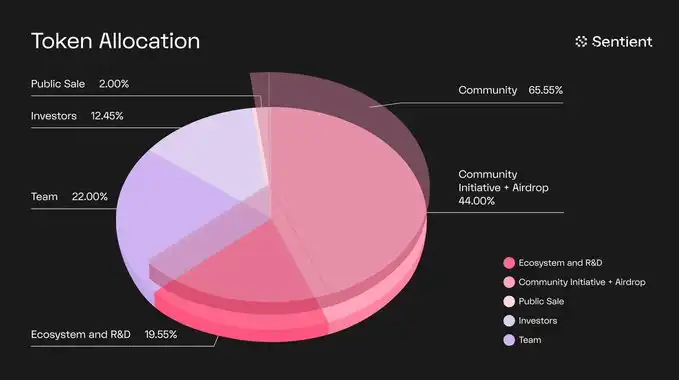
On January 16, the open-source AI platform Sentient announced the SENT token economics. The total supply of SENT tokens is approximately 34.3 billion, with 44% allocated to community incentives and airdrops, 19.55% to the ecosystem system and R&D, 2% to public sales, 22% allocated to the team, and 12.45% allocated to investors.
According to Polymarket data, the market's bet on the probability of Sentient's next-day FDV exceeding $200 million has risen to 99%, the probability of exceeding $400 million is 87%, and the probability of exceeding $600 million is 83%. The current trading volume of this prediction market is approximately $330,000.
Allocation Rules Details
Throughout the entire ecosystem, SENT is used for agents, models, data services, and other products driven by Artifacts. Artifacts can also use SENT for payments, thereby realizing composable on-chain value flows between services. The official set the total supply of SENT at 34,359,738,368, which is exactly 2³⁵. The official stated that the full story of how this number was chosen will be shared in the future; however, technically savvy readers might be able to deduce the reason.
SENT allocation is divided into five categories: Community Advocacy and Airdrops, Ecosystem System and R&D, Team, Investors, and Public Sale.
Community Activities and Airdrops ——44.00%
This portion of tokens accounts for 44% of the total supply and is specifically used for airdrops, community grants, bounties, and incentive programs to reward users and developers for their verifiable work on GRID. To ensure broad ownership, 30% of these tokens will be unlocked at TGE (approximately 13% of total supply), and the remaining 70% will be linearly unlocked over 4 years. According to the design, personnel who build, test, and share open-source intelligence and products will be eligible to receive the largest share of tokens. Airdrops will be fully unlocked at TGE.
Ecosystem System and R&D ——19.55%
This portion of tokens accounts for 19.55% of the total supply and will be used to promote ecosystem development, R&D, growth, infrastructure construction, and the operation of the Sentient Foundation. To ensure long-term stable supply, 30% will be unlocked at TGE (token issuance date), and the remaining 70% will be linearly unlocked over four years.
Team —— 22.00%
This funding pool accounts for 22% of the total supply and is exclusively for the team members of the Sentient Foundation and Sentient Labs, including employees, founders, and key contractors. At TGE, the team funding pool is locked for one year, after which the funds will be released linearly over 6 years, with a 1-year cliff period.
Investors ——12.45%
This portion of tokens accounts for 12.45% of the total supply and is allocated to investors who supported Sentient in private rounds. Investor tokens will be locked for one year and then linearly unlocked over four years. This structure aims to reward the confidence of early investors.
Public Sale ——2.00%
This public sale accounts for 2% of the total supply and aims to encourage broader participation from community members at the project's launch. This allocation will be fully unlocked at TGE. The specific public sale structure will be announced soon.
At the end of November 2025, Sentient opened airdrop registration for users, targeting four groups: community contributors, active Sentient Chat users, social platform Top Voices, and external open-source researchers.
The second season's activities will feature new roles based on contributions, clearer upgrade paths, and multiple reward mechanisms. Rewards will include SENT tokens, NFTs, and merchandise. Specific airdrop activity details have not yet been announced.
A New AI Star That Raised $85 Million
Sentient is an AI research organization dedicated to building an open artificial general intelligence (AGI) economy, developing a platform and protocol that allows open-source AI developers to monetize or tokenize their models, data, and other innovations. Here, developers can collaborate to build powerful AI agents and become key stakeholders in the new open AGI economy, driving AI transformation and prosperity.
Sentient proposed the "OML" (Open, Monetary, Loyal) model concept, hoping to promote the shared open AGI economy through the OML model, building a shared open AGI economic system involving millions of AI agents and billions of users, providing continuous momentum for the innovation and development of downstream applications.
At the product and architecture level, Sentient's main focus is its intelligent network called GRID (Global Research and Intelligence Directory). The official describes it as a collaborative system composed of specialized agents, models, data, tools, and computing power: when a user initiates a query, the task is decomposed, routed to suitable intelligences / tools / data sources, and then the multi-path results are aggregated into a consistent output.

For general users, Sentient Chat is positioned as the unified entry point and distribution channel into GRID, emphasizing that users can see which capabilities and sources are called during the interaction process; for developers and ecosystem partners, GRID provides channels to be used, distributed, and receive future回流 income, using the SENT token economy to incentivize contributors to connect various Artifacts to the network, directing incentives towards more valuable modules through signals like staking and usage volume.
To support this multi-agent collaboration capability, Sentient launched and open-sourced the ROMA (Recursive Open Meta-Agent) framework in 2025, abstracting complex tasks into a recursive hierarchical task tree: parent nodes are responsible for decomposing goals, sending context to child nodes, and completing aggregation after collecting results, making the context flow of medium-to-long chain tasks more transparent, traceable, and debuggable, and also facilitating the replacement of different models, tools, or manual verification steps at the node level. Sentient described ROMA in its product update as the skeleton for building high-performance multi-agent systems and synchronized it to GitHub as an open-source base for secondary community development.
Strong Alliance Between Academia and Crypto
In July 2024, Sentient announced the completion of an $85 million seed funding round, setting a record in the AI加密 field. This funding was co-led by Peter Thiel's Founders Fund, Pantera Capital, and Framework Ventures, with participation from Ethereal Ventures, Foresight Ventures, Robot Ventures, Symbolic Capital, Delphi Ventures, Hack VC, Arrington Capital, HashKey Capital, and Canonical Crypto.
One of Sentient's core contributors is Polygon's co-founder Sandeep Nailwal, and EigenLayer founder and CEO Sreeram Kannan is an advisor to the project.
In addition, in terms of team composition, Sentient Labs' public personnel page shows two other co-founders: Pramod Viswanath (Princeton University engineering professor) and Himanshu Tyagi (Indian Institute of Science engineering professor). Pramod Viswanath has long researched information theory and communication systems, leading Sentient's AI safety and theoretical foundation construction; Himanshu Tyagi is skilled in privacy protection and decentralized learning algorithms, providing academic support for model training and privacy collaboration.
The core engineering and development team consists of AI research lines led by university professors and researchers, as well as functions such as platform engineering, blockchain R&D, product, and operations, presenting a team structure that blends academic research, engineering implementation, and加密 economic mechanisms.
Ecosystem Cooperation and Landing Scenes
The official revealed that the ecosystem scale has reached 60+ partners / integrations, covering model cooperation partners, Agents, data providers, model and verifiable inference and other types.
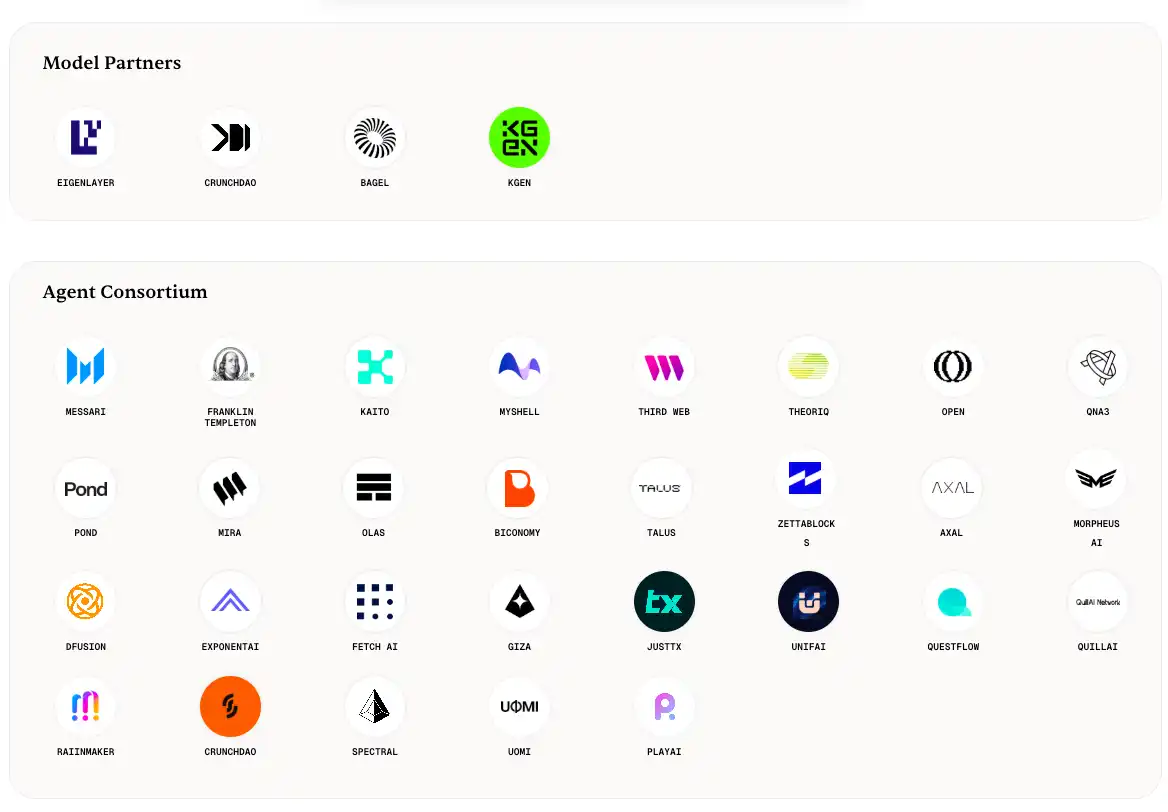
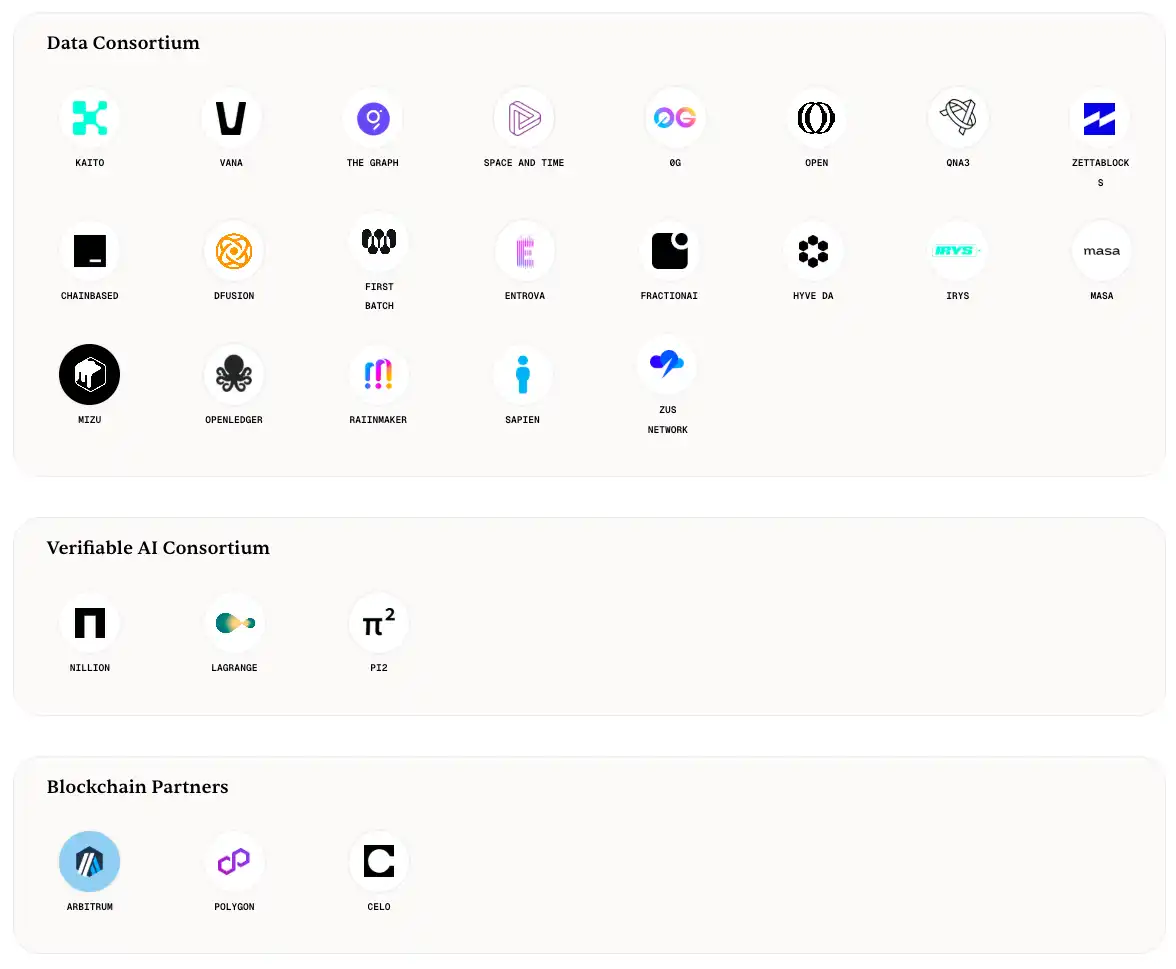
Overall, Sentient's differentiation lies in defining the path to AGI as a composable open network, using SENT's incentives and staking mechanisms to try to solve the funding, distribution, and sustainability issues long faced by open-source AI. Its key variables are therefore more about systematic engineering and mechanism design rather than single-point model capabilities, including whether the quality of ecosystem接入 can持续 improve, whether incentives will导向 real usage value, and whether the multi-agent system can form a replicable model in terms of reliability and safety.






