Sam Altman's Personal Alchemy of Wealth: Investing in 400 Companies, Over 10 Deeply Tied to OpenAI

Odaily星球日报2026-06-25 tarihinde yayınlandı2026-06-25 tarihinde güncellendi

Özet

The article investigates Sam Altman's personal wealth strategy, centered around his investments in approximately 400 companies while serving as OpenAI's CEO. Despite not holding direct equity in OpenAI, Altman has built a vast portfolio, with at least 10 of his investments having commercial ties or ongoing negotiations with OpenAI. This creates a complex network of potential conflicts of interest, drawing scrutiny from U.S. congressional committees and state attorneys general. Key investments highlighted include the anti-aging startup Retro Biosciences (valued at $258 million for his stake as of late last year) and the chipmaker Cerebras, whose value soared following an OpenAI procurement deal. His most significant financial gain is linked to the nuclear fusion company Helion, where a recent funding round reportedly increased his stake's value to at least $4.1 billion. The article details a decade-long relationship between Altman, Helion, and OpenAI, including a controversial non-binding power purchase agreement and Altman's efforts to secure investments from OpenAI and its backer SoftBank for Helion. Other points include internal investigations at Tools for Humanity (developer of Worldcoin) and OpenAI's massive contracts with tech giants like Nvidia. According to Forbes, Altman's net worth is around $3.4 billion, ranking him 1251st globally—a rise of over 1400 places since 2024. OpenAI's board states that Altman's external dealings are transparent and potential conflicts a...

Original from:WSJ

Compiled by | Odaily Planet Daily (@OdailyChina)

Translator | Wenser(@wenser2010)
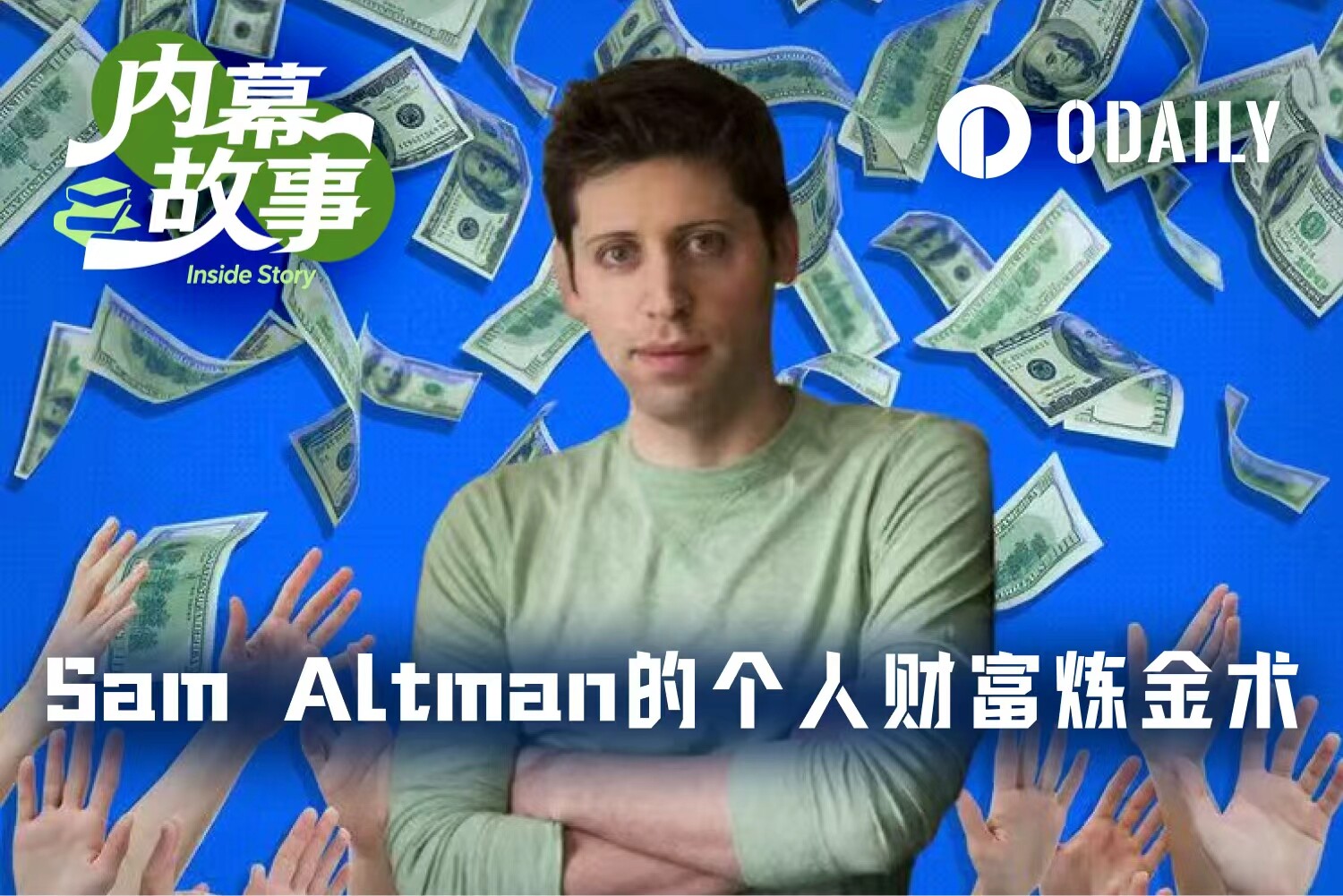
Editor's Note: Controversies surrounding OpenAI and Sam Altman have never ceased. Some see him as a leader in AGI, the soul who guides tech elites to challenge and explore the frontiers of AI, even calling him the 'Father of AI'; others consider him an outright villain, often citing evidence such as OpenAI's transition from a non-profit to a commercial company, his faction-building and elimination of dissidents within the OpenAI board. However, in terms of personal wealth, Altman is not as conspicuous as global richest Elon Musk, yet he has meticulously constructed his own 'wealth closed loop' in his own way, leveraging his position as OpenAI CEO, earning him the title of 'Master of Modern AI Wealth Alchemy'.

This issue, Odaily Planet Daily will combine a recent investigation by The Wall Street Journal to unveil the mystery of 'Sam Altman's Personal Alchemy' for our readers. The following is the main text, with some edits for clarity, Enjoy~

Altman's 'Personal Wealth Network': A Private Equity Wealth Group Built Around OpenAI

Most of Sam Altman's personal wealth is dispersed across a vast network of tech companies, including high-tech firms like the nuclear fusion company Helion, and even a startup dedicated to building a new city along the Mediterranean coast.

It is evident that many of these companies have already established various business partnerships with OpenAI, forming an intricate web of investment interests. Amid OpenAI's preparation for an IPO and intense scrutiny from all sides, last month, the U.S. House Oversight Committee launched an investigation into Altman's potential conflicts of interest, and several state attorneys general have called for the U.S. SEC to intervene.

Notably, he does not directly hold equity in OpenAI (latest valuation $852 billion), which signifies a rare phenomenon—his personal interests are not directly tied to the company he helms. Against this backdrop, The Wall Street Journal compiled dozens of his investments and analyzed the impact of some deals on his personal wealth.

Altman's 'Investment List': About 400 Projects, At Least 10 Have Partnerships or Potential Engagement with OpenAI

Three years ago (around 2023), at a public event, Altman personally stated that he had participated in investments in about 400 startup companies that were still active in the market. Based on public records and investigative reports, The Wall Street Journal filtered out over 80 of these investment projects, many of which can be traced back to his tenure as head of the venture capital firm Y Combinator.

These investments are largely concentrated in areas highly relevant to the AI wave, including software, biotech, and energy.

Among the companies he personally invested in, at least 10 have established commercial partnerships with OpenAI or have recently engaged in talks about doing so.

After Altman's personal investments, OpenAI established research collaborations with at least two biotech companies.

According to evidence presented in last month's trial of Musk v. OpenAI, Altman's stake in one of these companies—the anti-aging startup Retro Biosciences—was already worth $258 million as of last December.

Additionally, the chip manufacturer Cerebras, which achieved its IPO under the banner of being 'the next Nvidia,' received investment from Altman nearly a decade ago. A key factor driving its IPO was a recent chip procurement agreement with OpenAI. After Cerebras' IPO, the value of Altman's corresponding shares increased more than sixfold compared to their value in December last year.

Conventionally, CEOs of public companies are typically cautioned by their boards against 'holding substantial stakes in external companies.' The reason is that this creates an entangling of interests, potentially prompting them to facilitate deals favorable to their stake-holding companies or exposing them to accusations of 'self-dealing.'

But OpenAI board chairman Bret Taylor stated that Altman has consistently been highly transparent in disclosing his involvement with other entities, and OpenAI has carefully managed potential conflicts of interest.

Altman's 'Energy Play' Masterpiece: Made $4.1 Billion from Nuclear Fusion Startup Helion

When it comes to the largest investment project Altman has participated in, the nuclear fusion startup Helion is a notable one.

He first began investing in this company during his tenure as president of Y Combinator. The company claims to be close to achieving commercial power generation but does not publicly share its research results, making its claims difficult to independently verify.

On the other hand, the cooperation between OpenAI and Helion, which Altman vigorously promoted, also sparked significant controversy within the company.

The following is the over-a-decade-long 'entanglement of interests' between Altman and Helion—

2015, Altman invested in Helion and became its board chairman. That same year, he co-founded OpenAI.

2021, Altman made additional investments in Helion while leading OpenAI. That year, he invested a staggering $375 million, marking his then-largest-ever personal investment in a single startup.

2024, OpenAI signed a non-binding agreement to potentially purchase power from Helion in the future. During the OpenAI vs. Musk trial, former OpenAI board member Shivon Zilis (Odaily Planet Daily Note: mother of four of Musk's children) testified, saying this deal was 'surprising' because nuclear fusion was still a 'speculative technology' (Odaily Planet Daily: almost writing 'these projects are scams' on their foreheads).

2025, Japanese investment firm SoftBank invested in OpenAI. Altman subsequently lobbied SoftBank to invest in Helion, and SoftBank complied. Months later, according to The Wall Street Journal, Altman urged OpenAI to invest approximately $500 million in Helion, which left some OpenAI employees puzzled and uneasy. Ultimately, OpenAI declined the investment proposal at the company level.

2026, OpenAI still signed a revised agreement with Helion in March of this year; the same month, citing future collaboration with OpenAI, Altman resigned as chairman of Helion's board. OpenAI stated publicly that 'the board determined the agreement is in the company's best interests,' without indicating any impropriety.

2026, June, Helion announced a new round of financing at a $15.5 billion valuation, led by OpenAI strategic investor Thrive Capital. According to people familiar with the matter, Altman's stake in Helion at least doubled in value as a result, now worth at least $4.1 billion.

Finally, the developer behind the well-known Worldcoin, Tools for Humanity, the iris-scanning company co-founded by OpenAI CEO Altman once valued at $2.5 billion, recently returned to the spotlight due to internal investigation scandals.

According to Business Insider, against a backdrop of crashing cryptocurrency prices, global regulatory crackdowns, and business contraction layoffs, the company simultaneously launched two investigations led by external law firms, one focusing on alleged misuse of funds by executives and the other on potential regulatory violations in its Thailand operations.

Previously, OpenAI has faced criticism for its trillion-dollar contracts with major cloud and chip manufacturers, including a $500 billion partnership with chip giant Nvidia, a $300 billion agreement with AMD, a $300 billion deal with cloud service provider Oracle, and a transaction exceeding $22 billion with data center group CoreWeave.
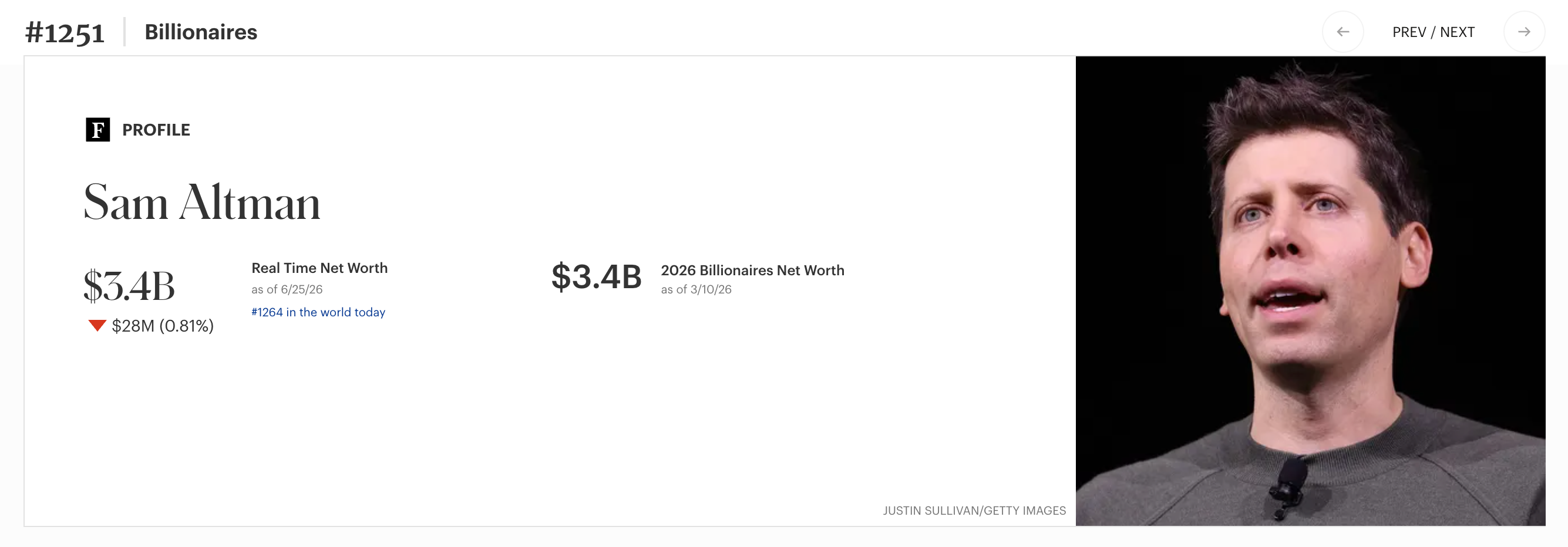
According to Forbes Billionaires List data, Sam Altman currently ranks 1251st on the global rich list, with a personal net worth of around $3.4 billion. Furthermore, he has investments in well-known tech companies like Stripe and Reddit. In April 2024, Altman's rank on this list was only 2692nd; two years later, his personal net worth ranking has risen by over 1400 places. It's worth noting that this list reflects the wealth rankings of over 8 billion people worldwide.

İlgili Sorular

QWhat is the core controversy surrounding Sam Altman and OpenAI as mentioned in the article?

AThe controversy revolves around perceptions of his leadership. Some view him as an AGI pioneer and 'Father of AI,' while others criticize his actions, such as transforming OpenAI from a non-profit to a commercial company, alleged favoritism within the board, and eliminating dissent. The article also details concerns about potential conflicts of interest due to his extensive personal investments in companies that do business with OpenAI.

QAccording to the article, how many companies has Sam Altman invested in, and how many of those have a direct business relationship with OpenAI?

ASam Altman has invested in approximately 400 companies. Of those, at least 10 have established commercial partnerships with OpenAI or have been in recent discussions to do so.

QHow did Sam Altman's investment in Helion Energy significantly increase in value according to the article?

AHis investment in Helion Energy significantly increased in value after a June 2026 funding round led by Thrive Capital, an OpenAI strategic investor, which valued Helion at $15.5 billion. This round at least doubled the value of Altman's stake, bringing it to at least $4.1 billion.

QWhat significant point does the article make about Sam Altman's direct ownership stake in OpenAI?

AThe article highlights that Sam Altman does not directly hold any equity in OpenAI, despite the company's high valuation. This creates a rare situation where his personal wealth is not directly tied to the company he leads.

QWhat internal investigations are reportedly happening at Tools for Humanity, the company behind Worldcoin, as per the article?

ATools for Humanity is reportedly undergoing two separate investigations led by external law firms. One investigation is focused on alleged misuse of funds by executives, and the other is examining potential regulatory violations in the company's Thailand operations.

İlgili Okumalar

Bitcoin and Ethereum Soar Together! Eight Altcoins Worth Watching in the Later Market

Bitcoin and Ethereum Surge, Fueling Altcoin Speculation. Bitcoin Eyes $77,000, Ethereum Gains 20% in a Single Day. Market anticipates capital rotation from major cryptos to high-beta altcoins, but a selective rise is expected, favoring projects with genuine users, protocol revenue, and healthy tokenomics. Analysts highlight eight altcoins across key sectors: **High-Performance Blockchains:** * **SOL (Solana):** Market cap ~$51.88B. A dominant player with a strong ecosystem. Considered a relatively safe bet for potential catch-up growth. * **SUI (Sui):** Market cap ~$3.03B. High volatility potential but faces risks from its low circulating supply and future token unlocks. **DeFi Lending:** * **UNI (Uniswap):** Market cap ~$2.38B. Transitioning to a revenue-capturing asset post-fee switch implementation. * **AAVE (Aave):** Market cap ~$1.53B. Features balanced tokenomics and revenue but has seen significant recent gains. * **MORPHO:** Market cap ~$1.50B. Rapid protocol growth but weaker token value capture and opaque supply data. **Perpetual DEX:** * **HYPE (Hyperliquid):** Market cap ~$16.41B. The clear sector leader with strong revenue but high valuation and a large portion of tokens still locked, warranting caution. **RWA & On-Chain Finance Infrastructure:** * **LINK (Chainlink):** Market cap ~$8.09B. A key oracle provider positioned to benefit from multiple trends like RWA and institutional adoption, offering strong fundamentals. * **ONDO (Ondo Finance):** Market cap ~$1.77B. Shows strong business growth but carries high risks due to concentrated token holdings and a massive unlock scheduled for 2027. **Conclusion:** The altcoin rally is expected to be selective. Recommendations include a medium position in SOL, small allocations to SUI and UNI/AAVE for DeFi exposure, and caution with HYPE and ONDO due to their specific risks. LINK is suggested as a core holding for the RWA thematic.

marsbit1 saat önce

Bitcoin and Ethereum Soar Together! Eight Altcoins Worth Watching in the Later Market

marsbit1 saat önce

Shanghai's $10 Billion Unicorn Is About to Go Public

Shanghai-based automotive-grade millimeter-wave radar chip unicorn Calterah Microelectronics Technology (Shanghai) Co., Ltd. has filed for an IPO on Shanghai's STAR Market, aiming to raise 3.49 billion yuan. Founded in 2014 by Chen Jiashu, a UC Berkeley PhD graduate, and his professor Ali Niknejad, Calterah pioneered CMOS technology for 77GHz radar chips, breaking the decades-long monopoly of international giants like Texas Instruments. Its low-cost, highly integrated solutions enabled millimeter-wave radar to move from luxury to mass-market vehicles. By 2025, Calterah captured a 31.1% share in China's automotive millimeter-wave radar chip market (second domestically, fourth globally), with cumulative shipments exceeding 30 million units. Its client list includes BYD, Geely, Nio, and Volvo. The company has undergone 11 funding rounds, attracting high-profile investors such as the National Integrated Circuit Industry Investment Fund Phase II, China Capital Management, and GD Capital. Its valuation has reached tens of billions of yuan, with a projected post-IPO valuation of approximately 14 billion yuan. Despite rapid revenue growth—increasing from 206 million yuan in 2023 to 632 million yuan in 2025 with a 75.28% CAGR—Calterah remains unprofitable. It reported net losses of 323 million yuan, 334 million yuan, and 193 million yuan from 2023 to 2025, accumulating over 900 million yuan in losses over three and a half years. These losses are primarily attributed to heavy R&D investment, which totaled over 1.039 billion yuan in the reporting period, often exceeding annual revenue. The company faces significant risks, including high customer concentration (its top five customers accounted for over 99% of revenue from 2023-2025, with BYD alone representing over 50% in 2025) and supply chain concentration. Revenue pressure from key customers and dependencies on overseas suppliers for EDA tools and IP pose challenges to sustainable growth. The IPO is seen as crucial for securing capital to expand production, diversify its customer base, and reduce supply chain dependencies.

marsbit1 saat önce

Shanghai's $10 Billion Unicorn Is About to Go Public

marsbit1 saat önce

Ray Dalio's Latest Macro Analysis Full Text: Buy More Gold, Add Some Bitcoin

In his latest macro analysis, Ray Dalio applies his framework from "How Countries Go Broke: The Big Cycle" to the current global debt environment. He highlights recent events like Japan selling U.S. Treasuries and rising U.S. long-term yields as signs of an unsustainable debt dynamic. Dalio explains that excessive government debt leads to either unacceptably high interest rates, severe economic downturns, or significant currency debasement through central bank money printing. He summarizes the U.S. fiscal situation: with $5.5 trillion in revenue, $7.5 trillion in spending, a $2 trillion deficit, and total debt at six times annual revenue, debt servicing costs are immense. Without correction, U.S. debt could reach $55-$60 trillion in a decade. Dalio proposes a "3% Three-Way" solution: reducing the budget deficit to 3% of GDP through balanced spending cuts, tax increases, and interest rate reductions to avoid a traumatic adjustment. In response to FAQs, he argues that the risk of a U.S. debt crisis is high and could materialize within a few years if the current path continues. He dismisses the notion that the dollar's reserve status makes the U.S. immune, citing historical precedents of reserve currency declines. He is also unconvinced by Japan's high-debt stability, noting poor returns for yen-denominated assets. For investors, Dalio recommends diversifying globally, underweighting bonds, and overweighting assets like gold and a small allocation to Bitcoin (around 10-15% to gold) to hedge against currency debasement and poor debt returns.

marsbit2 saat önce

Ray Dalio's Latest Macro Analysis Full Text: Buy More Gold, Add Some Bitcoin

marsbit2 saat önce

Stripe’s 16-Year Chronicle: From 7 Lines of Code to a $100 Billion Valuation

Stripe's 16-year journey began with a simple promise: "7 lines of code to accept payments." Founded by Patrick and John Collison, the company started by hiding the complexity of bank integrations and merchant accounts behind a clean API, initially targeting developers at startups. This early focus on user experience and technical simplicity fueled rapid adoption. A key early milestone was establishing vital bank partnerships, a challenge overcome by hiring Billy Alvarado, who brought crucial institutional relationship skills. From this foundation, Stripe systematically expanded its product boundaries. It launched Connect for platform payments, Atlas for company formation, Radar for fraud prevention, and Billing for subscriptions. This transformed Stripe from a payment processor into a broader financial infrastructure suite for internet businesses. The COVID-19 pandemic accelerated growth but also led to over-hiring. A 14% layoff in 2022 marked a period of organizational correction. Subsequently, Stripe shifted its growth strategy towards strategic acquisitions to enter new domains quickly. It acquired Bridge (stablecoin infrastructure), Privy (wallet infrastructure), Metronome (usage-based billing), and agreed to buy OpenRouter (AI model routing). These moves signal Stripe's ambition to build a "programmable money system" for the emerging AI and agent-based economy, managing not just currency flows but also the measurement and pricing of computational resources like AI tokens. Internally, Stripe leverages AI agents (like "Minions") to boost engineering productivity. Despite scaling to nearly 8,000 employees and processing $1.9 trillion in payment volume annually, the company remains private. A recent employee tender offer valued it at $159 billion. The core question for Stripe's future is whether it can successfully integrate its expanding product matrix—spanning payments, crypto, and AI infrastructure—into a cohesive platform, positioning itself as the foundational economic layer for autonomous software agents.

marsbit3 saat önce

Stripe’s 16-Year Chronicle: From 7 Lines of Code to a $100 Billion Valuation

marsbit3 saat önce

İşlemler

Spot
活动图片