This weekly report covers the period from December 12 to December 19, 2025. This week, the total on-chain RWA market cap slightly increased to $189 billion, with the number of holders continuing to grow; the stablecoin market cap surpassed $300 billion, but trading activity declined, indicating a market characterized by "stagnant liquidity." Global regulatory frameworks are accelerating their development, with China promoting the digital yuan, and the US, Canada, Hong Kong, and others actively formulating rules for stablecoins and asset tokenization. Traditional financial institutions are deepening their involvement: JPMorgan launched a tokenized fund on Ethereum and integrated JPM Coin with Base; Visa and Mastercard expanded stablecoin payment and clearing services; DTCC partnered with the Canton Network to advance US Treasury tokenization. Meanwhile, Coinbase, PayPal, SoFi, and others相继 launched tokenized assets, stablecoin yield products, and cross-border payment solutions. Emerging markets like Brazil and Pakistan are also actively exploring sovereign asset tokenization. Overall, driven by regulatory compliance and institutional adoption, RWA is gradually being integrated into global payment, settlement, and asset management systems.
Data Perspective
RWA Sector Overview
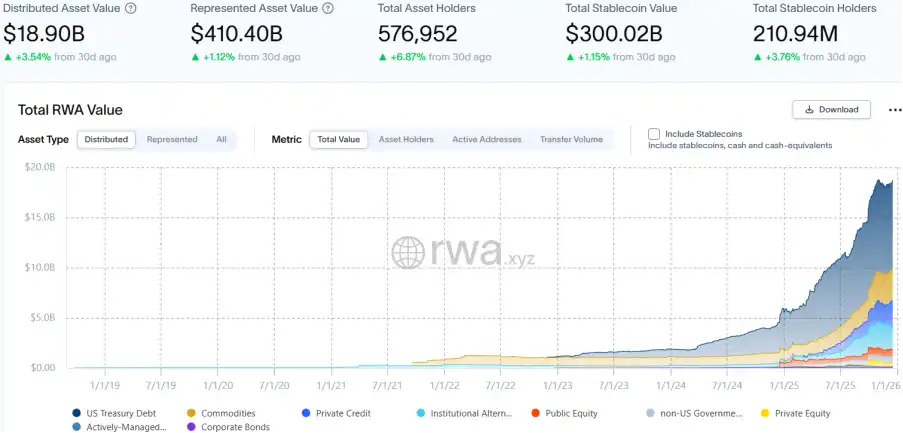
According to the latest data from RWA.xyz, as of December 19, 2025, the total on-chain RWA market cap reached $18.9 billion, a slight increase of 3.54% compared to the previous month, indicating a potential recovery in on-chain native financial activity. The total number of asset holders increased to approximately 577,000, up 6.87% month-on-month, showing steady growth.
Stablecoin Market
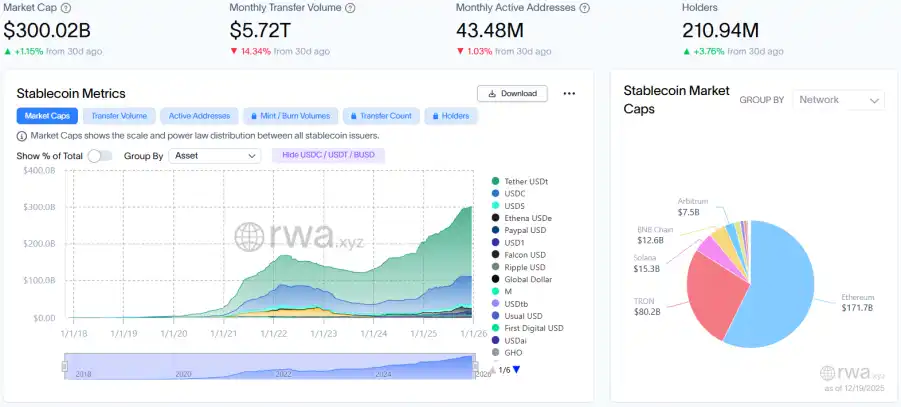
The total stablecoin market cap reached $3,000.2 billion, a slight increase of 1.15% month-on-month, maintaining slow growth and possibly entering a phase of stable liquidity. Monthly transfer volume contracted to $5.72 trillion, down 14.34% month-on-month. The total number of monthly active addresses decreased to 43.48 million, a slight drop of 1.03% month-on-month. The total number of holders steadily increased to approximately 211 million, a slight increase of 3.76% month-on-month. The divergence between these metrics continues to deepen. This data suggests the market is exhibiting a trend of expanding holder base but declining trading activity and capital turnover efficiency. New users may be holding for allocation purposes, while institutional settlement and retail trading demand are weakening simultaneously, challenging the on-chain payment and settlement function. The market may have entered a phase of "stagnant liquidity and declining activity." The top stablecoins are USDT, USDC, and USDS. Among them, USDT's market cap increased slightly by 1.92% month-on-month; USDC's market cap increased slightly by 1.05% month-on-month; USDS's market cap increased by 5.21% month-on-month.
Regulatory News
People's Bank of China: Advancing RMB Internationalization, Steadily Developing the Digital Yuan
The Party Committee of the People's Bank of China held a meeting, emphasizing the steady advancement of high-level financial openness and the maintenance of national financial security. Practicing the Global Governance Initiative, actively participating in and promoting the reform and improvement of global financial governance. Conducting financial diplomacy and multilateral and bilateral monetary and financial cooperation pragmatically. Advancing RMB internationalization. Continuously building and developing a multi-channel, wide-coverage cross-border RMB payment system. Steadily developing the digital yuan.
US FDIC Proposes Rulemaking for Stablecoin Application Framework to Implement the GENIUS Act
According to The Block, the US Federal Deposit Insurance Corporation (FDIC) is advancing the implementation of parts of the stablecoin bill passed into law this summer. On Tuesday, the FDIC board approved a notice of proposed rulemaking that sets an application process for institutions to issue payment stablecoins through subsidiaries. The agency is seeking public comment on the proposed rule. At the board meeting, FDIC General Counsel Nicholas Simons stated that applications need to clarify the scope of proposed activities, provide a description of the "subsidiary's ownership and control structure," and include an "engagement letter with a registered public accounting firm." Simons said: "In summary, the proposed rule will enable the FDIC to assess the safety and soundness of proposed payment stablecoin activities while minimizing the regulatory burden on applicants."
This summer, US President Trump signed the GENIUS Act, creating a federal regulatory framework for stablecoins. Earlier this month, FDIC Acting Chairman Travis Hill informed lawmakers that the agency planned to release an implementation framework for the GENIUS Act in the coming weeks. On Tuesday, he also stated that the agency plans to issue a proposed rule in the coming months to establish capital, liquidity, and risk management requirements for approved subsidiary stablecoin issuers.
Bank of Canada Announces It Will Only Approve High-Quality Stablecoins Pegged to Central Bank Money
According to Cointelegraph, the Bank of Canada has indicated that, under the country's upcoming stablecoin regulations expected in 2026, it will only approve high-quality stablecoins pegged to central bank money to ensure stablecoins become "sound money." Bank of Canada Governor Tiff Macklem stated in a speech to the Montreal Chamber of Commerce on Tuesday: "We want stablecoins to be sound money, like banknotes or bank deposits." Macklem wants stablecoins to be pegged 1:1 to central bank money and backed by "high-quality liquid assets" that can be easily converted to cash. Such assets typically include Treasury bills and government bonds.
Macklem's comments follow the lengthy Canadian budget report released in early November 2025. The report stated that stablecoin issuers would be required to hold sufficient reserves, establish redemption policies, and implement various risk management frameworks, including measures to protect personal and financial data.
Hong Kong FSTB: Studying the Legal Regulatory System for Tokenized Bond Issuance and Trading
According to Jinshi reporting, on December 18, the "Web5 Ecosystem" summit was held in Hong Kong. Hong Kong's Under Secretary for Financial Services and the Treasury, Joseph Chan, stated at the meeting that government departments are studying the legal regulatory system for tokenized bond issuance and trading, exploring optimization measures to promote the adoption of tokenization technology in Hong Kong's bond market and enrich the variety of products in Hong Kong's tokenization and digital asset field. Additionally, the Hong Kong Monetary Authority is promoting digital currency projects, including encouraging commercial banks to launch tokenized deposits and facilitating real tokenized asset transactions.
Pakistan to Partner with Binance to Explore Tokenization of $2 Billion in Assets Including Sovereign Bonds
According to Reuters, Pakistan's Ministry of Finance stated that Pakistan has signed a memorandum of understanding with cryptocurrency exchange Binance to tokenize up to $2 billion in assets (including sovereign bonds, treasury bills, and commodity reserves) to improve liquidity and attract investors. Additionally, the Virtual Asset Regulatory Authority stated that Pakistan has preliminarily approved Binance and digital asset platform HTX to register with the regulator to establish local subsidiaries and begin preparing applications for full exchange licenses.
Local Dynamics
Circle and LianLian Global Sign MoU to Explore Next-Gen Cross-Border Payment Infrastructure Driven by Stablecoins
According to a Circle official announcement, USDC issuer Circle and licensed cross-border payment institution LianLian Global have signed a memorandum of understanding. The two parties will explore cross-border payment solutions based on stablecoins to improve payment efficiency, transparency, and accessibility, focusing on emerging markets like Asia and global merchant needs, and consider interoperability between traditional payment systems and on-chain settlement through the Circle Payments Network and L1 chain Arc.
Standard Chartered Bank Launches Blockchain-Based Tokenized Deposit Solution
According to Techinasia, Standard Chartered Bank has launched a blockchain-based tokenized deposit solution for Ant International, supporting real-time transfers in Hong Kong dollars, offshore yuan, and US dollars. The bank partnered with global fintech company Ant International to deploy the technology on Ant's Whale Explorer platform. This launch is part of the Hong Kong Monetary Authority's "Digital Hong Kong Dollar" project (Project Ensemble), aimed at promoting the application of distributed ledger technology in the region.
Ant International is the first customer to adopt this new solution, which enables 24/7 fund management and liquidity transfer. Standard Chartered Bank and Ant International are both members of the EnsembleTX group, which supports the promotion and application of tokenization technology in Hong Kong. Since May 2024, Standard Chartered Bank has joined the "Digital Hong Kong Dollar" project architecture community, assisting in setting industry standards and testing tokenization application scenarios.
Project Progress
Bloomberg: Coinbase Announced Launch of Prediction Markets and Tokenized Stocks This Week
According to Bloomberg, citing people familiar with the matter, Coinbase Global Inc. announced the launch of prediction markets and tokenized stocks this week. Coinbase officially launched these products at a product showcase event on December 17. The source also mentioned that Coinbase's tokenized stocks will be launched internally, not through partners. Coinbase executives had previously expressed interest in these businesses but had not officially announced plans. For weeks, screenshots of applications hinting at these features have been circulating on social network X. This move is part of the company's effort to become a "one-stop app," aiming to provide traders with broad asset and market access and keep up with competitors who are also diversifying.
JPMorgan Launches Tokenized Money Market Fund on Ethereum and Deploys JPM Coin to Base Public Chain
According to the Wall Street Journal, JPMorgan Chase is launching the "My OnChain Net Yield Fund" (MONY), a tokenized money market fund issued on the Ethereum blockchain, with an initial investment of $100 million.
According to CoinDesk, JPMorgan has deployed its digital deposit token, JPM Coin, to the Base blockchain owned by Coinbase, marking the Wall Street giant's first large-scale integration with a public chain ecosystem. JPM Coin is distinct from stablecoins; it is a digital representation of bank deposits with interest, transferable only between whitelisted users. This move responds to institutional client demand to use bank deposit products on-chain, currently primarily used for collateral and margin payments in crypto trading. JPM emphasized that its deployment method has complete permission control and risk isolation, reflecting traditional finance's move towards DeFi.
Payment Giant Visa Launches Stablecoin Advisory Services and Enables USDC Stablecoin Clearing Services in the US
According to Fortune magazine, payment giant Visa announced on Monday the launch of stablecoin advisory services aimed at helping fintech companies, banks, and other enterprises develop stablecoin strategies and implement them. Visa's stablecoin advisory services have dozens of clients, including Navy Federal Credit Union, VyStar Credit Union, and a financial institution called Pathward. The service will help businesses formulate stablecoin strategies, technology and operational plans, and implement stablecoins. Use cases for its clients include cross-border transactions, especially with countries with high currency volatility, and business-to-business transactions.
According to Bloomberg, Visa announced that US banks can use Circle's USDC on the Solana blockchain for transaction clearing, marking the first full deployment of its stablecoin settlement service within the US banking system. The first users include Cross River Bank and Lead Bank. This move benefits from the relaxed regulations during the second term of the Trump administration and will facilitate the launch of the Arc chain co-developed by Visa and Circle. Visa expects stablecoins to become a key payment channel in the future, with annualized clearing volume reaching $3.5 billion by the end of November.
Mastercard Expands Blockchain and Stablecoin Payment Business in the Middle East Through Partnership with ADI Foundation
According to Cointelegraph, Mastercard is expanding its blockchain and stablecoin payment business in the Middle East through a new partnership with the ADI Foundation.
Interactive Brokers Now Supports Stablecoin Deposits
According to Bloomberg, brokerage giant Interactive Brokers now allows some US users to fund their accounts using stablecoins. Users can directly top up via crypto wallets without linking a bank account. This feature will be gradually rolled out to more users.
DTCC Partners with Canton Network to Advance US Treasury Tokenization, Supported by SEC "No-Action Letter"
According to CoinDesk, Wall Street settlement giant DTCC announced a partnership with the privacy-oriented blockchain Canton Network to advance the tokenization of US Treasury assets held by DTC. The project has received an SEC "no-action letter" and plans to launch a minimum viable product (MVP) in the first half of 2026, with future scaling depending on client demand. DTCC will serve as co-chair of the Canton Foundation alongside Euroclear, participating in the development of industry decentralized standards.
Brazilian Stock Exchange B3 to Launch Its Own Tokenization Platform and Stablecoin
According to CoinDesk, Brazil's main stock exchange, B3, plans to launch a tokenization platform and issue its own stablecoin next year to deepen its involvement in the cryptocurrency space. The tokenization platform will allow assets to be tokenized and traded on the exchange, sharing the same liquidity pool as traditional markets. To support settlement, B3 also plans to issue a stablecoin. This stablecoin will act as a payment and clearing tool in the tokenized environment, reducing reliance on existing cash processes. The stablecoin is expected to be pegged to the Brazilian Real.
B3 is also expanding its cryptocurrency-related derivatives business. Products under development include weekly options for Bitcoin, Ethereum, and Solana, as well as event-based contracts linked to cryptocurrency prices. These instruments are currently under review by Brazil's securities regulator, the Comissão de Valores Mobiliários (CVM).
Ripple Stablecoin RLUSD Expands to L2 Networks, Adopts Wormhole's NTT Standard
According to an official blog post, Ripple announced the first expansion of its stablecoin RLUSD to Layer 2 networks. Ripple will partner with the cross-chain interoperability protocol Wormhole and the NTT token standard to launch tests on Optimism, Base, Ink, and Unichain. Ripple expects to launch RLUSD on more chains after receiving final regulatory approval next year. The launch of RLUSD on subsequent chains requires testing and approval from the New York Department of Financial Services. RLUSD was initially issued only on XRPL and Ethereum.
Stablecoin $U Officially Launches: Live on BNB Chain and Ethereum, Integrated with Mainstream DeFi Protocols like PancakeSwap and ListaDAO, Listed on Centralized Exchange HTX
United Stables announced the official launch of the dollar stablecoin $U, currently deployed on both BNB Smart Chain (BSC) and Ethereum (ETH), with multiple ecosystem integrations completed. It is reported that the U stablecoin is 1:1 fully reserved (USD + top stablecoins), features real-time on-chain proof-of-reserve (PoR), monthly audits, and will support enterprise-grade privacy protection and AI-native payments (EIP-3009/x402) in the future. U is the first "unified stablecoin" on BNB Chain, integrating mainstream stablecoins as usable collateral assets to form a unified liquidity base.
Regarding ecosystem integration: U has integrated support for mainstream DeFi protocols including PancakeSwap, Aster, Four.meme, and ListaDAO. Users can directly trade, stake, lend, and provide liquidity on-chain. Regarding wallet support, Binance Wallet, Trust Wallet, and SafePal have simultaneously listed $U. Beyond the on-chain world, U is also listed on the centralized exchange HTX.
United Stables stated that U will focus on empowering scenarios such as trading, DeFi, institutional settlement, cross-border payments, and the AI autonomous economy, and plans to expand to more public chains, DeFi protocols, and trading platforms in the future.
Exodus, MoonPay, and M0 to Launch New Digital Dollar for Everyday Payments in Early 2026
Fintech company Exodus announced a partnership with MoonPay to launch a stablecoin fully backed by US dollar reserves to support a digital dollar experience within its ecosystem. The stablecoin will be issued and managed by MoonPay and developed based on M0's open stablecoin infrastructure.
This initiative will be combined with Exodus's upcoming payment feature, Exodus Pay, allowing users to use stablecoins for payments, transfers, and earning rewards without needing to understand cryptocurrency, while maintaining a self-custody model. The stablecoin will also be available through MoonPay's global distribution network, including buy/sell, exchange, deposit, and checkout functions, providing users and merchants with a wide range of practical application scenarios. The stablecoin is expected to officially launch in early 2026, with more details to be announced before the release. The specific launch time will depend on relevant regulatory requirements.
Intuit Partners with Circle to Introduce USDC, TurboTax and QuickBooks to Support Stablecoin Payments
According to The Block, financial software giant Intuit has signed a multi-year partnership with Circle to embed USDC stablecoin payments into core products like TurboTax and QuickBooks for faster, lower-cost settlement of tax refunds, business payments, etc. Circle provides the USDC infrastructure. Intuit did not disclose a specific launch date nor clarify whether users will directly hold USDC or if it will only be used as a backend payment channel. Previously, Visa enabled USDC (Solana)-based stablecoin settlement services for US banks, and Circle has expanded issuance and distribution with multiple exchanges (including Bybit).
PayPal Launches PYUSD Savings Vault on Spark Platform and Expands Stablecoin PYUSD Use Cases to Provide Support for AI Development Funding
According to The Block, PayPal is launching a PYUSD Savings Vault on the decentralized lending platform Spark, providing its stablecoin users with a new way to generate yield on their holdings, with an annual percentage yield (APY) of 4.25%. The yield for the PYUSD Savings Vault is "anchored" to the Sky savings rate, which is funded by revenue from the Sky protocol. PYUSD was integrated into SparkLend in September, allowing users to deposit and borrow the stablecoin. The two companies stated at the time that, after seeing first-day deposits reach about one-fifth of the target amount, they hoped to expand deposits to $1 billion. The new PYUSD Savings Vault may help increase PYUSD deposits on SparkLend. As part of Spark's Savings V2 product line, the vault also utilizes the Spark liquidity layer, deploying stablecoin deposits to Spark's balance sheet, including lending strategies on SparkLend.
For the PYUSD Savings Vault, 90% of deposits will be allocated through the Spark liquidity layer to yield-generating strategies, and the remaining 10% will be held in the contract as "instant withdrawal liquidity." Interest will be credited to the "accumulation token" spPYUSD issued to depositors. Based on the vault's current composition, over 57% is still held in stablecoins, 15.73% is allocated to on-chain crypto lending, 10.24% to AAA corporate bonds, 10.10% to over-the-counter crypto lending, 5.32% to US Treasuries, and the remainder to other investment strategies.
According to Cryptopolitan, payment giant PayPal announced that its stablecoin PYUSD will partner with the Web3 protocol USD.AI to provide funding support for artificial intelligence (AI) companies. USD.AI will use PYUSD to provide credit and financing services for AI companies regarding GPUs and data centers. The two companies intend to combine common payment frameworks with programmable settlement to facilitate long-term credit, leasing, and upcoming agent-driven transactions. The two companies also committed to offering a 4.5% interest rate on deposits totaling $1 billion as a customer incentive program to attract more clients. The incentive program will launch in early January and last for one year.
US Nationally Chartered Bank SoFi Launches Dollar Stablecoin SoFiUSD, Currently Live on Ethereum
According to The Block, SoFi Bank has released the dollar stablecoin SoFiUSD (1:1 cash reserves), calling itself the first US nationally chartered bank to issue a stablecoin on a public chain. SoFiUSD is live on Ethereum, offering banks, fintech, and enterprise partners near-instant, low-fee 24/7 settlement, and plans to open to SoFi users. SoFi stated it can hold cash reserves in Federal Reserve accounts, share profits, and support partners' white-label issuance or direct access to settlement and payment processes. The stablecoin will also be used in card networks, retail settlement, SoFi Pay cross-border remittances, and POS payments. Several institutions have advanced stablecoins this year, including KlarnaUSD, Western Union's USDPT, and Stripe's USDB.
Japan's Startale and SBI to Launch Regulated Yen Stablecoin
According to Techinasia, Japanese blockchain infrastructure company Startale Group and Japanese financial group SBI Holdings plan to launch a fully regulated, yen-pegged stablecoin by the second quarter of 2026 to support global settlement. The two will collaborate to develop this digital currency under a new agreement. Shinsei Trust & Banking will be responsible for the issuance and redemption management of the stablecoin, while SBI VC Trade, as a licensed crypto exchange, will handle its circulation. This yen stablecoin will be issued by a trust bank and is intended for global settlement and institutional use. Startale will be responsible for technical development, and SBI will focus on compliance, regulation, and issuance promotion.
StraitsX Partners with Solana Foundation, to Introduce XSGD and XUSD to Solana in Early 2026
StraitsX announced a partnership with the Solana Foundation to bring its Singapore dollar-backed stablecoin XSGD and US dollar-backed stablecoin XUSD to the Solana blockchain, planned for launch in early 2026. This integration will leverage Solana's efficient, low-cost network to enable real-time global payments and digital commerce.
XSGD and XUSD have previously operated on multiple blockchains, with cumulative on-chain transaction volumes exceeding $18 billion. This launch on Solana will mark the first time the Singapore dollar and US dollar are deeply connected on the same chain, supporting on-chain forex, AMM liquidity, lending markets, and institutional-grade payment flows.
StraitsX and the Solana Foundation will also collaborate to drive deep liquidity in DEXs, AMMs, and lending markets, further solidifying Solana's core position in AI-driven on-chain payments and DeFi applications.
Ondo Collaborates with LayerZero to Launch Cross-Chain Securities Bridge, and to Launch Its Tokenized Stock and ETF Platform on Solana in Early 2026
According to the Ondo official blog, Ondo and LayerZero have launched the "Ondo Bridge," supporting 100+ listed Ondo stocks and ETFs for 1:1 cross-chain transfers between Ethereum and BNB Chain, with expansion to more EVM chains possible within weeks. The bridge uses a unified architecture instead of individual asset-specific bridges; the 2600+ applications already integrated with LayerZero can quickly access Ondo Global Markets assets; Stargate already supports it. Ondo claims it is currently the largest "tokenized securities" cross-chain bridge. Previously, Ondo Global Markets had accumulated a TVL of over $350 million and trading volume of approximately $2 billion on Ethereum and BNB Chain.
Ondo Finance announced on platform X that its tokenized stock and ETF platform will launch on the Solana chain in early 2026. Ondo stated that this is currently the largest tokenized stock and ETF platform, aiming to bring Wall Street liquidity to the internet capital market.
SOL Treasury Company Forward Industries Tokenizes FWDI Stock Through Superstate
According to The Block, Nasdaq-listed SOL treasury company Forward Industries is issuing its stock on-chain through a native blockchain tokenization platform. As of Thursday, Forward stated: "Its SEC-registered stock is now live on the Solana blockchain via Superstate's Opening Bell platform, marking the first time a listed company's equity is directly available within the DeFi space." As an SPL token, the tokenized FWDI will be integrated into Solana's DeFi ecosystem. Under the arrangement, the tokenized stock will be held by a transfer agent under Superstate's name, responsible for tracking stock ownership in the non-custodial DeFi space and assisting in transferring stocks from "traditional brokerage accounts to whitelisted Solana wallets."
EquiLend Makes Strategic Investment in Digital Prime, Driving $4 Trillion Traditional Assets Towards Tokenized Market
According to CoinDesk, traditional finance giant EquiLend announced a strategic minority equity investment in crypto financing platform Digital Prime Technologies, focusing on collaborating on its institutional lending network Tokenet, and introducing new features like regulated stablecoin collateral. EquiLend manages over $4 trillion in lendable assets and stated this move is to adapt to the asset tokenization trend rather than a transformation, accelerating the convergence of traditional and digital asset markets.
Tether Explores Equity On-Chain Solutions After Completing $20 Billion Equity Financing
According to Bloomberg, while advancing plans for a financing round of up to $20 billion, Tether is considering ways to improve liquidity through buybacks or equity tokenization. Tether management is concerned that existing shareholders selling shares at a discount could affect valuation; they are currently not allowed to exit through this round of financing. Tether had previously launched the Hadron asset on-chain platform, intending to represent assets like stocks in blockchain form.
Malaysia's Halogen Capital Raises $3.2 Million to Expand Asset Tokenization Business
Malaysian licensed digital asset fund management company Halogen Capital announced it has raised 13.3 million Malaysian Ringgit (approximately $3.2 million). This round was led by Kenanga Investment Bank, with participation from institutions including 500 Global.
Kenanga, through its private equity division, acquired a 14.9% stake in Halogen Capital, becoming its largest institutional shareholder. Other participating institutions include 500 Global, Digital Currency Group, The Hive Southeast Asia, Jelawang Capital, and Mythos Venture Partners.
Halogen Capital stated that the funds will be used to expand its tokenization business for physical assets, including mutual funds, bonds, sukuk, private credit, and real estate. As of November 2025, the company's assets under management were approximately 400 million Malaysian Ringgit (approximately $97.81 million). Founded in 2023, Halogen Capital currently manages 8 wholesale funds and private mandate funds, serving high-net-worth individuals, corporations, and institutional investors.
Lightning Network-Based Stablecoin Payment Company Speed Completes $8 Million Funding Round Led by Tether
Tether led an $8 million funding round for payment infrastructure company Speed, with ego death capital participating. Speed (Speed1) builds a settlement network based on the Bitcoin Lightning Network and the stablecoin USDT, processing approximately $1.5 billion in payments annually, serving 1.2 million combined users and merchants, and providing BTC/USDT instant settlement and enterprise-grade routing.
Stablecoin Payment Platform RedotPay Completes $107 Million Series B Funding Round Led by Goodwater Capital
According to The Block, Hong Kong stablecoin payment platform RedotPay has completed a $107 million Series B funding round led by Goodwater Capital, with participation from Pantera Capital, Circle Ventures, Blockchain Capital, and existing investor HSG, among others. The funds will be used for product iteration, compliance license expansion, and strategic mergers and acquisitions. RedotPay's annualized payment volume exceeds $10 billion, with annual revenue over $150 million. Its users span 100+ global markets, registrations have surpassed 6 million, and the platform remains profitable.
Insights Collection
JPMorgan Reiterates: Does Not Expect Stablecoin Market Size to Reach $1 Trillion by 2028
According to The Block, JPMorgan analysts reiterated that they do not expect the stablecoin market size to reach the trillion-dollar level in the coming years; its growth may keep pace with the broader cryptocurrency market rather than significantly exceed it. Their report noted that the stablecoin market size has expanded by about $100 billion this year, breaking the $300 billion mark, and growth has been concentrated in the two major stablecoins. This confirms their long-held view that stablecoin growth is still primarily driven by activities within the crypto ecosystem. This year alone, driven by a surge in perpetual futures trading, stablecoin holdings on derivative exchanges increased by about $20 billion, an activity that remains a primary driver of stablecoin supply growth. Therefore, in the coming years, the stablecoin market size will likely continue to grow in sync with the overall cryptocurrency market capitalization, potentially reaching $500 to $600 billion by 2028, far below the most optimistic projections of $2 to $4 trillion.
Although payment-related use cases are expanding, it does not necessarily mean stablecoin market capitalization will grow significantly. As stablecoins become more deeply integrated into payment systems, their velocity of circulation will be more important than their absolute stock. As stablecoins gain adoption, banks are increasingly exploring tokenized deposits. Tokenized deposits aim to mitigate risks associated with stablecoins. Additionally, regional CBDC projects, as another competitive force, may reduce reliance on privately issued stablecoins, especially in institutional and cross-border application scenarios.
Grayscale: Stablecoins Achieved Explosive Growth in 2025, Supply Reaching $300 Billion
Grayscale stated on platform X that stablecoins achieved explosive growth in 2025, with supply reaching $300 billion and monthly average trading volume reaching $1.1 trillion. With the passage of the stablecoin GENIUS Act and increased stablecoin adoption, blockchain projects like ETH, TRX, BNB, and SOL will benefit from the growing transaction flow. Infrastructure like Chainlink (LINK) and emerging networks like XPL will also benefit.
a16z Bets on Energy Tokenization Experiment, How Will DayFi Use DeFi to Restructure the Power Grid?
PANews Overview: Against the backdrop of surging electricity demand in the AI era, the DayFi project, backed by top-tier capital like a16z, is attempting to restructure the power grid using DeFi. Its core model involves tokenizing the future electricity revenue of distributed energy projects (like solar) into crypto assets (sGRID), thereby providing financing channels for these projects and offering investors a combined return of Treasury interest and power generation revenue. However, this "energy tokenization" experiment faces severe dual challenges: On the regulatory front, its yield token sGRID is highly likely to be classified as a security by the US SEC, requiring strict disclosure obligations, while the detailed information of its underlying energy facilities is protected by the confidentiality regulations of the Federal Energy Regulatory Commission (FERC), creating a fundamental conflict with the transparency required by blockchain. On the valuation front, the value of the linked physical assets (like photovoltaic panels) depreciates and fluctuates, lacking a credible on-chain consensus evaluation mechanism, leading to valuation ambiguity and manipulation risks. Therefore, DayFi's exploration is essentially walking a regulatory tightrope, attempting to transform static energy resources into dynamic, composable on-chain financial assets. Its success will depend on finding a viable balance between compliance, transparency, and credible asset verification.
USDT Exits, EURC Fills the Gap, Euro Stablecoin Surges Over 170% Against the Trend
PANews Overview: In the globally dollar-dominated stablecoin market, the euro stablecoin (represented by Circle's EURC) has achieved an over 170% size counterattack, leveraging the certainty provided by the EU's Markets in Crypto-Assets (MiCA) regulatory framework. MiCA created a market vacuum for compliant issuers by setting high entry barriers (e.g., 100% reserves, monthly audits) that eliminated non-compliant issuers (like Tether's forced exit), and its "single license, passporting" mechanism facilitated widespread adoption on exchanges. Simultaneously, macroeconomic factors like the expectation of euro appreciation against the dollar provided investors with new tools for forex arbitrage and risk hedging, further driving capital inflows. Additionally, the foresighted布局 of the frontrunner Circle (obtaining a French license first) and its multi-chain ecosystem strategy (covering Ethereum, Base, Solana, etc.) solidified its approximately 70% market share. However, its future development faces dual pressures: first, competition from traditional banking "regular armies" (like Société Générale's EURCV) entering the market with strong deposit bases and institutional trust; second, the potential threat of the European Central Bank's digital euro (CBDC) as an official alternative, and the possibility of continuously increasing compliance costs imposed by regulators for financial stability reasons. Overall, euro stablecoins are perhaps moving from the fringe to the mainstream, and their growth also marks the accelerated formation of a diversified, compliance-driven on-chain euro ecosystem against the backdrop of deepening global RWA and cross-border settlement demand.