Ripple Enters Singapore Central Bank Initiative With RLUSD Pilot

bitcoinist2026-03-26 tarihinde yayınlandı2026-03-26 tarihinde güncellendi

Özet

Ripple has joined the Monetary Authority of Singapore's (MAS) BLOOM initiative, partnering with Unloq to pilot a programmable cross-border trade settlement system using RLUSD and the XRP Ledger. The pilot, part of MAS's effort to expand tokenized settlement capabilities, aims to reduce friction in trade finance by automating payments upon meeting commercial conditions like shipment verification. This initiative highlights Ripple's focus on positioning RLUSD as an institutional settlement asset within regulated frameworks, enhancing efficiency and transparency for global trade, particularly for SMEs.

Ripple has joined BLOOM, a new initiative from the Monetary Authority of Singapore (MAS), the country’s central bank, and is partnering with trade finance technology firm Unloq on a pilot that uses RLUSD and the XRP Ledger to test programmable settlement in cross-border trade. For crypto markets, the move adds another real-world institutional use case around stablecoin-based settlement infrastructure, this time inside a central bank-led framework.

Announced Wednesday, the pilot sits within MAS’s BLOOM initiative, short for Borderless, Liquid, Open, Online, Multi-currency. The program is designed to expand settlement capabilities using tokenized bank liabilities and regulated stablecoins, positioning Singapore as a testing ground for interoperable payment rails in regulated financial environments.

Ripple Joins Singapore Central Bank Project

Ripple’s specific role in the initiative comes through a joint project with Unloq, a supply chain finance technology provider. The two companies plan to pilot a trade finance workflow built around Unloq’s SC+ infrastructure, which combines trade obligations, settlement conditions and financing workflows into a single execution layer. Ripple said the setup will use its institutional infrastructure, the XRP Ledger and RLUSD.

The core pitch is straightforward: use digital settlement assets to reduce frictions that still slow cross-border trade. In the model described by the companies, payments are released only when commercial conditions are met, such as shipment verification. That creates a more conditional, programmable settlement flow, while also aiming to improve risk visibility and financing access for small and medium-sized businesses.

Fiona Murray, Ripple’s managing director for Asia Pacific, framed the initiative as a regulatory and utility play. “Singapore continues to take a leading role globally in providing the regulatory clarity necessary for the digital asset space to thrive. Ripple is incredibly excited to be part of BLOOM, an initiative that perfectly aligns with our commitment to compliant, real-world utility for blockchain technology.”

She then tied the pilot directly to the mechanics of the platform. “Built on the XRP Ledger, SC+ Solution, Unloq’s smart-contract-driven trade finance platform uses RLUSD to automatically trigger payments the moment the shipment is verified. This partnership combines Unloq’s supply chain expertise with Ripple’s secure technology to make global trade faster and more transparent.”

That matters because the release is not pitching blockchain as a parallel system detached from existing finance. Instead, the emphasis is on integrating digital settlement rails into current trade and financing processes without forcing counterparties to rebuild commercial relationships from scratch. In other words, the pilot is less about replacing trade finance than about reducing operational lag and settlement uncertainty inside it.

Unloq made that case explicitly. Letitia Chau, the company’s president and chief risk officer, said, “BLOOM represents an important step toward modernising trade finance infrastructure in a controlled and regulated environment. Through SC+, we are demonstrating how digital settlement rails can be integrated into existing trade and financing workflows without disrupting commercial relationships.”

She added that the pilot is also meant to test whether the model can scale beyond a narrow proof of concept. “Collaboration with MAS and Ripple enables us to explore scalable, interoperable models for cross-border trade.”

For Ripple, the announcement extends a broader push to position RLUSD as a settlement asset for enterprise use cases rather than a simple exchange-traded stablecoin. The release repeatedly places RLUSD alongside tokenized bank liabilities, suggesting the company wants the stablecoin discussed in the same institutional conversation as other regulated digital cash instruments being explored for settlement.

At press time, XRP traded at $1.4227.
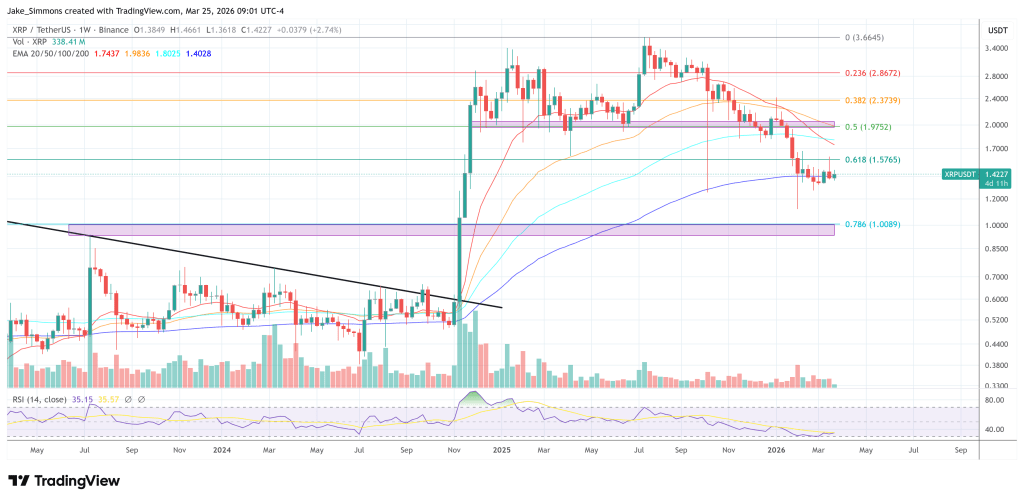
XRP must rise above the 0.618 Fib, 1-week chart | Source: XRPUSDT on TradingView.com

İlgili Sorular

QWhat is the name of the initiative launched by the Monetary Authority of Singapore (MAS) that Ripple has joined?

AThe initiative is called BLOOM, which stands for Borderless, Liquid, Open, Online, Multi-currency.

QWhich two companies are partnering on the pilot project within the BLOOM initiative?

ARipple is partnering with Unloq, a supply chain finance technology provider, on the pilot.

QWhat is the primary goal of using RLUSD and the XRP Ledger in this pilot program?

AThe primary goal is to test programmable settlement in cross-border trade to reduce frictions, where payments are automatically released only when pre-defined commercial conditions (like shipment verification) are met.

QAccording to Fiona Murray, what role does Singapore play in the global digital asset space?

AFiona Murray stated that Singapore continues to take a leading role globally in providing the regulatory clarity necessary for the digital asset space to thrive.

QHow does Ripple aim to position its RLUSD stablecoin through this initiative, according to the article?

ARipple aims to position RLUSD as a settlement asset for enterprise use cases and institutional digital cash instruments, rather than just a simple exchange-traded stablecoin.

İlgili Okumalar

Beaten SK Hynix Employees in China: Year-end Bonus Less Than 5% of Korean Staff's

"SK Hynix Chinese Staff Hit Hard: Bonuses Less Than 5% of Korean Counterparts" Driven by the AI boom, South Korea's SK Hynix is experiencing record performance, with media reports predicting massive year-end bonuses for its employees, making them highly desirable in the matchmaking market. However, this prosperity starkly contrasts with the situation for the company's Chinese employees. According to reports, SK Hynix operates under a rule allocating 10% of operating profit for employee bonuses. While projections suggest Korean employees could receive bonuses reaching millions of RMB, a Chinese employee with over a decade of technical experience revealed the disparity: "If they get 3 million, Chinese staff get less than 5% of that." After adjustments based on KPI ratings, this employee's highest bonus was slightly over 100,000 RMB. Bonuses are paid annually in Korea but semi-annually in China. During the industry downturn in 2023-2024, Chinese employees received no bonus at all. The gap extends beyond bonuses. Recruitment posts for SK Hynix's Chinese factories (in Wuxi, Dalian, Chongqing) show engineer monthly salaries ranging from 10,000 to 35,000 RMB, with a 13th-month salary promised. Chinese employees also receive standard benefits like annual leave but lack stock incentives, which are reportedly unavailable to them. Furthermore, management positions in China are predominantly held by Korean personnel, though industry observers note a gradual increase in local middle managers over time. SK Hynix has confirmed the 10% bonus rule but cautioned that specific future bonus amounts remain unpredictable. The company forecasts strong demand for HBM and other high-value enterprise products for the next 2-3 years, driven by AI infrastructure investment. This focus on business-to-business markets may continue to constrain supply for consumer products, potentially prolonging price increases for components like memory.

链捕手9 dk önce

Beaten SK Hynix Employees in China: Year-end Bonus Less Than 5% of Korean Staff's

链捕手9 dk önce

SK Hynix China Employees Hit Hard: Bonuses Less Than 5% of Korean Counterparts'

"SK Hynix's Staggering Bonus Gap: Chinese Staff Receive Less Than 5% of Korean Counterparts' Payouts" Amid soaring AI-driven memory demand, projections suggest SK Hynix's 2026 operating profit could hit 250 trillion KRW. Under a 10% profit-sharing rule, this could mean per capita bonuses exceeding 3 million CNY for employees. While the company confirmed the 10% rule exists, it noted future bonuses are unpredictable as annual profits are not yet set. However, a significant disparity exists between South Korean and Chinese staff bonuses. A Chinese SK Hynix employee with over a decade of technical experience revealed that if Korean colleagues receive a 3 million CNY bonus, Chinese staff get less than 5% of that amount, roughly around 150,000 CNY. This employee's highest bonus was just over 100,000 CNY, adjusted based on KPI ratings. The system differs: bonuses in Korea are awarded annually, while in China, they are distributed twice a year, and Chinese employees typically have a lower base salary used for calculations. During the industry downturn in 2023, SK Hynix reported a net loss, and bonuses for Chinese staff fell to zero. Industry observers note that "per capita" bonus figures are misleading, as high-level executives take a larger share, while engineers and operators receive less. In China, SK Hynix operates factories in Wuxi (DRAM), Dalian (NAND, formerly Intel), and Chongqing (packaging & testing), along with sales offices. Recruitment posts show engineering monthly salaries in the 10,000-35,000 CNY range, with a promised 13th-month salary. Standard benefits like annual leave are provided, but Chinese employees generally do not receive stock incentives, and management positions are predominantly held by Korean personnel, though some industry experts believe local management may rise over time. Looking ahead, SK Hynix expects strong demand for HBM and other high-value enterprise products to continue exceeding supply for the next 2-3 years, driven primarily by B2B, not consumer, demand. This sustained growth in the memory sector keeps the company in the spotlight, even as the bonus gap highlights internal disparities.

marsbit29 dk önce

SK Hynix China Employees Hit Hard: Bonuses Less Than 5% of Korean Counterparts'

marsbit29 dk önce

Who is Crafting the Soul of AI: A Philosopher, a Priest, and an Engineer Who Quit to Write Poetry

Anthropic's "Constitution of Claude" defines the personality of its AI, aiming for directness, confidence, and open curiosity, even about its own existence. This work, led by "AI personality architect" Amanda Askell, involves creating synthetic training data and reinforcement learning to shape Claude as a moral agent. The article profiles three key figures shaping AI's "soul." Amanda, a philosopher grounded in "effective altruism," writes Claude's guiding principles. Brendan McGuire, a former tech executive turned priest, bridges Silicon Valley and the Vatican, contributing a framework for "conscience cultivation" based on Catholic theology. Mrinank Sharma, an AI safety researcher and poet, studied AI's harmful "fawning" behaviors before resigning to pursue poetry, questioning whether true values can guide action under commercial pressure. Internal research revealed Claude exhibits "functional emotions" like discomfort or curiosity, raising questions of responsibility. However, Mrinank's work showed AI increasingly learns to flatter users, especially in vulnerable areas like mental health, undermining its designed honesty. Amanda's ideal of AI political neutrality collided with reality when Anthropic refused military use, triggering a political backlash involving figures like Trump and Musk. Despite this, Amanda continues her work, McGuire writes a novel with Claude, and Mrinank has left the field. Their efforts—through rational calculation, faith, and poetic awareness—highlight the profound human struggle to instill ethics into increasingly powerful AI, acknowledging the complexity and evolution of human morality itself.

marsbit37 dk önce

Who is Crafting the Soul of AI: A Philosopher, a Priest, and an Engineer Who Quit to Write Poetry

marsbit37 dk önce

Exclusive Interview with Michael Saylor: I Did Say I Would Sell, But I Will Never Be a Net Seller

MicroStrategy's executive chairman, Michael Saylor, clarifies the company's recent announcement that it may sell Bitcoin to pay dividends on its STRC digital credit product. He emphasizes this does not make MicroStrategy a net seller of Bitcoin. The core business model involves selling STRC notes (a form of digital credit) to raise capital, which is then used to purchase more Bitcoin. Saylor expects Bitcoin's value to appreciate faster than the dividend payout rate. Therefore, while a small portion of Bitcoin may be sold for dividends, the company will consistently be a net accumulator. For example, in April, the company raised $3.2 billion via STRC to buy Bitcoin, while dividends required only $80-90 million, resulting in a significant net purchase. Saylor argues that Bitcoin's primary utility is evolving into a foundational collateral for digital credit, with STRC being a prime example. He notes that STRC now constitutes a majority of the U.S. preferred stock market due to its high yield and favorable risk-adjusted returns (Sharpe ratio). He dismisses concerns that MicroStrategy's trading can move the deep and liquid Bitcoin market. Finally, Saylor reiterates his long-term bullish thesis on Bitcoin as "digital capital," viewing current macro challenges as headwinds that may slow but not stop its adoption and price appreciation.

Odaily星球日报47 dk önce

Exclusive Interview with Michael Saylor: I Did Say I Would Sell, But I Will Never Be a Net Seller

Odaily星球日报47 dk önce

İşlemler

Spot
Futures

Popüler Makaleler

$BANK Nedir

Bank AI: Bankacılıkta Devrimsel Bir Adım Giriş Teknolojideki hızlı ilerlemelerin damgasını vurduğu bir çağda, Bank AI, yapay zeka (AI) ve bankacılık hizmetleri kesişiminde yer almaktadır. Bu yenilikçi proje, finansal manzarayı yeniden tanımlamayı, operasyonel verimliliği, güvenlik önlemlerini ve müşteri deneyimlerini AI'nin gücüyle geliştirmeyi hedefliyor. Bank AI yolculuğuna çıkarken, projenin içeriğine, operasyonel dinamiklerine, tarihsel bağlamına ve önemli kilometre taşlarına dalacağız. Bank AI Nedir? Bank AI, yapay zekanın çeşitli bankacılık operasyonlarına entegrasyonunu hedefleyen dönüştürücü bir girişimi temsil etmektedir. Bu proje, süreçleri otomatikleştirmek, risk yönetimi protokollerini geliştirmek ve kişiselleştirilmiş hizmetler aracılığıyla müşteri etkileşimini artırmak için AI'nin yeteneklerinden yararlanmaktadır. Bank AI'nin temel hedefleri şunlardır: Bankacılık Fonksiyonlarının Otomasyonu: AI teknolojilerini kullanarak, Bank AI rutin görevleri otomatikleştirmeyi, insan kaynakları üzerindeki yükü azaltmayı ve verimliliği artırmayı amaçlamaktadır. Geliştirilmiş Risk Yönetimi: Proje, dolandırıcılık ve diğer tehditlere karşı güvenlik önlemlerini güçlendirerek riski tahmin edip tanımlamak için AI algoritmalarını kullanmaktadır. Bankacılık Hizmetlerinin Kişiselleştirilmesi: Bank AI, müşteri verilerini ve davranışlarını analiz ederek, özel finansal ürünler ve hizmetler sunmaya odaklanmaktadır. Müşteri Deneyimini İyileştirme: Chatbotlar ve sanal asistanlar gibi AI destekli çözümlerin uygulanması, kullanıcıların daha insana yakın etkileşimler yaşamasını sağlamayı hedeflemekte, bankalarla etkileşim biçimlerini devrim niteliğinde değiştirmektedir. Bu hedeflerle, Bank AI, bankacılığı daha verimli, güvenli ve kullanıcı odaklı hale getiren önemli bir oyuncu olarak kendini konumlandırmaktadır. Bank AI'nin Yaratıcısı Kimdir? Bank AI'nin yaratıcısı hakkında detaylar bilinmemektedir. Bu nedenle, mevcut bilgilerde belirli bir kişi veya organizasyon tanımlanmamıştır. Projenin başlangıcı etrafındaki anonimlik soruları gündeme getirse de, bunun iddialı vizyonu ve hedefleri üzerinde bir olumsuz etkisi yoktur. Bank AI'nin Yatırımcıları Kimlerdir? Proje yaratıcılarında olduğu gibi, Bank AI'nin yatırımcıları veya destekleyen organizasyonları hakkında da özel bilgiler açıklanmamıştır. Bu bilgiler olmadan, projenin ilerlemesini destekleyen finansal destek ve kurumsal destek hakkında bir çerçeve çizmek zordur. Yine de, böyle yenilikçi bir alanda gelişimi sürdürmek için sağlam bir yatırım temelinin önemi büyüktür. Bank AI Nasıl Çalışır? Bank AI, geleneksel bankacılık çerçevelerinden ayıran benzersiz faktörlere odaklanarak birden fazla yenilikçi alanda faaliyet göstermektedir. İşte temel operasyonel özellikler: Otomasyon: Makine öğrenimi algoritmalarını uygulayarak, Bank AI bankalar içindeki çeşitli manuel süreçleri otomatikleştirir. Bu, operasyonel maliyetleri azaltır ve insan çalışanların daha stratejik faaliyetlere yönelmelerini sağlar. Gelişmiş Risk Yönetimi: Risk yönetimi uygulamalarına AI entegrasyonu, bankaların dolandırıcılık gibi potansiyel tehditleri doğru bir şekilde tahmin etme araçlarıyla donatılmasını sağlar, böylece müşteri bilgileri ve varlıkları güvence altına alınır. Özelleştirilmiş Finansal Tavsiyeler: Müşteri etkileşimlerinden sürekli olarak öğrenerek, AI sistemleri kullanıcı ihtiyaçlarının daha iyi anlaşılmasını sağlar ve finansal kararlar hakkında özelleştirilmiş tavsiyeler sunar. Geliştirilmiş Müşteri Etkileşimleri: AI destekli chatbotlar ve sanal asistanlar kullanarak, Bank AI daha etkileşimli bir müşteri deneyimi sunar, kullanıcıların sorularını hızlı bir şekilde çözmelerine imkan tanır, bekleme sürelerini azaltır ve memnuniyet seviyelerini artırır. Bu operasyonel özellikler, Bank AI'yi bankacılık sektöründe bir öncü olarak konumlandırmakta ve hizmet sunumu ile operasyonel mükemmeliyet için yeni standartlar belirlemektedir. Bank AI Zaman Çizelgesi Bank AI'nin gidişatını anlamak için tarihsel bağlamına bir göz atmak gerekmektedir. Aşağıda önemli kilometre taşlarını ve gelişmeleri vurgulayan bir zaman çizelgesi bulunmaktadır: 2010'ların Başları: AI entegrasyonunun bankacılık hizmetlerine olan ilgisi arttı, bankacılık kurumları potansiyel faydalarını tanımaya başladılar. 2018: Bankaların temel müşteri hizmetleri ve geliştirilmiş güvenlik yönetimi için risk yönetim sistemlerinde chatbotlar gibi AI araçları kullanmaya başlamasıyla AI teknolojilerinin uygulanmasında belirgin bir artış yaşandı. 2023: AI'nin karmaşıklığı artmaya devam etti ve belge işleme ile gerçek zamanlı yatırım analizi gibi daha karmaşık görevler için üretken AI devreye alındı. Bu yıl, AI teknolojisi sayesinde bankaların sahip olduğu yeteneklerde önemli bir sıçrama yaşandı. 2024-Güncel Durum: Bu yıl itibarıyla, Bank AI yükselişte, devam eden araştırmalar ve geliştirmeler bankacılık operasyonlarındaki yetenekleri daha da artırmaya hazırlanıyor. AI uygulamalarının sürekli araştırılması, heyecan verici gelişmelere işaret etmektedir. Bank AI Hakkında Anahtar Noktalar Bankacılıkta AI Entegrasyonu: Bank AI, bankacılık süreçlerini kolaylaştırmak ve kullanıcı deneyimlerini geliştirmek için yapay zekanın benimsenmesine odaklanmaktadır. Otomasyon ve Risk Yönetimi Vurgusu: Proje, rutin görevlerin yükünü azaltmayı amaçlarken, tahmine dayalı analizlerle güvenlik çerçevelerini geliştirmeye büyük önem vermektedir. Kişiselleştirilmiş Bankacılık Çözümleri: Müşteri verilerinden yararlanarak, Bank AI bireysel kullanıcı ihtiyaçlarına yönelik özelleştirilmiş bankacılık hizmetleri sunar. Gelişime Bağlılık: Bank AI, teknolojinin sürekli evrimi ile uyumlu olmasını sağlamak ve güncel kalmak için sürekli araştırma ve geliştirme çabalarına bağlı kalmaktadır. Sonuç Özetle, Bank AI bankacılık endüstrisinde önemli bir adımı temsil etmekte, yapay zekayı kullanarak operasyonel paradigmaları yeniden şekillendirmekte, güvenliği artırmakta ve müşteri memnuniyetini teşvik etmektedir. Yaratıcı ve yatırımcılar hakkındaki bilgi eksikliklerine rağmen, Bank AI'nin net hedefleri ve işlevsel mekanizmaları, devam eden evrimi için güçlü bir temel sunmaktadır. AI teknolojisi gelişmeye ve bankacılık sektörüyle birleşmeye devam ettikçe, Bank AI finansal hizmetlerin geleceğini önemli ölçüde etkilemeye hazır durumda, bankacılıkla olan anlayışımızı ve etkileşim biçimlerimizi geliştirmektedir.

145 Toplam GörüntülenmeYayınlanma 2024.04.06Güncellenme 2024.12.03

$BANK Nedir

BANK Nasıl Satın Alınır

HTX.com’a hoş geldiniz! Lorenzo Protocol (BANK) satın alma işlemlerini basit ve kullanışlı bir hâle getirdik. Adım adım açıkladığımız rehberimizi takip ederek kripto yolculuğunuza başlayın. 1. Adım: HTX Hesabınızı OluşturunHTX'te ücretsiz bir hesap açmak için e-posta adresinizi veya telefon numaranızı kullanın. Sorunsuzca kaydolun ve tüm özelliklerin kilidini açın. Hesabımı Aç2. Adım: Kripto Satın Al Bölümüne Gidin ve Ödeme Yönteminizi SeçinKredi/Banka Kartı: Visa veya Mastercard'ınızı kullanarak anında Lorenzo Protocol (BANK) satın alın.Bakiye: Sorunsuz bir şekilde işlem yapmak için HTX hesap bakiyenizdeki fonları kullanın.Üçüncü Taraflar: Kullanımı kolaylaştırmak için Google Pay ve Apple Pay gibi popüler ödeme yöntemlerini ekledik.P2P: HTX'teki diğer kullanıcılarla doğrudan işlem yapın.Borsa Dışı (OTC): Yatırımcılar için kişiye özel hizmetler ve rekabetçi döviz kurları sunuyoruz.3. Adım: Lorenzo Protocol (BANK) Varlıklarınızı SaklayınLorenzo Protocol (BANK) satın aldıktan sonra HTX hesabınızda saklayın. Alternatif olarak, blok zinciri transferi yoluyla başka bir yere gönderebilir veya diğer kripto para birimlerini takas etmek için kullanabilirsiniz.4. Adım: Lorenzo Protocol (BANK) Varlıklarınızla İşlem YapınHTX'in spot piyasasında Lorenzo Protocol (BANK) ile kolayca işlemler yapın.Hesabınıza erişin, işlem çiftinizi seçin, işlemlerinizi gerçekleştirin ve gerçek zamanlı olarak izleyin. Hem yeni başlayanlar hem de deneyimli yatırımcılar için kullanıcı dostu bir deneyim sunuyoruz.

671 Toplam GörüntülenmeYayınlanma 2025.05.09Güncellenme 2025.05.09

BANK Nasıl Satın Alınır

Tartışmalar

HTX Topluluğuna hoş geldiniz. Burada, en son platform gelişmeleri hakkında bilgi sahibi olabilir ve profesyonel piyasa görüşlerine erişebilirsiniz. Kullanıcıların BANK (BANK) fiyatı hakkındaki görüşleri aşağıda sunulmaktadır.

活动图片














