Report Analysis: What Is Coherent Planning as CPO Booms?

marsbit2026-06-24 tarihinde yayınlandı2026-06-24 tarihinde güncellendi

Özet

Title: Report Interpretation: What Moves Is Coherent Making Amid the CPO Boom? Summary: JP Morgan analyst Samik Chatterjee reiterates an Overweight rating on Coherent (COHR), citing undervalued growth potential across three core areas: data center optical transceivers, co-packaged optics (CPO) chips, and industrial lasers/thermal management. COHR's 1.6T data center transceivers are in high demand, with pricing remaining firm. The rise of CPO is seen not as a threat but as a catalyst, creating higher demand for sophisticated optical components, an area where COHR holds a competitive edge with its comprehensive portfolio (lasers, isolators, VCSELs, thermoelectric coolers). Each CPO chip offers significantly greater revenue potential than traditional transceivers. Furthermore, its Optical Circuit Switch (OCS) technology targets a potential $4B market with reliability and power advantages. The company is expanding its InP (Indium Phosphide) device capacity fourfold within two years, securing substrate supply and transitioning to more cost-effective 6-inch wafers. As one of only two major suppliers of high-quality pump lasers—currently in severe shortage—COHR can now move up the value chain from components to complete line cards/systems, boosting ASP over tenfold. Gross margin targets (>42%) may be revised upward due to high-end product premiums, cost improvements from the wafer transition, and contributions from new high-margin products like CPO and OCS. Its efficient thermad...

Author: Rita

TideGuide

J.P. Morgan analyst Samik Chatterjee recently reiterated his Overweight rating on Coherent (stock code COHR) at an investor conference. The company manufactures optical communication chips and components, and the market underestimates its growth potential. The core logic revolves around three product lines: optical transceivers for data centers, Co-Packaged Optics (CPO) chips, and industrial lasers and thermal solutions.

Data Communication Transceivers, Demand Continues to Rise

First, look at the most mature business line. COHR's 1.6T transceivers are now standard in data centers, and supply remains tight. Demand for 1.6T is already present, the pricing environment is healthy, with no significant pressure observed. Some worry that CPO might cannibalize traditional transceiver business, but the analyst believes the opposite is true. CPO integrates optical and electrical chips, which will actually increase demand for high-end optical components rather than replace them.

CPO and OCS, An Underestimated Opportunity

CPO is currently a major industry focus, with all major chip manufacturers involved. COHR's competitive advantage lies in providing a comprehensive portfolio of optical components. It can supply lasers, isolators, VCSELs, and thermoelectric coolers. COHR covers nearly all the optical components required in a CPO system. This means the value COHR can capture per CPO chip is far greater than with traditional transceivers.

The target market size for Optical Circuit Switches (OCS) is $4 billion, and its application scenarios are expanding. From internal data center traffic optimization, it extends to data center interconnects and even Scale-Up scenarios. COHR uses Liquid Crystal technology, competing against MEMS-based solutions, offering clear advantages in reliability and power consumption.

InP Capacity, The Foundation for Upstream Integration

COHR plans to increase its InP (Indium Phosphide) device capacity fourfold within two years. The transition to 6-inch wafers is underway, with yields exceeding those of mature processes. The company has signed agreements with five substrate suppliers to secure supply, addressing the primary bottleneck for capacity expansion.

Pump lasers are currently in particularly short supply. COHR is one of only two global high-quality suppliers, holding about 70% share for certain models. This tight supply environment presents a strategic opportunity: vertical integration. Moving beyond selling just laser components to selling complete line cards or systems. The average selling price per solution can increase by more than tenfold.

Raising Gross Margin Targets, Cost Structure Improving

The company reaffirmed its gross margin target of greater than 42%, hinting at potential future increases. The drivers come from three aspects: premium pricing for high-end products, cost improvements from the transition to 6-inch wafers, and volume ramp-up of high-margin new products like CPO and OCS. The efficiency of the thermal management material "thermadite" is 2 to 5 times that of copper-based solutions, representing another long-term growth driver.

The Industrial Segment, An Overlooked Growth Point
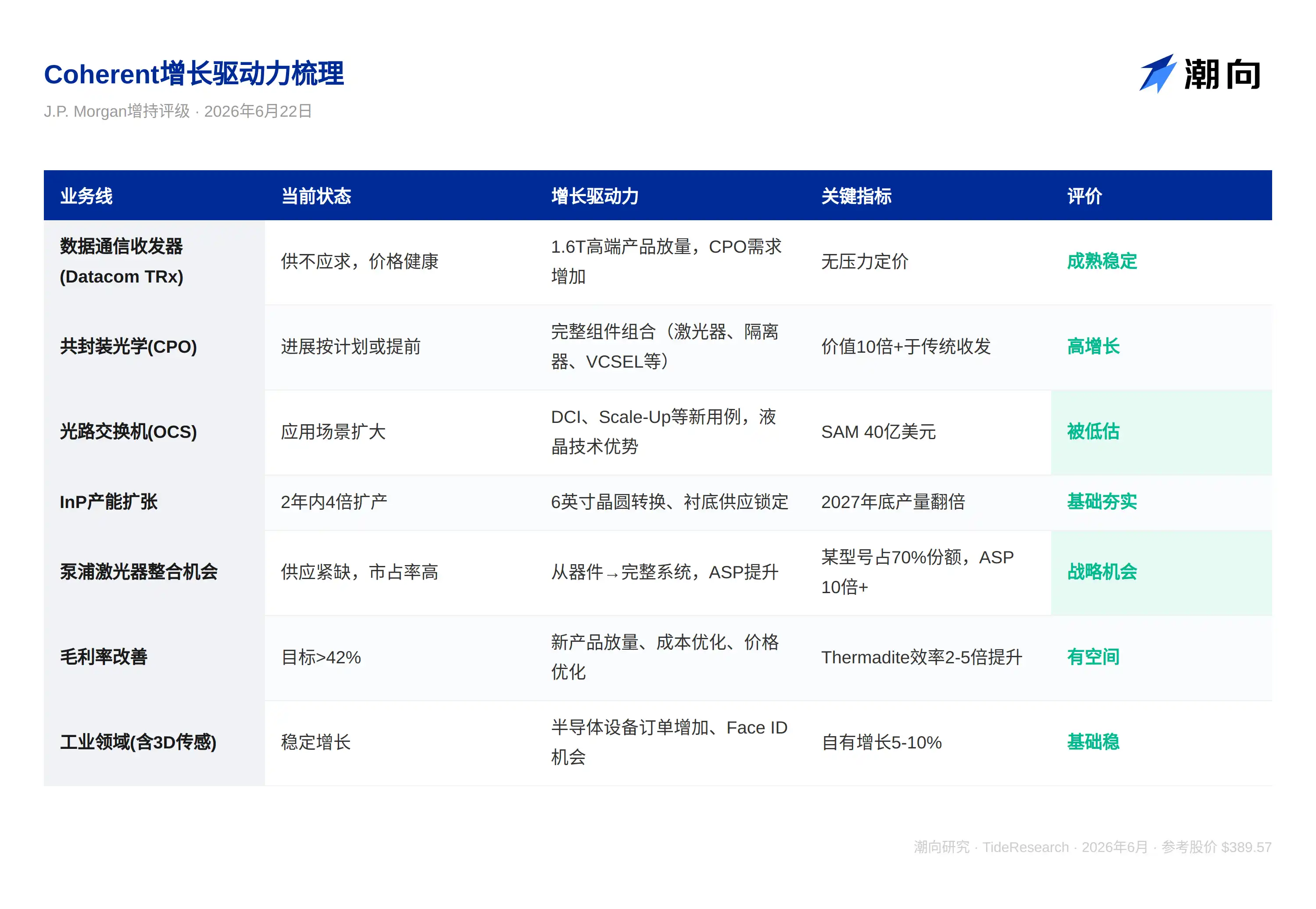
Organic growth in industrial revenue remains steady at 5% to 10%. Semiconductor manufacturing equipment orders are growing. In 3D sensing, Apple's next-generation Face ID might adopt a new protocol, presenting a re-competition opportunity for suppliers.

Optical communication chips are the underlying infrastructure for data centers. AI is driving higher computing power demands, which in turn increases the need for high-speed optical interconnects. COHR holds a critical position in this supply chain. The new opportunities in CPO and OCS, stable growth in the industrial segment, and room for gross margin improvement all support the Overweight rating.
Disclaimer

This article is TideResearch's analysis and interpretation of a third-party brokerage research report. The ratings, price targets, earnings forecasts, and related judgments cited herein are the views of the J.P. Morgan analyst, representing only the stance of their affiliated institution. They do not represent TideResearch's views and do not constitute any investment advice.

Please note three points while reading: First, ratings are analysts' comprehensive judgments on a company's prospects and are subject to frequent adjustments based on performance and market conditions. Second, sell-side research reports are inherently bullish, and some covered companies may have investment banking relationships with the brokerage. Third, the value of research reports lies in their core logic and underlying assumptions, not just a specific price target. Focus on the logic, not just the rating.

Markets involve risks, and investment decisions should be made independently. This article should not be used as a basis for trading any securities.

Data Source: Coherent Corp Investor Conference Minutes (J.P. Morgan, Samik Chatterjee, June 22, 2026)

TideResearch · June 2026

İlgili Sorular

QAccording to J.P. Morgan's analysis, what are the three core growth drivers for Coherent (COHR) mentioned in the article?

AThe three core growth drivers are: 1) Data center optical transceivers, 2) Co-packaged optics (CPO) chips, and 3) Industrial lasers and thermal management.

QWhat is the analyst's view on the relationship between the demand for traditional optical transceivers and the rise of CPO technology?

AThe analyst believes that CPO technology will not replace or cannibalize demand for traditional optical transceivers. Instead, it will increase the demand for high-end optical components, as CPO integrates optical and electrical chips together.

QWhat are Coherent's specific advantages in the CPO market, as highlighted in the report?

ACoherent's competitive advantage lies in providing a complete portfolio of optical components, including lasers, isolators, VCSELs, and thermoelectric coolers, which are essential for CPO systems. This allows them to capture significantly more value per CPO chip compared to traditional transceivers.

QWhat strategic opportunity is presented by the current tight supply of pump lasers for Coherent?

AThe tight supply of pump lasers, where Coherent is one of only two high-quality global suppliers, presents a strategic opportunity for vertical integration. Instead of just selling laser components, the company can now sell complete line cards or systems, increasing the average selling price per solution by more than tenfold.

QWhat three factors are driving the company's target for gross margins to exceed 42%?

AThe three driving factors are: 1) Premium pricing power for high-end products, 2) Cost improvements from the transition to 6-inch InP wafers, and 3) The ramp-up of new high-margin products like CPO and Optical Circuit Switches (OCS).

İlgili Okumalar

Ondo, the Leader in RWA Tokenization, is Entering the Perp DEX Arena

Ondo Finance, the dominant player in the real-world asset (RWA) tokenization space, is entering the perpetual futures (Perp) DEX arena with the launch of "Ondo Perps." This move signifies a strategic pivot from primarily being an asset issuer to becoming a comprehensive trading infrastructure provider. The platform uniquely focuses on tokenized traditional assets like stocks, indices (e.g., US 500), and commodities (gold, silver, oil), offering up to 20x leverage for 24/7 trading. A key differentiator is its planned multi-asset collateral system, which will allow users to employ tokenized stocks and bonds as margin, enabling sophisticated portfolio hedging and strategies. This approach leverages Ondo's existing strengths—deep institutional relationships, regulatory approvals, and a vast library of tokenized assets—to create a bridge between traditional finance liquidity and decentralized, permissionless trading. By integrating its asset issuance (Ondo Global Markets) with a proprietary trading venue, Ondo aims to complete the RWA financialization loop, transforming tokenized holdings from passive investments into productive capital for leverage and complex financial engineering. The launch positions Ondo Perps not just as another derivatives exchange, but as a foundational piece of next-generation infrastructure merging TradFi assets with DeFi-native execution.

Foresight News15 dk önce

Ondo, the Leader in RWA Tokenization, is Entering the Perp DEX Arena

Foresight News15 dk önce

Founder of Baixing.com: The Notion That Large Language Models Will Devour Everything, I Believe Half of It

Founder of Baixing.com: I Only Half-Believe the Saying “Large Language Models Will Devour Everything” Author: Wang Jianshuo, Founder of Baixing.com Many proclaim that large models are everything, but the author is skeptical. He argues that such sweeping claims often stem from a limited understanding of the future. Drawing parallels to past technologies like electricity and the internet—which were predicted to “devour everything” but didn’t—he suggests that large language models (LLMs) are better seen as a foundational base. Like electricity, this base is essential for modern development, but its real value emerges only when applied to specific scenarios through various “machines” or “tools” (e.g., Claude Code for programming, Claude Design for design). The author acknowledges that LLMs may indeed replace many existing software systems built on rigid rules, workflows, and forms (e.g., CRMs, SaaS tools), as these are precisely what LLMs excel at processing. However, he emphasizes that beyond software, elements like customer data, execution capabilities (e.g., booking a flight), trust, and physical-world interactions will not be “devoured.” Instead, he foresees that after streamlining existing software, LLMs will open up a larger space for innovative, next-generation applications. These new tools will likely feature fluid interfaces and rely less on fixed rules, unleashing greater creativity. The author cautions against short-sightedness, recalling how in 2004 many believed internet giants like Sina, Sohu, and NetEase would monopolize the market—only to be proven wrong by subsequent disruptions. In conclusion, while LLMs are a crucial foundation and a current focal point, the true mainstream of this wave lies in the diverse applications built atop them to solve concrete problems. The phrase “devour everything” is imprecise; the real opportunity lies in identifying and leveraging the areas where LLMs do bring transformative change.

marsbit29 dk önce

Founder of Baixing.com: The Notion That Large Language Models Will Devour Everything, I Believe Half of It

marsbit29 dk önce

Founder of Baixing.com: I Only Half Believe in the Notion that Large Language Models Devour Everything

The founder of Baixing Wang states that while large language models (LLMs) are an extremely important foundational technology—akin to electricity or the internet—he only "half believes" the notion that they will "consume everything." He argues that LLMs provide a base layer of intelligence, but real-world value and transformation come from integrating this intelligence into specific applications and devices designed for particular scenarios—like how electricity powers various appliances from washing machines to TVs. He agrees LLMs will likely consume or replace a significant portion of existing rule-based, workflow-driven software (e.g., many SaaS systems, CRMs), as these are precisely what LLMs excel at handling. However, numerous other elements—such as customer data, execution capabilities (e.g., booking a flight), trust, and physical-world interactions—will not be consumed. Wang emphasizes that after LLMs absorb certain software layers, they will open up a much larger space for innovation: new types of "streaming" software with less rigid interfaces, where fixed rules are managed by AI. This next wave of applications built on top of the stable LLM foundation is where the true mainstream opportunity lies. He cautions against the short-sightedness of declaring any technology as all-consuming, drawing parallels to past premature predictions about internet giants monopolizing the web. The key is to find opportunities within the areas LLMs do transform.

链捕手34 dk önce

Founder of Baixing.com: I Only Half Believe in the Notion that Large Language Models Devour Everything

链捕手34 dk önce

İşlemler

Spot
活动图片