Founder of Baixing.com: I Only Half Believe in the Notion that Large Language Models Devour Everything

链捕手2026-07-07 tarihinde yayınlandı2026-07-07 tarihinde güncellendi

Özet

The founder of Baixing Wang states that while large language models (LLMs) are an extremely important foundational technology—akin to electricity or the internet—he only "half believes" the notion that they will "consume everything." He argues that LLMs provide a base layer of intelligence, but real-world value and transformation come from integrating this intelligence into specific applications and devices designed for particular scenarios—like how electricity powers various appliances from washing machines to TVs. He agrees LLMs will likely consume or replace a significant portion of existing rule-based, workflow-driven software (e.g., many SaaS systems, CRMs), as these are precisely what LLMs excel at handling. However, numerous other elements—such as customer data, execution capabilities (e.g., booking a flight), trust, and physical-world interactions—will not be consumed. Wang emphasizes that after LLMs absorb certain software layers, they will open up a much larger space for innovation: new types of "streaming" software with less rigid interfaces, where fixed rules are managed by AI. This next wave of applications built on top of the stable LLM foundation is where the true mainstream opportunity lies. He cautions against the short-sightedness of declaring any technology as all-consuming, drawing parallels to past premature predictions about internet giants monopolizing the web. The key is to find opportunities within the areas LLMs do transform.

Author: Wang Jianshuo, Founder of Baixing.com

Many people blurt out phrases like 'large models are everything.' I'm not so convinced.

Every time I hear phrases like 'devour everything,' I think it's mostly because our understanding of the future hasn't reached that level, leading us to make such broad statements. Otherwise, how could one thing devour everything? Take the internet for example—it has been touted as devouring everything for so many years, has it truly devoured everything now? So which is it, the internet devouring everything or large models devouring everything? Both are devouring, leaving nothing left?

So, I'd rather put it differently: it is a very important foundational layer. Without this foundation, the entire world cannot develop, just as the internet cannot exist without the underlying backbone network, or using electricity is impossible without power plants. This I acknowledge.

But once the foundation is in place, the real excitement happens on top of it.

Take electricity. Once electricity was generated, what were the first applications people saw? The light bulb. Thomas Edison lit the first one, and then it just kept shining, shining, shining. If the world ended there, with just one light bulb, I could totally say: the power plant is the core of the entire world, the power plant devours everything.

But that's not how it happened. Later came motors to drive machines; then you realize that once you have a fundamental thing like electricity, countless electrical appliances will grow on top of it to use it. Washing machines are for washing clothes, televisions are for watching TV, vacuum cleaners are for vacuuming—they are all applications of electricity. Without electricity, none of these things would exist. But if you say 'electricity devours everything,' I don't believe it.

Large language models are the same. They provide foundational intelligence. But this intelligence must be placed into a specific, scenario-oriented 'machine' or 'appliance' to truly function and change the world.
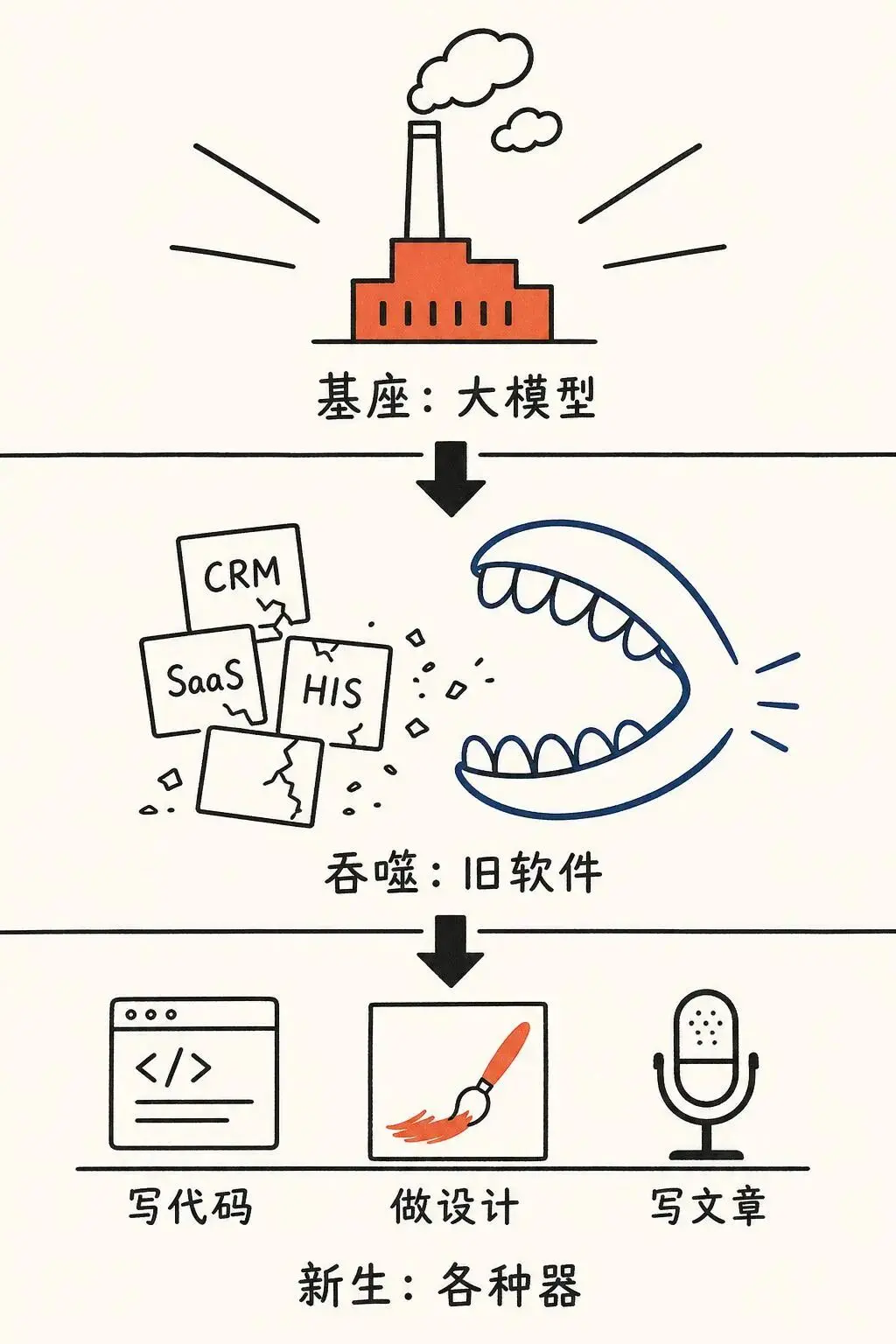
Claude Code is for writing code, Claude Design is for design, VoiceDrop is for writing articles. The same large model, placed into different 'appliances,' solves completely different problems.

Just having electricity, just having water, without a washing machine, clothes still can't be washed. Imagine, the power plant produces a massive amount of electricity, the electricity is incredibly powerful, and then what? Without a washing machine, can this pile of electricity wash clothes by itself?

Intelligence is great, but most things in the world require the combination of multiple elements to work, just as a washing machine needs to combine elements like electricity, water, and even a drum. Large models might replace a lot in the field of software, but there aren't many application scenarios in the world that require only one element.

Let's take a current example. We have large models now, but just having a large model isn't enough. There needs to be a layer on top of it called Harness—this layer has only recently emerged—which interacts with code to finally form something truly usable. A large model by itself cannot write code. Of course, the core of something like Claude Code, honestly, I could write it in fifty-odd lines, add a few more for longer versions, and it could run to write programs. But you must see: with only the large model and without this outer layer, it's still not user-friendly—meaning, the intelligence of the large model, if not combined with the code execution capabilities provided by an operating system, relying on the large model for calculations is uneconomical and sometimes even impossible.

The core value of this interface layer is to help us put that intelligence, akin to electricity and water, into a specific application scenario, turning it into a machine that solves a concrete problem.

Having said that, of course, I don't completely disbelieve the logic behind 'devour everything.'

What it mainly refers to is existing software. Up until now, we have piled up a very large layer of software—things pieced together with many rules, forms, buttons, workflows. A lot of filters, fixed templates, backend operations, many SaaS detection functions. And the various things we used to know as 'M' systems, whether CRM, HIS (hospital information system), all sorts of things called 'systems,' 'software,' or whatever, a whole lot.

This layer, I believe large language models will indeed devour quite a bit of.

Why? Because these software were originally formed by solidifying and repeatedly executing clear, computer-executable instructions—that's what we call software. And this is precisely what large language models are most adept at tackling.

But.

Beyond software, within this layer, there are many other things. Customer information. Execution capabilities—like when you book an airline ticket, the actual capability to move a plane, to transport people from here to there. And trust. Many things in the physical world. These, I don't think will be devoured.

After devouring that layer, it actually opens up an even larger space—on top of it lies the new type of software.

The new software will definitely have a fluid interface; it likely won't solidify as many rules as before. After handing all those rules to AI, think about it, before we could achieve something like Salesforce's CRM, which was already the pinnacle of human effort, requiring immense struggle. If this part becomes relatively easier to solve, then what everyone will work on next is unlocking even more imagination, more possibilities on top of that—and that part is precisely what we haven't seen yet.

This is the mistake we often make. When a new technology arrives, because we can't see the bigger path that follows, we can only focus on the immediate part. We see the leaf but not the forest.

Forget such trend judgments. I still remember in 2004, a group of friends were complaining together, saying that the entire internet could never produce companies larger than Sina, Sohu, and NetEase, that the internet was almost over, that they would monopolize everything. And look how many years have passed since then? The world turned upside down. We would be shocked by our own shortsightedness back then.

So my view is this: Are large models important? Yes, they are a foundational layer, the main focus of recent times. But once they become stable, continuously provided resources, they will require various 'machines' and 'appliances' on top to solve specific problems. That thick layer—where it's used, how it's used—will be the mainstream of the second wave of this trend.

The phrase 'devour everything' is far too imprecise. What thing, what social form, what technology in the world has ever truly devoured everything?

Finding the opportunities within the areas it does devour—that is what truly matters.

Trend Kriptolar

İlgili Sorular

QWhy does the founder of Baixing.com believe that 'large models will devour everything' is an imprecise statement?

AHe believes it's imprecise because no single technology has ever truly devoured everything. Large models are a foundational infrastructure, like electricity or the internet, but to be useful, they need to be integrated into specific applications ('machines' or 'devices') that solve real-world problems. They are an essential base, not the entirety of the solution.

QWhat is the author's main analogy for explaining the role of large language models?

AThe author compares large language models to electricity. Just as electricity is a foundational utility that powers various specific appliances (like light bulbs, washing machines, and TVs), large models provide a base of 'intelligence' that must be channeled into specific application tools to solve concrete problems in different fields.

QAccording to the article, what layer of the current software stack is most susceptible to being 'devoured' by large language models, and why?

AThe layer of current software built on fixed rules, forms, workflows, and templates (like many SaaS applications, CRMs, or HIS systems) is most susceptible. This is because such software essentially consists of clear, computer-executable instructions—precisely what large language models are good at processing and generating, making them efficient at handling these structured tasks.

QWhat new layer or space does the author predict will emerge after large models 'devour' parts of the existing software layer?

AThe author predicts the emergence of a larger space for new types of software. Once AI handles the rule-based logic, software can become more 'stream-like' and fluid, without needing to hardcode so many rules. This opens up more imagination and possibilities for applications that are currently unseen, moving beyond the limitations of traditional, rigidly structured software.

QWhat historical example does the author use to caution against short-sightedness when evaluating new technological trends?

AThe author recalls the year 2004, when people complained that the internet was nearing its end, with companies like Sina, Sohu, and NetEase monopolizing everything and no larger companies could emerge. Looking back just a few years later, this view was proven completely wrong and short-sighted, as the internet landscape transformed dramatically.

İlgili Okumalar

Ondo, the Leader in RWA Tokenization, is Entering the Perp DEX Arena

Ondo Finance, the dominant player in the real-world asset (RWA) tokenization space, is entering the perpetual futures (Perp) DEX arena with the launch of "Ondo Perps." This move signifies a strategic pivot from primarily being an asset issuer to becoming a comprehensive trading infrastructure provider. The platform uniquely focuses on tokenized traditional assets like stocks, indices (e.g., US 500), and commodities (gold, silver, oil), offering up to 20x leverage for 24/7 trading. A key differentiator is its planned multi-asset collateral system, which will allow users to employ tokenized stocks and bonds as margin, enabling sophisticated portfolio hedging and strategies. This approach leverages Ondo's existing strengths—deep institutional relationships, regulatory approvals, and a vast library of tokenized assets—to create a bridge between traditional finance liquidity and decentralized, permissionless trading. By integrating its asset issuance (Ondo Global Markets) with a proprietary trading venue, Ondo aims to complete the RWA financialization loop, transforming tokenized holdings from passive investments into productive capital for leverage and complex financial engineering. The launch positions Ondo Perps not just as another derivatives exchange, but as a foundational piece of next-generation infrastructure merging TradFi assets with DeFi-native execution.

Foresight News1 saat önce

Ondo, the Leader in RWA Tokenization, is Entering the Perp DEX Arena

Foresight News1 saat önce

Founder of Baixing.com: The Notion That Large Language Models Will Devour Everything, I Believe Half of It

Founder of Baixing.com: I Only Half-Believe the Saying “Large Language Models Will Devour Everything” Author: Wang Jianshuo, Founder of Baixing.com Many proclaim that large models are everything, but the author is skeptical. He argues that such sweeping claims often stem from a limited understanding of the future. Drawing parallels to past technologies like electricity and the internet—which were predicted to “devour everything” but didn’t—he suggests that large language models (LLMs) are better seen as a foundational base. Like electricity, this base is essential for modern development, but its real value emerges only when applied to specific scenarios through various “machines” or “tools” (e.g., Claude Code for programming, Claude Design for design). The author acknowledges that LLMs may indeed replace many existing software systems built on rigid rules, workflows, and forms (e.g., CRMs, SaaS tools), as these are precisely what LLMs excel at processing. However, he emphasizes that beyond software, elements like customer data, execution capabilities (e.g., booking a flight), trust, and physical-world interactions will not be “devoured.” Instead, he foresees that after streamlining existing software, LLMs will open up a larger space for innovative, next-generation applications. These new tools will likely feature fluid interfaces and rely less on fixed rules, unleashing greater creativity. The author cautions against short-sightedness, recalling how in 2004 many believed internet giants like Sina, Sohu, and NetEase would monopolize the market—only to be proven wrong by subsequent disruptions. In conclusion, while LLMs are a crucial foundation and a current focal point, the true mainstream of this wave lies in the diverse applications built atop them to solve concrete problems. The phrase “devour everything” is imprecise; the real opportunity lies in identifying and leveraging the areas where LLMs do bring transformative change.

marsbit1 saat önce

Founder of Baixing.com: The Notion That Large Language Models Will Devour Everything, I Believe Half of It

marsbit1 saat önce

İşlemler

Spot

Popüler Makaleler

PEOPLE Nasıl Satın Alınır

HTX.com’a hoş geldiniz! ConstitutionDAO (PEOPLE) satın alma işlemlerini basit ve kullanışlı bir hâle getirdik. Adım adım açıkladığımız rehberimizi takip ederek kripto yolculuğunuza başlayın. 1. Adım: HTX Hesabınızı OluşturunHTX'te ücretsiz bir hesap açmak için e-posta adresinizi veya telefon numaranızı kullanın. Sorunsuzca kaydolun ve tüm özelliklerin kilidini açın. Hesabımı Aç2. Adım: Kripto Satın Al Bölümüne Gidin ve Ödeme Yönteminizi SeçinKredi/Banka Kartı: Visa veya Mastercard'ınızı kullanarak anında ConstitutionDAO (PEOPLE) satın alın.Bakiye: Sorunsuz bir şekilde işlem yapmak için HTX hesap bakiyenizdeki fonları kullanın.Üçüncü Taraflar: Kullanımı kolaylaştırmak için Google Pay ve Apple Pay gibi popüler ödeme yöntemlerini ekledik.P2P: HTX'teki diğer kullanıcılarla doğrudan işlem yapın.Borsa Dışı (OTC): Yatırımcılar için kişiye özel hizmetler ve rekabetçi döviz kurları sunuyoruz.3. Adım: ConstitutionDAO (PEOPLE) Varlıklarınızı SaklayınConstitutionDAO (PEOPLE) satın aldıktan sonra HTX hesabınızda saklayın. Alternatif olarak, blok zinciri transferi yoluyla başka bir yere gönderebilir veya diğer kripto para birimlerini takas etmek için kullanabilirsiniz.4. Adım: ConstitutionDAO (PEOPLE) Varlıklarınızla İşlem YapınHTX'in spot piyasasında ConstitutionDAO (PEOPLE) ile kolayca işlemler yapın.Hesabınıza erişin, işlem çiftinizi seçin, işlemlerinizi gerçekleştirin ve gerçek zamanlı olarak izleyin. Hem yeni başlayanlar hem de deneyimli yatırımcılar için kullanıcı dostu bir deneyim sunuyoruz.

508 Toplam GörüntülenmeYayınlanma 2024.12.12Güncellenme 2026.06.02

PEOPLE Nasıl Satın Alınır

Tartışmalar

HTX Topluluğuna hoş geldiniz. Burada, en son platform gelişmeleri hakkında bilgi sahibi olabilir ve profesyonel piyasa görüşlerine erişebilirsiniz. Kullanıcıların PEOPLE (PEOPLE) fiyatı hakkındaki görüşleri aşağıda sunulmaktadır.

活动图片












