Report Analysis: What Is Coherent Planning as CPO Booms?

marsbit2026-06-24 tarihinde yayınlandı2026-06-24 tarihinde güncellendi

Özet

Title: Report Interpretation: What Moves Is Coherent Making Amid the CPO Boom? Summary: JP Morgan analyst Samik Chatterjee reiterates an Overweight rating on Coherent (COHR), citing undervalued growth potential across three core areas: data center optical transceivers, co-packaged optics (CPO) chips, and industrial lasers/thermal management. COHR's 1.6T data center transceivers are in high demand, with pricing remaining firm. The rise of CPO is seen not as a threat but as a catalyst, creating higher demand for sophisticated optical components, an area where COHR holds a competitive edge with its comprehensive portfolio (lasers, isolators, VCSELs, thermoelectric coolers). Each CPO chip offers significantly greater revenue potential than traditional transceivers. Furthermore, its Optical Circuit Switch (OCS) technology targets a potential $4B market with reliability and power advantages. The company is expanding its InP (Indium Phosphide) device capacity fourfold within two years, securing substrate supply and transitioning to more cost-effective 6-inch wafers. As one of only two major suppliers of high-quality pump lasers—currently in severe shortage—COHR can now move up the value chain from components to complete line cards/systems, boosting ASP over tenfold. Gross margin targets (>42%) may be revised upward due to high-end product premiums, cost improvements from the wafer transition, and contributions from new high-margin products like CPO and OCS. Its efficient thermad...

Author: Rita

TideGuide

J.P. Morgan analyst Samik Chatterjee recently reiterated his Overweight rating on Coherent (stock code COHR) at an investor conference. The company manufactures optical communication chips and components, and the market underestimates its growth potential. The core logic revolves around three product lines: optical transceivers for data centers, Co-Packaged Optics (CPO) chips, and industrial lasers and thermal solutions.

Data Communication Transceivers, Demand Continues to Rise

First, look at the most mature business line. COHR's 1.6T transceivers are now standard in data centers, and supply remains tight. Demand for 1.6T is already present, the pricing environment is healthy, with no significant pressure observed. Some worry that CPO might cannibalize traditional transceiver business, but the analyst believes the opposite is true. CPO integrates optical and electrical chips, which will actually increase demand for high-end optical components rather than replace them.

CPO and OCS, An Underestimated Opportunity

CPO is currently a major industry focus, with all major chip manufacturers involved. COHR's competitive advantage lies in providing a comprehensive portfolio of optical components. It can supply lasers, isolators, VCSELs, and thermoelectric coolers. COHR covers nearly all the optical components required in a CPO system. This means the value COHR can capture per CPO chip is far greater than with traditional transceivers.

The target market size for Optical Circuit Switches (OCS) is $4 billion, and its application scenarios are expanding. From internal data center traffic optimization, it extends to data center interconnects and even Scale-Up scenarios. COHR uses Liquid Crystal technology, competing against MEMS-based solutions, offering clear advantages in reliability and power consumption.

InP Capacity, The Foundation for Upstream Integration

COHR plans to increase its InP (Indium Phosphide) device capacity fourfold within two years. The transition to 6-inch wafers is underway, with yields exceeding those of mature processes. The company has signed agreements with five substrate suppliers to secure supply, addressing the primary bottleneck for capacity expansion.

Pump lasers are currently in particularly short supply. COHR is one of only two global high-quality suppliers, holding about 70% share for certain models. This tight supply environment presents a strategic opportunity: vertical integration. Moving beyond selling just laser components to selling complete line cards or systems. The average selling price per solution can increase by more than tenfold.

Raising Gross Margin Targets, Cost Structure Improving

The company reaffirmed its gross margin target of greater than 42%, hinting at potential future increases. The drivers come from three aspects: premium pricing for high-end products, cost improvements from the transition to 6-inch wafers, and volume ramp-up of high-margin new products like CPO and OCS. The efficiency of the thermal management material "thermadite" is 2 to 5 times that of copper-based solutions, representing another long-term growth driver.

The Industrial Segment, An Overlooked Growth Point
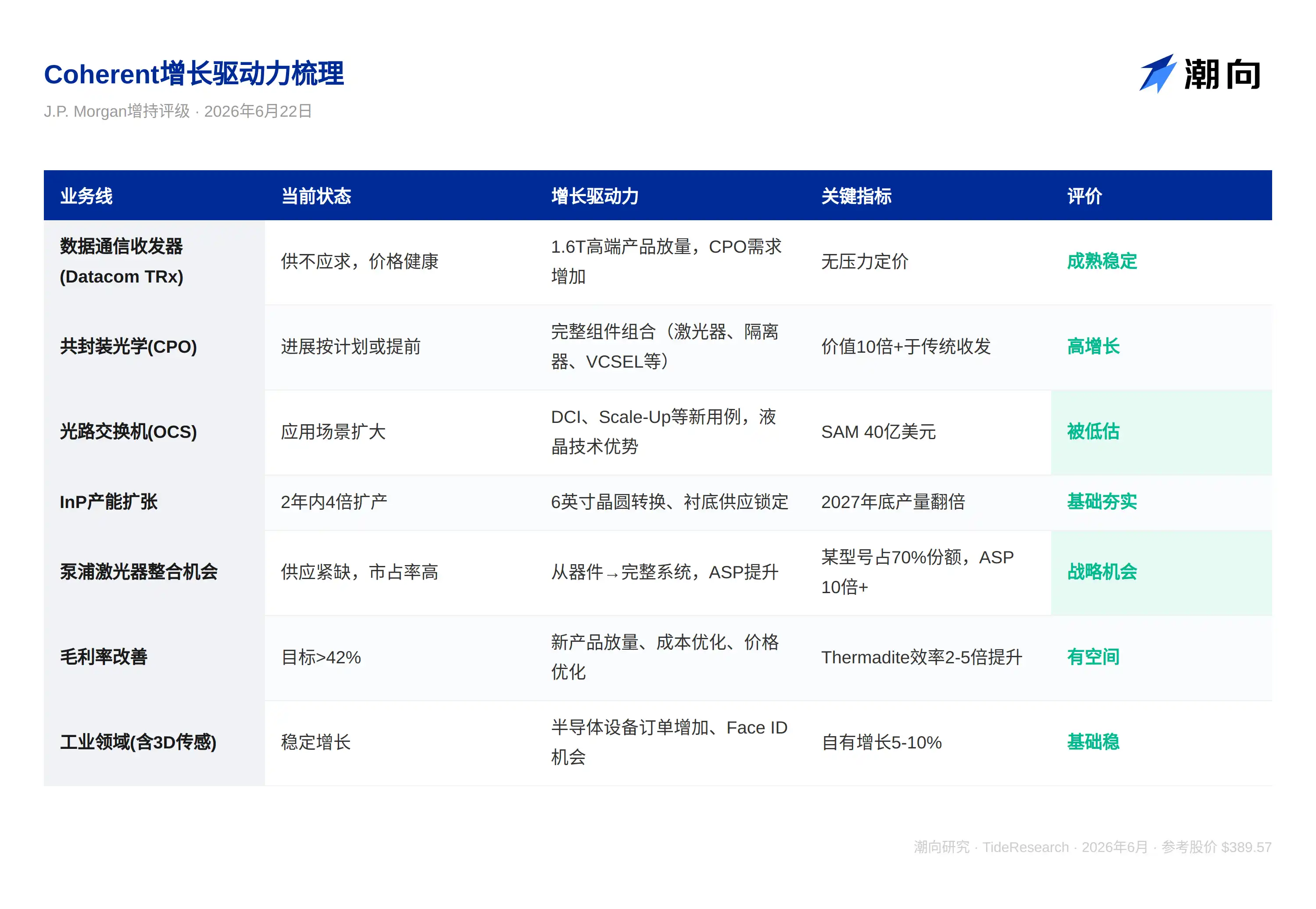
Organic growth in industrial revenue remains steady at 5% to 10%. Semiconductor manufacturing equipment orders are growing. In 3D sensing, Apple's next-generation Face ID might adopt a new protocol, presenting a re-competition opportunity for suppliers.

Optical communication chips are the underlying infrastructure for data centers. AI is driving higher computing power demands, which in turn increases the need for high-speed optical interconnects. COHR holds a critical position in this supply chain. The new opportunities in CPO and OCS, stable growth in the industrial segment, and room for gross margin improvement all support the Overweight rating.
Disclaimer

This article is TideResearch's analysis and interpretation of a third-party brokerage research report. The ratings, price targets, earnings forecasts, and related judgments cited herein are the views of the J.P. Morgan analyst, representing only the stance of their affiliated institution. They do not represent TideResearch's views and do not constitute any investment advice.

Please note three points while reading: First, ratings are analysts' comprehensive judgments on a company's prospects and are subject to frequent adjustments based on performance and market conditions. Second, sell-side research reports are inherently bullish, and some covered companies may have investment banking relationships with the brokerage. Third, the value of research reports lies in their core logic and underlying assumptions, not just a specific price target. Focus on the logic, not just the rating.

Markets involve risks, and investment decisions should be made independently. This article should not be used as a basis for trading any securities.

Data Source: Coherent Corp Investor Conference Minutes (J.P. Morgan, Samik Chatterjee, June 22, 2026)

TideResearch · June 2026

İlgili Sorular

QAccording to J.P. Morgan's analysis, what are the three core growth drivers for Coherent (COHR) mentioned in the article?

AThe three core growth drivers are: 1) Data center optical transceivers, 2) Co-packaged optics (CPO) chips, and 3) Industrial lasers and thermal management.

QWhat is the analyst's view on the relationship between the demand for traditional optical transceivers and the rise of CPO technology?

AThe analyst believes that CPO technology will not replace or cannibalize demand for traditional optical transceivers. Instead, it will increase the demand for high-end optical components, as CPO integrates optical and electrical chips together.

QWhat are Coherent's specific advantages in the CPO market, as highlighted in the report?

ACoherent's competitive advantage lies in providing a complete portfolio of optical components, including lasers, isolators, VCSELs, and thermoelectric coolers, which are essential for CPO systems. This allows them to capture significantly more value per CPO chip compared to traditional transceivers.

QWhat strategic opportunity is presented by the current tight supply of pump lasers for Coherent?

AThe tight supply of pump lasers, where Coherent is one of only two high-quality global suppliers, presents a strategic opportunity for vertical integration. Instead of just selling laser components, the company can now sell complete line cards or systems, increasing the average selling price per solution by more than tenfold.

QWhat three factors are driving the company's target for gross margins to exceed 42%?

AThe three driving factors are: 1) Premium pricing power for high-end products, 2) Cost improvements from the transition to 6-inch InP wafers, and 3) The ramp-up of new high-margin products like CPO and Optical Circuit Switches (OCS).

İlgili Okumalar

Only 14% of Russian Universities and Research Institutions Have Approved Rules for Using AI

Only 14% of Russian universities and scientific research institutes have officially approved internal regulations governing the use of artificial intelligence (AI), according to a survey conducted in May-June 2026 by HSE's Institute for Statistical Studies and Economics of Knowledge. The study involved 424 organizations, including 250 universities and 174 research institutes. It found that 72% of these institutions have no such regulations at all, while the remaining 14% did not provide an answer. This absence of formal rules exists despite the widespread practical use of AI in education. The survey highlights a significant gap between the rapid adoption of AI technologies and the slower pace of internal policy development within academia. In contrast, Russia is actively expanding the application of AI in school education. Since September 2026, a professional development program titled "Artificial Intelligence in the Teacher's Work" has been available, aiming to train 250,000 teachers on using neural networks for preparing lessons and assignments by the end of the year. A dedicated "Artificial Intelligence" track for schoolchildren has also been introduced. Thus, two parallel processes are unfolding: the state is promoting AI training for teachers and students, while higher education and research institutions largely lack unified internal guidelines for its use. The analysis suggests this regulatory lag is typical for new technologies, akin to the early adoption of email and the internet. In practice, students and educators are already utilizing AI tools, such as chatbots for routine tasks and exam preparation, regardless of official institutional policies. The key question remains whether future standards will be set by the educational institutions themselves or by the developers of the AI tools already integrated into the learning process.

cryptonews.ru1 dk önce

Only 14% of Russian Universities and Research Institutions Have Approved Rules for Using AI

cryptonews.ru1 dk önce

J.P. Morgan Report Analysis: Oracle Backlog Surges by $26 Billion, Funding Path Questioned

Morgan Stanley Report Analysis: Oracle's Backlog Grows by $26B, Funding Path in Question Oracle's F1Q27 remaining performance obligations (RPO) surged by $26 billion to $664 billion, a 46% year-over-year increase. Cloud infrastructure (IaaS) revenue hit $7.4 billion, up 121%. Morgan Stanley reiterated its Overweight rating with a $200 price target. The report highlights strong growth but ongoing investor debate over Oracle's funding capacity for its massive capital expenditure cycle. Key quarterly results showed total revenue of $19.35 billion (up 30%), beating consensus. IaaS growth of 121% significantly exceeded expectations, though gross margin of 61.0% was slightly below forecasts due to data center ramp-up costs. EPS of $1.92 beat estimates. The $26 billion sequential RPO increase included over $30 billion in new AI contracts. Management stated these contracts, structured with prepayments, vendor financing, or customer-purchased hardware (BYOH), require capex but not additional Oracle cash. Approximately half the RPO is expected to convert to revenue within 36 months. FY27 guidance was above consensus: revenue of at least $90 billion (up 34%) and EPS of $8.10. Capex is guided between $90-$95 billion, with net cash capex not exceeding $70 billion, implying $20-$25 billion in customer prepayments/vendor financing offsets. Management identified FY27 and FY28 as peak investment years but did not provide a timeline for positive free cash flow. Morgan Stanley expects Oracle will need to raise over $20 billion annually on average in coming years, with FCF remaining negative until at least FY30. Risks include high customer concentration (OpenAI accounts for over 50% of RPO), potential funding market tightening, and execution on capacity delivery and margin improvement. While the revenue path appears solid, the funding path remains a key hurdle for the market.

marsbit11 dk önce

J.P. Morgan Report Analysis: Oracle Backlog Surges by $26 Billion, Funding Path Questioned

marsbit11 dk önce

Crypto.com August Report: Risk Assets Rebound Across the Board, Crypto Market Re-enters Net Accumulation Cycle

**Crypto.com August 2026 Market Report: Risk Assets Rebound, Crypto Re-enters Accumulation** August saw a broad-based recovery across global risk assets. Cryptocurrencies led the gains, with Bitcoin (+25.0%), Ethereum (+32.6%), and Solana (+41.5%) posting strong returns. U.S. equity indices also rose, fueled by AI and semiconductor optimism following Nvidia's robust earnings. Most G20 central banks maintained a "wait-and-watch" stance on rates, with Brazil being the exception by cutting its Selic rate. Key market themes included potential trade friction, sovereign debt management, and the broader adoption of AI-driven capital expenditure. In crypto markets, all major DeFi categories grew, with oracles (+30.8%) leading by market cap. Institutional interest remained strong, with U.S. spot Bitcoin and Ethereum ETFs recording net inflows of $3.5B and $1.8B, respectively—their highest levels in nearly a year. Regulatory activity intensified in the U.S., UK, South Korea, Japan, and Brazil. TradFi developments highlighted growing institutional adoption: BlackRock launched tokenized money market funds, Wells Fargo announced plans for tokenized deposits, and Charles Schwab expanded its crypto offerings. Crypto.com introduced tokenized stocks and expanded its PayTM integration to Dubai Duty Free and REAL Jet. On-chain data indicated Bitcoin has re-entered a net accumulation phase, with apparent demand turning positive for the first time since February. Ethereum's roadmap update prioritized quantum readiness and user privacy. Solana expanded its remittance capabilities via a MoneyGram integration. Other notable updates included progress from Ethena Labs, World Liberty Trust, and community fund approvals on Cardano.

marsbit41 dk önce

Crypto.com August Report: Risk Assets Rebound Across the Board, Crypto Market Re-enters Net Accumulation Cycle

marsbit41 dk önce

İşlemler

Spot
活动图片