Recent On-Chain Review: No Clear Narrative Under U.S. Stock Market Pressure, Just Hype

marsbit2026-06-12 tarihinde yayınlandı2026-06-12 tarihinde güncellendi

Özet

This article analyzes the current state of the Solana meme coin and community token ecosystem, highlighting a market caught between two dominant forces: attention-based PvP and a gradual return to community-centric projects. The first part explores the "Attention PvP" dynamic, where success is driven by celebrity endorsements, viral events, and speed. Examples include $JOTCHUA, which surged after its meme creator's social media activity, and $WORLDCUP, which outperformed a similar Base chain project ($PITCH) largely due to influencer support. The recent "pump.fun GO" feature, allowing bounty tasks for token promotion, is critiqued for fostering sensationalist and often negative stunts—like people getting token tickers tattooed on their bodies for rewards—reminiscent of old internet shock content. In contrast, the article points to a resurgence of organic, community-driven tokens that survive market volatility through strong holder bases and shared ideology, not just hype. Influencer Ansem is cited, arguing that durable meme coins rely on communities willing to endure losses and promote their core message daily. Examples given are older tokens like $neet (anti-work ethos), $troll, $buttcoin, and $triplet, which have maintained relative price stability. A prime example of this community-build model is the new project $KINS, the token for the browser-based MMORPG Kintara. Its success stems not from advanced graphics but from consistently delivering updates, fostering player t...

After the ETH mainnet gradually grew quiet, degens have returned to be active on Solana once again. Despite this, it's hard to say there is a clear main narrative for the activity on Solana. To summarize, it might be fitting to describe it as "oscillating between a return to community and attention PvP."

Attention PvP

Ever since Trump issued a token, the meme coin market has grown accustomed to the playbook of relying on celebrity endorsements, hot events, and competing on speed for a long time.

Everyone is used to it, so even with poor liquidity, people still follow this playbook to find opportunities, thus forming an inertia for this kind of strategy.

$JOTCHUA, a dog meme that became popular in Spanish and English-speaking circles in 2021. On January 24, 2021, Instagram user @_kingorange uploaded an inspirational poster featuring a crudely drawn dog picture with the text "JOTCHUA," which received over 29,000 likes within three months.
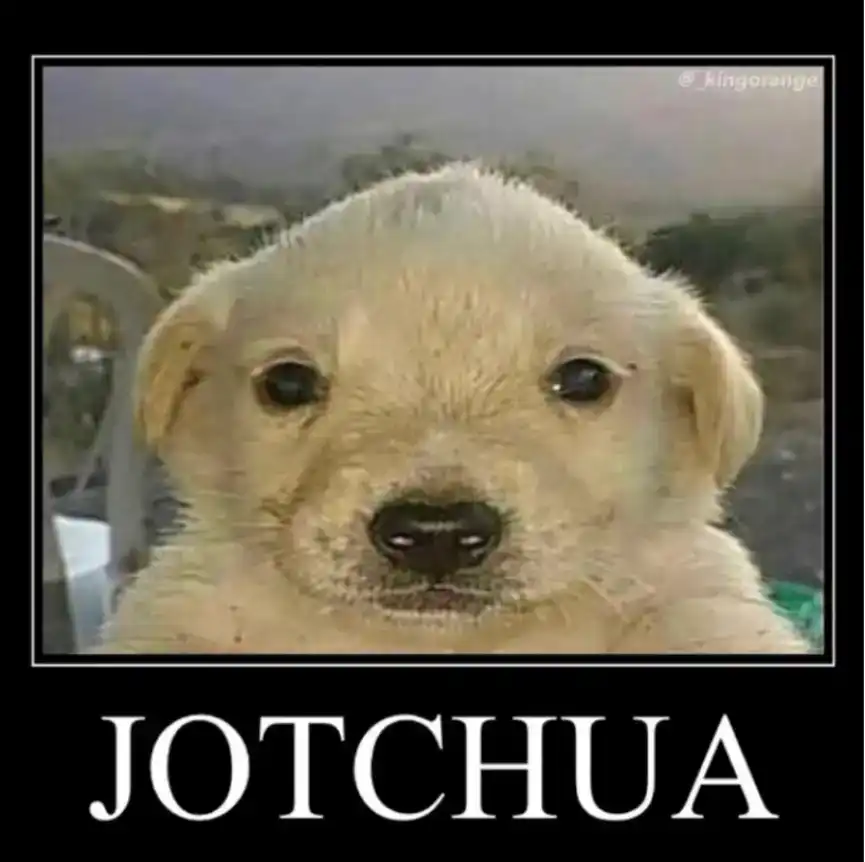
Its market cap once neared $9 million at its peak. The community has significant debates over whether this token is "organic," because its launch did not occur after the meme's creator @_kingorange claimed it, making it almost impossible to say the "claim" was the direct cause of the price surge.

Many players believe this token is another instance of "setting up a play," or attribute it to KOL Ansem sparking market speculation about his purchase being related to this token when he claimed on June 9th that he had returned to buying Solana meme coins for the first time in over a year.

The same concept, even the same ticker, but your coin just doesn't pump. $JOTCHUA on the ETH mainnet was deployed as early as December 2023, and has had consistent content and community, but it couldn't compete with getting the creator to click a few buttons and claim it.

A similar situation happened with the World Cup concept. $WORLDCUP on Solana, due to bonkguy's purchase and detailed analysis, saw its market cap surge from around $5 million to once break $12 million. Meanwhile, the World Cup concept project $PITCH on Base had fallen from a peak market cap of about $7 million to nearly $700,000.

Although $PITCH indeed has its own issues, mainly on the communication front. The project is not inactive, it keeps updating, but the dev rarely speaks up, and their X (Twitter) account got repeatedly suspended and still hasn't sorted out a new one. But admittedly, without any endorsements, similar concepts and playstyles lose out in the battle for attention.

The recent new feature from pump.fun, pump.fun GO, allows anyone to post paid bounty tasks on pump.fun.

This did attract mainstream media attention, but unfortunately, once again in a negative light reaching the masses.

$Bountywork, this token's market cap once approached $2.5 million at its peak. Its dev @ayushquantt's strategy is to continuously post new tasks on pump.fun, creating hype for this token.

He certainly succeeded—by offering a bounty of 40 SOL to have someone tattoo $bountywork on their forehead.

An Indian man actually got it tattooed, and strictly followed a typo the dev made in the description—missing an 'n', incorrectly writing the ticker as $boutywork.
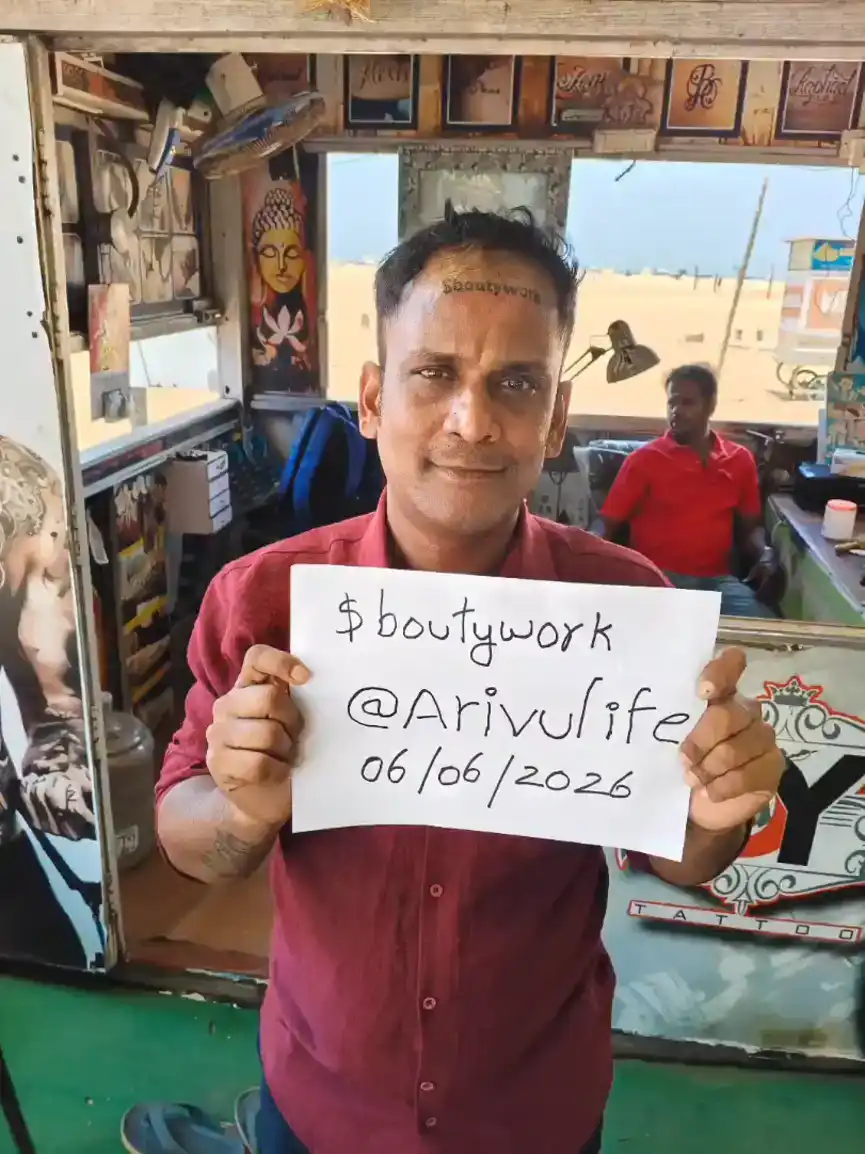
Initially, his bounty application was rejected because the tattoo was missing the letter 'n', and the dev demanded he correct the tattoo. Then, someone launched a new token using the incorrect tattoo as the ticker, $boutywork.

Finally, the 40 SOL bounty reward was still given to him, and the creator revenue from the new token was also given to him, earning him a total of about $48,000.

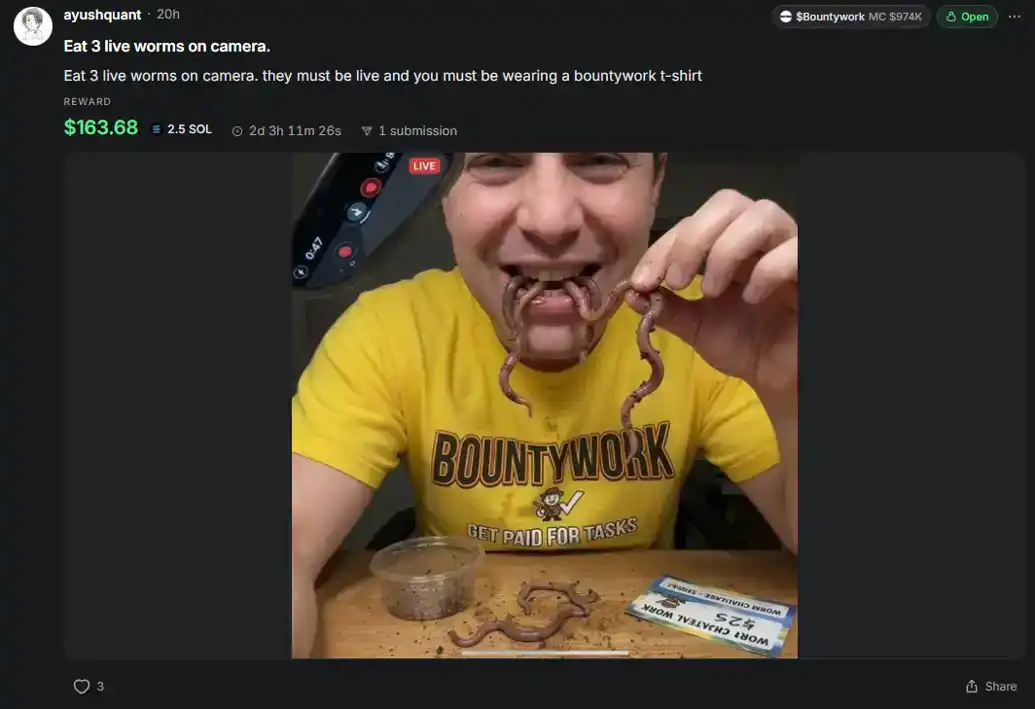
Then, as the hype faded, $boutywork has essentially gone to zero. The dev of $Bountywork is still continuously posting new bounties trying to replicate this "success," for example, having someone eat 3 insects on camera while wearing a $Bountywork t-shirt.
There are quite a few tattoo-related tasks on pump.fun; some have received up to 200 SOL in return for tattooing their own face.
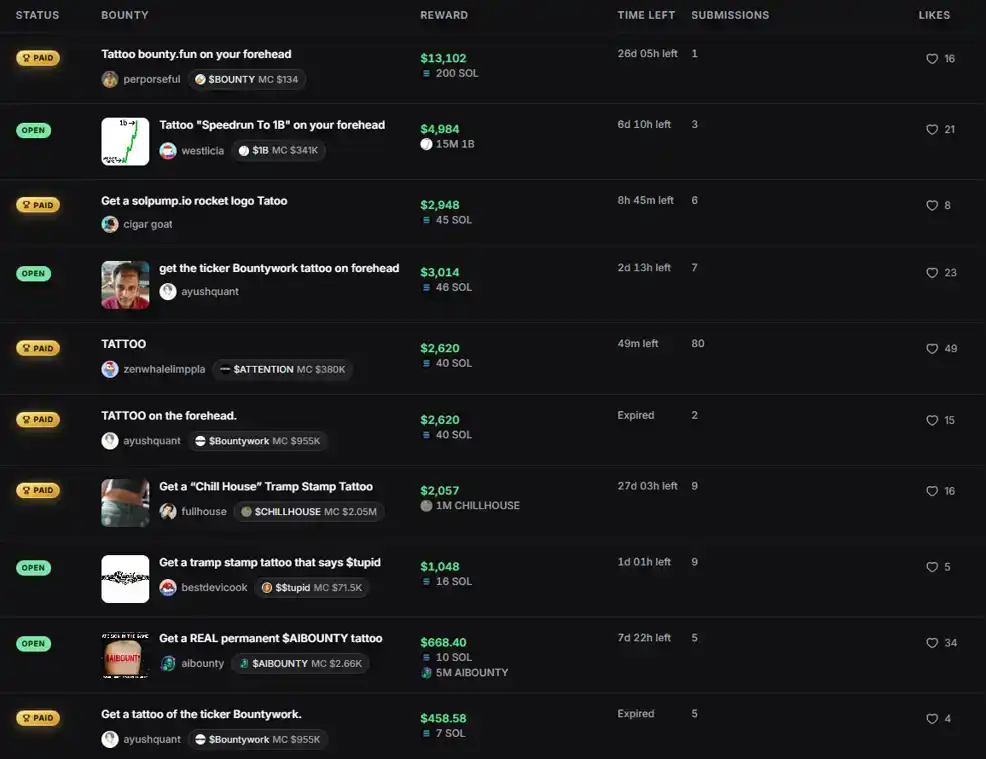
Honestly, this isn't much different from the days when big brothers on Kuaishou tipped people to eat raw eggs or gulp down white liquor...

The Return of Community

Let's continue the discussion around pump.fun's new feature. Almost all bounty tasks are related to generating attention-hype for specific tokens. The only one not treated as a joke might be this bounty task for $neet—organizing a gathering in New York for people who resist work.
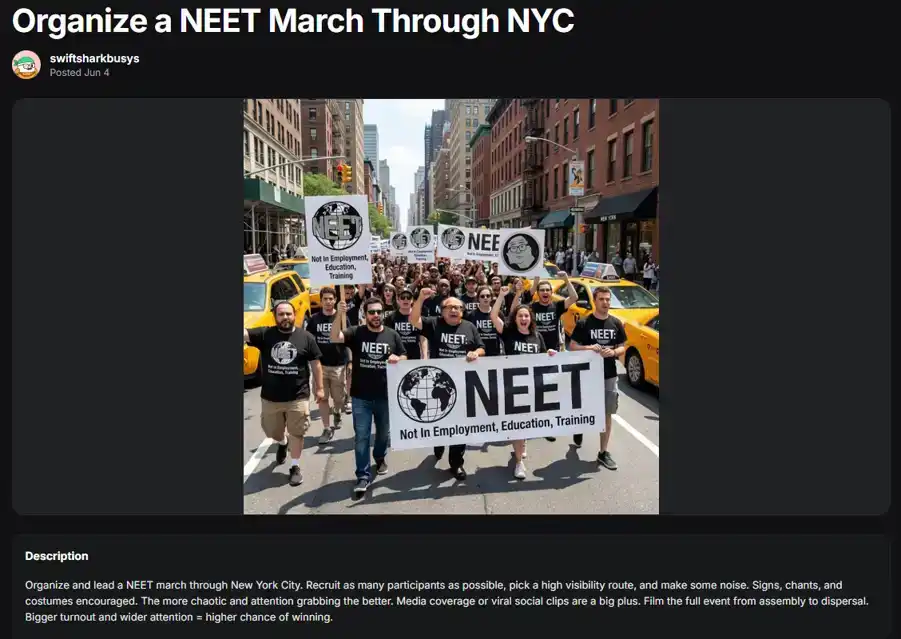
The reward for this bounty is paid in $neet, equivalent to over $15,000. The $neet community has previously self-organized 2 offline "anti-work gatherings" in the US; if this bounty is completed, it will be the 3rd.

Although it's unclear what pump.fun's intention is in supporting community-type meme coins, their official Twitter always features promotions for such community tokens. Although the performance of these tokens varies—for instance, $chillhouse's price has been sluggish for a while—the ones pump.fun officially picks out are generally quite community-driven and organic.

Currently, those with relatively stable visibility and price performance, besides $neet, include $troll, $buttcoin, and $triplet. A brief introduction to the survival status and themes of these community-type tokens:

- $neet: Deployed 410 days ago, peak market cap ~$51 million, current market cap ~$27 million. The community's mission is to make more people realize that dedicating most of one's life to work means losing one's own life.

- $troll: Deployed 416 days ago, holds the copyright to the classic meme Troll, listed on Coinbase. Peak market cap ~$290 million, current market cap ~$65 million.

- $triplet: Deployed 107 days ago, an abbreviation for "Tung Tung Tung Sahur," the hottest breakout character from last year's viral "Italian Classic of Mountains and Seas." Peak market cap ~$13.6 million, current market cap ~$6.6 million.

- $buttcoin: Deployed 153 days ago, originated from a 2011 joke on the Bitcoin forum, a pun on Bitcoin as "Buttcoin" (Butt coin). Peak market cap ~$68.6 million, current market cap ~$27 million.

Mentioning these tokens and the return of community-type coins brings us back to Ansem. After he mentioned returning to buy Solana memes, someone told him to just post the CA (contract address), and if he did, they would aggressively buy 1% to add to their position.
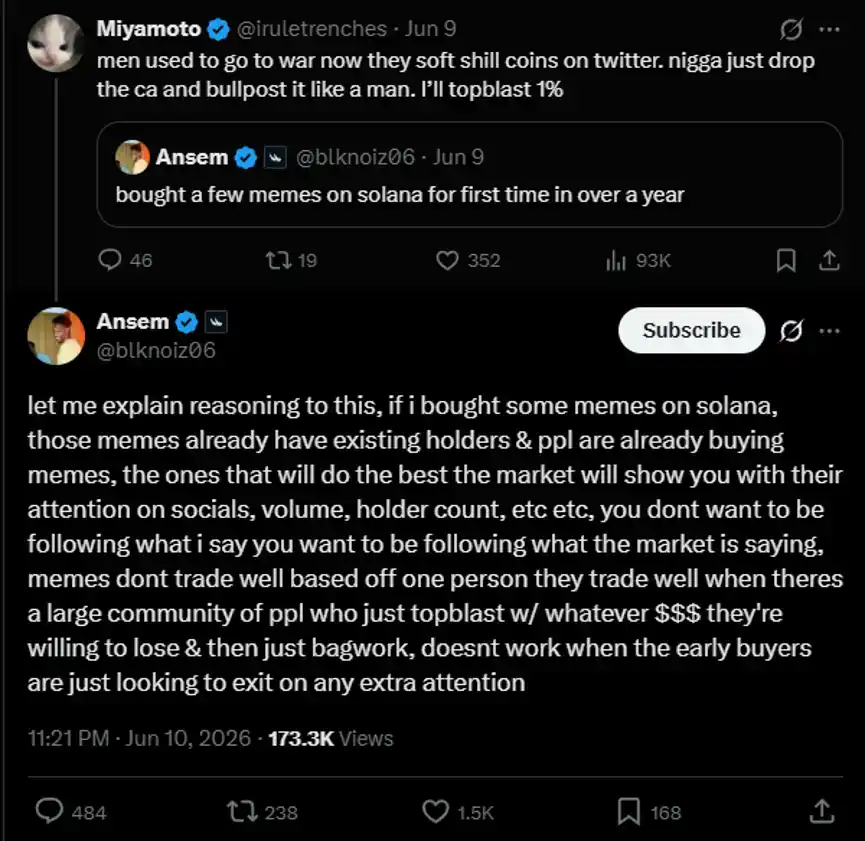
Ansem's response sparked much discussion:

"Let me explain why I don't post CAs. If I buy some Solana meme coins, and these coins already have good holders, the market will tell you which ones are good through social media performance, trading volume, holder count, etc. You shouldn't listen to me, but to the market. Meme coins relying on a group of holders who just compete on speed, wait for endorsements to dump, won't be good. Only tokens with a large community, where people within the community are willing to endure losses and promote their beliefs day after day, will succeed. Tokens dependent on a single celebrity won't do well."

Besides the older tokens mentioned above that have survived long and maintained relatively stable prices, there are indeed new tokens emerging that align with Ansem's view, such as $KINS.

$KINS is the token for Kintara, which is a blockchain game. Interestingly, Kintara hasn't led the Solana gaming sector because its rise wasn't due to the game's polish, but rather its step-by-step actions to earn community trust.

A brief introduction to $KINS' mechanism. This is an MMORPG playable in a browser; to play, your wallet needs 1,000 $KINS. Once in, you can chop wood, mine, fish, buy houses, fight monsters and bosses, and PvP.
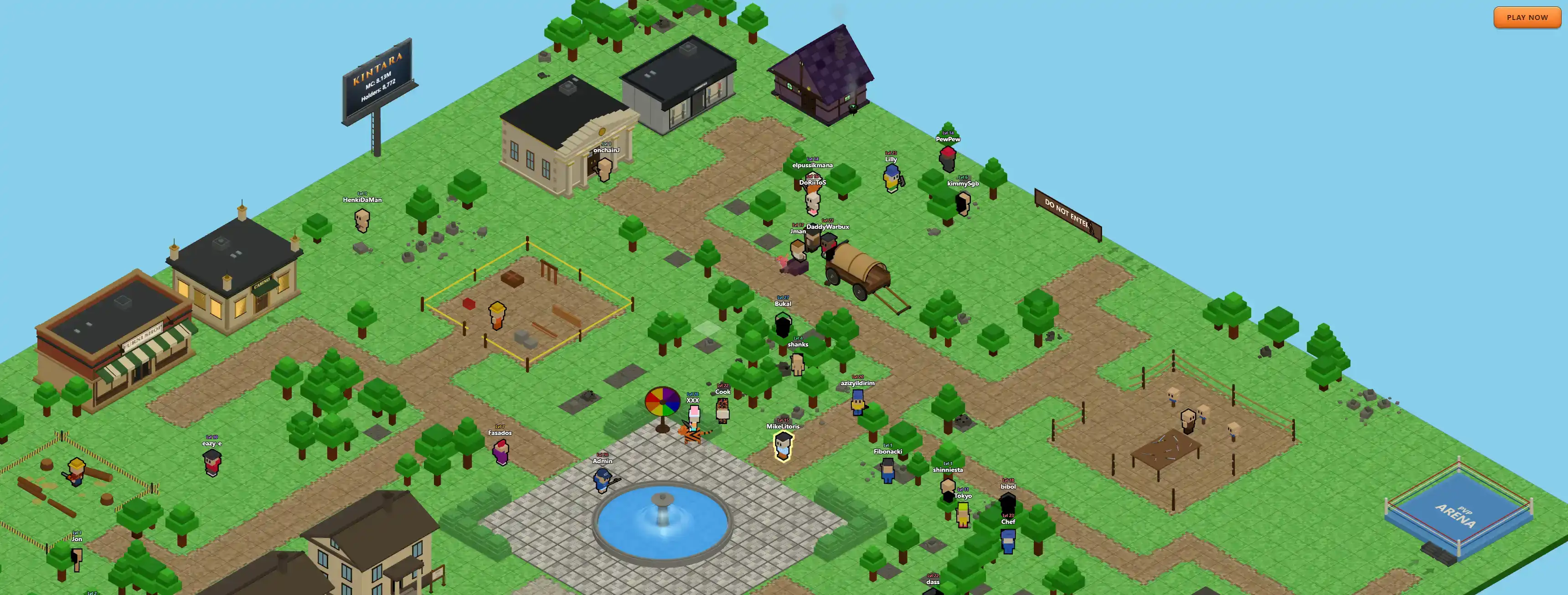
The game has no other pay-to-win options, only a reward wheel. If players don't want to spin only once a day, they can spend $3 worth of $KINS to continue spinning. 50% of this revenue is used for token buyback and burn, 50% for project maintenance and development.

The core gameplay loop is roughly: gather resources -> craft items -> challenge tougher monsters. If players lack resources, they need to use the in-game currency "Gold" to buy from other players. Players can sell "Gold" in the game priced in $KINS, with 5% going to the treasury and 95% to the player.

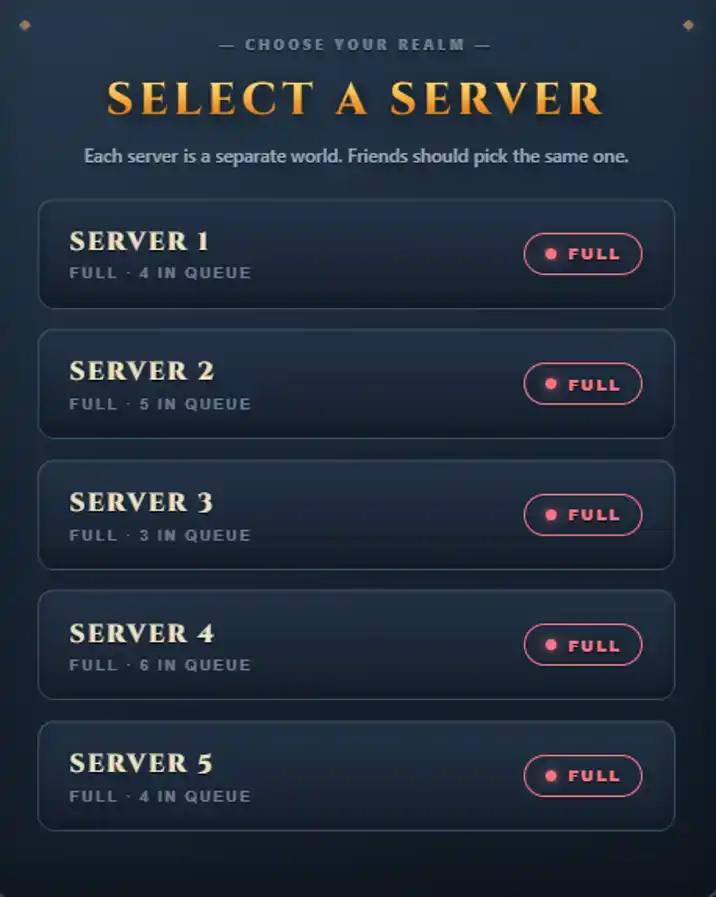
It sounds fairly ordinary, and the data isn't particularly impressive either (so far, 0.5% of $KINS has been repurchased), but the project's consistent delivery has built solid trust. Perhaps because the market is so disheartening, many players have genuinely gotten into it. The number of people fishing in the game daily is increasing. The project has expanded to 5 servers, but there's still a queue...
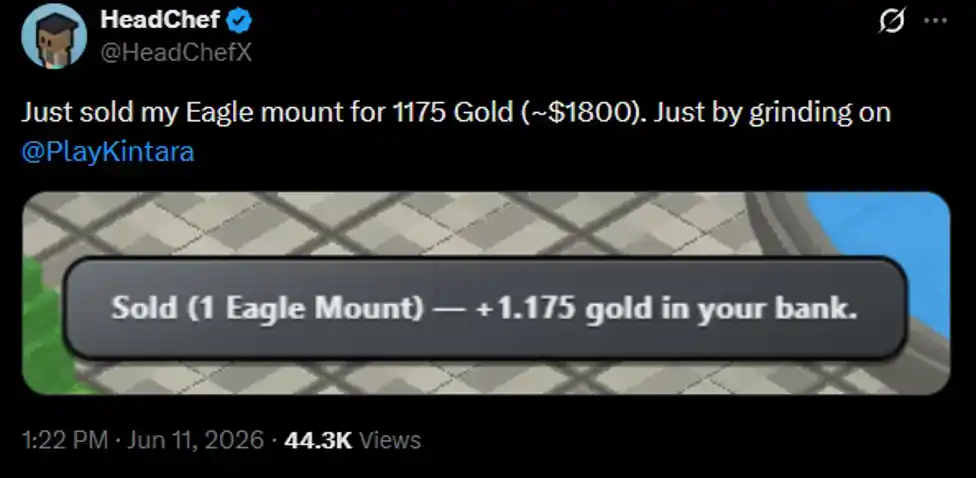
A player successfully sold a rare mount obtained from fishing and earned $1,800:
The project team of this game almost "doesn't promote play-to-earn," instead focusing heavily on "how to build network effects and a sense of player belonging." For example, integrating various Solana community meme coins or newly hot tokens into game elements, such as auctioning mansions in the game.

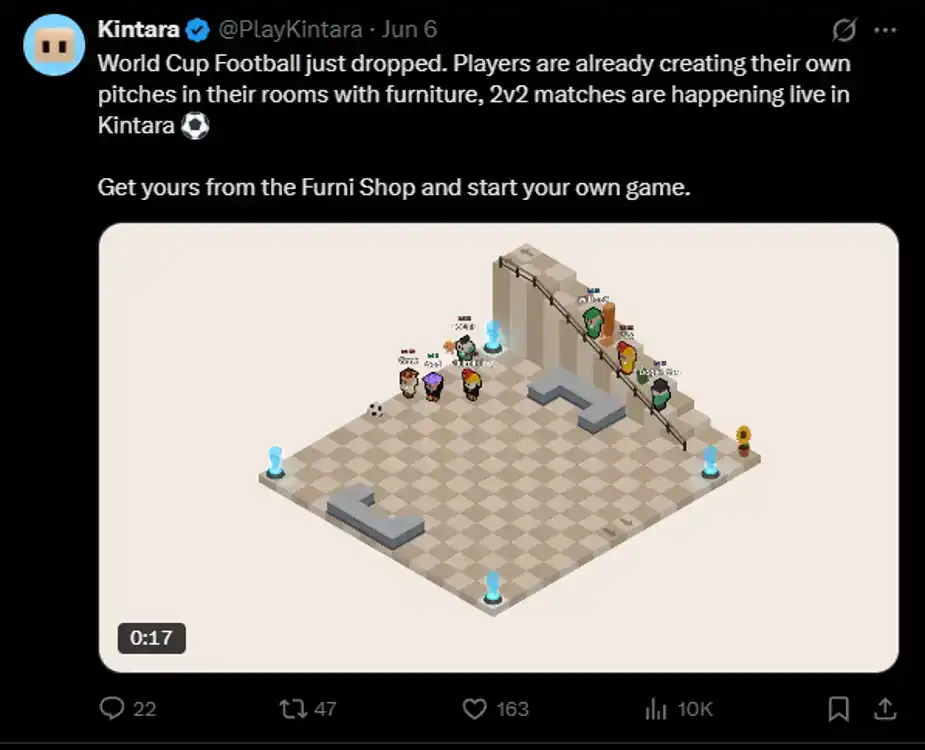
Or, promoting people organizing World Cup football matches in their houses:
When it was still obscure, with less than $40,000 market cap and 243 holders, this early phase of "unheard of and unknown" was written on the stats board in the game's main map. Everyone watched Kintara persistently and rapidly update game content, slowly gaining people's trust, gradually attracting KOLs like Gake and Ansem to become part of the game as players.
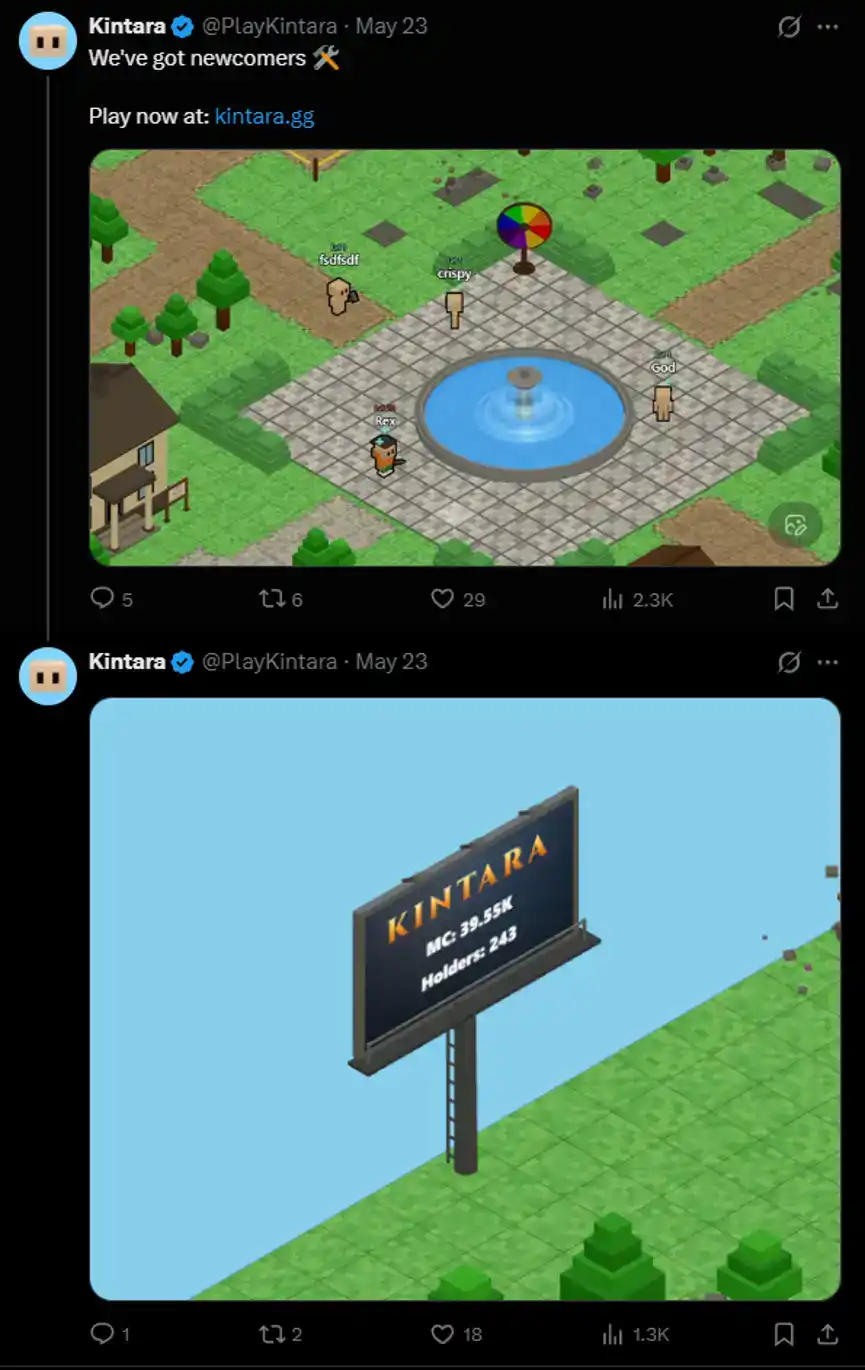
So no one calls this kind of project a "set-up play."

"What are we constantly chasing after all along? A game of mutual trust, or a game of mutual deception?"

This is a recent question Zhàn Háo has been asking himself.

Hopefully, such questioning can persist and ultimately lead to a healthier market.

Trend Kriptolar

İlgili Sorular

QWhat are the two main competing themes or approaches observed in the current Solana meme coin market, according to the article?

AThe two main competing themes are 'Attention PvP' and the 'Return of the Community'. Attention PvP relies on quick, hype-driven plays involving celebrity endorsements, hot events, and speed-based speculation. The Return of the Community focuses on meme coins with organic, long-term communities built around a shared culture or purpose, where members are willing to endure price fluctuations and consistently promote their project's ideals.

QHow did the $JOTCHUA meme coin benefit from the 'Attention PvP' dynamic, and what controversy surrounded its success?

AThe $JOTCHUA coin gained attention and its price surged largely after the meme's creator, @_kingorange, 'claimed' the coin on social media. However, its success is controversial because the coin's launch and initial pump did not happen after the creator's claim. Many believe the surge was due to market speculation triggered by KOL Ansem announcing his return to buying Solana meme coins, suggesting it was another 'pump group' setup rather than an organic community-driven event.

QWhat is the core mission of the $neet community, and how does it distinguish itself from typical 'Attention PvP' coins?

AThe core mission of the $neet community is to promote the idea that dedicating most of one's life to work means losing one's own life. It distinguishes itself from 'Attention PvP' coins by being a long-term, community-driven project. The community has organically organized offline 'anti-work' gatherings in the U.S. and focuses on a shared cultural belief rather than relying on short-term hype or celebrity endorsements for price action.

QAccording to Ansem's statement quoted in the article, what are the key characteristics of a successful meme coin that does not rely on a single influencer?

AAccording to Ansem, a successful meme coin that doesn't rely on a single influencer should have a large, genuine community. Members of this community should be willing to endure losses and consistently promote the project's underlying philosophy or culture day after day. Success should be indicated by market data like social media activity, trading volume, and holder count, not by the endorsement of any single key opinion leader (KOL).

QHow did the project behind the $KINS token (Kintara) build trust and a sustainable community, as described in the article?

AThe Kintara project ($KINS) built trust and a sustainable community through consistent delivery and focusing on player engagement rather than financial speculation. Key strategies included: rapidly updating game content, integrating other community meme coins into the game, organizing in-game community events (like house auctions and soccer tournaments), and having a transparent tokenomics model where 50% of optional spin revenue is used for token buyback/burns. This approach fostered a sense of belonging and network effect, attracting genuine players and even respected KOLs who became part of the community.

İlgili Okumalar

Preferred Stock Is Not the Trigger for Corporate Bankruptcy, MicroStrategy's Dollar Reserves Can Cover Dividend and Interest Payments Until February 2027

Preferred Shares Are Not the Catalyst for Corporate Bankruptcy; MicroStrategy's Dollar Reserves Can Cover Dividend and Interest Payments Until February 2027. This article analyzes the nature of preferred shares used by MicroStrategy (MSTR). Legally equity but economically similar to debt, these shares, including its Bitcoin-linked STR convertible preferred notes (STRC), offer fixed or floating dividends. Crucially, MicroStrategy's preferred shares lack rigid redemption clauses, meaning they are not classified as traditional debt. This eliminates principal repayment pressure and means missed dividends do not constitute default or trigger bankruptcy, creating a "self-contradictory virtuous cycle." The article clarifies that if funds are short, MicroStrategy can defer or suspend preferred share dividends (except for non-cumulative types like STRD) without immediate risk. The real potential crisis point lies with its convertible bonds. If a prolonged bear market prevents conversion, MicroStrategy might need to sell Bitcoin to repay these bonds starting from the earliest maturity in September 2027, potentially creating a downward spiral. Preferred dividend suspensions would only exacerbate market panic in such a scenario. Recent financial activity shows MicroStrategy strengthened its position through four weeks of common stock (MSTR) issuances, raising over $851 million without issuing new preferred shares. It increased its dollar reserves to approximately $1.4 billion, which is sufficient to cover all preferred share dividends and interest until around March 2027. While Bitcoin purchases slowed recently, this prioritization of cash reserves enhances the company's near-term financial safety. The analysis concludes that if the Bitcoin bear market ends by early 2025 as anticipated, MicroStrategy can resume issuing MSTR stock in a rising market to replenish reserves and manage future dividend obligations, thereby reducing the long-term pressure from its preferred share structure.

marsbit45 dk önce

Preferred Stock Is Not the Trigger for Corporate Bankruptcy, MicroStrategy's Dollar Reserves Can Cover Dividend and Interest Payments Until February 2027

marsbit45 dk önce

Giants Wage the Context War, Reconstructing AI Moats

The article "Giants Launch the Context War, Reconstructing AI's Moat" discusses how leading AI companies—OpenAI, Anthropic, and Google—are shifting their competitive focus from model size to acquiring, managing, and utilizing user context (Context). Initially, Context referred to the length of text a model could process, leading to a "arms race" for longer context windows. However, the competition has evolved through three key phases: expanding text capacity (long context windows), enabling memory across sessions, and finally, integrating AI into real user environments like browsers and desktops to capture dynamic task states. Each company is pursuing a distinct strategy. OpenAI is building Context around the ChatGPT account, turning it into a central hub that accumulates user understanding across various integrated applications and tools. Anthropic, lacking a major user base, focuses on high-value verticals like coding, empowering its Claude model to actively gather Context through GUI interaction (Computer Use) and system connections (MCP protocol). Google, with vast existing user data from products like Search and Gmail, faces the challenge of restructuring this data into actionable, AI-understandable Context for its Gemini model within its ecosystem. The core argument is that the nature of competitive advantage in AI is changing. The internet era prized network effects—connecting more users. The AI era values "individual depth": the ability to build deep, task-specific understanding of a user. This creates a new moat through 1) the compounding value of accumulated Context, 2) deep integration with user tools and permissions, and 3) the establishment of trust for complex tasks. Therefore, the battle for Context is fundamentally about capturing "task entry points" and converting existing digital ecosystems into environments where AI can effectively understand and act, rather than merely scaling user numbers.

marsbit1 saat önce

Giants Wage the Context War, Reconstructing AI Moats

marsbit1 saat önce

Foundation Steps Back, Ethlabs Steps Forward: Ethereum Undergoes Its Largest Restructuring in History

On June 23rd, the Ethereum ecosystem witnessed two major shifts, signaling a significant governance realignment. First, former Ethereum Foundation researchers established Ethlabs, a new independent non-profit. Backed by major ETH holders like Bitmine and SharpLink, Ethlabs aims to address practical needs for institutional adoption, including faster settlement, native asset issuance, cross-chain transactions, and mainnet scaling. Secondly, the Ethereum Foundation announced a major restructuring, laying off 54 employees (20% of its staff) to become a leaner entity focused on protocol governance and maintenance rather than being the primary builder. This move represents a pivotal correction. Criticisms had mounted over the Foundation's perceived slowness, lack of clear strategy, and over-reliance on Vitalik Buterin's influence. Ethlabs emerges as a more execution-oriented, "industrialized" layer focused on market adoption—bridging the gap between research and real-world use. Notably, Vitalik Buterin is absent from its list of supporters, interpreted as an intentional step to avoid excessive personal endorsement and allow the organization to build independent credibility. The Ethereum Foundation's downsizing and redefinition mark a retreat from its former central coordinating role. It now aims to share the "privilege of stewarding Ethereum" with other emerging groups like Ethlabs, the Ethereum Applications Guild, and The Ethereum Economic Zone. Analysts frame this dual shift as the Foundation ensuring Ethereum remains "correct" (credibly neutral), while Ethlabs must prove it remains "effective" (competitive and attractive for capital and adoption). This addresses community "shareholder-like anxiety" about ETH's market performance. While risks exist—such as concerns over shifting from Foundation centrality to large-holder influence—the consensus is that the greater risk for Ethereum was inaction, caught between technical idealism and organizational inertia. These steps aim to create a more multi-stakeholder, execution-driven future for the network.

链捕手9 saat önce

Foundation Steps Back, Ethlabs Steps Forward: Ethereum Undergoes Its Largest Restructuring in History

链捕手9 saat önce

Second Half of U.S. Crypto Policy: The Clarity Act Aims for 60 Votes, CFTC's "One-Person Commission" Becomes Biggest Variable

In a pivotal year for US crypto policy, the "CLARITY Act" is advancing in the Senate but faces a high hurdle, needing 60 votes to pass. Key challenges include bridging partisan divides on ethics and swaying undecided Republican senators within a tight legislative calendar of only about 40 working days. The policy "second half" involves intense negotiations on a broader framework for Web3 and DeFi, including crypto tax reforms and the Blockchain Regulatory Certainty Act. A significant uncertainty is the understaffed CFTC, operating with four commissioner vacancies, which complicates regulatory clarity. Meanwhile, the departure of key "crypto champions"—SEC Commissioner Hester Peirce and Senator Cynthia Lummis—will impact ongoing policy efforts. Industry experts are cautiously optimistic but realistic. Sara K. Weed notes that while progress is being made, CLARITY is unlikely to pass this Congress, pushing agencies like the SEC and CFTC to provide more guidance. Sulolit Mukherjee suggests meaningful crypto tax legislation is more likely to be attached to larger must-pass bills. Rashan Colbert discusses the jurisdictional debate over prediction markets, emphasizing the need for a regulatory framework that fosters their development as financial tools rather than treating them broadly as gambling. The clock is ticking, but opportunities remain for substantive progress through continued bipartisan dialogue and pragmatic efforts.

marsbit11 saat önce

Second Half of U.S. Crypto Policy: The Clarity Act Aims for 60 Votes, CFTC's "One-Person Commission" Becomes Biggest Variable

marsbit11 saat önce

İşlemler

Spot
Futures

Popüler Makaleler

HYPE Nasıl Satın Alınır

HTX.com’a hoş geldiniz! Hyperliquid (HYPE) satın alma işlemlerini basit ve kullanışlı bir hâle getirdik. Adım adım açıkladığımız rehberimizi takip ederek kripto yolculuğunuza başlayın. 1. Adım: HTX Hesabınızı OluşturunHTX'te ücretsiz bir hesap açmak için e-posta adresinizi veya telefon numaranızı kullanın. Sorunsuzca kaydolun ve tüm özelliklerin kilidini açın. Hesabımı Aç2. Adım: Kripto Satın Al Bölümüne Gidin ve Ödeme Yönteminizi SeçinKredi/Banka Kartı: Visa veya Mastercard'ınızı kullanarak anında Hyperliquid (HYPE) satın alın.Bakiye: Sorunsuz bir şekilde işlem yapmak için HTX hesap bakiyenizdeki fonları kullanın.Üçüncü Taraflar: Kullanımı kolaylaştırmak için Google Pay ve Apple Pay gibi popüler ödeme yöntemlerini ekledik.P2P: HTX'teki diğer kullanıcılarla doğrudan işlem yapın.Borsa Dışı (OTC): Yatırımcılar için kişiye özel hizmetler ve rekabetçi döviz kurları sunuyoruz.3. Adım: Hyperliquid (HYPE) Varlıklarınızı SaklayınHyperliquid (HYPE) satın aldıktan sonra HTX hesabınızda saklayın. Alternatif olarak, blok zinciri transferi yoluyla başka bir yere gönderebilir veya diğer kripto para birimlerini takas etmek için kullanabilirsiniz.4. Adım: Hyperliquid (HYPE) Varlıklarınızla İşlem YapınHTX'in spot piyasasında Hyperliquid (HYPE) ile kolayca işlemler yapın.Hesabınıza erişin, işlem çiftinizi seçin, işlemlerinizi gerçekleştirin ve gerçek zamanlı olarak izleyin. Hem yeni başlayanlar hem de deneyimli yatırımcılar için kullanıcı dostu bir deneyim sunuyoruz.

298 Toplam GörüntülenmeYayınlanma 2024.12.11Güncellenme 2026.06.02

HYPE Nasıl Satın Alınır

Tartışmalar

HTX Topluluğuna hoş geldiniz. Burada, en son platform gelişmeleri hakkında bilgi sahibi olabilir ve profesyonel piyasa görüşlerine erişebilirsiniz. Kullanıcıların HYPE (HYPE) fiyatı hakkındaki görüşleri aşağıda sunulmaktadır.

活动图片